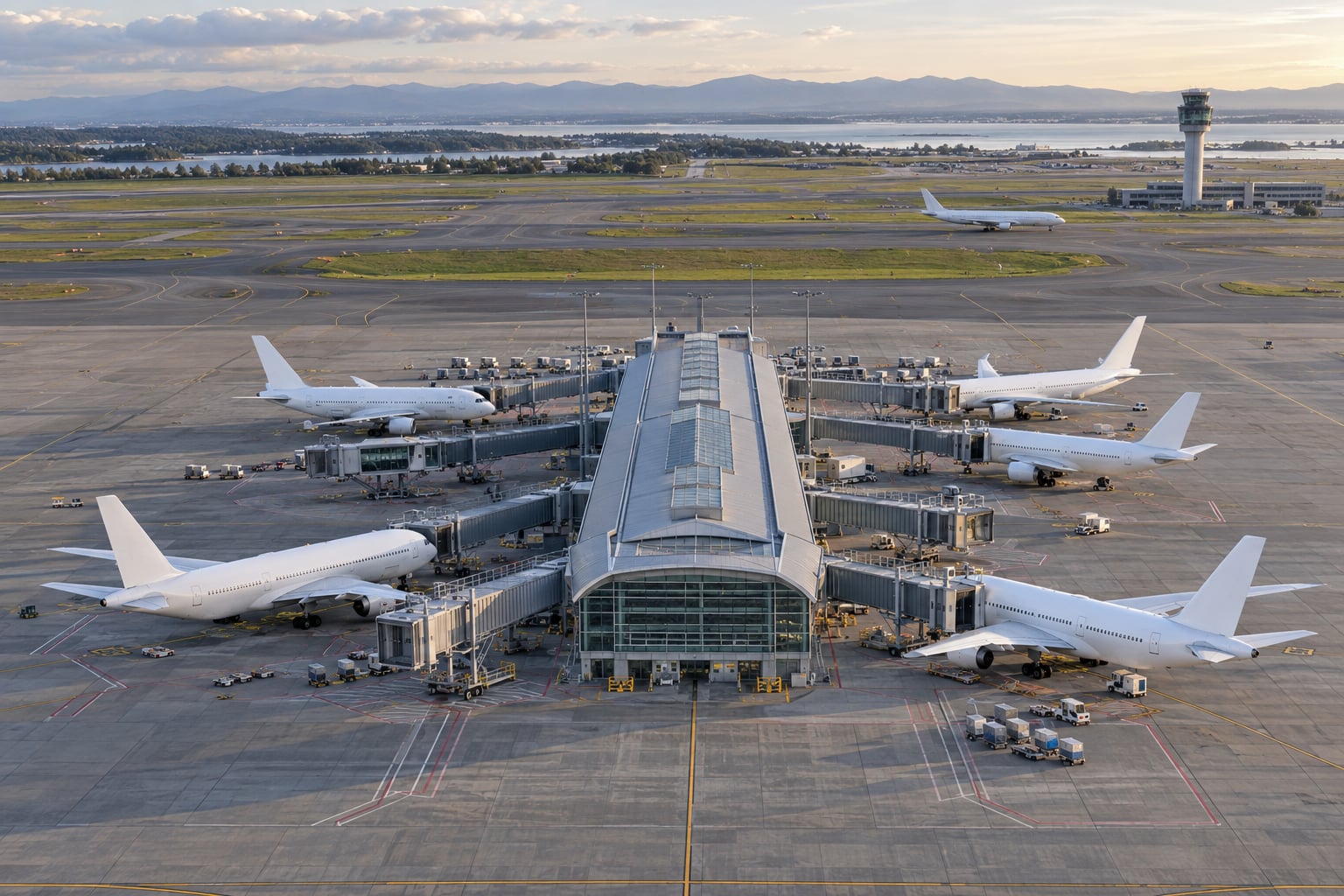
Airline hubs work by funnelling flights from many small cities into one central airport, then sending those passengers onward on a second flight to a different destination. That single airport is the hub, the small airports are the spokes, and the transfer between two flights is the connection. Most of the world’s major airlines run on this hub-and-spoke model, which is why a trip between two nearby towns can route through a city a thousand miles away.
The strange part, at least for travelers, is that the routing usually makes sense for the airline even when it looks pointless on a map. Once you see how the schedules, aircraft and banks line up, the awkward-looking detour usually turns into a rational choice.
This guide covers 2026 airline networks as they actually operate, including the parts that matter most when you are holding a boarding pass with a tight connection on the other side.
Table of Contents
- 1What Is an Airline Hub?
- 2How an airline hub differs from a focus city
- 3Why Airlines Build Hubs
- 4Where the hub-and-spoke model came from
- 5How Airline Hubs Work Step by Step
- 6What happens to the passenger
- 7What happens to the aircraft
- 8What Is a Connecting Bank?
- 9Hubs, Focus Cities, and Transit Hubs
- 10How hubs and alliances work together
- 11How Hubs Affect Connection Times
- 12What Can Go Wrong at an Airline Hub?
- 13Frequently Asked Questions
- 14Which airline has the most hubs in the United States?
- 15What is the biggest airline hub in the world?
- 16Which airlines use the hub and spoke model?
- 17What are the disadvantages of hub and spoke?
- 18What is a minimum connection time at an airport?
- 19Do I need a transit visa when connecting at a hub?
- 20Conclusion
What Is an Airline Hub?
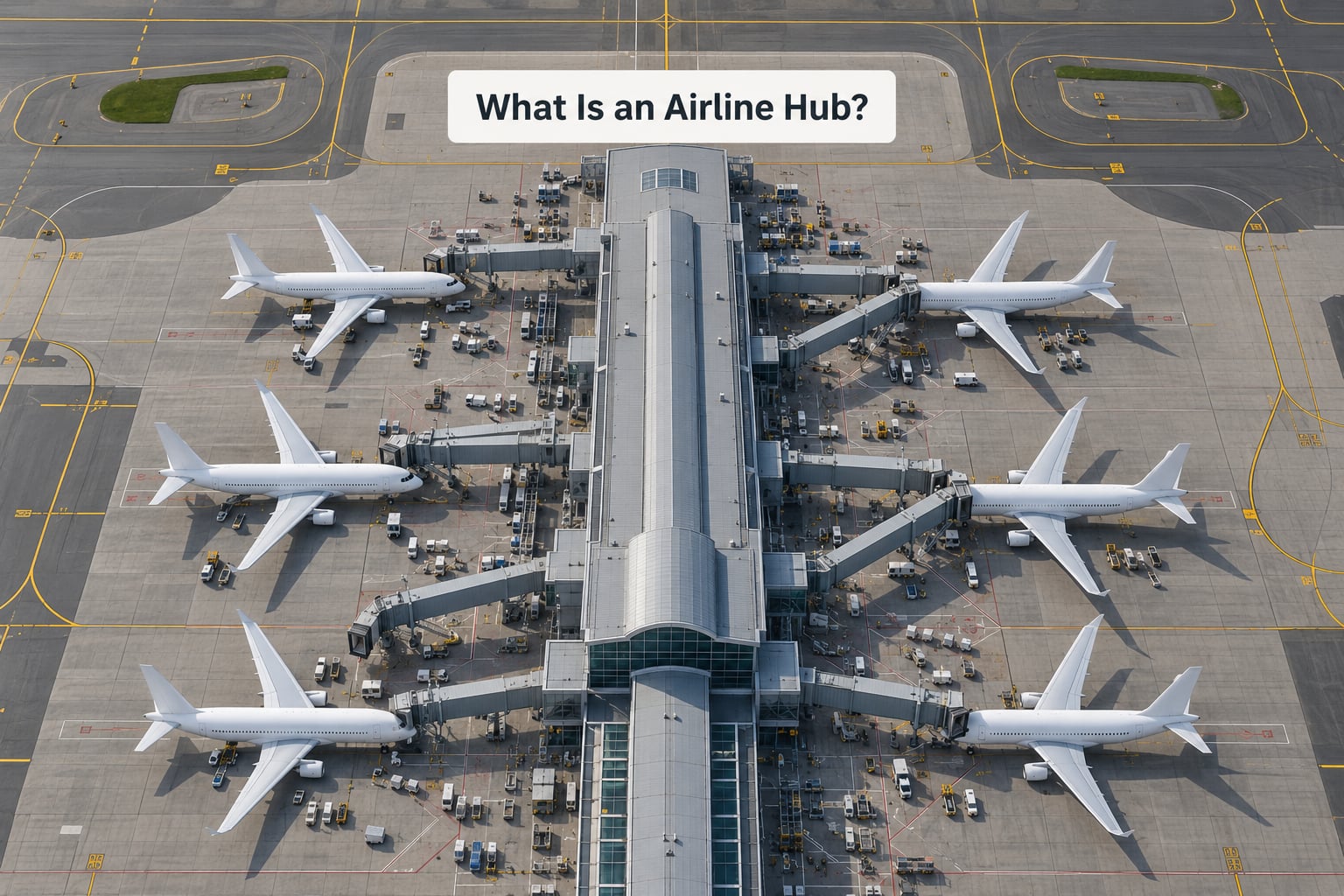
An airline hub is a central airport where an airline concentrates most of its arrivals and departures so that passengers can transfer between flights. Small cities feed passengers into that airport on short flights, and the airline then carries them out again on a much wider selection of long or medium-haul routes. One busy airport replaces hundreds of possible nonstop city pairs.
The system has three moving parts, and once you can name them, most confusing itineraries stop being confusing:
- Spokes: the smaller cities and regional airports that send passengers into the hub on feeder flights.
- Hub: the central airport where the airline schedules most of its flights and holds most of its aircraft overnight.
- Connection: the passenger transfer from an inbound flight to an outbound one, usually booked on a single itinerary.
A hub is not the same thing as a big airport. Plenty of very large airports have no airline treating them as a central point at all, and plenty of mid-sized airports are the hub for one regional airline only. Atlanta, Chicago O’Hare, Dallas/Fort Worth and Frankfurt are the sort of places readers picture immediately, but the list changes as networks shift, so treat any ranking as a snapshot rather than a permanent fact.
How an airline hub differs from a focus city
A focus city is a destination the airline serves heavily without concentrating its operations there. You can fly into a focus city on many separate flights, yet there is no controlled arrival and departure rhythm to connect them. In a hub, the airline deliberately times arrivals so that a passenger landing at 10:40 in the morning can walk to a gate and board something leaving at 11:15.
Why Airlines Build Hubs
The commercial answer is simple: an airline cannot fly every city pair and stay in business. Concentrating in one place lets a carrier cover a huge map with fewer aircraft, and that is where airline hubs earn their keep.
Fewer aircraft, more destinations. Instead of flying a 09:00 nonstop from Albany to Kalamazoo and an equally empty 11:00 back, the airline runs full flights in both directions between Albany and its hub, then picks up Kalamazoo passengers on the same aircraft. One plane serves several markets a day rather than one.
Better load factors. Aircraft sitting on a quiet spoke route carry a fraction of their seats. By merging passengers from many spokes onto hub flights, the airline fills bigger planes more completely, and the cost per passenger falls.
Longer aircraft days. A plane that flies out of the hub early in the morning can cover several spoke cities through the day and return to base in the evening. That productive turnaround is what makes the economics work.
Market presence. A dominant hub airport brings gate space, landing slots, lounges, ground handlers and local corporate relationships that are hard to buy on the open market. It also lets an airline respond quickly when a new city starts generating demand, because adding a spoke flight only requires a slot at the hub.
Network resilience. When weather closes one hub, an airline with several hubs has somewhere else to send traffic. A carrier that depends on a single base has fewer options on a bad day.
There is a marketing angle too. Travelers who know a hub is home base to their preferred airline are more likely to book the connection that keeps them on that airline, which is exactly the behaviour hubs are designed to produce.
Where the hub-and-spoke model came from
The model is a product of airline deregulation in the United States, which took effect in the late 1970s and ended decades of fixed route and fare rules. Before that, an airline was largely obliged to fly the routes it had been granted, and a major carrier could serve a small city with a single daily flight whether or not anyone wanted it. Freeing the routes let carriers redeploy capacity wherever demand actually sat, and concentrating at hubs was the fastest way to do it.
Low-cost carriers later pushed the other direction. Without the premium cabins, loyalty programs and business contracts that make hubs work, they had less reason to funnel passengers through one expensive airport, and their point-to-point style put pressure on hub carriers in some markets. Both models now exist side by side, and plenty of airlines mix them, using hubs in dense markets and direct routes in thinner ones.
How Airline Hubs Work Step by Step
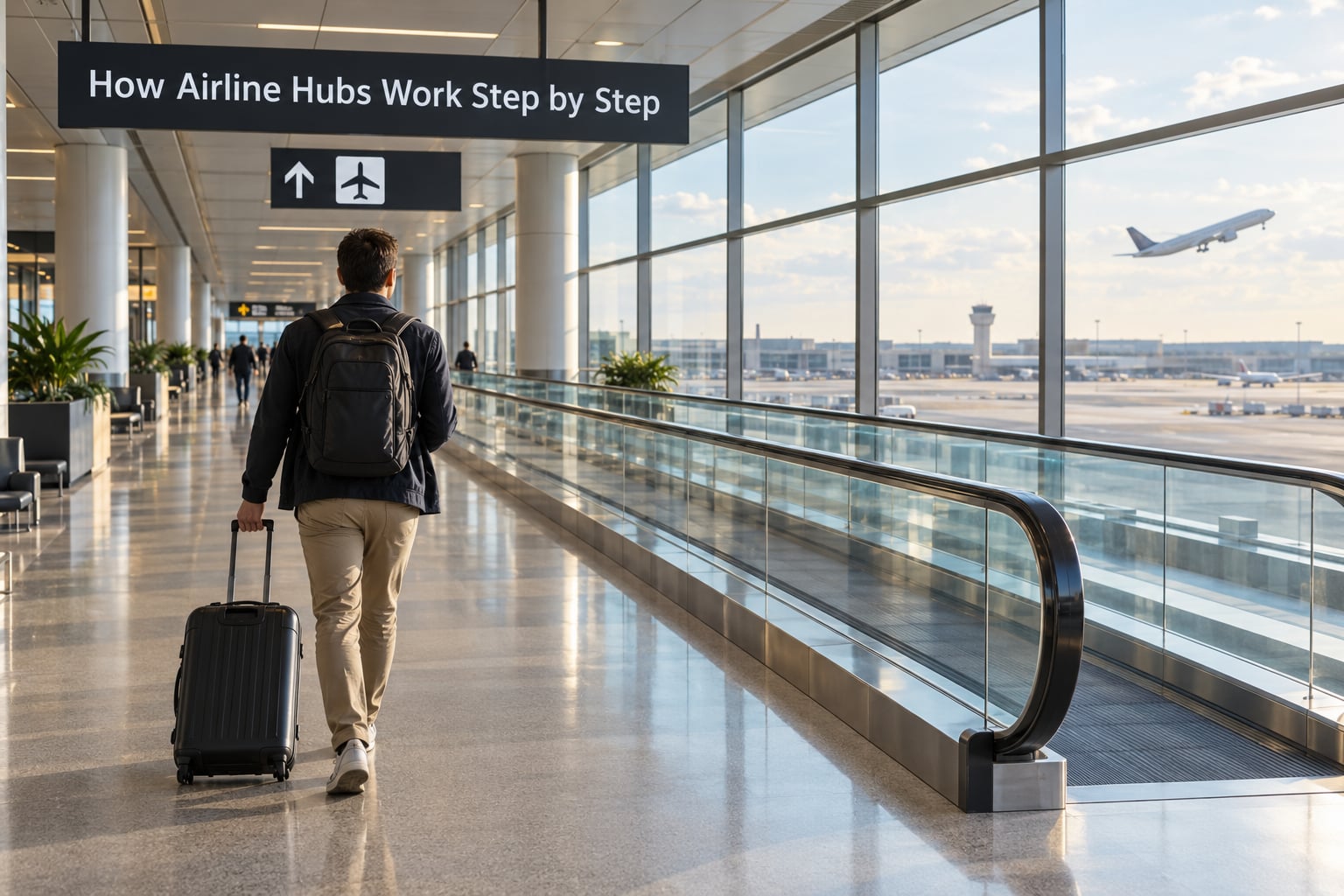
It helps to follow two trips at once, because the passenger experience and the aircraft experience are different stories running on the same clock.
What happens to the passenger
- Arrival at the hub. Your flight from a spoke city sets down at the hub. On a single itinerary, your bag is tagged to the final destination and is already moving toward it.
- Walk or shuttle to the transfer gate. Signs point to connecting flights, not to arrivals. In a large multi-terminal hub, this can mean a train or a bus between buildings.
- A wait, usually short. The gap is designed, not accidental. Airlines build in time for deplaning, walking and boarding without making you sit at the gate for two hours.
- Departure onward. You board the next sector, which may end at your destination or feed into yet another spoke.
If you are connecting internationally, immigration and baggage reclaim usually come between those steps, which changes the timing completely. That is covered further down.
What happens to the aircraft
The same plane you just left keeps flying. It was assigned a rotation in the morning: arrive from a spoke, wait on the ground for a while, fly to a different spoke or long-haul destination, do that turn, and come back to the hub in the evening. The time it sits at the hub between rotations is the buffer that absorbs minor delays.
This is why an airline hub is not really about the terminal building at all. It is about the ground schedule at one airport, arranged so that aircraft and passengers both need to be in the same place at the same time.
What Is a Connecting Bank?
A connecting bank is a scheduled block of time when an airline deliberately brings a large share of its flights into and out of a hub at once. Instead of spreading 40 departures evenly across the day, arrivals and departures are clustered into a few concentrated periods so that passengers arriving in one wave can connect to departures in the same wave.
Banking existed because airlines needed enough layover time for passengers to walk to gates and check in, but not so much that travelers abandoned the connection. Clustering the schedule compressed the waiting without shortening the usable window.
Today the practice is looser. Several waves may run through the day at a busy hub, and low-cost carriers often prefer a different pattern entirely: quick turnarounds and short connections so passengers get charged again for another flight. The result is a familiar experience. Hub flights cluster, gate areas fill and empty in waves, and a short delay at 08:00 can travel forward through an entire morning of departures.
Hubs, Focus Cities, and Transit Hubs
These words get used interchangeably in casual conversation, but they describe different levels of service. It matters when you are deciding whether a routing is realistic or whether a short layover will actually work.
- Airline hub. The airline concentrates operations there and times flights into banks. Connecting is easy in theory because the schedule is built for it.
- Focus city. Served often, but without a coordinated arrival and departure rhythm. A connection is possible with no protection built in.
- Spoke airport. Mostly feeder flights into and out of a hub. Connections are rare because there are few onward options.
- Ground transit hub. A rail or coach interchange that feeds the airport. Transferring there is not a flight connection at all.
A ground transit hub is a different concept entirely. Large airports often have a railway station or express coach terminal underneath, and connecting from one to the other takes time that belongs in your connection budget. Some very large international airports are themselves transit hubs for an entire region, where the airport is one stop among many on a high-speed rail journey.
One more term worth knowing: a gateway describes a hub that connects a country or region to the wider world. It is less about the airline’s schedule and more about what the airport does for the surrounding geography.
How hubs and alliances work together
Two airlines that both use hubs usually inherit a bonus: their hubs sit close together. When one airline flies into a city that is another airline’s main base, the arriving passenger often lands next door to the partner’s terminal and can connect on a single itinerary through a code-share.
That arrangement lets small airlines reach destinations they could never serve alone. A regional carrier based at one hub can feed a partner’s long-haul network simply by bringing passengers to the right airport, without operating a single wide-body flight itself.
How Hubs Affect Connection Times
The time on your itinerary between two flights is the gap the airline schedules, and the airline sets it based on how long the connection actually takes at that airport. At a simple hub with a single terminal, 30 to 45 minutes can be plenty. At a sprawling international airport with separate terminals and passport control, the same itinerary usually gets 90 minutes or more.
Several things make a connection easier or harder.
Baggage handling. On a single booking, your bag is transferred automatically to the next flight. On two separate tickets bought separately, you often have to collect it, clear customs in some countries and check it in again. That can add an hour or more and turn a 45-minute connection into an impossible one.
Terminal layout. Travelers report that moving between distant terminals at the largest international hubs can take 20 to 30 minutes on foot or by shuttle. Gate assignments also change, which adds another layer of uncertainty to a tight connection.
Immigration. International connections that require passport control or a transit visa belong in a much longer buffer. Checking visa rules for every country on the itinerary, including the country you connect in, is the step people most often skip.
Buffer time. A connection time of 35 minutes at a hub is not generous, it is a minimum operational figure. The airline has calculated it for aircraft turnaround and walking pace, not for a family with a stroller, a slow lift or an oversized bag.
Weather and airspace. Thunderstorms in summer, snow in winter and flow-control restrictions in busy airspace all eat into the margin. This is why experienced travelers build in extra time rather than booking the tightest connection available.
Most of the practical advice that circulates about hubs lands on the same number. Roughly two hours is a sensible minimum for a typical domestic connection, and three hours or more is safer at a large airport or on an international itinerary.
What Can Go Wrong at an Airline Hub?
Everything, eventually. Hubs concentrate volume, and concentrated volume means a problem affects many more people at once.
Missed connections. If your inbound flight is late and you are booked on a separate ticket, the airline has no obligation to rebook you, and you may pay for a new ticket on the spot. On a single itinerary, the airline is required to put you on the next available service and, depending on the circumstances and the law that applies, provide meals or a hotel.
Broken aircraft rotations. When a plane arrives late, it departs late on every remaining leg of its day, and the delay moves down the line. A storm over one hub in the evening can still be rolling aircraft out of place the following morning.
Crowding and long walks. Peak waves fill concourses, boarding queues extend down the corridor, and walking distance turns into a real factor in the schedule.
Gate changes and misrouted bags. Both are routine and both get resolved, but they add stress and time.
Overcrowding in the air. When demand outstrips capacity, an airline will sometimes fly a larger aircraft from another base into the hub. That solves the passenger problem and creates a bigger challenge finding space for the plane on the ground.
Airlines manage these issues with buffer time built into the schedule, reserve crews and aircraft that can be repositioned, and rebooking systems that shift passengers across later flights. Travelers who book a single itinerary on one airline are protected by that machinery. Anyone on separate tickets is running their own recovery plan.
Frequently Asked Questions
Which airline has the most hubs in the United States?
Network size changes with mergers and schedules, so the answer shifts over time. In the current US market, the largest hub networks generally belong to United, Delta and American, with American and Delta each working a very large number of connecting airports, and United concentrated heavily around its Chicago, Denver, Dallas and San Francisco hubs. Treat any ranking as a snapshot rather than a fixed fact.
What is the biggest airline hub in the world?
Atlanta Hartsfield-Jackson is usually cited as the busiest hub airport in the world by passenger volume, and it is the primary hub for Delta. Frankfurt, Dallas/Fort Worth, Chicago O’Hare and Dubai regularly appear alongside it. Busiest does not always mean best connected for your itinerary, because what matters is whether the onward flights you need are on the schedule.
Which airlines use the hub and spoke model?
Most full-service network carriers do, including United, Delta, American, Air France-KLM, Lufthansa, British Airways and Emirates. Low-cost carriers such as Ryanair and Southwest use simplified versions of it, with their own short-haul bases and quick turnarounds. The model is close to standard for any airline covering more than a handful of destinations.
What are the disadvantages of hub and spoke?
The main drawbacks are longer total travel times for trips that could have been nonstop, cascading delays when an aircraft runs late at a hub, crowded terminals during peak waves, and a higher risk of missing a connection. A single severe weather event at one hub can also ripple across an entire network on the same day.
What is a minimum connection time at an airport?
A minimum connection time is the shortest gap an airline schedules between an arriving and a departing flight while still counting it as one itinerary. It varies by airport and by whether the connection is domestic or international, commonly running from around 30 to 45 minutes at simple hubs and 90 minutes or more where passports, terminals or baggage reclaim are involved.
Do I need a transit visa when connecting at a hub?
It depends entirely on your nationality, the country you are connecting in and your final destination. Many countries require a visa or an electronic travel authorization even when you never leave the airport and never collect a bag. Check the rules for your passport on official government travel advice sites before you book, not at the gate.
Conclusion
Understanding how airline hubs work changes how you read a boarding pass. A route through Atlanta or Frankfurt is not an accident. It is the airline using one aircraft to serve several markets, which is why the trip is often cheaper and why the schedule is arranged so that the transfer works when things run normally.
The one practical step worth taking: before you book, compare the total travel time, the connection length and the baggage policy rather than the departure time alone. A nonstop flight that lands six hours earlier is often the better deal for a business trip, while a well-timed connection can win on price and on the rest of your day.