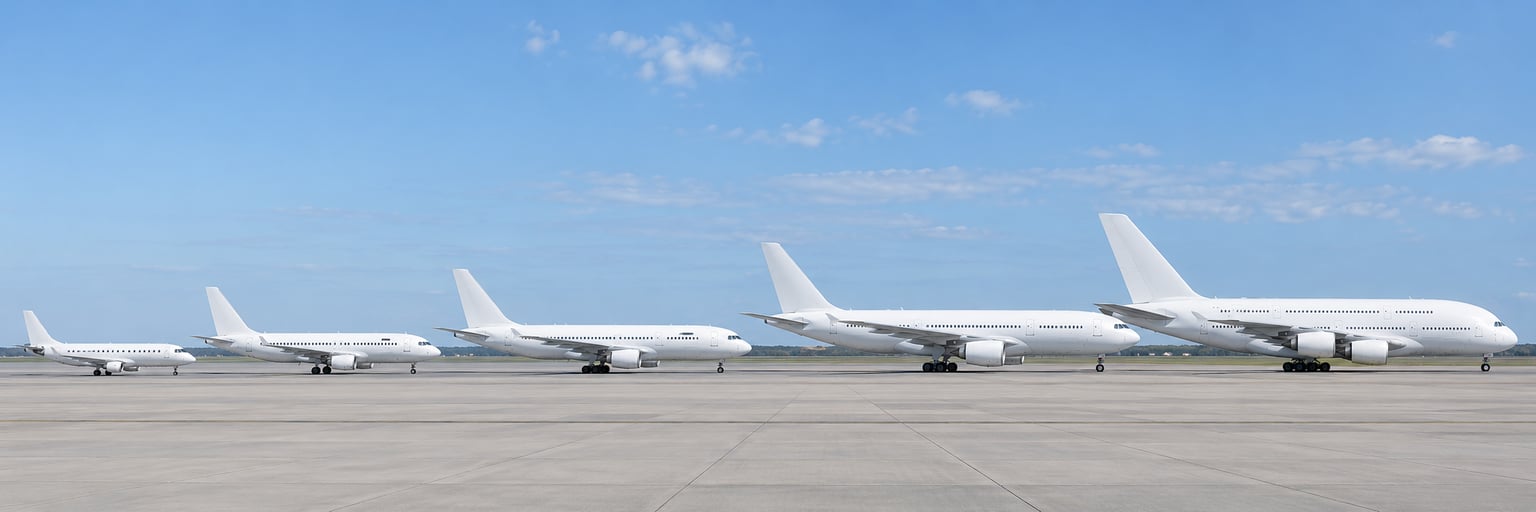
Airbus models split into two jobs. The narrow-body single-aisle jets, the A220 and the A320 family, fly short and medium routes where airlines fill every seat. The twin-aisle wide-bodies, the A330neo, the A350 and the A380, take the long-haul and ultra-long-haul flying. Knowing what the different Airbus models are used for comes down to working out which of those two jobs a route actually needs.
I’ve spent years explaining aircraft types to friends who just wanted to know whether their long flight would be comfortable. The confusing part is not the flying, it’s the naming. So this guide walks through each family by mission, which is the only way it ever clicks.
One thing to keep in mind before you start: the aircraft printed on your booking is a plan, not a guarantee. Airlines swap equipment for schedule, maintenance or demand reasons, sometimes days before departure. What follows tells you what a model is built to do, not what you are certain to be sitting in.
Table of Contents
- 1Airbus Models at a Glance: What Each Family Does
- 2How to Read Airbus Model Numbers and Family Names
- 3What the Different Airbus Models Are Used For on Short and Regional Routes
- 4Where the A320 Family Is Used
- 5What the A330neo Is Used For
- 6What the A350 Is Used For
- 7What the A380 Is Used For and Where It Does Not Fit
- 8Passenger, Cargo, and Private-Operator Variants
- 9How to Choose the Right Airbus for a Flight
- 10Frequently Asked Questions
- 11What do the numbers in Airbus model names mean?
- 12Is the Airbus A380 the largest passenger airplane ever built?
- 13Why do airlines use different aircraft on the same route?
- 14Does the Airbus neo version always have a longer range?
- 15Which Airbus model is used for the longest flights?
- 16Conclusion: Start with the Flight’s Job
Airbus Models at a Glance: What Each Family Does
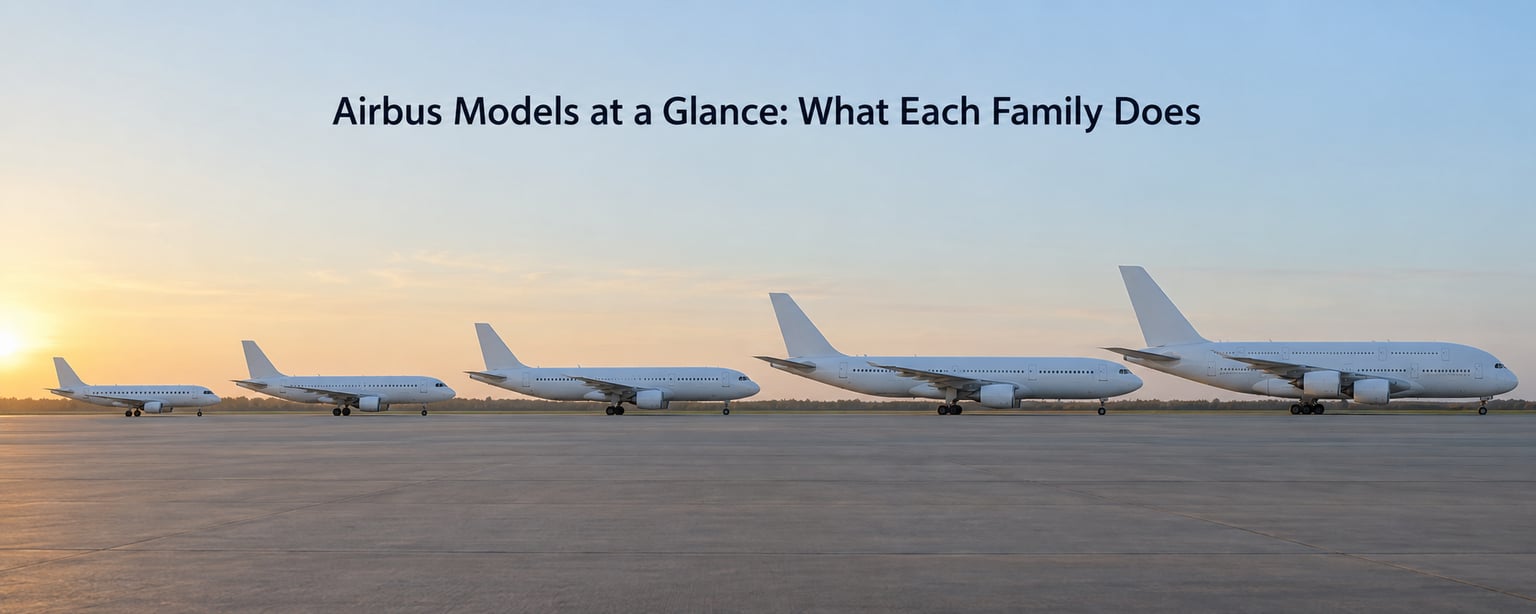
Here is the whole lineup on one page. Seat counts and ranges below are typical reference figures rather than guarantees, because an airline’s layout choice can move the seat number by thirty or more and the real-world range depends on how the aircraft is loaded and where it flies.
| Model | Body type | Typical seats | Nonstop range | Main job |
|---|---|---|---|---|
| A220-100 | Narrow-body, single aisle | About 100 to 130 | Short to medium haul | Thin regional routes, feeder traffic |
| A220-300 | Narrow-body, single aisle | About 130 to 160 | Medium haul | Bigger regional jets, quick turnarounds |
| A319neo | Narrow-body, single aisle | About 150 to 180 | Short to medium haul | Smaller hubs, European city pairs |
| A320neo | Narrow-body, single aisle | About 170 to 210 | Medium haul | The default short-haul workhorse |
| A321neo | Narrow-body, single aisle | About 190 to 240 | Medium to long haul | High-density routes, hub feeds, some transatlantic |
| A321XLR | Narrow-body, single aisle | About 200 to 244 | Long haul | Transatlantic and long thin routes on a single aisle |
| A330-800 | Wide-body, twin aisle | About 250 to 290 | Medium to long haul | Cargo-heavy and lower-demand long routes |
| A330-900 | Wide-body, twin aisle | About 280 to 350 | Long haul | Busy medium- and long-haul routes |
| A350-900 | Wide-body, twin aisle | About 300 to 350 | Long haul | Long-range twin-aisle with strong cargo volume |
| A350-1000 | Wide-body, twin aisle | About 350 to 480 | Ultra-long-haul | The longest non-stop missions, big premium cabins |
| A380-800 | Wide-body, twin aisle, double deck | About 500 to 850 | Long haul | Only where demand and airport conditions justify it |
The table covers the families in production today. Airbus also builds versions of these airframes for freight, military and private use, which I cover further down, plus a few older models you can still see at small airports.
How to Read Airbus Model Numbers and Family Names
The naming follows a pattern, and once you see it the numbers stop looking random. Every airliner name starts with an A, then a series number, then a size variant.
The series number tells you the generation and rough size. The A220 is the smallest current airliner, the A320 family is the mid-size single-aisle generation, and the A330, A350 and A380 are the large twin-aisle generation. Airbus builds its airliners in ascending size order, which is the opposite of how the numbers feel when you read them quickly.
The variant number after the dash tells you how long the fuselage is. A220-100 and A220-300 are the same aeroplane at two lengths, and the same is true of the A330-800 versus A330-900 or the A350-900 versus A350-1000. Bigger number, longer body, more seats, same family. The A321XLR follows the same logic as the longest A321 of them all.
A passenger number does not tell you the best aircraft for a route. A380 and A321neo numbers look far apart, yet both fly short-haul routes happily. What decides the choice is how much you need to carry, how far you are going and what the airport can take.
What the Different Airbus Models Are Used For on Short and Regional Routes
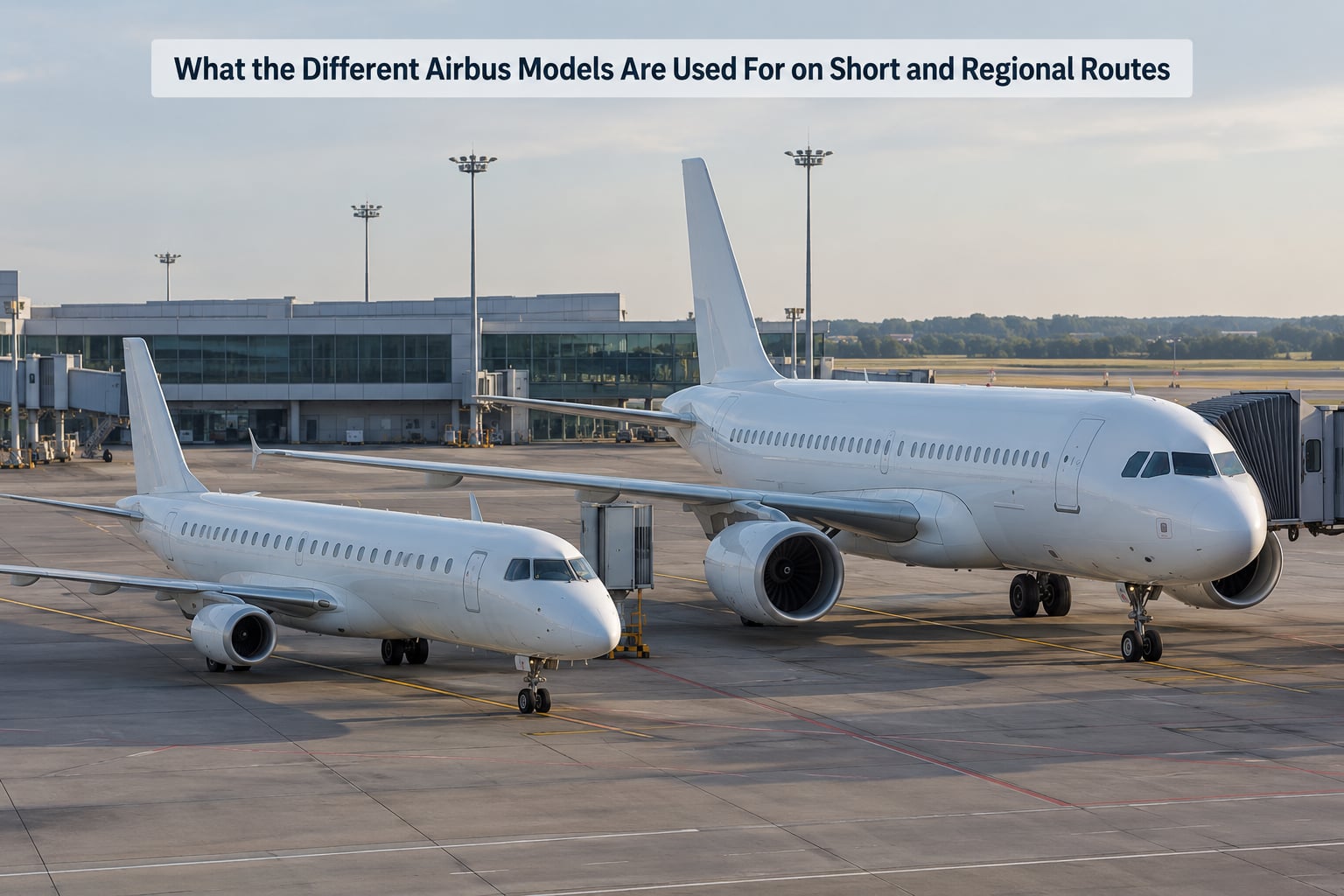
The A220-100 and A220-300 handle the routes where a full-size narrow-body would burn fuel on empty seats. Think a city pair with two or three daily rotations, a short domestic hop, or a feeder service that connects a small town to a hub. Their job is to get people there cheaply and turn around fast, and the smaller cabin makes the turnaround quicker too.
The A319neo, A320neo and A321neo take over where demand is heavier. A three-hour flight across Europe usually means one of these, because a bigger single aisle carries more people and more hold baggage for the same crew count. Airlines pick the exact member based on how many seats the route can fill.
On a light route, a jet that fits the demand is the economical choice, and an A220 often wins. On a busy one, seat count and cargo capacity matter more, and the A320 family usually takes over. Both are narrow-bodies, so the cabin experience is broadly the same shape: one aisle, overhead bins, no lie-flat beds outside any premium cabin.
Worth knowing if you follow the forums: the A220 began life as the Bombardier C-Series before Airbus bought the programme. That history explains why it looks and sits differently from the A320 family, even though both count as Airbus narrow-body models.
Where the A320 Family Is Used
The A320 family does most of the world’s short and medium-haul flying, and each member has a slightly different job.
The A319neo is the smallest of the current three. Airlines use it where a route needs more capacity than a regional jet but not a full-size cabin, commonly on European city pairs and smaller hub connections. It has the shortest range of the three, so it stays closer to home.
The A320neo is the version you are most likely to be assigned. Hub runs, domestic shuttles and short European hops all default to it, because it balances seat count, range and operating cost neatly. When a traveller asks me what a normal short-haul flight looks like, this is the answer.
The A321neo is the stretched one, and it goes further as a result. Airlines use it on dense high-frequency routes where every extra seat earns, and increasingly on medium-long and transcontinental legs that used to need a wide-body. The A321XLR, the extra-long-range version, pushes that further, adding cabin pressurisation and fuel work that let it fly long thin routes between city pairs that would not justify a twin-aisle.
Two things vary a lot here and are worth knowing. Seat count and range both depend heavily on layout, so the same model can be configured as a high-density leisure jet or a roomy one with generous legroom in economy. And the stretched A321 variants create a genuinely large cargo door, which means belly cargo on a single aisle can rival what you’d expect from an older wide-body.
What the A330neo Is Used For
The A330neo is the wide-body for routes that are long but not the longest. It comes in two main sizes and the difference matters on thin routes.
The A330-900 is the larger of the two, with a stretched fuselage and more cargo volume. It suits busier medium- and long-haul services where a twin aisle earns its keep in passenger count and the hold needs to be full of freight. Think a daily widebody between business centres with a strong cargo market underneath.
The A330-800 is the shorter one, and airlines use it where demand does not fill a bigger cabin or where the route carries a lot of cargo. Its hold volume relative to its passenger capacity is the selling point, and freight operators like that trade. On a route that runs three times a week with soft demand, a smaller frame with a big hold is often the sensible call.
There is a commercial reason the A330neo is so widespread: airlines like fleet commonality. The same type rating and similar systems across the family mean a pilot can move between them and a spare part fits more than one aircraft. That is unglamorous, but it shapes which planes a route actually gets.
On the cabin side, a twin aisle is the first thing you notice. Operators pick between high-density layouts for leisure routes, standard ones, and premium-heavy ones that put a lie-flat product at the front. Same airframe, very different experience, so the seat map matters more than the model name.
What the A350 Is Used For
The A350 is Airbus’s long-haul wide-body, and it comes in two sizes: the A350-900 is the standard long-range one, and the A350-1000 is the stretched ultra-long-range one.
The A350-900 handles the mainstream long-haul network, transatlantic crossings and long Asian routes. Compared with an A330 of similar size it is a newer design, with more composite structure and a modern cabin, and airlines pick it when the route needs range and a good passenger product in a twin aisle.
The A350-1000 is the one for the longest missions. It has a substantially longer fuselage, which means more seats, a very large cargo hold and the biggest premium cabins Airbus offers. On a route where an airline wants a daily non-stop rather than a connecting itinerary, this is the aircraft that makes it possible without adding a stop. A350-1000ULR variants extend that further, and the extreme long-range version is flown on ultra-long-haul sectors with multi-hour climbs at cruise altitude.
What the A350 does not do is maximise seats. Its whole case rests on carrying a strong load of passengers plus a lot of cargo over a long distance at a sensible cost per seat. On a route with thin traffic, a very large aircraft burns fuel it cannot recover, and the A330neo or a well-loaded A321XLR is often the better answer. On a route with dense traffic and heavy freight, the A350-1000 wins easily.
Which of the two is right comes down to route demand and airline configuration, not size for its own sake. That is the single most useful habit for reading any aircraft list, Airbus or otherwise.
What the A380 Is Used For and Where It Does Not Fit
The A380-800 was built for one job: very high demand between major hubs, on airports that can handle an aircraft its size. In that specific situation it carries more people than any other passenger airliner in service and spreads that load across four engines.
The problem is that situation proved narrower than expected. An airline needed a route busy enough to fill a double-deck cabin, plus an airport able to handle the wingspan, pavement loading and gate requirements, plus enough demand to justify two daily rotations. Fewer routes and airports qualified than the original business case assumed, and long thin routes never made the arithmetic work at that size.
New orders dried up and production ended in 2021, with 251 aircraft delivered. Several major operators have since retired their A380s, and more are expected to follow, so as of 2026 the aircraft you see in the wild is increasingly a special occasion rather than a routine booking.
Here is the part that surprises people. On many long-haul routes, an A350-1000 offers similar passenger capacity with lower operating cost, which is exactly why operators ended up with those aircraft instead. The A380 was the bigger plane, not the better answer, and the market has said so fairly clearly.
Passenger, Cargo, and Private-Operator Variants
Some Airbus models you will read about are not the passenger jet you picture. These are mission variants, and the airframe family tells you the base while the variant tells you the job.
Converted freighters are the most common. Rather than pay to certify a brand new frame, airlines and cargo operators convert passenger A330s and A350s into freighters, removing the seats and installing a main deck cargo door and floor. The A330P2F is the best-known example, and these aircraft carry the e-commerce and express freight that fills a normal passenger jet’s hold.
Combi arrangements put passengers and cargo in the same aircraft, with the main cabin split so the front section carries people and containers of freight take the rest of the floor. It is a way for an airline with strong cargo demand to serve a passenger route without flying a dedicated freighter.
The ACJ A330 is the private-jet version of the A330, sold to governments, corporations and VIP operators with a bespoke cabin, extra fuel for long legs and the range to fly a small private-aircraft itinerary at airliner practicality. If you see a very large, very quiet Airbus with few windows and a registration that looks unusual, this is what you are looking at.
Military and special-mission versions sit on the same family too, including tanker and surveillance derivatives of the A330 and the outsized cargo transports. I am not going through every derivative here, but the pattern is worth remembering: the model name tells you the airframe, and the variant suffix tells you the mission.
How to Choose the Right Airbus for a Flight
You rarely pick the aircraft, so this is really about reading a booking sensibly. Six factors explain almost every assignment.
Stage length comes first. Short routes get single-aisle narrow-bodies because the aircraft can turn around quickly and seats are cheap to fill. Long routes get twin-aisle wide-bodies that can carry a premium cabin, more baggage and enough fuel to fly the sector nonstop.
Passenger count on the route decides the size within that class. A lightly used long route may get an A330-800 or even an A321XLR, while a busy one may get an A350-1000. A large aircraft on a thin route is a cost the airline cannot spread.
Fleet commonality shapes the choice more than passengers expect. Airlines prefer assigning the same small number of types, so a route may get a slightly larger aircraft than ideal simply because that is what the airline operates into that airport. Forum regulars make this point constantly, and they are right.
Cabin layout is the part that actually reaches you. The same model can be delivered with an extra few rows of seats, a bigger premium economy cabin, or a different seat product entirely. If seat comfort or a lie-flat bed matters, look at the seat map rather than the aircraft type.
Cargo needs and airport compatibility finish the picture. A route with heavy freight may get a smaller passenger frame with a large hold, and an airport with a shorter runway or a smaller gate area rules out the biggest jets entirely. The 777-versus-A380 question comes up constantly, and the honest answer is that the A380 is the larger of the two, though neither wins on every route.
Two rules keep you out of trouble. A larger model is not automatically a better flight: pitch and layout matter more than size. And a long-range variant is usually flown well short of its maximum, so do not read an XLR badge as a guarantee of an ultra-long sector.
Frequently Asked Questions
What do the numbers in Airbus model names mean?
Airbus names start with an A, followed by a series number that hints at size and generation, then a variant number that tells you the fuselage length. The A220 is the small regional jet, the A320 family is the mid-size single aisle, and the A330, A350 and A380 are the large twin-aisle models. A220-300 is longer than an A220-100, and an A350-1000 is longer than an A350-900.
Is the Airbus A380 the largest passenger airplane ever built?
The A380 is the largest passenger airliner ever built, and it remains the biggest in service today, with a double deck and a typical layout carrying several hundred passengers. The only aircraft close to it in size is the Boeing 747, which is longer in the fuselage but has four engines mounted on the wings rather than two, and which is now a rare sight on passenger routes.
Why do airlines use different aircraft on the same route?
Because the assignment is a business decision, not a rule about distance. Airlines weigh demand, freight, airport gates and runway length, and they also like to keep a small number of aircraft types, so a route can get a model that is not the obvious size match. Equipment can also be swapped for maintenance or schedule reasons, which is why the type on your booking is never guaranteed.
Does the Airbus neo version always have a longer range?
No. Neo means a new engine and aerodynamics package, and what you get is better fuel burn, better cabin comfort and sometimes more range, but not always. Range also depends on the variant and the layout, which is why the LR, XLR and ULR tags exist as separate names. Check the specific variant rather than assuming neo automatically means longer legs.
Which Airbus model is used for the longest flights?
For the longest passenger flights, the A350-1000 and its ultra-long-range version are the aircraft of choice, because the stretched fuselage carries a large load of passengers, fuel and cargo between major hubs without a stop. The A330neo handles plenty of long-haul flying at a smaller size, and the A380 was built for volume rather than distance. The exact aircraft on your route still depends on the airline.
Conclusion: Start with the Flight’s Job
Airbus models divide by the job they do. The A220 covers many regional and lighter short-haul missions. The A320 family handles the everyday narrow-body routes, with the A321neo and A321XLR stretching further. The A330neo and A350 do long-haul flying, and the A350-1000 takes the longest sectors. The A380 only makes sense where demand and airport conditions justify it. That is the whole answer to what the different Airbus models are used for, and it holds even as operators change their fleets.
For your actual flight, check the flight number and the seat map rather than the marketed aircraft type. That seat map tells you the layout, which is the part that decides whether the trip is comfortable.