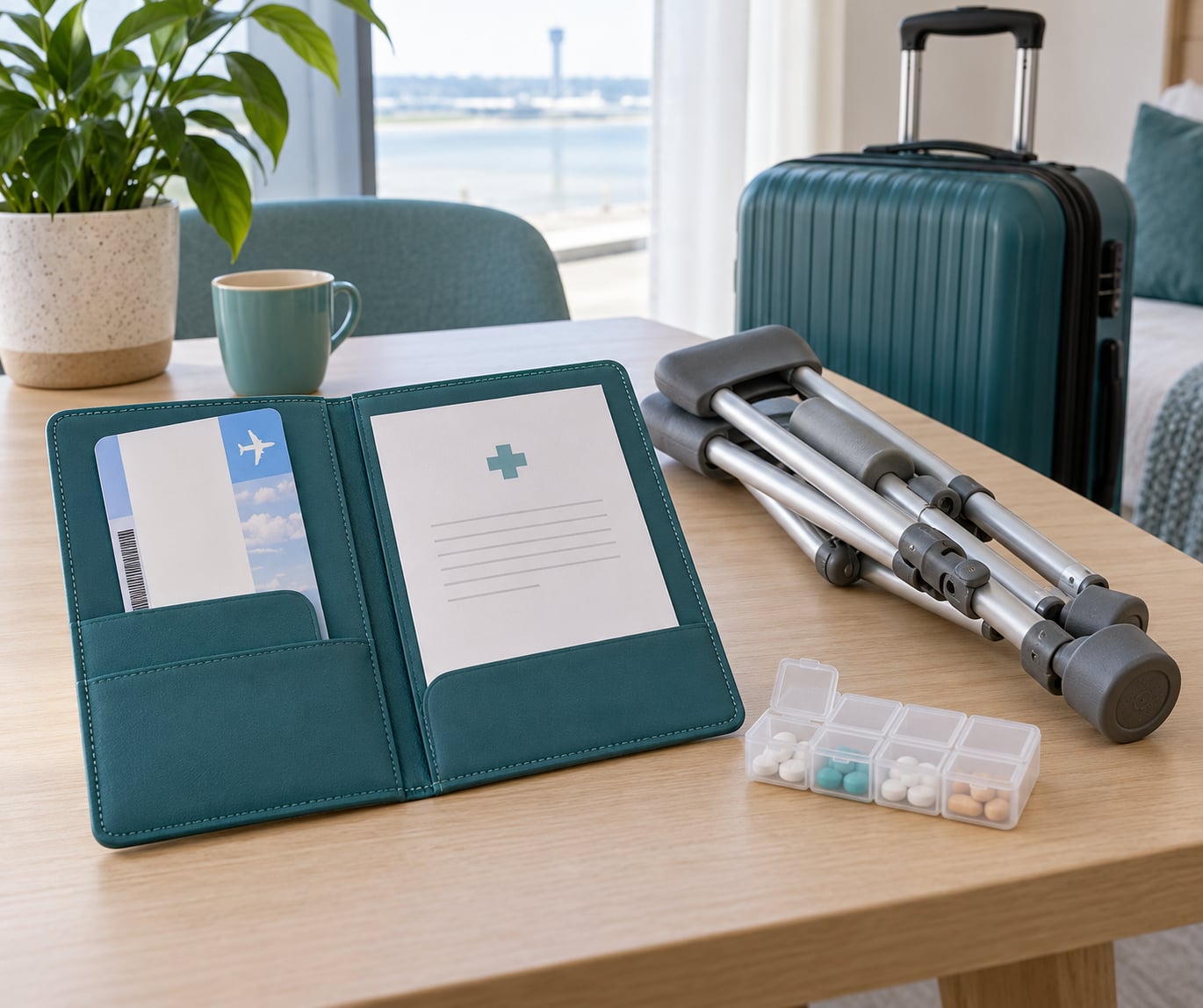
You can usually fly with a broken bone once a doctor confirms the fracture is stable and the healing has reached a point where cabin pressure and a few hours of sitting will not cause a problem. The airline also has to accept you with your cast, splint, boot or crutches. Most of the work is done before you book: get medical clearance, tell the airline what you need, and pack the right support.
Medical disclaimer: this is general travel guidance, not medical advice. Cabin pressure, immobility, blood-clot risk and cast swelling are real concerns, and only your doctor or orthopaedic surgeon can judge your individual case. If anything below conflicts with what your clinician has told you, follow them.
Last updated: October 2026
Table of Contents
- 1What You Need Before You Fly With a Broken Bone
- 2Step-by-Step: How to Fly With a Broken Bone
- 3How to Check Medical Fitness Before Flying With a Broken Bone
- 4Ask the Airline About Assistance and Equipment
- 5Pack Medication and Mobility Support Safely
- 6Plan the Airport and Flight Itinerary
- 7Know When to Change or Cancel the Trip
- 8Common Mistakes
- 9Frequently Asked Questions
- 10Can I fly with a broken bone or in a cast?
- 11Do airlines allow wheelchairs and crutches?
- 12What should I do with medication after a fracture?
- 13Will I need a doctor’s note for the flight?
- 14How long after a break can you fly?
- 15Conclusion
What You Need Before You Fly With a Broken Bone
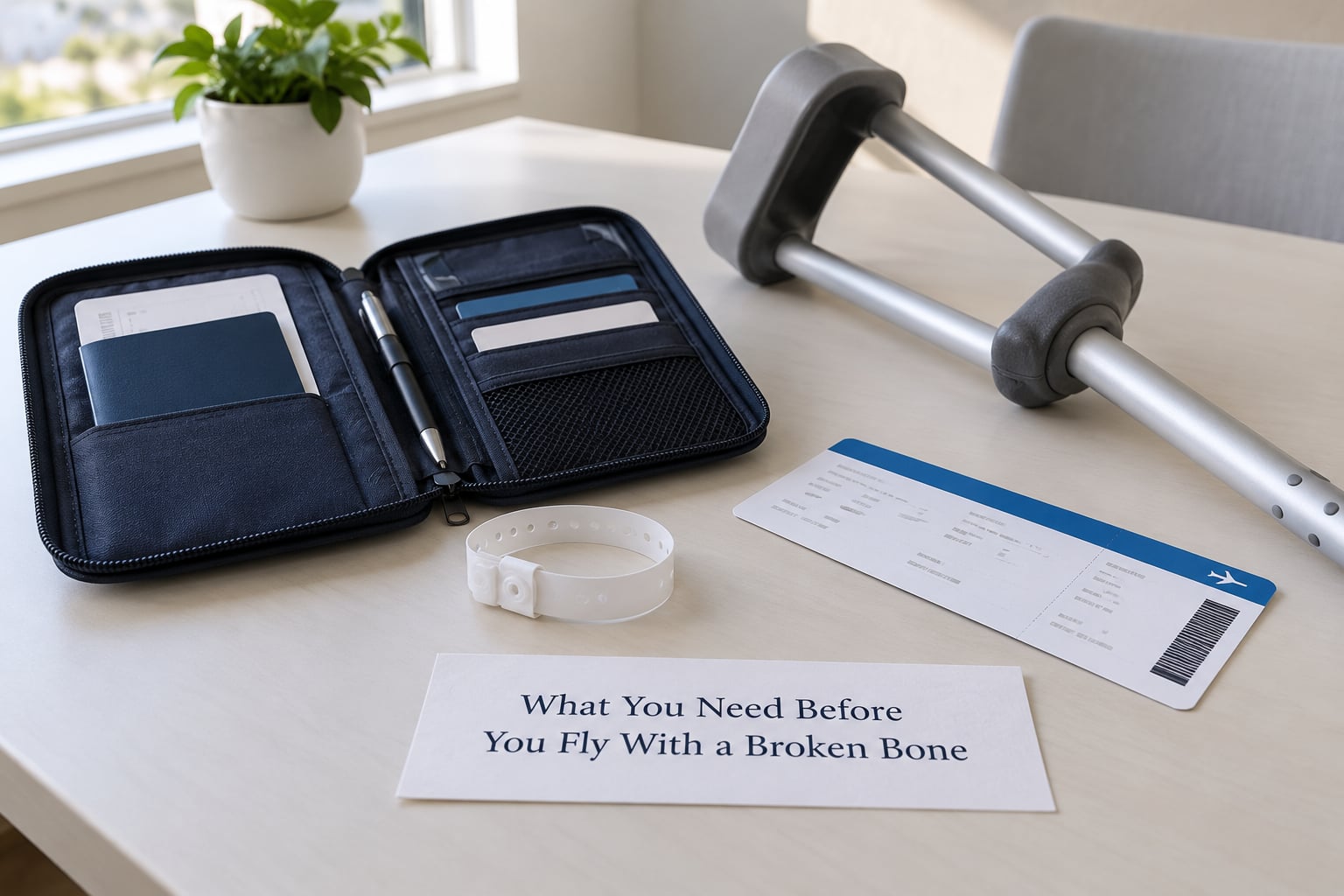
Most travel disasters with a fracture come from things that were arranged last minute. Ten minutes of admin a week before departure removes almost every awkward scenario at check-in.
- Written medical clearance. A letter from your doctor or the team that treated you, stating the fracture type, the date of the injury, what immobilisation you are using, whether you are weight-bearing, and that flying is considered safe for you. Airline wording varies, so ask the airline what it wants the letter to say before you pay for it.
- Photo identification and your booking reference. Assistance is much faster when the agent can look up your booking in front of you.
- The airline’s special assistance contact. Email or phone, not just the general reservations line. You want a written reply you can show at the airport.
- Your mobility equipment. Crutches, a folding wheelchair, a walking frame or a walker boot, plus the airline’s rules on whether these travel in the cabin or in the hold. Wheelchairs and walking aids are generally not treated as paid baggage, but the airline still needs to know in advance.
- Medication in original packaging. Prescription labels intact, in your hand luggage, with the dosing instructions you were given. Add a few extra days’ worth in case of delay.
- A companion’s details. If someone is travelling with you, give the airline their name and seat so the agent can coordinate assistance rather than improvise at the gate.
- Contact details for your treating team. If anything goes wrong mid-journey, you want the clinic number on your phone, not buried in an email.
Step-by-Step: How to Fly With a Broken Bone
How to Check Medical Fitness Before Flying With a Broken Bone
Ask your clinician before you book, not at the airport. Whether flying is sensible depends on the fracture itself, how stable it is, and what you will be doing for the whole journey, which can include transfers, stairs and several hours seated without moving.
Tell them the airline, the route, the flight length, whether there are connections, and how many steps or walking transfers you face at each end. Mention any planned surgery, the date you were put in a cast, and any pain, swelling, breathing trouble or numbness you have noticed. A letter written with those details is far more useful than a generic note.
Be aware of what the cabin itself does. Pressurised cabins sit at roughly the equivalent of 2,000 to 2,500 metres, so oxygen partial pressure is lower than at sea level and swelling in an injured limb tends to increase. Long periods without moving your legs also slow blood flow. Neither is automatically dangerous with a stable fracture, but both are reasons a careful clinician wants to see you first.
Ask the Airline About Assistance and Equipment
Contact the airline before you pay for anything, and ask specific questions. Can you bring crutches into the cabin, and can a folding wheelchair be gate-checked and returned at your destination? Do they need a completed medical form in a particular format, and how far in advance must it arrive? Will they provide an aisle seat, pre-boarding, or a wheelchair at the gate?
Ask about connections too. A through-ticket with two flights usually means one airline handles the assist at both ends. Separate tickets often do not, and you can end up transferring yourself at a strange hour with a bag and a pair of crutches.
One rule catches people out: many carriers impose a waiting period after a cast or plaster is fitted. The published figures differ sharply between airlines, and they depend on flight length and on whether the cast is plaster or a lighter fibre splint, so a number quoted for one airline tells you nothing about the next one you book. Treat any post-cast window as real, ask for your airline’s rule in writing, and ask again if you rebook.
Pack Medication and Mobility Support Safely
Keep every prescribed medication in its original labelled container and in your hand luggage, never in checked baggage. Bring enough for the itinerary plus one extra day, and a short written list of what each medicine is for.
Time your doses so that a long-acting painkiller is taken shortly before boarding rather than during the middle of the cabin. Sitting still with sedating medication makes the transfer and the toilet trip harder than they need to be, so talk to your prescriber about timing rather than guessing.
On equipment: put crutches through the airline’s oversized-baggage process, since they can trip the cabin bag sizer and get refused at the gate. Wrap a wheelchair or frame in a protective cover, remove loose cushions and footplates, and note your chair’s fold instructions if staff need to handle it.
Watch the cast. Flight-induced swelling is the single most common practical problem, and a rigid cast that fits in the morning may not fit after a ten-hour flight. Ask your medical team about a split or bivalved cast, a removable cast shoe, or a cast protector so you can get it wet and get to your skin.
Plan the Airport and Flight Itinerary
Request an aisle seat so you can stand and stretch without climbing over anyone. On a long-haul, extra legroom or a lie-flat seat makes a real difference for someone who cannot reposition a plastered leg. Avoid the middle of a three-seat row.
Leave far more time than usual. Allow at least three hours for a long-haul flight, and tell the airline you need assistance when you arrive rather than at check-in. Ask for priority or early boarding so you are not queueing on crutches, and check whether your airport offers wheelchair assistance through the terminal.
At security, keep your medical letter and any cast letter to hand. Crutches usually go through the machine with you rather than being screened separately, but officers can ask what you cannot lift or reach. A calm, early explanation is much easier than improvising at the x-ray belt.
Plan movement on board. Get up and walk the aisle every couple of hours where the seat and your injury allow it, flex your ankle if the fracture is not in that leg, and stay hydrated. If you are non-weight-bearing after a lower-limb fracture, ask your doctor beforehand whether graduated compression stockings or any other preventative measure make sense for you.
Know When to Change or Cancel the Trip
Postpone the flight if your symptoms are getting worse rather than settling. Increasing pain, spreading swelling, numbness, a change in colour or temperature in the injured limb, fever, or a cast that feels too tight are all reasons to speak to your medical team before travelling.
Do not fly with a chest injury that is still affecting your breathing, an unresolved pneumothorax, a suspected head or spinal injury, uncontrolled bleeding, or a recent general anaesthetic where your doctor advises against it. Reduced cabin oxygen and shallow breathing because of pain are a genuinely poor combination, and any of these warrants medical advice, not a forum answer.
Change the plan if the airline cannot meet your needs. If they will not accept your equipment, cannot seat you safely, or cannot provide the assistance your itinerary requires, the trip as booked does not work. Know the airline’s rules for medical cancellations and get insurance to confirm whether your cover responds to a fracture-related change.
If you are injured abroad and need to return home, a commercial seat with a medical escort is often enough. Air ambulance repatriation exists for patients who cannot be moved safely in a cabin, and your insurer or the local hospital can usually arrange and price it. Ask early, because it needs scheduling.
Common Mistakes
Booking first, asking later. Many airlines need a medical form before ticketing, and some will not accept a letter that arrives the evening before departure. Fix: email the special assistance desk first and keep the reply.
Assuming assistance is guaranteed because you asked. Requests are usually handled on a best-effort basis, and services vary between airports and even between terminals. Fix: ring the airport’s assistance line and the destination airport separately.
Packing essentials in checked luggage. Medication in the hold is the classic mistake, and crutches that fail the cabin sizer are another. Fix: hand luggage only for medicine, and declare crutches in advance.
Treating the fit-to-fly letter as optional. Airline conditions of carriage let carriers refuse boarding where a recent injury makes the flight unsafe. Fix: carry the letter, plus a copy of it, and know who at the airline has read it.
Underestimating the journey, not the flight. People plan for nine hours in the air and forget the transfers, stairs and waiting. Fix: count every step between the front door and the seat, and build in rest.
Ignoring the last few hours after landing. Swelling and clot risk do not stop at the aircraft door. Keep moving gently, hydrate, and follow your discharge advice for the first day or two.
Frequently Asked Questions
Can I fly with a broken bone or in a cast?
Many people do, but only once a clinician confirms the fracture is stable and flying is safe for you. A cast, splint or boot on its own does not stop you boarding. What matters is the bone’s stability, how long ago it broke, whether you are weight-bearing, and how you will manage swelling and pain over the whole journey. Get written medical clearance, tell the airline in advance, and plan for help at both ends of the flight.
Do airlines allow wheelchairs and crutches?
Airlines commonly assist passengers who use wheelchairs, crutches, frames or walking boots, but the exact service and the cabin rules vary. Ask the airline in advance whether crutches can travel in the cabin, whether a folding wheelchair is gate-checked and returned at your destination, and whether assistance needs a form. Booking through-tickets and one airline’s programme usually gives you more help than separate tickets on two carriers.
What should I do with medication after a fracture?
Carry prescribed medication in original labelled containers in your hand luggage, never in checked baggage. Bring enough for the itinerary plus one extra day and a short list of what each medicine is for. Ask your prescriber when to take long-acting pain medication around the flight so you are not sedated during transfers. Keep your clinic’s contact details on your phone for the whole journey.
Will I need a doctor’s note for the flight?
A doctor’s note or medical letter may be required and is useful even when it is not, particularly after a recent fracture, surgery, or with oxygen use. Requirements vary by airline and country, so ask the airline’s special assistance team what wording and form it needs, and how far in advance it must arrive. Carry the original plus a copy, and make sure it states your diagnosis, treatment so far and weight-bearing status.
How long after a break can you fly?
There is no fixed number of days that applies to everyone, and published waiting periods differ sharply between airlines. Short flights are usually easier than long ones, and some carriers count in days or weeks after a cast is fitted rather than hours, particularly with plaster and on longer sectors. Fractures fixed with plates or nails are different again, since the healing and the wound matter more than the calendar. Your doctor should set the timing from your imaging and progress, and your airline should confirm its own rule in writing.
Conclusion
Start with your doctor. They set the timing, the wording of the medical clearance and whether your fracture is stable enough to fly at all. Then confirm everything with the airline in writing: assistance, mobility equipment, seating and any waiting period after a cast is fitted.
Before departure, make sure you have the medical letter and a copy of it, all medication in original packaging in your hand luggage, your mobility aids declared and correctly packed, an aisle seat if you can get one, extra time at the airport, and assistance arranged at your destination. Get those four things in place and flying with a broken bone becomes an ordinary day of travel rather than a series of problems.