Most budget airline fees can be avoided completely, and the method is simple: travel the way the fare was designed for, with one free under-seat personal item, whatever seat you are assigned, online check-in, food from home, and no changes. Budget carriers sell the seat cheaply and charge for everything around it, so every add-on you decline is money you keep. Fifteen minutes of reading before you pay saves more than any fare search will.
Learning how to fly a budget airline without extra fees is mostly a reading exercise done before you pay. On the US ultra-low-cost carriers, a checked bag, a seat assignment and priority boarding together can add more than the base fare again. The math below is about removing charges, not finding a cheaper ticket, because the second problem has already been solved by the airline.
Table of Contents
- 1What You Need
- 2Step-by-Step: How to Fly a Budget Airline Without Extra Fees
- 3Step 1: Compare the Total Fare Before Booking
- 4Step 2: Check Carry-On and Personal-Item Rules
- 5Step 3: Choose Seats and Fare Options Strategically
- 6Step 4: Prepare Documents and Check In Early
- 7Step 5: Avoid Buying Add-Ons at the Airport
- 8Common Mistakes That Lead to Extra Airline Fees
- 9Frequently Asked Questions
- 10Can I fly a budget airline without paying extra fees?
- 11Are seats free on budget airlines?
- 12What is usually included in a budget airline fare?
- 13How can I avoid checked-bag fees on a budget airline?
- 14Are snacks and drinks included on low-cost flights?
- 15Do budget airlines charge for changing a flight?
- 16Conclusion: What to Do First
What You Need
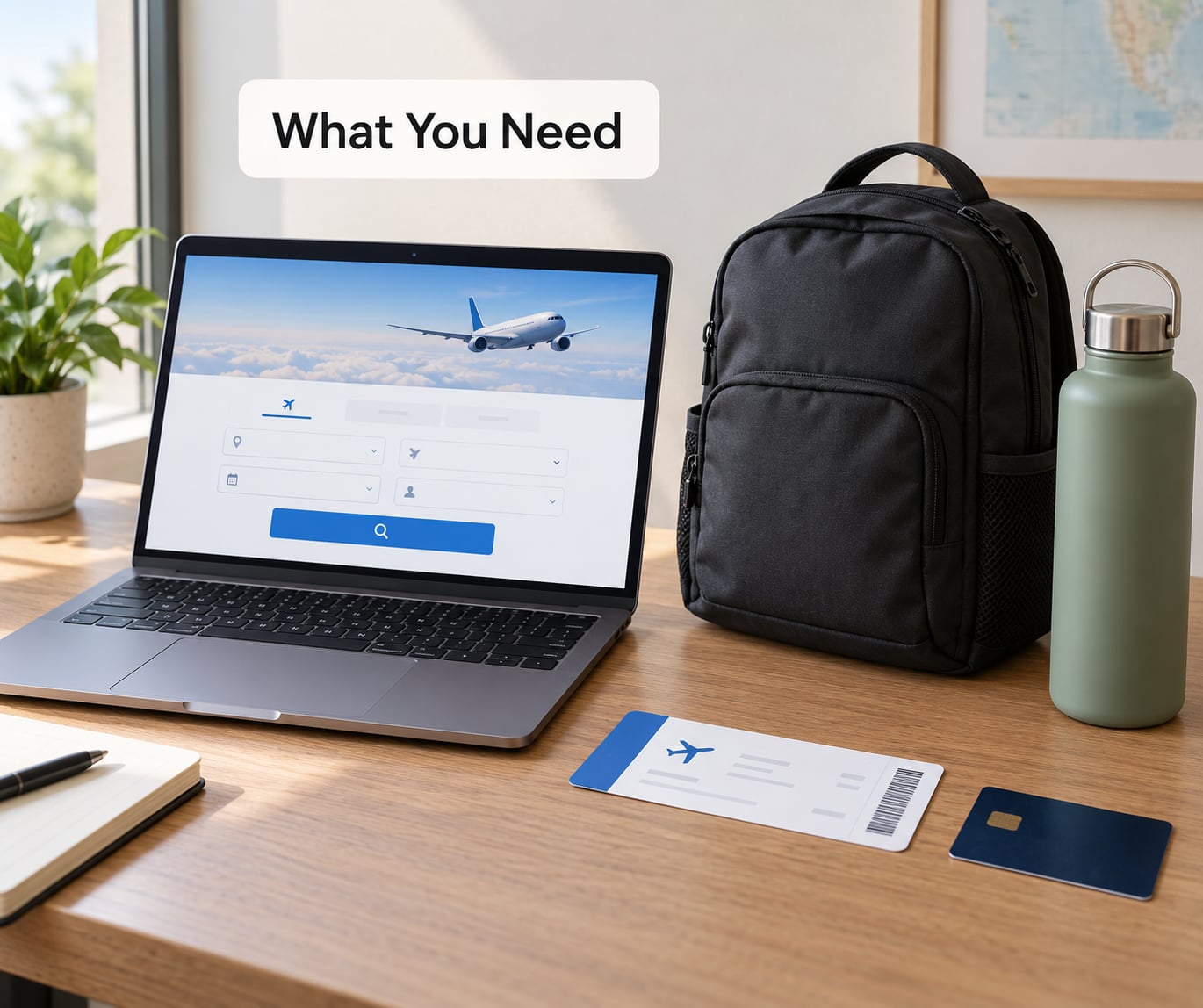
You need the airline’s own fee page open in a second tab, not a blog post about fees, because fee schedules change several times a year. Everything else is free to gather and takes about ten minutes.
- The airline’s fees page. Baggage, seat selection, boarding, and change fees are listed separately, and they are the only numbers that matter for your trip.
- The fare breakdown at checkout, expanded to the total. Airline sites hide the extras behind a link. Click it before you pay.
- Your airline’s personal item dimensions. Most US ultra-low-cost carriers allow something close to 18 by 14 by 8 inches, which is why a 28-liter backpack usually qualifies. European carriers such as Ryanair, easyJet and Wizz Air are tighter and sometimes weigh the bag.
- A tape measure or a ruler. Measure the bag at home, including the external pockets. A soft bag stuffed to the seams measures bigger than the label suggests.
- Boarding group and check-in deadlines. Budget carriers often have shorter check-in counters and earlier cutoffs than the network airlines you are used to.
- A chip-enabled payment card. Spirit, Frontier and Ryanair all refuse cash on board, and some only take card payments through a reader. A cash-only traveler is genuinely stuck.
- An empty water bottle and a snack from home. Bottled water is one of the most expensive things on any flight.
- A phone with the airline app installed and your free rewards account joined. The number attached to the account is the one they refund to.
One more thing worth having open: your credit card’s benefits page. Several travel cards reimburse a checked bag fee or a seat fee per passenger, per trip. If your card covers it, that changes which fare looks cheapest.
Step-by-Step: How to Fly a Budget Airline Without Extra Fees
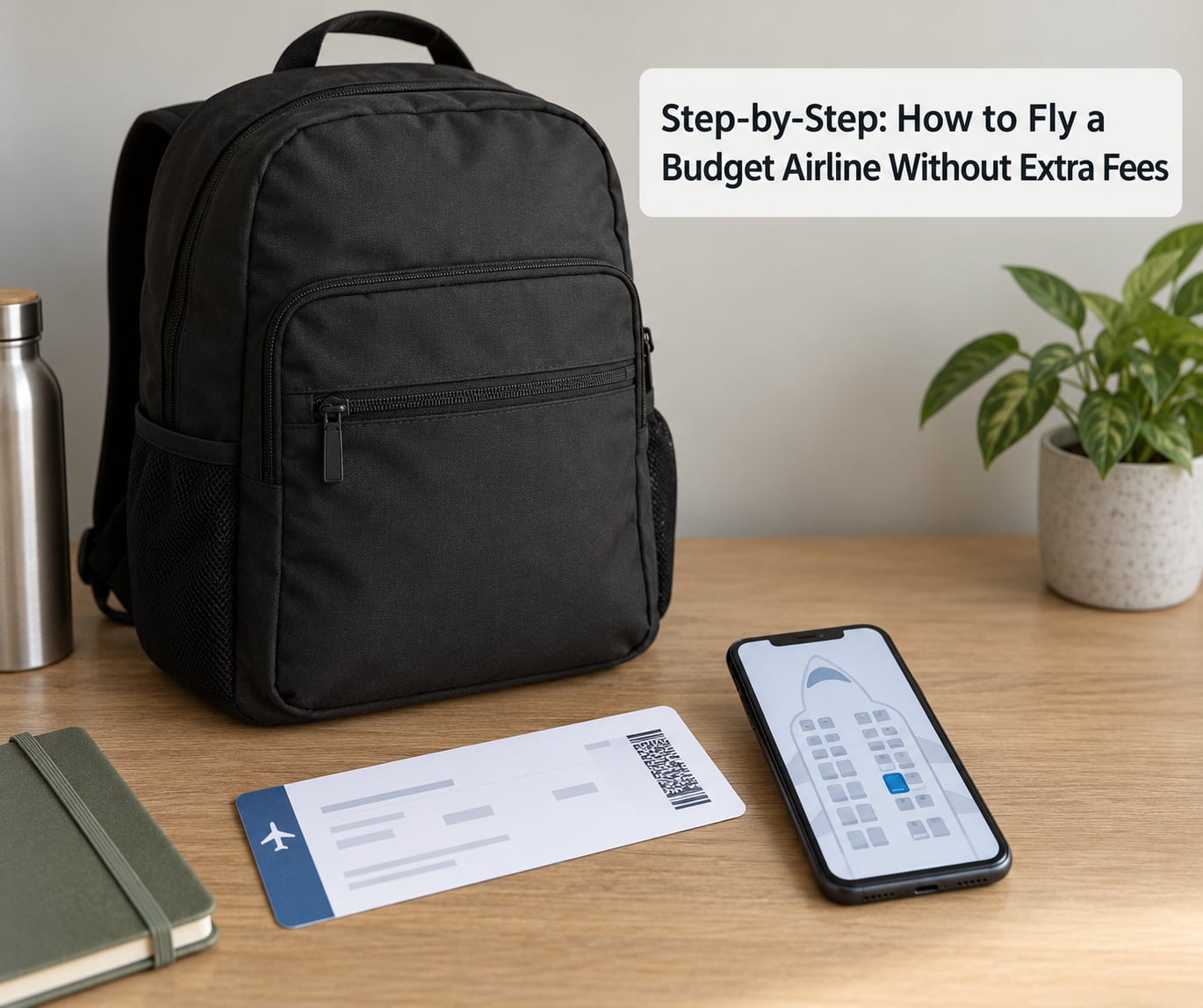
Step 1: Compare the Total Fare Before Booking
The cheapest headline fare is rarely the cheapest trip. Before you commit, add up the eight fee categories against what you will actually do on this specific journey. Most of how to fly a budget airline without extra fees gets decided on this one screen.
- Personal item. Usually free on every fare, including the cheapest one. This is the whole foundation of the strategy.
- Carry-on bag. Normally a paid add-on on an ultra-low-cost fare, and it is priced higher at the airport than online.
- Checked bag. Prepaid online is consistently cheaper than the airport price, which is often a large multiple of it rather than a small premium.
- Seat assignment. A standard seat is free on most carriers. Front rows, extra legroom and preferred rows are not.
- Priority boarding. Sold separately, and worth almost nothing to you if your only bag fits under the seat.
- Food and drink. Buy-on-board pricing, and no free water on most low-cost carriers.
- Changes and cancellations. The lowest fare is usually non-changeable and non-refundable, so this is a risk cost rather than a line item.
- Airport-side charges. Parking, transfers, and boarding pass printing. Not the airline’s fee, but they hit the same budget.
Work out the realistic total: base fare, plus the bags you will genuinely bring, plus a seat only if you need a specific one. Most solo weekend trips land at zero extras, which is why the personal-item route is the cheapest option in practice.
Book on the airline’s own site rather than a comparison site when you can. Third-party sellers add a service fee on top, and some lock seat and bag changes to their own interface, where you pay again to touch your own booking. Set the itinerary aside briefly, search it once by hand, then decide.
Step 2: Check Carry-On and Personal-Item Rules
On almost every budget carrier, a backpack counts as a personal item, and the rule that catches people is not the size, it is the shape. Your bag has to sit under the seat in front of you with the straps stowed, so anything with a frame, rigid structure or bulging sides is the version that gets challenged.
The four things that trigger a gate check most often, based on what travelers report in the budget airline communities:
- Backpack straps left hanging out instead of tucked in.
- A soft duffel packed to the point of bulging, which reads as oversized even when the label fits.
- External side pockets, even a thin one.
- A second bag that the traveler assumed would fit in the same allowance.
Before you leave, empty the bag, lay it flat, measure the base and the height with the straps tucked, and compare that against the published figure. A roller that works as a carry-on on a full-service airline will fail as a personal item almost everywhere else, because the wheels and handle are exactly what the under-seat limit excludes.
Check the allowance against your fare, not just your airline. Spirit, Frontier, Breeze, Avelo and Allegiant all sell at least one fare where the free personal item shrinks, and the same week can have two different rules depending on which fare you picked. Fees also change often, so confirm the numbers on the airline’s own page in October 2026 rather than trusting a listicle.
Step 3: Choose Seats and Fare Options Strategically
You can decline seat selection entirely and get a standard seat free at check-in. The seat is assigned rather than chosen, so you will not get the aisle by the exit row, but you pay nothing for it.
Two things make that trade worth taking. First, a personal-item traveler has no overhead-bin space to fight for, so the boarding group matters much less than it does for someone with a roller. Second, once checked in, most apps let you move yourself to a different free seat yourself, at no cost, if the one you got is a bad one. A middle seat in a row of three is a normal outcome and rarely worth paying to avoid.
What is worth paying for is legroom, and only on a long flight. Extra legroom or a front row on a five-hour sector is a real comfort purchase, and it is one of the few add-ons I would call reasonable. The same money spent on priority boarding for a bag that fits under the seat is not.
On the “three-seat economy” trick that circulates online: the idea is that some carriers let a group of three book an extra seat so the middle one stays empty, leaving a buffer on each side. It does not work on most ultra-low-cost carriers, because your booking reference claims a specific assigned seat and the system will not seat a passenger in a seat that is already assigned to someone else. Treat it as folklore unless your airline’s own seat map shows an unassigned middle seat at booking.
Read the fare rules before clicking. The cheapest fare is normally sold as non-changeable and non-refundable, so a mistake at checkout costs you the whole ticket rather than a change fee.
Step 4: Prepare Documents and Check In Early
Check in online, free, as soon as the airline opens it, usually about 24 hours before departure. That single step avoids a possible boarding pass printing charge, assigns your free seat, and gets you onto the list for free seat changes.
Budget carriers frequently tighten the window between check-in closing and departure compared with the network airlines, and their check-in desks often stop earlier. Arrive with a bigger margin than you would for a full-service airline, and read the closing time in the app rather than assuming it.
Save the boarding pass to your phone wallet and print a paper copy anyway. A phone with a dead battery at the gate is a bad way to start a trip.
For documents, confirm your passport or ID requirements for every country on the itinerary, including transit countries on a connection. The name on your booking has to match the travel document exactly, and budget carriers are noticeably less forgiving of a middle name added or a maiden name swapped than legacy airlines.
If a connection is booked as two separate one-way tickets on the same low-cost carrier, treat it as two unrelated flights. You will re-check in, and a delay on the first leg becomes a missed second flight.
Finally, before you fly, ask yourself one question: does any card in your wallet cover checked bags or seats? If so, pay for those items with that card and claim them afterwards, and a fee that looked expensive is free.
Step 5: Avoid Buying Add-Ons at the Airport
Airport counters and gate desks are where the price of everything is highest and where impulse spending happens. Deciding before you land removes the decision entirely, and that habit is the practical end of how to fly a budget airline without extra fees.
Bring these from home: a refillable bottle filled after security, snacks, a charger, your own headphones, and any documents you need. On board, expect no free water on most budget carriers and buy-on-board pricing for everything else, paid by card only.
At the counter, add bags online rather than at the desk. The desk price for the same bag is markedly higher, which is a fee you avoid rather than reduce. If you have to check a bag anyway, check in online first, then pay through the app.
At the gate, say nothing about the larger seats, the extra bag, the food, or the boarding upgrade unless you actually need it. “No thank you” is a complete sentence and the answer is always the same.
Families have real exemptions here, and they are widely misunderstood. Strollers and car seats are generally checked free, a diaper bag for a lap infant is usually not counted as a second bag, and infant bassinets are free but limited, so request one in advance. It is a per-passenger allowance, not a per-family one, which catches people booking a free seat for a toddler and then finding the bag count doubled.
One situation deserves its own note: if a gate agent says your free bag is too large, you have options rather than just a card terminal. Ask what measurement they are applying and have your own ready, since the published limit is the one that counts. Offer to check it instead of carrying it, which is usually cheaper than a gate-checked fee plus a penalty. And if it goes in the bin, accept it and move on, because arguing at the jet bridge costs you the flight you paid for.
Common Mistakes That Lead to Extra Airline Fees
Every avoidable charge traces back to one of a handful of assumptions. These are the ones I see repeated constantly.
Assuming the fare includes a checked bag. On an ultra-low-cost fare it does not, and the assumption only becomes expensive at the airport. Read the allowance before you pack, not after.
Guessing at personal item size. A bag that is “about right” is how travelers get charged. Measure the packed bag, straps included.
Booking two separate one-way tickets instead of one itinerary. Two one-way fares on the same low-cost carrier are often more expensive than a single round trip, and each is non-changeable on its own.
Waiting until the terminal to add a bag. The online price and the counter price are not close, and the counter price is what the gate agent will quote you.
Expecting to pay cash on board. Several budget carriers take no cash at all, and some only accept a card tap in a specific part of the cabin.
Treating a prepaid seat or bag as a refundable purchase. When a low-cost fare is changed, the add-ons are frequently gone and have to be bought again.
Declining seat selection and then expecting an aisle. Free assignment is free assignment. Take the middle seat and keep the money, or pay deliberately if a specific seat matters.
Paying priority boarding for a personal item. You are buying overhead-bin priority for a bag that will not go in the bin.
Skipping the credit card check. A bag fee waiver you already qualify for is the easiest money saved on this entire list.
Booking through a third-party site for a “discount” that includes a fee. Sometimes the aggregator’s service fee plus restrictive change rules costs more than the airline’s own fare. Compare the total at checkout, not the headline.
Frequently Asked Questions
Can I fly a budget airline without paying extra fees?
Yes, on most trips. A free under-seat personal item, a free standard seat assigned at check-in, online check-in, food and an empty water bottle from home, and no changes to the booking add up to a flight with no add-on charges at all. Checked bags, front-row or extra-legroom seats, priority boarding, and buy-on-board food are the charges that stay on your bill.
Are seats free on budget airlines?
A standard seat is normally free, but it is assigned rather than chosen. You get it when you check in online, and most apps then let you move to a different free seat yourself before check-in closes. Front rows, exit rows and extra legroom are sold as paid upgrades, sometimes at very different rates depending on how far ahead you book.
What is usually included in a budget airline fare?
The flight itself and one personal item that fits under the seat in front of you, on even the cheapest fare. What is not included: a carry-on bag, a checked bag, seat selection, priority boarding, food, drinks, and usually any change or cancellation. Some fares are also sold as non-refundable and non-changeable, which is the single biggest risk in the booking.
How can I avoid checked-bag fees on a budget airline?
You cannot avoid them if you need the bag, so reduce the need. Travel with a personal item only, ship laundry instead, or rent at your destination. If you must check, prepay through the airline’s site or app, which is always cheaper than the counter. Then check whether your credit card already reimburses a checked bag fee before you pay anything.
Are snacks and drinks included on low-cost flights?
Almost never. There is no free water, coffee or meal on a budget carrier, and everything on the buy-on-board menu is marked up. Cash is frequently not accepted, so bring a card and a refillable bottle you can fill after security, plus a snack from home. That one habit usually removes the largest in-flight expense on the whole trip.
Do budget airlines charge for changing a flight?
The lowest fare cannot be changed at all. Fares that allow changes charge a fee per passenger per direction, and often the fare difference on top, so on a long-haul route the change can cost more than a new ticket. If your plans might move, compare the changeable fare total with a separate new booking before you pay, and check whether your travel insurance covers the change fee.
Conclusion: What to Do First
Start with the baggage rules, not the flight search. Read your airline’s personal item dimensions, measure the bag you plan to bring, and if it does not fit under the seat with the straps tucked, the answer is to pack less.
Then expand the fare breakdown at checkout and look at the total, not the base fare. Take the free seat assigned at check-in, check in online, fill your water bottle after security, and plan on no changes.
That is the whole method. The base fare you found is most of what you should pay, and everything else is optional if you travel accordingly.