Low cost carriers keep fares cheap by flying a stripped-down product on a tighter cost base and then selling the removed services back to you as optional extras. One aircraft type, dense seating, quick turnarounds, secondary airports and lean crews cut the operating cost per seat. A high load factor and yield management fill the rest.
The catch sits in the same place as the savings: what looks cheap on the fare screen is only one part of what you pay. Bags, seat choice, boarding priority and food usually live outside that number, and on a short trip with a suitcase they can eat most of the gap you were trying to capture.
Table of Contents
- 1How Do Low Cost Carriers Keep Fares Cheap?
- 2The Low-Cost Business Model
- 3How Low Cost Carriers Keep Fares Cheap
- 4Which Costs Do Airlines Cut?
- 5How Extra Fees Affect the Real Price
- 6Why Aircraft Use and Route Design Matter
- 7How Pricing Changes With Demand
- 8What Travelers Give Up for a Low Base Fare
- 9How to Fly a Low Cost Carrier for Less
- 10Frequently Asked Questions
- 11How do low-cost carriers make money?
- 12Why is budget air so cheap?
- 13What does ancillary mean in airlines?
- 14Why aren’t carry-on bags free anymore?
- 15How do airlines adjust prices day to day?
- 16Are low-cost carriers cheaper once you add bags and seats?
- 17Conclusion: Compare the Total Cost
How Do Low Cost Carriers Keep Fares Cheap?
Low cost carriers keep fares cheap by lowering the cost of flying each seat and selling the removed service separately. They operate a single aircraft type, pack in more seats, run short point-to-point routes out of less expensive airports, turn aircraft around in under half an hour, keep lean crews, and charge separately for bags, seat assignment, boarding priority and food. High load factors and daily price changes fill the remaining seats.
Those levers fall into two buckets:
- Cost cuts: one fleet type, dense cabins, outsourced ground handling, secondary airports, fast turnarounds, no free catering.
- More revenue per passenger: the base fare is set low on purpose, then bags, seats, priority boarding and onboard sales push the total back up.
The Low-Cost Business Model
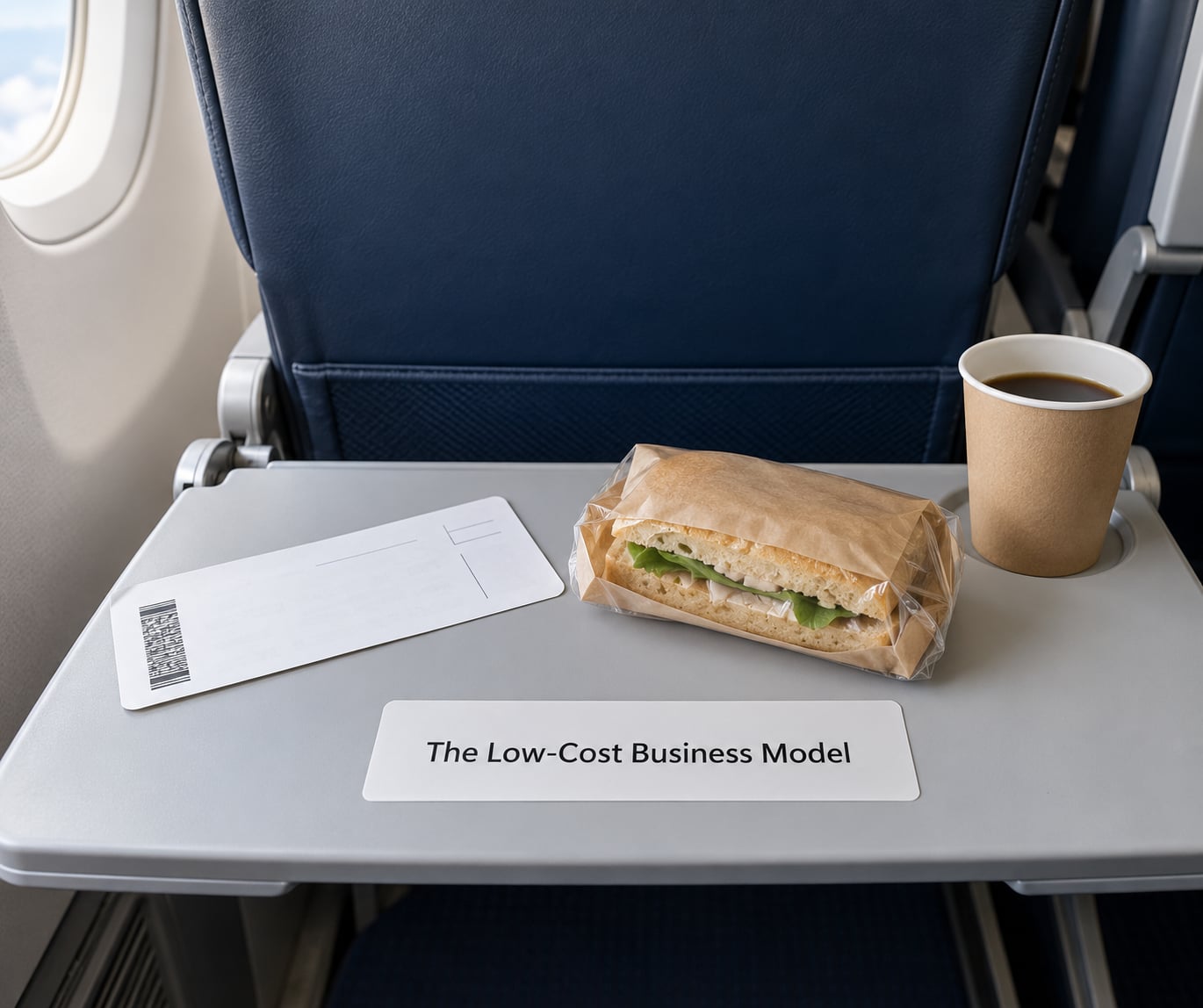
A low cost carrier, usually called an LCC, is an airline that removes nearly everything from the ticket except the flight itself. The seat is basic, there is no meal unless you buy one, no free entertainment, no lounge, and no free checked bag. The ultra-low-cost carrier, the ULCC, pushes that further: thinner margins between the base fare and the extras, tighter seating and a narrower menu of what you are allowed to bring.
The model dates back to airline deregulation in the US in 1978. For decades before that, routes and fares were regulated, so airlines competed on service and comfort rather than price. Once fares were freed, operators could undercut the established airlines on a narrow set of routes and win, and the low cost carrier idea spread to Europe and elsewhere. Ryanair, easyJet and Wizz Air built their networks on it in Europe; Southwest, Spirit, Allegiant and Frontier run it in North America.
The commercial idea in one line: the advertised fare is a hook, and the profit shows up across the whole trip rather than on the ticket.
How Low Cost Carriers Keep Fares Cheap
The mechanism has three moving parts. Airlines cut what it costs to fly a seat, they accept restrictions that make the product easy to run at scale, and they make more money from each passenger than the fare alone would produce.
The restrictions matter more than most travelers expect. One fare class, no free changes on the cheapest ticket, no standby, seats assigned at check-in unless you pay. Each of those rules lowers cost because the airline is not paying for a service it might never use, and because a simple product is easier to price.
Southwest is the useful outlier here. It keeps the low cost structure, with a single aircraft family and high utilization, but sells a fare that includes a free checked bag and free seat assignment. It is the clearest proof that the low base fare is a pricing choice rather than a physical limit on how cheaply a plane can fly.
Which Costs Do Airlines Cut?
Every cost area on an airline’s books gets looked at, and low cost carriers attack them differently from traditional airlines. The table below covers the areas that show up most often in this discussion.
| Cost area | Low cost carrier approach | Traditional airline approach | Who feels the trade-off |
|---|---|---|---|
| Fleet | One aircraft type, sometimes one aircraft family | Several types across the network | Pilots and mechanics trained on fewer variants |
| Cabin | Single class, more seats per row, non-reclining seats, thinner pitch | Multiple classes, wider seats, more pitch | The passenger, on every flight |
| Meals and drink | Bring your own, or buy onboard | Included, at least in most cabins | The passenger, especially on longer sectors |
| Ground handling | Contracted handlers, cleaners, caterers | More in-house staff and premium services | Staff, and the service level passengers see |
| Crewing | Cross-trained crew, lean staffing, fewer spare seats | Tighter rosters and higher staffing on board | Cabin crew, who are often the first to notice |
| Airports | Secondary and regional airports, fewer long taxi times | Major hubs with high fees and long walks | Passengers, through transport and arrival time |
| Distribution | Online and app sales dominate, no complex loyalty system | Wide agency and corporate networks, loyalty programs | Travelers who need flexibility or support |
| Ticket flexibility | One restricted fare family, changes cost money | Several fare families with changeable options | Anyone whose plans might move |
Savings on a spreadsheet always land somewhere real. Sometimes they land on the airline, through a smarter operation. Sometimes they land on the passenger, in comfort, convenience and flexibility. Reading the table honestly means asking which column you are fine with before you book, not after.
How Extra Fees Affect the Real Price
Ancillary revenue is anything an airline sells beyond the flight itself: bags, seat selection, priority boarding, onboard food and drink, extra-legroom seats, lounge access, and fees for changing or cancelling. It is the second engine behind the low base fare, and it is the part travelers forget when comparing options.
Three things make fee stacking confusing:
- Where you pay matters. Most low cost carriers charge less for a bag or a seat when you add it online and more at the airport counter. The same item can cost meaningfully different amounts on the same flight.
- Some charges are effectively unavoidable. A seat has to be assigned somehow, and a bag has to go somewhere. The difference between a fee and a free choice is that you pay either way.
- The cheapest fare is not always the cheapest option. Several fare families can sit under one route, and the very cheapest ticket is often restricted enough to add fees back the moment you change anything.
Baggage has moved fastest. What counted as a free carry-on in many markets is increasingly a paid or size-restricted item, and fee creep has spread from ultra-low-cost carriers to regional and mainline airlines. Once one airline charges for a bag, competitors follow, because the passenger who shops across several airlines will simply switch to the one that still includes it.
Answering the question people actually ask, which is whether a budget ticket ends up cheaper than a full-service one: it depends entirely on the trip. One traveler with a backpack and no seat preference can come out well ahead. A family of four with two suitcases each, wanting to sit together, is often better off comparing the full-service fare after taxes and bags. Travelers on r/travel and r/Flights keep landing on the same conclusion, that the base fare rarely predicts the total.
Why Aircraft Use and Route Design Matter
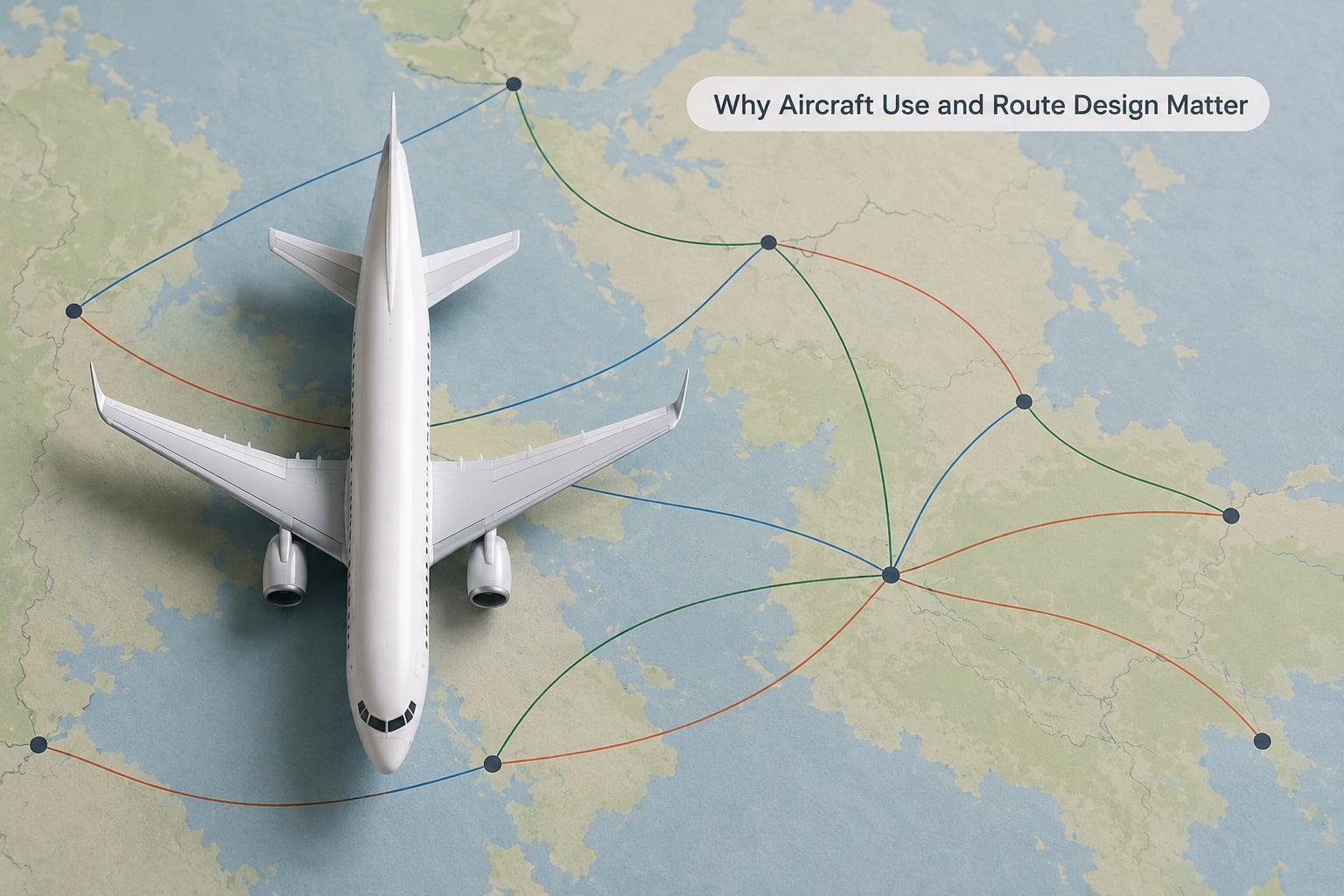
An airplane sitting on the gate costs money without earning any. That single fact explains most of the low cost carrier schedule. A traditional airline will often keep a wide-body on a domestic route for hours while it waits for a connecting bank of passengers. A low cost carrier lands, cleans, refuels, boards and departs, then does it again several times a day.
That behavior shows up in how routes are built too. Short and medium sectors dominate, because they can be flown more often per day. A thin route flown three times a week is cheaper to run when no single flight has to cover a fixed daily cost. The trade-off is exactly what travelers complain about: a cancellation on a twice-weekly route can strand you for days.
Two terms explain the rest. Load factor is the share of seats actually sold. Yield is the average fare paid per passenger on that flight. An airline earns more when load factor and yield rise together, which is why an empty middle section is more worrying to a carrier than a full one at a lower price.
The unit cost side is usually measured per available seat kilometer, CASK, with revenue measured the same way as RASK. You do not need the formulas. The idea is that fixed costs, which cover the aircraft, the crews and the airport fees regardless of passengers aboard, get spread across more people when more seats are filled and more flights happen each day.
Here is the relationship in plain numbers on a single-aisle aircraft with about 180 seats:
| Load factor | Passengers per departure | Effect on cost per passenger |
|---|---|---|
| 70% | 126 | Fixed costs spread over fewer people |
| 80% | 144 | Roughly the break-even the model is built around |
| 90% | 162 | Per-passenger cost falls noticeably |
| 95% | 171 | Little room left, so fares on that flight climb |
Dense seating is the same arithmetic in another form. Add rows to a narrow-body and the crew, the fuel and the landing fee are spread across more paying passengers on the same flight. The cost per available seat kilometer drops, and so does the fare the airline can afford to advertise. The passenger who feels it is the one with a 30-inch pitch and a seat that does not recline.
Regional airports complete the picture. Landing fees, gate rents and passenger charges are often lower away from major hubs, and the taxi time saved adds flights to the day. Travellers absorb it with a bus or train from a smaller airport to the city, and a longer drive home at the end of the night.
How Pricing Changes With Demand
The base fare is not a fixed shelf price. It moves several times a day, and knowing why makes the search results much easier to read.
- Remaining seats. Airlines price against expected demand, so as a flight fills, the cheapest fare disappears rather than being repriced downward.
- How far ahead you book. Early bookings carry the widest spread of prices. The final week is where fares often spike.
- When you fly. Friday and Sunday evenings, holiday weeks and school breaks run at a premium, while midweek and off-season flights can be the cheapest on the board.
- How you book. Direct with the airline is often cheaper than a third-party site, though a metasearch tool is useful for seeing the whole market.
- Competition on the route. When two or three low cost carriers fly the same city pair, fares drop and stay low. On a thin route with one operator, you pay whatever that operator asks.
Demand for air travel has grown, capacity has not always grown with it, and fuel and labour costs have moved in the same direction. Since deregulation, the gap between the cheapest fare and the old regulated-era fare has narrowed considerably. A low cost carrier still runs a cheaper operation than a traditional airline; what has changed is how much of that advantage reaches the ticket price on a given day.
That is the honest version of why budget air no longer feels as cheap as it once did. The model is intact. The headroom has been competed away.
What Travelers Give Up for a Low Base Fare
None of this makes the model a bad deal. It makes it a specific deal, and the trade-offs are predictable once you can see them.
What you give up:
- Included services: food, drinks, entertainment and, on most carriers outside North America, a checked bag.
- Flexibility: the cheapest fare usually cannot be changed or cancelled without a fee.
- Seat comfort: tighter pitch, narrower seats, and no recline on many aircraft.
- Convenience: secondary airports, longer transfers, and boarding groups that dictate when you get on.
- Frequency on thin routes, which is where cancellation pain shows up.
What you get: a genuinely lower cost on the right trip, more departures on busy routes, and coverage of city pairs no traditional airline serves.
How to Fly a Low Cost Carrier for Less
A few habits go a long way, and most of them come straight from the model itself.
- Travel light or not at all. A backpack that fits the published carry-on limits is the single biggest saving available.
- Add bags and seats online, where the same item usually costs less than at the counter.
- Skip paid seat selection unless a specific seat matters to you, and check in online early for a free random assignment.
- Board in the free group, carry only what fits under the seat, and expect a scramble for overhead space.
- Fly midweek, book early, and compare the whole basket of fees before choosing between two airlines.
- Set fare alerts, because on a low cost route the price of the same flight changes often in both directions.
Frequently Asked Questions
How do low-cost carriers make money?
They sell a low base fare and recover the removed service through extras. Bags, seat assignment, priority boarding, food and onboard sales are the main ones, alongside card payments and larger bookings. A simple aircraft, dense cabin, fast turnarounds and secondary airports keep the operating cost per seat low, and high load factors spread fixed costs across more passengers.
Why is budget air so cheap?
Because the product itself costs less to run. One aircraft type cuts training, spares and maintenance costs, dense seating spreads fuel and crew over more passengers, quick turnarounds squeeze more flights out of an expensive asset, and smaller airports carry lower fees. No free catering or entertainment removes a whole cost line. The saving shows up in the advertised fare.
What does ancillary mean in airlines?
Ancillary means everything an airline sells beyond the flight itself: checked and carry-on bags, seat selection, priority boarding, meals and drinks, extra legroom, lounge access, and change or cancellation fees. For low cost carriers these extras are a core revenue stream, not a rounding error, which is why the headline fare and the total trip cost can diverge so sharply.
Why aren’t carry-on bags free anymore?
Weight and volume cost an airline more than they look like they do. Bags in the hold add weight, and every extra kilogram raises fuel burn on every flight the aircraft operates. Some carriers also use bag fees to steer passengers toward a larger cabin bag they can charge for at the gate. Once one airline introduces the charge, rivals follow quickly to keep the booking.
How do airlines adjust prices day to day?
Airlines use yield management, which reprices the same flight many times a day based on how many seats remain and how fast they are selling. The system forecasts demand, opens cheap buckets early, then closes them as a flight fills. Booking window, day of week, season and route competition all feed into it, so the price of one flight can change several times before you buy.
Are low-cost carriers cheaper once you add bags and seats?
Often, yes, but not always. A solo traveler with a backpack and no seat preference usually pays less end to end. Two people with checked bags who want to sit together can easily reach the price of a full-service fare once seats and bags are added. Compare the complete trip cost for your specific party, including taxes, rather than the lowest fare on the screen.
Conclusion: Compare the Total Cost
Low fares come from a cheaper operation, a thinner product and revenue earned outside the ticket. Every one of those three is a deliberate business decision, and together they explain the price difference you see on a search result.
So decide in this order: check the total itinerary price for your actual party and bags, decide which trade-offs you can live with, then pick the airline. Doing the bag math before you pay is the part that turns a cheap fare into a cheap trip.