The best way to keep kids entertained on a plane without screens is rotation, not volume. Pack three to five quiet, self-contained activities in separate pouches, let your child pick one, and swap to the next every 10 to 15 minutes. It takes about 20 minutes to set up before you leave home.
Screens fail in the air. Batteries drain faster at altitude, a tablet can slide into a seat crack, and the seat-back entertainment is often aimed at an adult sitting still for six hours. Families on r/travelwithkids describe the same moment over and over: a flat battery halfway across the Atlantic and two tired kids with nothing between them and a meltdown.
Screen-free activities for kids on the plane are simply non-digital games, crafts, and toys that fit on a tray table or in a lap. Nothing fancy. The reason they work is not the toy, it is the sequence you set up around it.
This guide covers four age bands from toddlers to tweens, the flights where screens feel hardest, and what to do when a child has already decided the flight is boring.
Table of Contents
- 1What You Need
- 2The core kit
- 3What to leave at home
- 4How many activities to bring
- 5Step-by-Step: How to Keep Kids Entertained on a Plane Without Screens
- 6Set Up a Simple Activity Kit Before the Trip
- 7Choose Games That Work in a Small Space
- 8Turn the Flight Into a Small Adventure
- 9Use Crafts, Books, and Audio Without Screens
- 10Build a Routine for Takeoff and Landing
- 11Keep the Middle of the Flight Flexible
- 12Handle Boredom, Tantrums, and Delays
- 13What To Bring For Each Age
- 14Common Mistakes
- 15Frequently Asked Questions
- 16How do you keep kids busy on an airplane?
- 17What is the hardest age to fly with kids?
- 18How do you entertain a 10 year old on a plane without screens?
- 19What are some fun things for a 5-year-old to do on a plane?
- 20How do you keep a child quiet on a flight without upsetting other passengers?
- 21What do you do if the tablet battery dies mid-flight with kids?
- 22Conclusion
What You Need
A decent screen-free setup costs very little and most of it you already own at home. What matters is that each item is self-contained: your child should be able to open it and start without you explaining the rules.
The core kit
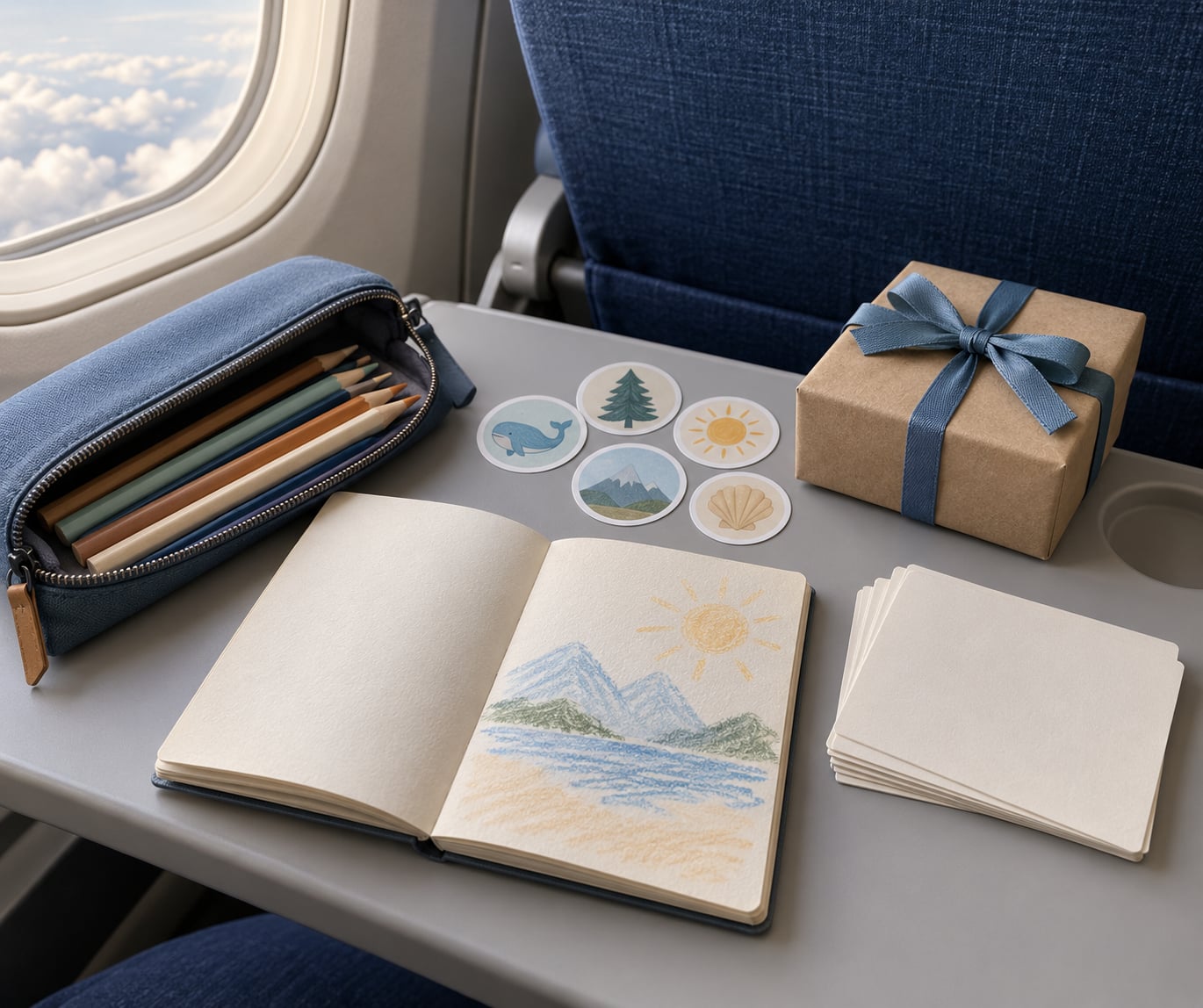
- Colored pencils, not pens. They cannot stain the tray table or leak into clothes if you land on them. A short tie keeps them from rolling under the seat.
- A small sketchbook or travel notebook. Loose sheets get lost in the seat cracks. A reusable drawing board with a dry surface wipes clean and lasts the whole trip.
- A sticker book or a sheet of reusable vinyl stickers. Stickers are the most recommended item in parent forums for one reason: nothing to lose, no mess, and they quietly absorb attention for ages.
- A deck of plain cards for a game of their own invention. Blank cards are better than a bought deck because nothing is too precious to lose.
- Pipe cleaners and a few chunky crayons for threading, shapes and tiny sculptures. Flat in a bag, no small parts.
- Two or three favorite books from home, not new ones. Familiar stories settle nervous children faster than anything unfamiliar.
- One wrap or small pouch left unopened. This is your reserve for turbulence or the last hour. Wrapping two or three small items and revealing them one at a time is a trick that recurs across almost every parent thread on flying.
- A quiet fidget item. A soft, washable, non-rolling sensory toy beats anything hard. Balls and marbles find the aisle.
What to leave at home
Some toys actively cause problems in a cabin. Magnetic tiles are fine until they vanish into the seat mechanism, and loose small pieces are usually gone for good by the end of the flight. Dry-erase and permanent markers permanently mark the hard plastic tray table, water pens burst in a tote bag, and anything with glitter ends up in the seat fabric for the rest of the day. Noisy dice, clicky pop-it style toys and battery sound effects travel a cabin row by row.
Skip loose LEGO too, unless you build the box as a travel case the way many families now do, so pieces stay put during the bag’s whole life.
How many activities to bring
Set expectations honestly. A typical preschooler holds one activity for roughly 10 to 15 minutes; a three-year-old may last five. For a flight under two hours, two activities and a snack supply is plenty. For four to six hours, plan three or four plus the wrapped reserve. For a twelve-hour overnight, pack for the flight plus one hour more than you think, because delays belong to the trip.
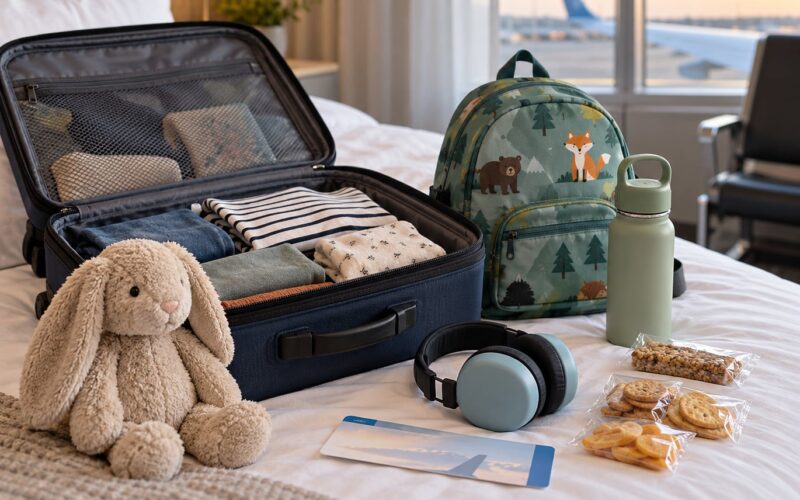
Everything should fit in one personal item, zipped and in the child’s reach. Parents report that a single bag a child can open independently cuts down on how much they have to intervene, which is the whole point.
Step-by-Step: How to Keep Kids Entertained on a Plane Without Screens
Set Up a Simple Activity Kit Before the Trip
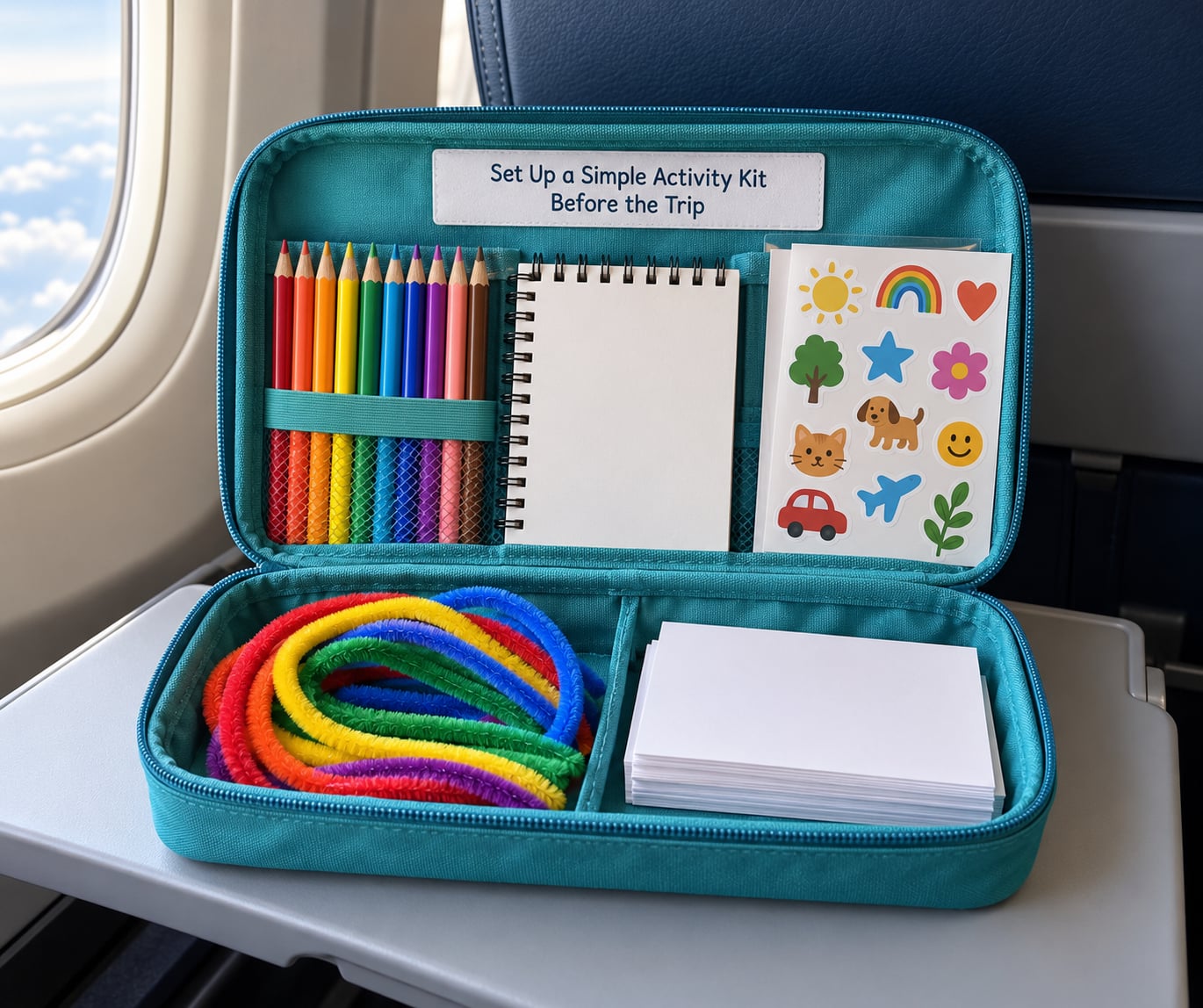
Everything happens before you reach the airport. Decanting the kit into separate small pouches is the single change that makes the biggest difference: one pouch per activity, labeled only by the child, opened one at a time.
Then explain the flight in concrete terms a child can hold: the seat belt goes on, the plane will climb, at some point it will feel bumpy and that is normal, we will go to the toilet before anything happens, and then we land and get to the other place. Name the sequence rather than the duration, because “five hours” means nothing to a four-year-old.
Rehearse the tray-table game once at home. Sit at a real table, put out only the tray space you will have, and run one activity start to finish. Fifteen minutes at the kitchen table prevents a lot of fuss in row 22.
Choose Games That Work in a Small Space
Good travel games use vertical space and voices, not floor space. Start with I Spy by colour through the window: find three red things, then three round things, then one thing that looks like a wing. It works because the cabin supplies endless material.
Add a guessing round where you describe something with two words, and a drawing round where everyone sketches the same object and the others guess it. Story chains work too: one person starts “the plane opened its door and found a dragon”, and each person adds one sentence and passes it on.
Snack counting turns food your child was going to eat anyway into a game: sort the crackers into groups, build towers, or invent prices and run a little shop at the tray table. For older kids, twenty questions, categories chosen from the window view, and clapping rhythm games that pass down the row all hold attention without a single prop.
Turn the Flight Into a Small Adventure
Give the trip a shape. The cabin crew become flight helpers, the aisle becomes a road, and the window becomes a television. Set a simple goal that resolves in flight: find three different countries’ flag colours in the clouds, spot the aircraft with the most engines, keep a tally of how many pilots say hello at the galley.
Attach progress to the parts of the trip the child can already recognise. Takeoff, meal service, the rainy patch where the plane shakes, and landing become chapters. A child who knows what comes next can wait through the boring stretch, because the good part is on the other side of it.
Keep the last chapter, the goodnight stretch before landing, genuinely short. Sleep is the goal there, not entertainment.
Use Crafts, Books, and Audio Without Screens
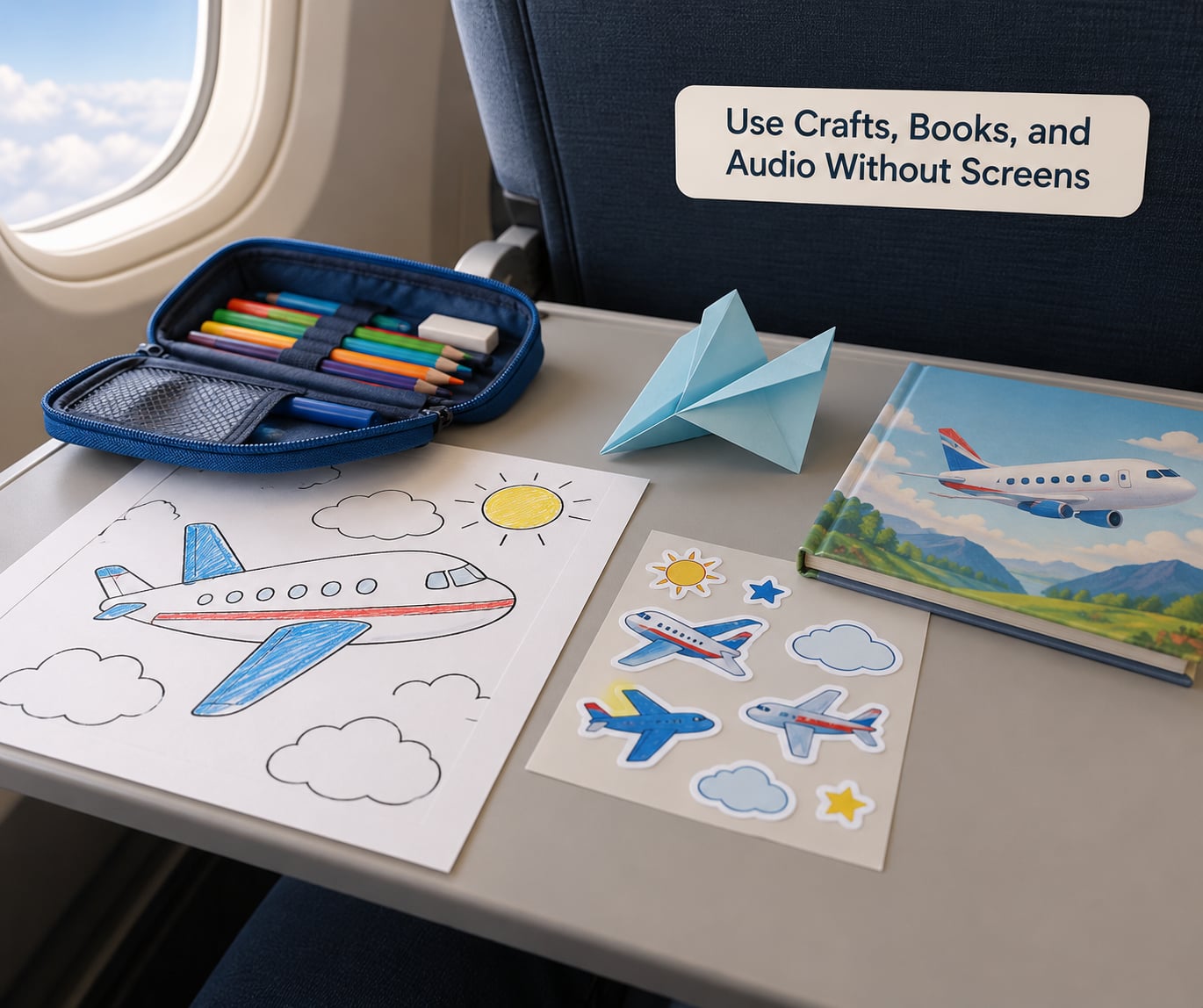
Crafts keep going after the novelty fades because they leave evidence. A colored-in page, a pipe-cleaner creature, a sticker-covered sheet: children keep returning to see what they made. Origami from a single sheet of paper costs nothing, needs no supplies beyond a crease, and the creased triangles are easy to lay flat in a book.
Comic creation works for the six-to-twelve band. Four empty panels, one prompt each, and the story carries over two flights. Make a comic about the flight itself and it doubles as the keepsake of the trip.
Reading out loud on the tray table suits younger children who will not read alone. Older children do better with a real book than with toy-based play, because at eight they find a picture-book activity patronising. Audio on a cheap offline player or a phone in airplane mode counts as screen-free in practice: one long story, a podcast, or a language track is a quiet fallback that costs you no attention.
Build a Routine for Takeoff and Landing
Transitions cause more trouble than boredom does. Agree on the order before the doors close: toilet first, then seatbelt, then one quiet tray-table activity while the safety briefing runs.
Handle ears before they hurt, not after. Swallowing, chewing, sipping water or having a snack during the climb and the descent equalises pressure more reliably than anything a child will do when the pain starts. A short drink before landing also helps the landing itself go smoothly.
During takeoff and landing, hand out one pouch only. These are the phases where a calm child watching the wing is better than a busy one holding a marker.
Keep the Middle of the Flight Flexible
The cruise hours are the easiest to plan badly, because nothing is happening. Children need to alternate between independent play, attention from you, movement, and food, roughly every twenty minutes, and they need it from adults as much as from toys.
Break up the seat without leaving it. Stand in the aisle for two minutes, stretch at the back of the cabin where there is a bit of floor, run a lap-eating contest with crackers. Movement resets attention better than a new toy does.
Then go back to independent play. A child who is entertained by an adult for a whole flight learns that the interesting thing is you. Use the flight to read to them, draw with them, or play one long game, not thirty minutes of hovering.
Handle Boredom, Tantrums, and Delays
Boredom is not an emergency. Offer two choices rather than everything you packed: stickers or the drawing board, book or cards. A choice restores their sense of control in about a second.
Name what is happening before you fix it. “You are bored and the flight is still long” is more effective than “don’t be bored”, because it does not argue with the feeling. Then shorten the activity rather than lengthening it. A three-minute version of the same game feels possible; a twenty-minute version does not.
If a meltdown starts, drop the plan. Go to the toilet, take a lap walk at the back of the cabin, or offer water and a snack, then rebuild the sequence from there. Holding to the original order while a child cries helps nobody.
For turbulence, keep the plan predictable rather than clever: seated, tray table down, drawing, snack, the window. If it is delay, not fear, the wrapped reserve is the strongest card in the bag. When there is a flight delay with kids and no screens, you cannot buy your way out of the wait, so plan the wait: walk the terminals once, find the play space, then settle with a quiet kit.
Flying solo with one child changes the arithmetic. Board early when the airline allows it, put the child in the aisle seat beside you, prep the first pouch in the bathroom before boarding, and hand over one pouch at a time rather than the whole bag. You cannot manage a meltdown and a bathroom trip at once, so make the toilet trip the thing you decide early and plan around.
What To Bring For Each Age
Toddlers from one to two years need simple sensory play: stickers, a soft book, a reusable drawing board, and mostly your attention. They will not entertain themselves for long, and that is the normal shape of the age.
Preschoolers from three to five do well with anything that ends in a result: sticker scenes, lacing cards, threading pipe cleaners, simple puzzles, and snack sorting.
Children from six to eight enjoy games with rules, hiding objects, drawing games, comic pages and story chains. Their attention span has grown to around 15 to 20 minutes, so the swap interval can lengthen.
Tweens from nine to twelve resist anything that looks babyish. Give them a novel, an activity workbook, a pack of playing cards, a journal for the trip, window photography notes, or a real task like planning the next three days of the holiday.
Common Mistakes
Packing everything and handing it all over. Novelty is spent in the first twenty minutes, and then you have nothing left. Fix: one pouch per activity, opened one at a time, one reserve kept sealed.
Choosing one activity for a six-hour flight. No single game lasts that long at any age. Fix: assume a 10 to 15 minute life per item and pack accordingly, which for a long flight means a separate pouch roughly every hour of cruise time.
Trying to entertain nonstop. Constant activity produces a child who cannot settle and a parent who has nothing left for landing. Fix: alternate play, talk, movement, food and quiet, and let the quiet parts stay quiet.
Ignoring transitions. Takeoff, landing and the first ten minutes after boarding are where the distress lands. Fix: toilet first, then seatbelt, then one quiet activity, every single time, so the order itself becomes reassuring.
Buying toddler toys for a ten-year-old. The child feels humoured rather than engaged, and it fails badly. Fix: match the kit to the age band, and for older children lean on books, card games and small real projects.
Leaving the hardest stretch unplanned. The last hour, when everyone is tired and cramped, breaks most well-behaved flights. Fix: keep the wrapped surprise back until then, and plan the landing to be sleepy rather than busy.
One more that catches people: treating the activity kit as the whole job. Water, snacks, a toilet plan, a nap plan and the ear-pressure routine do more for the mood than any toy in the bag.
Frequently Asked Questions
How do you keep kids busy on an airplane?
Keep them busy by rotating through three to five self-contained activities rather than stacking everything in front of them. Pack each activity in its own pouch, let your child choose the order, and swap to the next pouch every 10 to 15 minutes. Anchor the sequence to the flight itself: one quiet activity during boarding, a toy for the takeoff climb, rotating crafts and games through the cruise hours, and a wrapped surprise kept back for the last stretch.
What is the hardest age to fly with kids?
The hardest band is roughly 18 months to 3 years old. At that age a child is walking, exploring and developing a strong opinion, but cannot hold still for longer than a few minutes, and they often cannot sit independently in a seat. A two-year-old on a six-hour flight is a genuinely hard combination. By four or five most children manage an activity independently, and above eight a book or a card game holds them for a whole hour.
How do you entertain a 10 year old on a plane without screens?
Ten-year-olds want something that feels like a project, not a toy. Pack a novel, an activity workbook, a pack of playing cards for invented games, and a journal for writing the trip as a story. Window-based activities work well too: photography notes, a country-identification challenge, or a drawing challenge with four prompts. Give them a small real task such as planning the next three days of the holiday and they will stay absorbed far longer than with anything meant for a preschooler.
What are some fun things for a 5-year-old to do on a plane?
At five a child can finish something small, so favour activities with a visible result. Sticker scenes, lacing and threading cards, simple puzzles, pipe-cleaner shapes and colouring pages all work. Add tray-table games that produce a finished object: draw a picture and have a family member guess it, or build a cracker tower together. Snack sorting and counting keeps them busy for free using food they were going to eat anyway.
How do you keep a child quiet on a flight without upsetting other passengers?
Choose quiet activities and set the volume early. Drawing, stickers, reading and card games make no noise; skip rolling toys, noisy dice and anything with a click or a chime. Model a low voice in the first half hour and it usually carries for the rest of the flight. During a meltdown, move to the back of the cabin where there is more floor space, or take the child to the toilet, rather than trying to talk them down in the row.
What do you do if the tablet battery dies mid-flight with kids?
Stop treating it as a crisis and start treating it as the plan. If you packed a kit, this is the moment it was for. Offer two choices from separate pouches, name the feeling out loud, and keep the same sequence you used at boarding: something quiet and predictable. A short activity that finishes beats a long one that stalls. If the flight is long enough that the pouches run out, use the cabin itself: window I Spy, snack sorting, or a walk at the back of the cabin.
Conclusion
Start tonight, not the morning of the flight. Decant your child’s usual activities into separate pouches, add one thing you will wrap, and rehearse the tray-table order once at the kitchen table.
Two or three familiar activities plus one unopened surprise covers most flights, and you always have the cabin itself as a game: window I Spy, snack sorting, a story chain. Knowing how to keep kids entertained on a plane without screens is mostly knowing your child’s attention span and planning the swap before they ask for it.