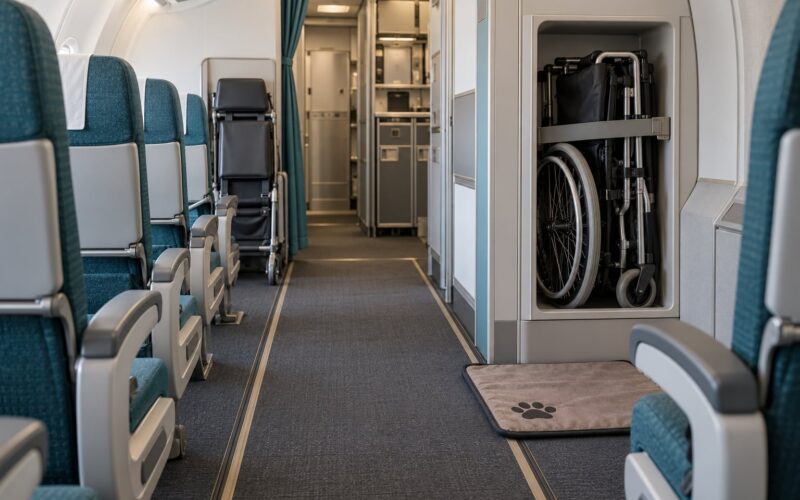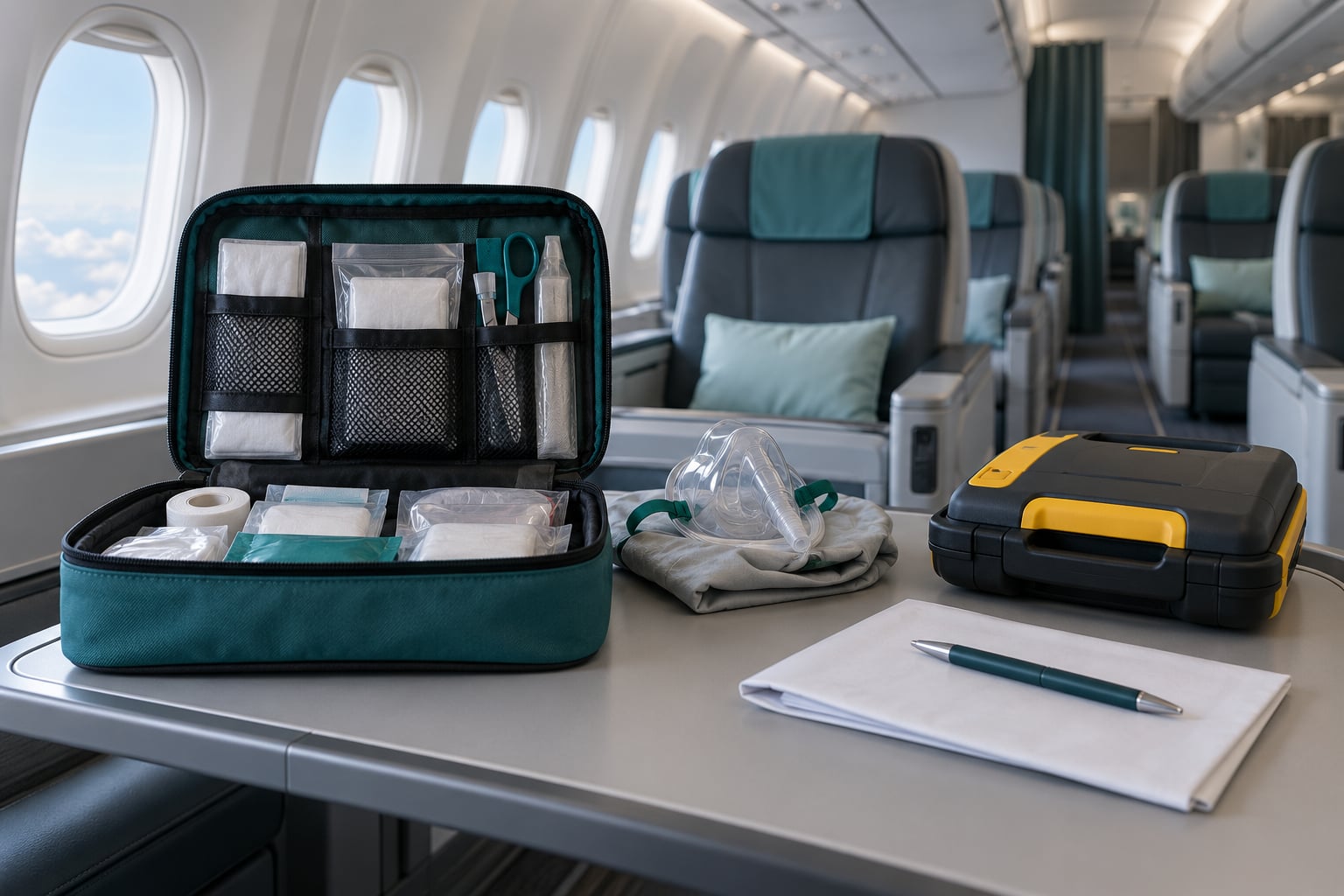
If you want to know how to handle a medical emergency on a plane, the first and most important step is to tell a flight attendant straight away, describe what you are seeing in plain words, and then follow their instructions. Cabin crew are trained and authorised to give first aid, start CPR and use the onboard defibrillator. They will contact a ground medical team by radio, and the captain decides whether to land early.
Most of these events are not the cardiac emergency people picture. A widely cited 2013 study in the New England Journal of Medicine put the rate at roughly one medical emergency per 604 commercial flights, with about 7.3% of them ending in a diversion, and the most common presentations were fainting, chest discomfort, breathing difficulty, seizures and stomach pain. Knowing the sequence in advance is what separates a calm cabin from a bad one, and it takes about ten seconds to learn. This guide was last reviewed in 2026.
Table of Contents
- 1What You Need to Handle a Medical Emergency on a Plane
- 2Step-by-Step: How to Handle a Medical Emergency on a Plane
- 31. Assess the situation and alert the cabin crew immediately
- 42. Give the crew clear information without diagnosing
- 53. Follow the airline and crew instructions
- 64. Help communicate with medical support on the ground
- 75. Keep appropriate records and preserve important details
- 86. Follow the landing and post-flight plan
- 9Common Mistakes
- 10Frequently Asked Questions
- 11What happens if someone has a medical emergency on a plane?
- 12Are doctors legally obligated to help on a plane?
- 13What medical conditions stop you from flying?
- 14Does the airline pay for an in-flight medical emergency?
- 15How can I prepare for a medical issue during a flight?
- 16Conclusion
What You Need to Handle a Medical Emergency on a Plane
Most of what you need is already in your cabin bag. The point is to make it reachable rather than buried under a laptop sleeve when somebody needs it in the next minute.
- Your medication in its original labelled packaging, in your carry-on, plus a written list of doses and timing. Cabin pressure does not meaningfully break most tablets, but gel caps, insulin cold chains and nitroglycerin in a hot hold are worth thinking about before you fly.
- A one-page medical summary: your conditions, allergies, current medications and the name and phone number of your doctor. One side of paper, written once and photographed on your phone.
- Insurance and travel-assistance documents, including the 24-hour assistance number. It is the first thing a family member or hospital will ask for.
- A charged phone and a power bank. Crew will often need to reach the ill passenger’s family, or contact a doctor, and cabin connectivity can be patchy.
- A pen and a quiet corner of your awareness of where the nearest call button, exit row and first aid kit are on this particular aircraft.
Onboard equipment is not uniform. US rules require an emergency medical kit on aircraft with more than 30 passenger seats and a defibrillator on larger aircraft, and rules have been amended in recent years, while other countries set their own requirements. Cabin crew procedures also differ by carrier. Treat anything you read about kit contents as a general guide, not a promise about what will be in the cupboard on your flight.
Step-by-Step: How to Handle a Medical Emergency on a Plane
1. Assess the situation and alert the cabin crew immediately
Look for the signs that mean call someone now rather than watch for a while: no response or confusion, chest pain or pressure, difficulty breathing, a seizure lasting more than about five minutes or repeated seizures, severe bleeding, or a swallowed object with no cough. For anything severe, skip the assessment and press the call button or wave the nearest flight attendant over.
Do not travel up the aisle to find a crew member. The person nearest you is the fastest route. Saying so directly, for example, press the call button or say “I need a flight attendant now, in this row,” carries more weight than describing symptoms quietly to your neighbour.
2. Give the crew clear information without diagnosing
Report what you observed, when it started, and what the person says about their own condition. Then add what you know: age, known conditions, medications, allergies, whether they ate or drank anything unusual, and whether this has happened before.
Describe, do not diagnose. Saying “he is grey, sweaty and holding his chest, and he says the pain started twenty minutes ago” is gold. Saying “he is having a heart attack” is a guess that can derail the crew’s questions. Likewise, leave medication decisions to the crew and any medical volunteer working with them.
3. Follow the airline and crew instructions
Once crew take charge, your job shrinks to support. Move to a seat if you are the passenger being assessed, unless the crew asks you to stay put. Make space in the row, open the window shade if requested, and keep the aisle clear so the crew can work and so nobody falls during turbulence.
Hand over the medical summary, the medication list and any relevant documents when asked. If you have first-aid training, say so plainly once, then do what the crew asks, which usually means bringing the kit, working the defibrillator, or timing chest compressions. Do not argue with the crew about what should happen. Chain of command is not bureaucracy for its own sake.
4. Help communicate with medical support on the ground
Crew will radio ahead to a medical doctor on the ground, who advises the team on board and authorises certain medications. You can help by relaying facts accurately: what the person was doing just before it started, what was observed, and what history you have. Being the person who stays calm and answers one clear question at a time is genuinely useful.
Stay honest about the limits. Do not tell the crew or the ground doctor what you think the onboard team is capable of, and do not repeat a rumour that there is no doctor on board. If a medical volunteer comes forward, follow the crew’s direction on where to work.
5. Keep appropriate records and preserve important details
After the immediate response settles, write down the time the crew was alerted, what instructions you were given, which medications or procedures were used, what was relayed to the flight deck, and the airport where the aircraft eventually landed. Note the names of the crew and medical volunteers if you have them.
Photograph the medical summary you handed over, keep boarding passes and receipts, and ask for a copy of the airline’s medical incident report. Details fade fast in a turbulence. Never delay assistance to take notes, though. Jot things down from a companion while the crew keeps working.
6. Follow the landing and post-flight plan
If the flight continues, stay nearby until the crew releases you, and offer to pass along the records you kept. Watch the person for the rest of the flight if you know them; symptoms that improve once, when the person finally sits down and relaxes, can return.
If the aircraft diverts, expect paramedics to meet it on the tarmac. Go with the patient only if you are a relative, a companion or the crew asks you to. Hand the crew’s notes and your records to the paramedic team, and give a short account of the sequence rather than your interpretation. Afterwards, ask the airline about rebooking, and follow up with a qualified clinician. If warning signs return at any point after landing, get medical care rather than waiting it out.
Common Mistakes
Most problems in a real emergency come from bystanders, not from the crew. These are the ones that come up again and again.
- Waiting to be sure. You do not need to confirm it is serious before calling. A crew member can assess in seconds; you cannot. Safer response: alert the nearest flight attendant the moment something feels wrong.
- Diagnosing out loud. Announcing a heart attack, stroke or panic attack sets a frame the crew has to correct. Safer response: describe signs and timings only.
- Moving the person. If a fall or a head injury may be involved, moving them can make things far worse. Safer response: leave them in place unless there is immediate danger or the crew tells you otherwise.
- Offering food, drink or a pill from your own bag. Someone who is drowsy, seizing or choking cannot safely swallow. Safer response: hand the medication to the crew and let the decision stay with them.
- Crowding or filming. A ring of passengers with phones up makes the cabin darker, louder and harder to work in. Safer response: step back, put phones away, keep the aisle clear.
- Arguing with the crew. Safer response: ask for the reason behind a decision once, then follow it. Debating mid-crisis wastes minutes.
- Forgetting follow-up. A diversion or a cleared episode feels like the end. Safer response: keep the records and see a clinician afterwards.
Prevention is the better emergency plan. Keep your medication to hand and timed for a long flight, drink water rather than alcohol, walk the aisle on long-haul legs, and ask your doctor before travelling if you have a recent surgery, an unstable heart condition, severe anaemia, poor control of epilepsy, or an active infection. Your airline can also tell you whether it needs a medical clearance form for your condition. This is educational information, not medical advice, so any personal decision belongs with your doctor or pharmacist.
Frequently Asked Questions
What happens if someone has a medical emergency on a plane?
A flight attendant becomes the first responder, giving first aid, oxygen and, if needed, CPR and defibrillator use. The crew radio a medical doctor on the ground for advice and medication authorisation, the captain decides whether to divert, and paramedics meet the aircraft if it lands early. Most events are minor and resolve on board.
Are doctors legally obligated to help on a plane?
In most jurisdictions, no. There is generally no legal duty to provide care, but the Aviation Medical Assistance Act of 1998 protects a medical volunteer in the United States from liability for assistance given in good faith, and most airlines carry their own Good Samaritan agreements. Doctors on medical forums describe the pressure to step forward as ethical and professional rather than legal.
What medical conditions stop you from flying?
Airlines usually defer to a doctor rather than impose their own list, but recent surgery, an unstable heart condition or recent heart attack, poorly controlled seizures, severe anaemia, active transmissible infection and certain recent diving or decompression illness usually warrant advice before flying. Long-haul trips also need a plan for oxygen or medication timing. Ask your clinician, and check whether your airline requires a clearance letter.
Does the airline pay for an in-flight medical emergency?
It varies. Airlines commonly cover the immediate care and the cost of a diversion they decide on, and many will rebook and provide meals or a hotel, while the passenger may still see charges for ambulance transport, prescriptions and follow-up visits. Travel insurance that specifically includes medical and evacuation cover is what usually fills the gap. Keep every receipt and call your insurer early.
How can I prepare for a medical issue during a flight?
Carry medication in original packaging in your cabin bag with a written dose schedule, keep a one-page medical summary and your insurance assistance number in the same place, and tell a travelling companion what you take and for what. Drink water, pace yourself, and move around on long flights. If you have a chronic condition, ask your doctor before booking and check your airline’s medical clearance rules.
Conclusion
To handle a medical emergency on a plane, alert the cabin crew immediately, give clear facts instead of a diagnosis, and follow the crew’s instructions without arguing. Keep the records of what happened, and if the aircraft lands early, hand them to the paramedics and follow up with a clinician afterwards. That sequence is short enough to memorise, and it is the whole job.
Keep your own medication, medical summary and insurer number in one reachable pocket of your cabin bag, and check your airline’s medical clearance rules before you book. Reviewed for 2026.