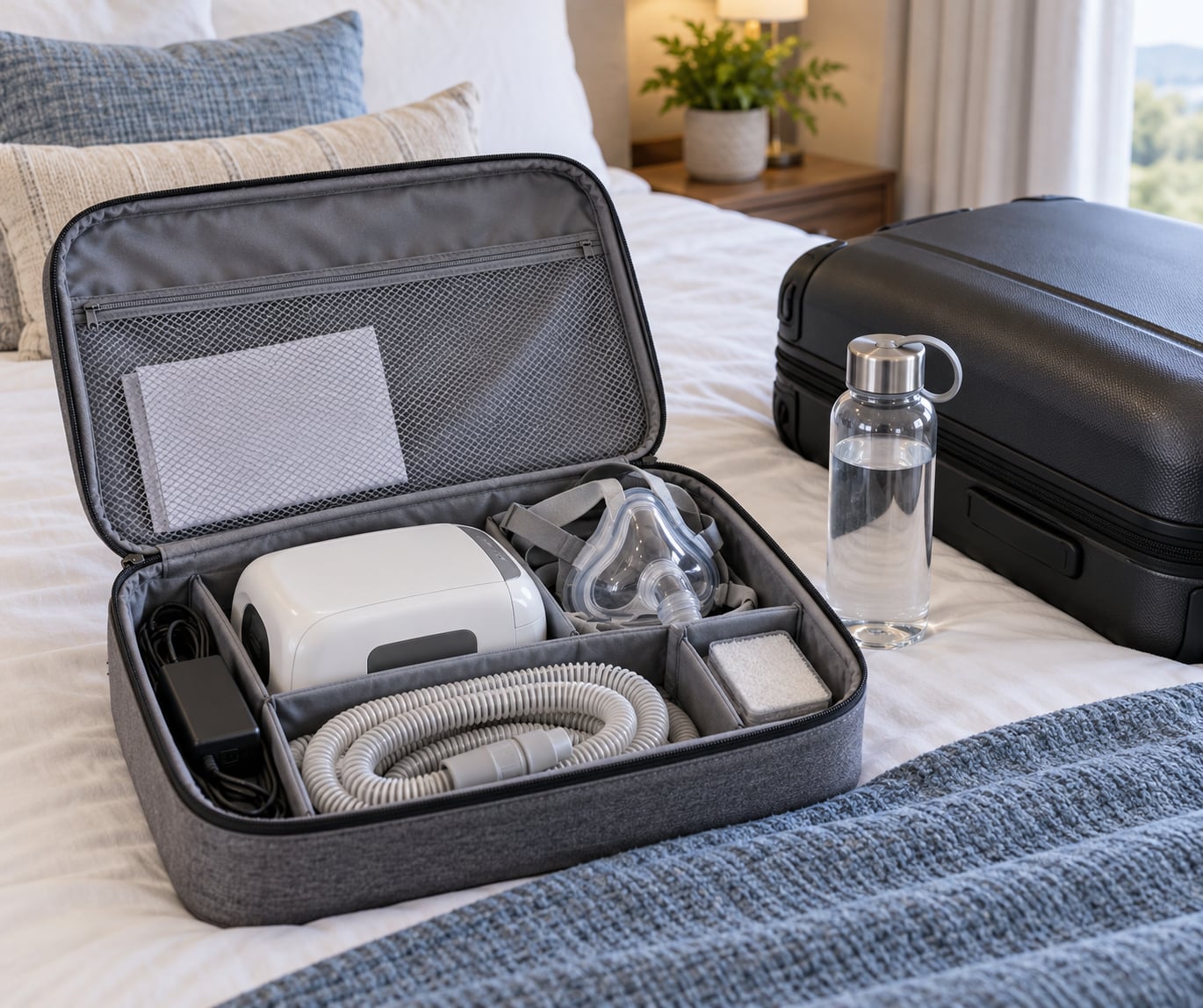
If you are figuring out how to travel with a CPAP machine, the short answer is that it travels in the cabin with you, never in a checked suitcase. It counts as a medical device, so it does not use up your normal carry-on allowance, and you must never hand it over at the baggage belt. Most of the work happens before you leave home: confirm the airline’s rules, pack the machine and its power supply together, and plan where you will get distilled water when you land.
This guide covers flying, driving and cruising, plus what to do when a machine fails a thousand miles from home. Rules shift, so treat what follows as a solid plan and confirm the specifics with your airline, the security authority at your departure airport and your sleep clinic before departure. Your prescribing clinician is the right person for any question about your therapy itself.
Table of Contents
- 1What You Need
- 2The machine and its parts
- 3Documents and contacts
- 4Power and water planning
- 5A backup plan
- 6How to Travel with a CPAP Machine: Step-by-Step Plan
- 7Check Your Airline and Route Rules
- 8Pack the Machine and Essential Accessories
- 9Pass Through Airport Security With a CPAP Machine
- 10Use the CPAP During the Flight
- 11Set Up and Maintain It at Your Destination
- 12Prepare for Delays and Equipment Problems
- 13Common Mistakes
- 14Frequently Asked Questions
- 15Does my CPAP count as a carry-on?
- 16Can you use a CPAP machine on a plane?
- 17Can you bring distilled water through airport security?
- 18Do I need a doctor’s note to fly with my CPAP machine?
- 19What happens if my CPAP breaks while I am traveling?
- 20Can I go without my CPAP machine for two weeks?
- 21Conclusion
What You Need
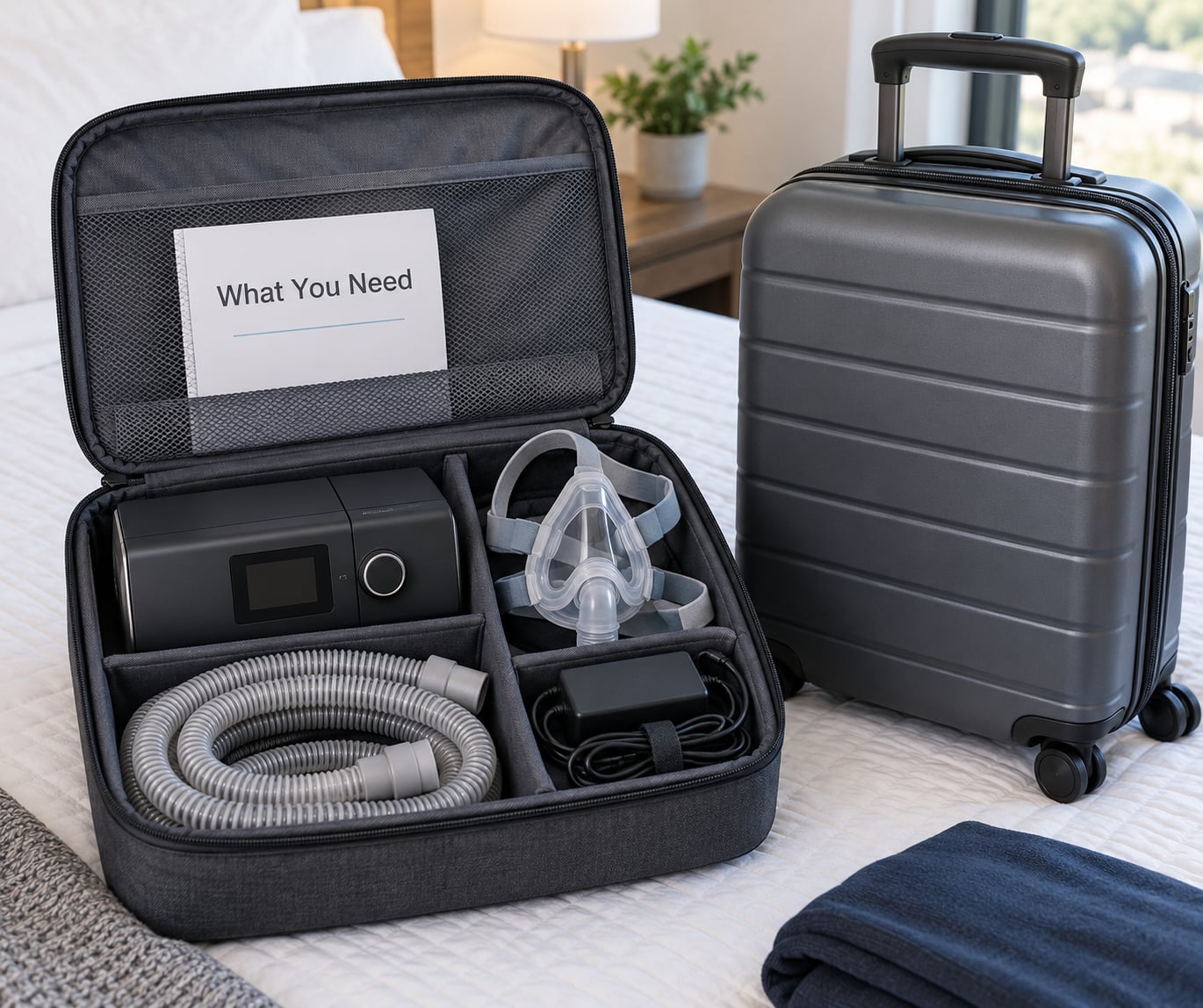
Most travel problems with CPAP equipment come from something small that stayed on a dresser at home. Build your kit a few days ahead and run a full test with everything you would actually take.
The machine and its parts
- The machine itself, in its dedicated travel case if you have one.
- The mask you normally use, plus a spare cushion or membrane if yours wears out.
- The tubing. Bring a second length if the trip is longer than a week; it kinks and tears more often than people expect.
- The AC power supply. This is the piece travelers leave behind most often, and the machine simply will not run without it.
- The DC cable if you plan to run from a car socket, RV outlet or battery pack.
- Spare filters, because a dusty destination will clog the originals fast.
- CPAP wipes or a mild soap for cleaning between nights.
Documents and contacts
Carry a photo of your prescription on your phone and a paper copy in your carry-on. Also bring the phone number and email of your equipment provider and your sleep clinic. A letter of medical necessity is rarely needed for a standard domestic flight, but some international destinations and some airline staff will ask for one, and writing it before departure is far easier than finding a doctor abroad.
Power and water planning
Check the label on the bottom or back of your power supply for its input range. Most modern units accept 100-240V, which means one power brick works in most of the world, but you still need a plug adapter for the socket shape. For water, empty and fully dry the humidifier chamber before you pack it, then buy distilled water when you arrive. Carrying water through security is the part that does not work the way most travelers expect.
A backup plan
Decide now what you will do if the machine stops working or never arrives: who you call, whether your provider offers loaner equipment, and whether your insurance covers out-of-network replacement. Travelers who write that plan down handle the problem far better than those who improvise at a foreign airport counter at midnight.
How to Travel with a CPAP Machine: Step-by-Step Plan
Check Your Airline and Route Rules
Start with the airline, not the machine. Under the EMSAAD framework that most major carriers operate, a CPAP is treated as medically necessary baggage and is exempt from the normal carry-on count, which means you can carry it in addition to your normal bags rather than instead of one.
Look for the airline’s specific medical equipment page and read three things: whether CPAP machines are allowed in the cabin, whether you must remove the machine from its case before screening, and whether the carrier wants advance notice for in-flight use. Policies also vary by aircraft type and by route, so a rule that holds on a domestic hop may be applied differently on an international or codeshare leg.
Then check the battery rules, because this is where travelers get stopped at the gate. The FAA tiers spare lithium batteries by watt-hour capacity:
- Up to 100Wh allowed in carry-on baggage with no special permission.
- 100Wh to 160Wh allowed with airline approval, usually limited in quantity, and you should be able to show the approval at the gate.
- Above 160Wh is not permitted in passenger baggage at all.
Every battery also needs terminals protected against short circuit, which in practice means the cover on, or the terminals taped. Spare batteries and power banks stay in the cabin with you, never in a bag that gets gate-checked.
Pack the Machine and Essential Accessories
Pack the machine in a small dedicated case and keep that case inside your personal item so it comes out in one piece at security. Before the lid closes, empty the humidifier water chamber and let it air dry completely. A machine packed with damp water in a sealed bag is how mold starts, and a chamber that smells musty on arrival is a bad sign for the rest of the trip.
Loose items inside the case should be the power supply, the DC cable, a plug adapter, spare filters, wipes, a spare mask cushion and your documents. Coil the tubing rather than folding it sharply; sharp creases at a bend are where cracks start, and a cracked tube will quietly leak air during the flight.
Fill the case only to the top. A heavy bag that slides around an overhead bin is a bag that ends up on the floor before you have taken a single sip of water.
Two hard rules for this step. Never check the machine in checked luggage, because a lost or crushed CPAP is a trip-ending event and insurance claims are slow. Never pack a spare lithium battery in checked luggage either, because it is prohibited there in the first place.
The companion question travelers ask is whether to buy a small travel machine instead. A compact unit with waterless humidification makes sense if you carry the machine daily, travel light or want fewer parts to manage. Otherwise, the full-size machine is allowed on board and there is no rule that requires you to upgrade for a trip.
Pass Through Airport Security With a CPAP Machine
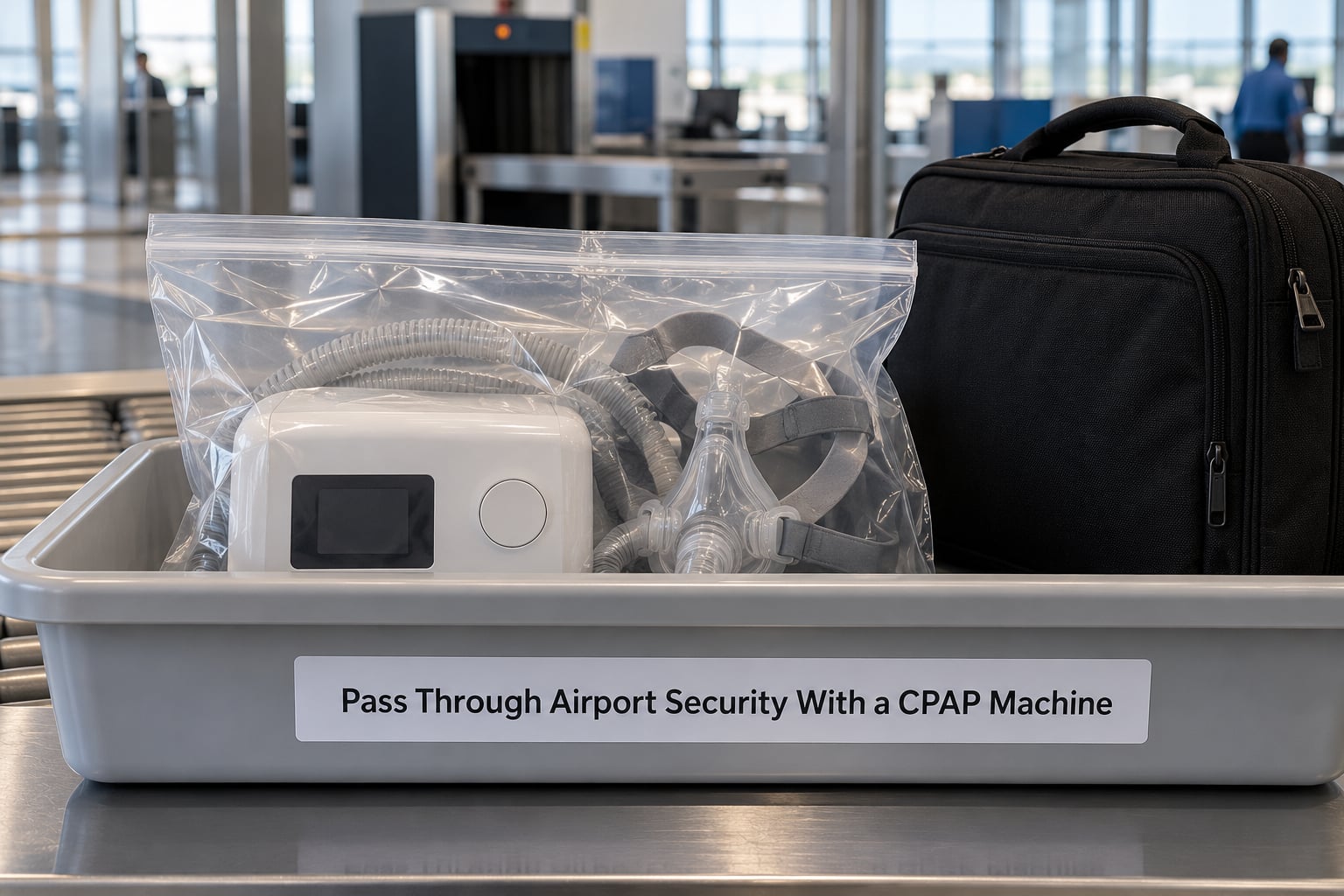
The screening itself takes under two minutes. Put the machine in its own clear plastic bag for hygiene, keep it in a separate bin from the rest of your bag, and be ready to lift it out if the officer prefers the machine outside its case. Expect to be asked whether it contains water; the honest answer is that the chamber is empty and dry, and it usually ends there.
Two things help. Ask the officer to inspect the device rather than handling it yourself, since screening officers generally do not need to man-handle medical equipment. And put your machine back together only once you are clear of the checkpoint, not while other passengers are still piling bins.
At a connection, you go through screening again in most countries, so keep the machine in an easy-to-reach pocket of your bag rather than buried under a layer you will unpack at the gate. TSA PreCheck members usually walk through with the machine still bagged, which is the smoothest path available to US travelers.
Use the CPAP During the Flight
Bringing a CPAP on board and using it on a plane are two different questions, and most confusion comes from mixing them up. Most modern machines are certified by their manufacturer for in-flight use, which is stated in the device documentation. Your airline’s medical equipment page will also tell you whether onboard use needs advance notice.
Plan for the pessimistic case. Not every seat has a working outlet, many do not have one at all, and a seat that works may not deliver enough power. Ask a flight attendant early rather than after take-off, because if you need a different seat or a seat with power, they are more able to help before the cabin fills.
If your clinician has prescribed oxygen for travel, follow that plan rather than substituting your CPAP. Keep your pressure settings exactly as prescribed, including on red-eyes. A long flight with jet lag is not the moment to experiment, and your clinician is the right person to ask what to change, if anything.
Set Up and Maintain It at Your Destination
Arriving is not the end of the process. At a hotel, put the machine on a stable side table near the outlet but not on the floor, and run the tubing to a length that lets you turn over without pulling the machine off the nightstand. Most hotel bathrooms have outlets that are either far from the bed or occupied by a lamp you need, so pack a short extension cord.
For water, buy distilled water locally. Supermarkets and pharmacy shelves in most countries carry it, and it is cheaper and more reliable than trying to carry it through a checkpoint. If you cannot find distilled water, purified or bottled drinking water works far better than tap water, which varies by region and is the main cause of mineral buildup travelers see in humidifier chambers.
On a cruise, the situation is usually simpler than travelers expect. Cabin outlets work for most CPAP machines, though voltage varies by ship, so check your device label before you sail and bring a converter if needed. Most ships also have a medical center that can supply or arrange equipment if something fails at sea. Bring your own machine anyway; the rental unit on board may not match your settings.
For driving and RV trips, you have far more freedom. Most RVs have 12V DC outlets that work with the DC cable directly, and a small inverter or a portable power station covers everything else. Check the inverter’s continuous wattage against your machine’s draw before you buy, and test the whole setup at home with the gear you plan to take.
Wherever you land, clean the mask and tubing every other day with wipes or mild soap, and let the chamber dry fully before refilling it. A humidifier left full for a week is how a clean machine arrives home smelling like a swamp.
Prepare for Delays and Equipment Problems
Problems fall into three buckets, and the response order matters.
It will not turn on. Before anything else, test it on a different outlet and with a different power supply if you have one, and confirm the machine has actually powered on rather than run through a two-second start. A blown adapter is far more common than a dead machine.
It is damaged, lost or stolen. Contact your equipment provider first; they know how to get a replacement issued at short notice and can tell you what documentation they need. Then file a report with the airline or the relevant authority while you are still there. If your travel insurance covers medical equipment, this is the moment to call the insurer as well. Abroad, rental equipment from a local durable medical equipment supplier is usually possible, though getting your settings back to prescribed levels may take an appointment.
You are separated from it by accident. If the machine ends up in a different bag on a delayed flight, contact the airline’s baggage service immediately with the bag tag number, and ask your provider whether a loaner can be arranged while you wait.
If a therapy interruption is medically concerning, contact your sleep clinic or prescribing clinician rather than searching for advice online. They can tell you whether a gap of one or two nights is acceptable for your specific situation and how to minimize the effects, which usually means napping, avoiding alcohol and sleeping on your side.
Common Mistakes
Checking the machine in a suitcase. It can be lost, crushed or exposed to moisture and temperature swings, and spare lithium batteries are prohibited there outright. Fix: keep the CPAP in the cabin with you, every flight, no exceptions.
Packing without the power supply. The machine, mask and tubing weigh almost nothing together; the AC brick is often packed separately and left behind. Fix: run a full test with only the bag contents one day before departure.
Leaving a spare battery in a gate-checked bag. When an agent tags your personal item at a full flight, the battery inside is now in prohibited baggage. Fix: keep every lithium battery and power bank in your hand or your personal item, and check your bag before you hand it over.
Assuming every airline works the same way. Exemptions are standard across most major carriers, but in-flight use rules, notice requirements and power availability are not. Fix: read the specific carrier’s medical equipment page before each trip.
Filling the humidifier and packing it wet. It attracts mold and smells within days. Fix: empty and dry the chamber at home, refill at your destination.
Not testing the setup after you arrive. A wrong plug adapter or a confusing outlet in a dark room at midnight is a rough start. Fix: set the machine up while you are still awake and dressed, not at bedtime.
Frequently Asked Questions
Does my CPAP count as a carry-on?
No. Under the medical-device exemption that most major airlines follow, a CPAP machine is medically necessary baggage and travels in the cabin in addition to your normal carry-on allowance. You still have to remove it at security for screening, and international carriers can apply their own documentation requirements, so check the specific carrier’s medical equipment page before you fly.
Can you use a CPAP machine on a plane?
Usually yes, provided the machine is certified for in-flight use by its manufacturer and the airline permits onboard use, sometimes with advance notice. Do not assume your seat has a usable outlet; ask a flight attendant early, because power is often limited or unavailable. Keep your prescribed pressure settings unchanged for the flight and ask your clinician about oxygen instead of improvising.
Can you bring distilled water through airport security?
Carry-on liquids are limited to containers of 100 mL or less that fit in a single quart bag, so a bottle of distilled water will not make it through a standard checkpoint. The easy fix is to fly with an empty, dry humidifier chamber and buy distilled water at your destination. Most large supermarkets and pharmacies stock it, and purified drinking water is a reasonable substitute when distilled is hard to find.
Do I need a doctor’s note to fly with my CPAP machine?
For most domestic flights, no note is required for the medical-device carry-on exemption. A photo of your prescription on your phone plus a paper copy is the practical safeguard, and travelers often say that is all they needed. A letter of medical necessity becomes relevant for unusual circumstances, some international destinations or equipment replacements abroad, so ask your sleep clinic in advance if you are unsure.
What happens if my CPAP breaks while I am traveling?
Call your equipment provider first, since they can arrange replacement or loaner hardware quickly and will tell you what paperwork they need. Then file a report with the airline and contact your travel insurer if medical equipment is covered. Abroad, a local durable medical equipment supplier may rent a machine, though getting back to your prescribed settings can take an appointment. Tell your sleep clinic how long you have been without therapy.
Can I go without my CPAP machine for two weeks?
It is not a rule you break, but untreated sleep apnea symptoms often return within a night or two: snoring, unrefreshing sleep and heavy daytime tiredness. Ask your clinician whether a short gap is acceptable for your situation, and ask your provider about loaner equipment before you travel rather than after. If therapy is interrupted anyway, skip alcohol, sleep on your side and expect to feel the effects the next day.
Conclusion
Traveling with a CPAP machine is mostly preparation done at home. Confirm your specific airline’s medical equipment and battery rules about 48 hours before departure, read the watt-hour label on any lithium battery and get written approval if it sits between 100 and 160Wh. Keep the machine, mask, tubing, power supply and documents in one cabin bag that never gets checked, fly with an empty and dry humidifier, and buy distilled water when you arrive.
Most importantly, write down your backup plan today: who you call if the machine fails, who can issue a loaner, and which number your clinic answers on. It takes five minutes and it is the difference between a bad night and a ruined trip.