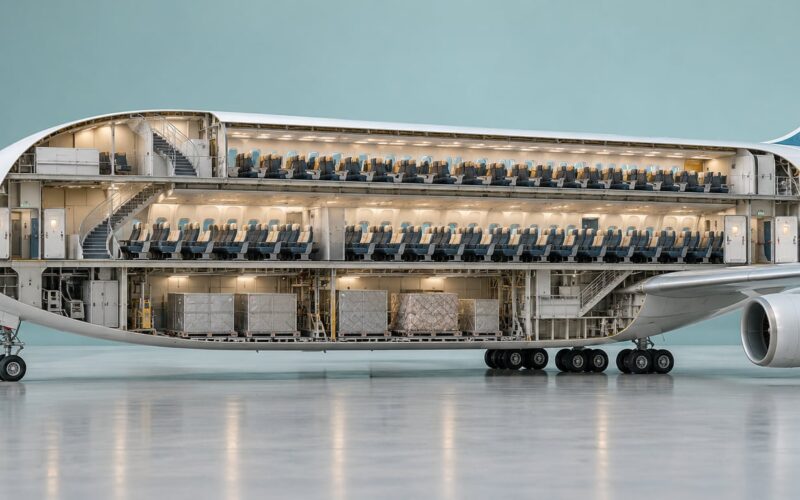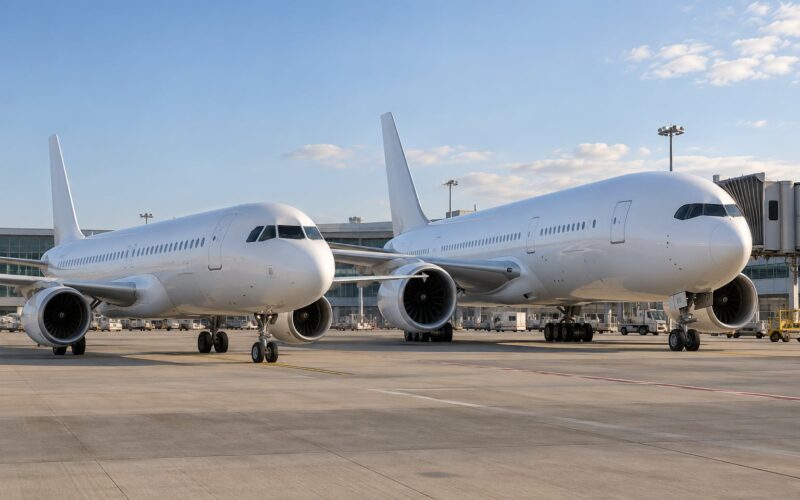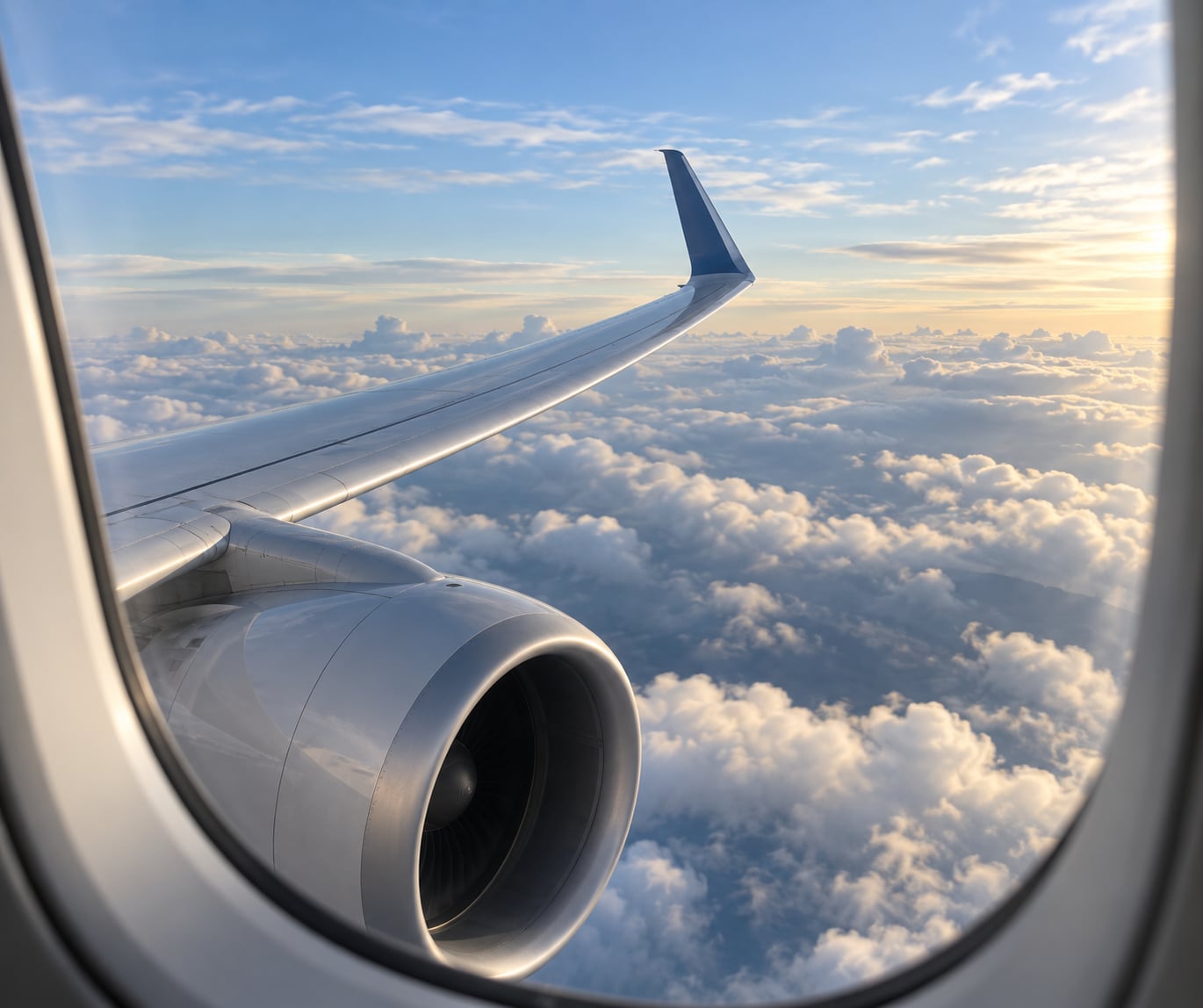
You can identify most airplane models from a window seat by working outward from what you can actually see: the wingtip device, the engine nacelle, the wing and fuselage proportions, and the cabin details around your seat. Confirm the family with a second clue, then check the safety card or the airline app before you commit to a variant.
The honest limit is worth saying up front. Learning how to tell airplane models apart from your seat gets you the family reliably and the variant sometimes. Retrofitted winglets, mixed fleets and airline-specific interiors blur the edges, and a night flight over cloud kills most of the visual clues entirely.
Table of Contents
- 1What You Need
- 2Airbus vs Boeing at a Glance
- 3Step-by-Step: How to Tell Airplane Models Apart From Your Seat
- 41. Check the wing and wingtip design
- 52. Look at the engine shape and position
- 63. Use the wing and fuselage proportions
- 74. Check the window and cabin layout
- 85. Read the safety card and flight information
- 96. Confirm the identification without guessing
- 10Common Mistakes
- 11Frequently Asked Questions
- 12How can I identify an airplane from my seat?
- 13How do I find out what model plane my flight is before I board?
- 14How do I tell a Boeing 737 from an Airbus A320 from a window seat?
- 15How do I tell a 787 from an A350 from a window seat?
- 16Can I still identify the aircraft at night or in bad weather?
- 17Is there an app that identifies the plane I am on?
- 18Conclusion
What You Need
Your window is the main tool, and it is already in front of you. Look through it during taxi and takeoff, when the aircraft is low enough that you see the wing from below and slightly ahead.
A few optional aids make the job easier:
- The safety card in the seat-back pocket, which usually carries a small aircraft diagram.
- The seat-back entertainment screen or the airline app, which often lists the aircraft type on the flight status page.
- A boarding pass or booking confirmation, where the operational model is sometimes printed.
- A flight tracker on your phone, used as a final check rather than a first guess.
One safety note that matters: stay seated and belted. Do not stand, press against the window or lean across the aisle to get a better angle. Reading a wing through a window from your own seat is easy, and it does not require moving.
Airbus vs Boeing at a Glance
Before individual models, learn the manufacturer-level habits. These are the clues enthusiasts check first, though each one has exceptions.
| Clue | Airbus habit | Boeing habit |
|---|---|---|
| Cockpit side window | Flat lower edge with a notched upper rear corner | V-shaped or slanted lower edge |
| Typical wingtip device | Sharklets, upturned and blended into the wing | Split-tip winglets or raked, swept tips |
| Engine nacelle | Smooth, often with a scalloped or chevron trailing edge | Flattened bottom on some classic narrow-bodies, chevrons on newer models |
| Nose profile | Shorter, more rounded | Pointier in most narrow-body families |
| Wing location | Mounted low, with a visible fairing against the fuselage | Mounted lower on some narrow-bodies, with less visible fairing |
None of these hold on every aircraft. Boeing split its narrow-body window line into two shapes over the years, and Airbus winglets have been retrofitted onto plenty of Boeing jets, so a sharklet no longer proves an Airbus.
Step-by-Step: How to Tell Airplane Models Apart From Your Seat
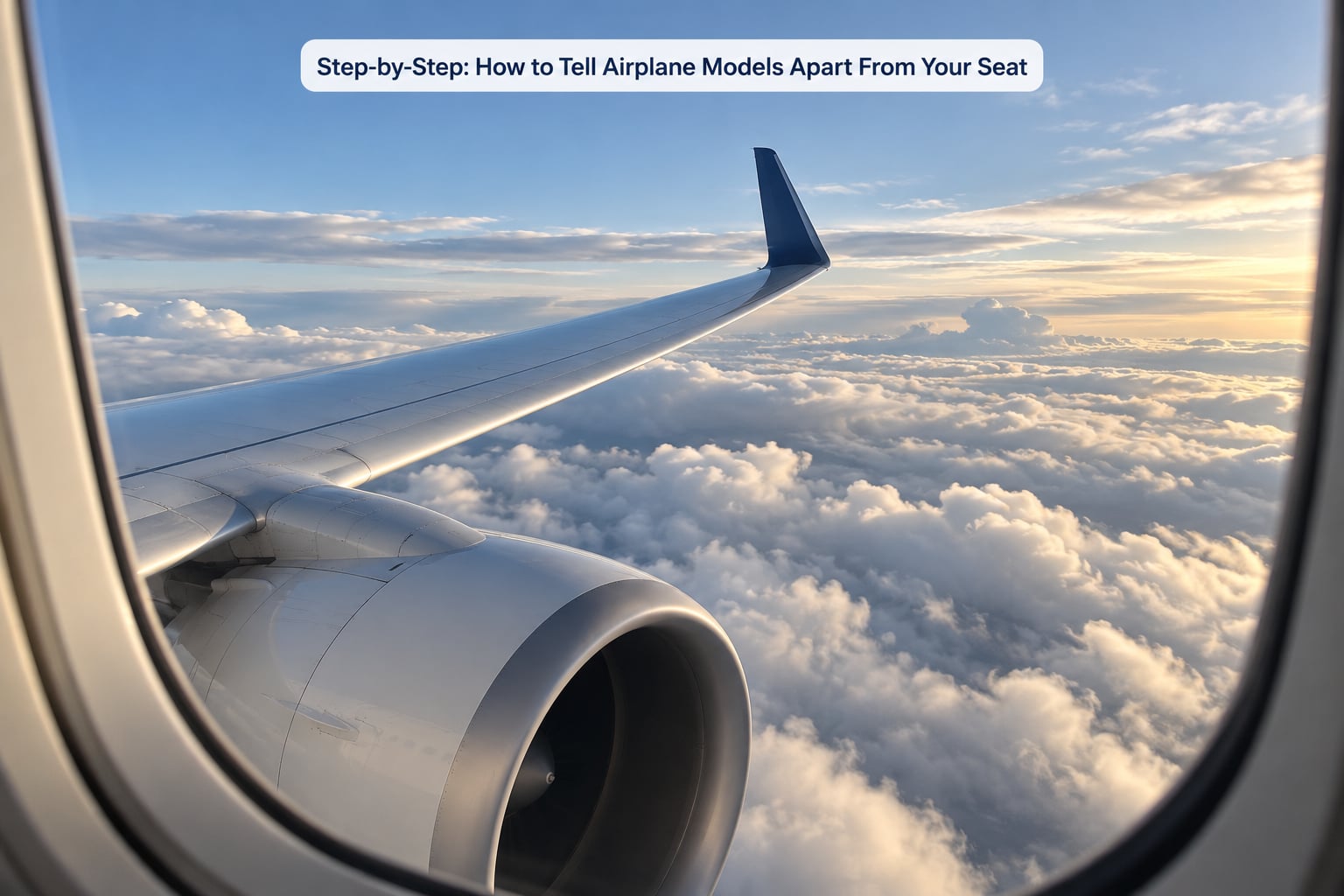
Work through this in order and stop at the first confident answer. Airlines configure the same type differently, so no single feature is conclusive on its own.
1. Check the wing and wingtip design
The wingtip is usually the first thing you can see clearly, and it splits the field quickly. A Boeing 757 looks narrow and long from the window, with a tall vertical fin at the tip. The 787 family has a blended, gently curved tip that flows straight out of the wing rather than standing up from it. Airbus aircraft most often carry sharklets, the swept-up fin that blends into the wing edge.
Older 737s originally flew without winglets at all, and blended winglets were later added in the aftermarket. A 737 with split-tip winglets is a MAX-family jet, because that is standard on the MAX. Configuration varies by operator, so treat the tip as a strong hint rather than a verdict.
2. Look at the engine shape and position
Underwing engines on a single-aisle jet are the common case, and both Airbus and Boeing use them. What narrows things down is size and placement: a very large nacelle under a long wing usually means a wide-body rather than a narrow-body.
Chevrons, the serrated pattern on the nacelle trailing edge, are a genuinely useful clue from a window seat on newer aircraft. They are much more visible on some models and families than others. Engine appearance alone cannot name the aircraft, because airlines specify different engines for the same airframe and nacelle shapes change across production.
3. Use the wing and fuselage proportions
Proportions tell you the size class before anything else. An A320-family jet looks short and wide with a chunky, thick fuselage. A 757 looks long and slender, and it is often mistaken for a wide-body because of that length. A 787 or A350 looks big, long and heavy, with a wide fuselage and very large engines.
A wing alone is unreliable. Seats forward of the wing give you a clean front view of the wing root and the nose; seats behind it show you the wing trailing edge and the tail instead. If you can lean forward a few rows’ worth of sightline, proportions become much easier to judge.
4. Check the window and cabin layout
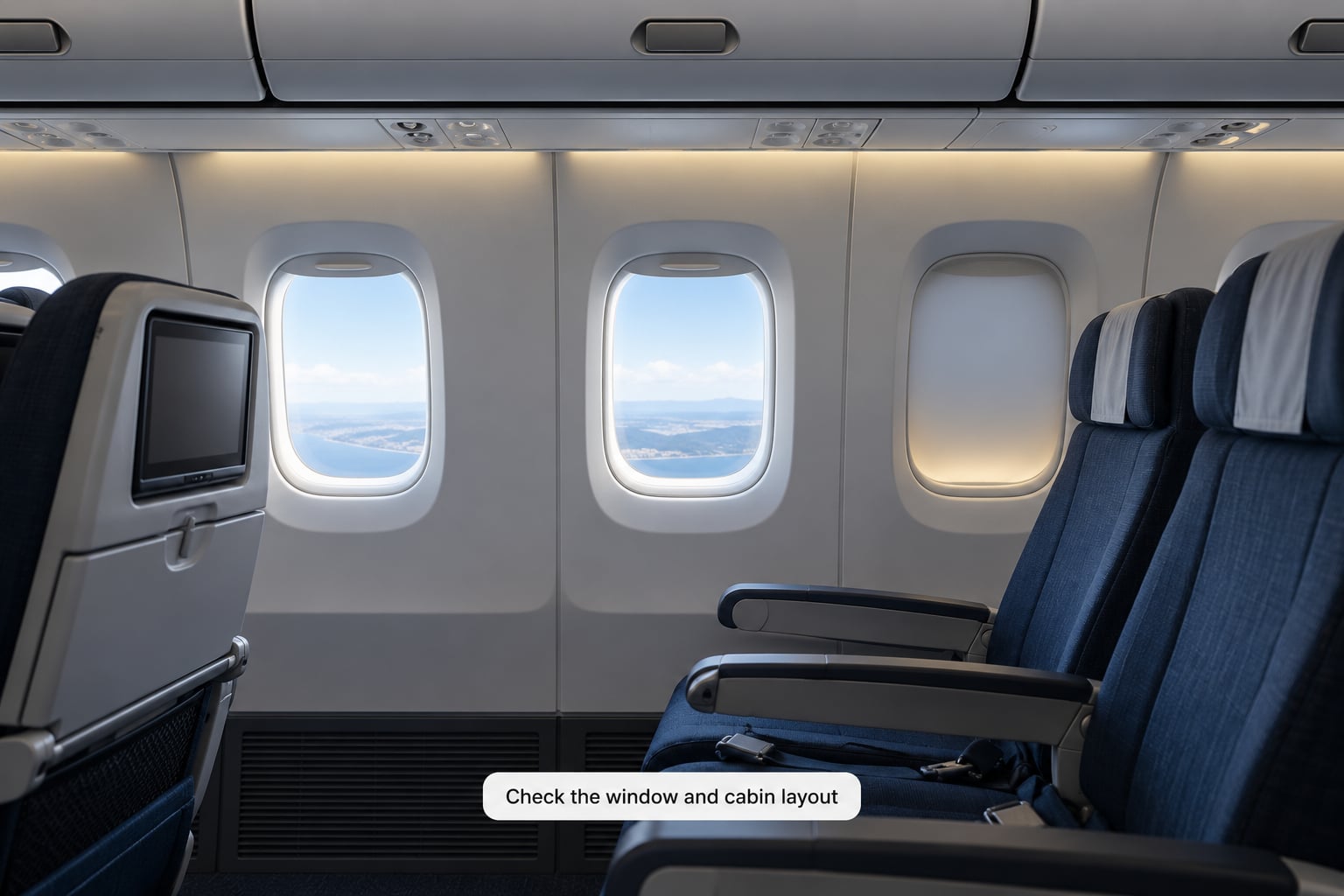
Cabin details are the best clue available when you are mid-cabin and the view outside is useless. Overhead bin design, the shape and spacing of the cabin windows, the seat-back screen size and the emergency exit arrangement all shift between families.
Dimmable windows with no manual shade are a strong signal on the 787 family. A noticeably larger number of overwing exit windows suggests a stretched fuselage, which is why an A321 can carry more exit windows than an A319 on the same basic airframe.
Two interior quirks trip people up. Airlines that use modular Cabin Flex interiors can reposition doors, galleys and exits, which changes how windows line up with seat rows. And a window shade that cannot quite close flat is usually a flexible pane in a curved fuselage wall, not a defect.
5. Read the safety card and flight information
The safety card in the seat-back pocket is the most under-used identification tool in aviation. Most cards show a small side profile of the aircraft with doors and exits marked, and the exits drawn on that profile are a real configuration clue, especially on stretched narrow-bodies.
Be aware that many cards describe a generic type rather than the exact aircraft you are on, because one card gets printed for a whole fleet. For the operational model, check the boarding pass, the airline app or the flight status page, which is more likely to name the specific variant.
6. Confirm the identification without guessing
Require two independent clues before you name an aircraft. A sharklet plus a long narrow fuselage reads as a narrow-body Airbus. A blended tip plus very large nacelles reads as a wide-body Boeing. One clue alone, especially a winglet, is worth very little on its own.
When you get to a variant, be careful about the wording. Naming the family is usually safe. Naming the exact sub-variant from a passenger seat is often not possible, and saying so is more accurate than guessing. A flight tracker entry for your flight number settles the question quickly and takes about ten seconds.
Common Mistakes
Treating one wing feature as proof. Sharklets have been retrofitted across both manufacturers, and split-tip winglets mark the 737 MAX but tell you nothing else. Cross-check before you commit.
Assuming an airline flies one type. Large carriers operate mixed fleets of both Airbus and Boeing, and sometimes swap the assigned aircraft on the day. Livery tells you the airline, not the model.
Confusing a 737 MAX with older 737 variants. The split-tip winglet is the clearest passenger-visible marker, followed by the larger, more rounded LEAP-family engine nacelles. Without either, you are guessing between generations.
Treating engine placement as proof of a model. Underwing engines rule out very little. Many unrelated aircraft share that layout, and the same airframe can arrive with different engines depending on the customer.
Ignoring what blocks your view. Mid-cabin rows on large aircraft can have an engine nacelle filling much of the window. Forward of the wing, the nacelle sits behind you. Pick your side accordingly.
Forgetting what you cannot see. At night, in cloud, or above a solid overcast, the outside view gives you very little. The safety card and the airline app become your main sources instead.
Two things that help when the view is poor: a window in the first few rows forward of the wing gives you a view along the fuselage and nose, and polarised sunglasses add glare rather than detail. If condensation or frost forms between the window panes at altitude, wait for it to clear before deciding anything.
Frequently Asked Questions
How can I identify an airplane from my seat?
Start with the wingtip device, then the engine nacelle, then the wing and fuselage proportions, then the cabin around you. Require at least two matching clues before naming the aircraft, then confirm with the safety card diagram or the airline app.
How do I find out what model plane my flight is before I board?
Check the airline app or flight status page for the scheduled aircraft type, then look at the booking confirmation and boarding pass. Seat maps for the specific aircraft show window and exit layout. Confirm again on the boarding screen at the gate, since swaps happen.
How do I tell a Boeing 737 from an Airbus A320 from a window seat?
Look at the wingtip first: sharklets usually mean Airbus, split-tip winglets mean a 737 MAX, and a 737 with no winglet or blended winglets may be an older 737. Then check the nose shape from a forward row and the nacelle shape from the window.
How do I tell a 787 from an A350 from a window seat?
Both are long twin-engine wide-bodies, so proportions and engines matter more than the tip. A 787 has smoothly blended, swept wingtips and visible nacelle chevrons. The A350 wingtip curves gently upward and the cockpit window surround is dark.
Can I still identify the aircraft at night or in bad weather?
Sometimes, but the outside clues mostly disappear. Night flights over cloud can leave you with the cabin only: window type, overhead bin design, exit layout and the safety card diagram. On a clear night you can often spot the wingtip light pattern and the size of the engine.
Is there an app that identifies the plane I am on?
Airline apps and flight status pages name the scheduled aircraft type for your flight number. General flight trackers show the same registration for live flights. Both are quick confirmations, and neither replaces looking at the aircraft yourself.
Conclusion
Start at the wingtip, move to the engine nacelle, judge the proportions, and note one cabin detail. When two of those agree, you have an aircraft family. Then open the safety card or the airline app to confirm, and describe your finding as the most likely family if you cannot verify the variant.