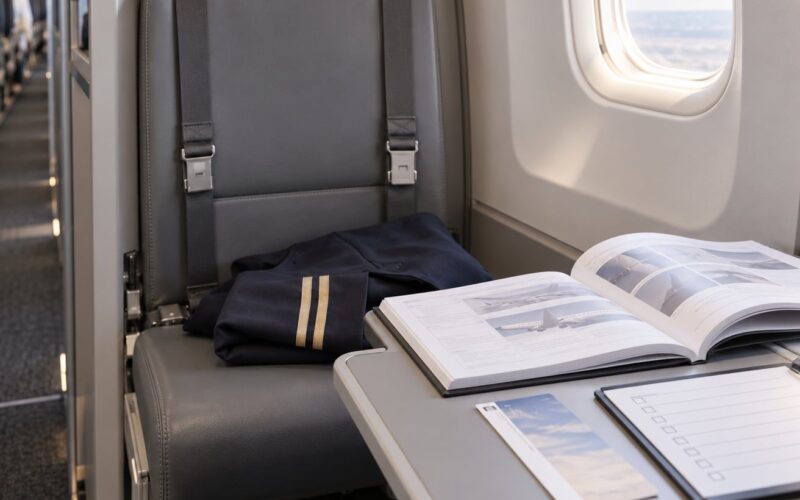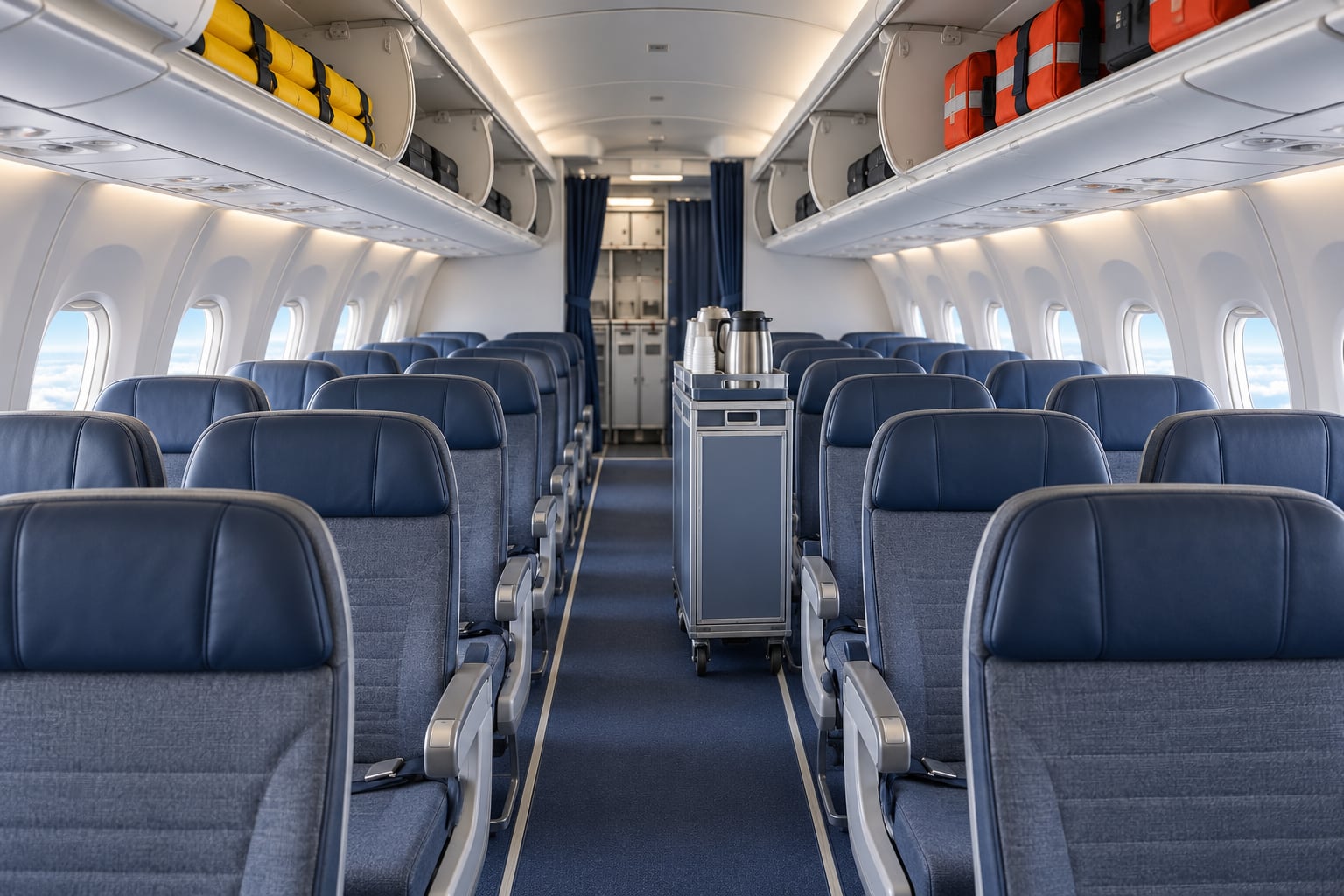
Cabin crew are the trained airline employees responsible for passenger safety, comfort and service in the cabin. They do not fly the aircraft. They report long before passengers arrive, check every piece of safety equipment on board, board and secure the cabin, run the services, handle whatever goes wrong, and write a report after landing.
The word sounds grander than the job usually is. Cabin crew spend most of their working hours walking aisles, checking seatbelts, restocking carts and repeating safety instructions. But when something goes wrong, they are the only people on board trained to handle it, and that is the part that matters.
Duties differ by airline, by aircraft type and by cabin layout, so treat this as the general shape of the job rather than a script any single crew member follows.
Table of Contents
- 1What Cabin Crew Actually Do During a Flight
- 2How Cabin Crew Prepare Before the Flight
- 3What Happens During Boarding and Taxi
- 4The Main Cabin Crew Duties in Flight
- 5How Cabin Crew Handle Safety Emergencies
- 6What Cabin Crew Do on Long-Haul Flights
- 7What Cabin Crew Do When a Flight Is Disrupted
- 8How Cabin Crew Work With the Flight Deck
- 9What Happens After the Flight
- 10Frequently Asked Questions
- 11What is the main role of a flight attendant?
- 12What safety checks do flight attendants do?
- 13Do flight attendants worry about turbulence?
- 14How long do flight attendants sleep on long-haul flights?
- 15What is the highest position in cabin crew?
- 16How many flight attendants are on a plane?
- 17Conclusion
What Cabin Crew Actually Do During a Flight
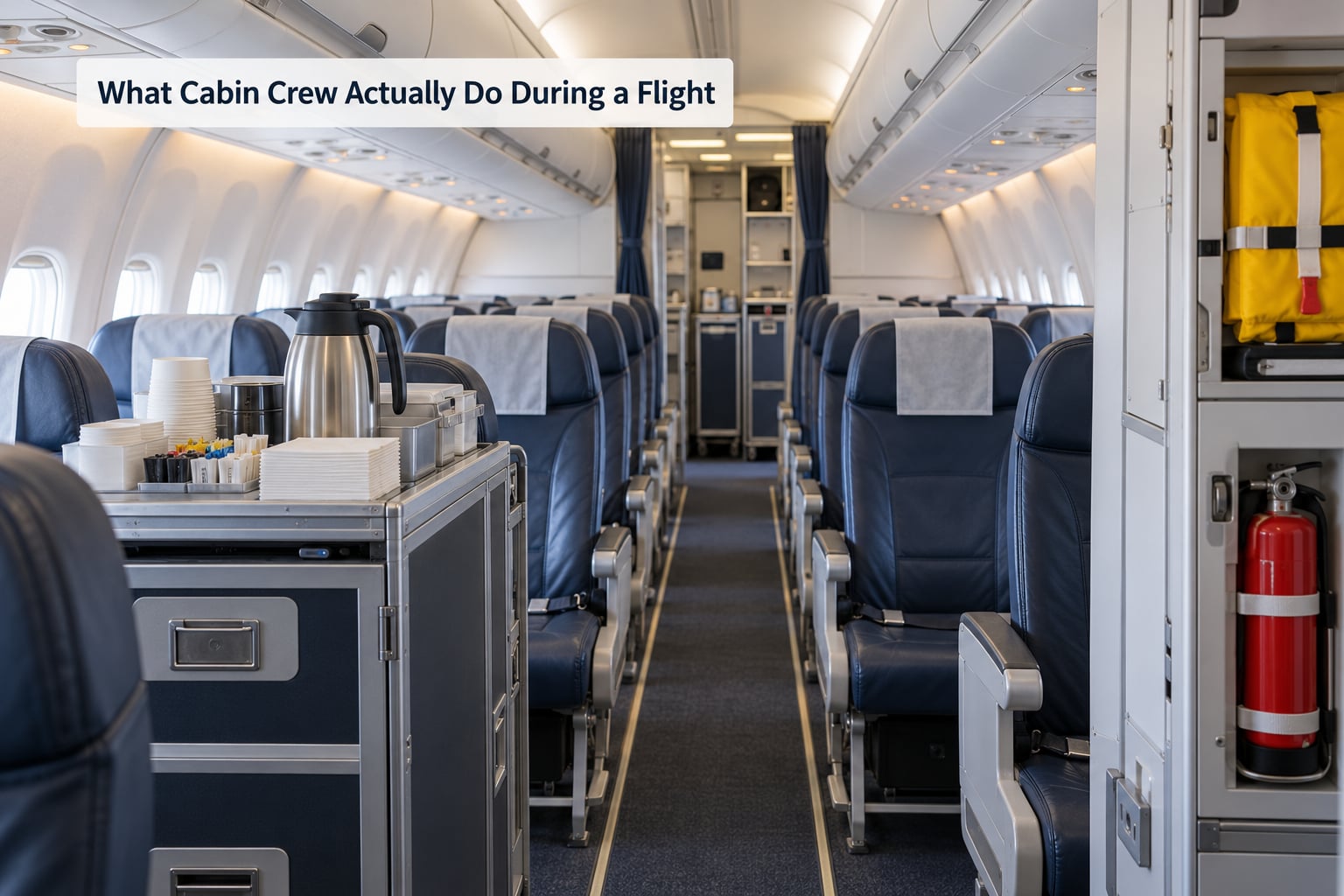
The job splits into three levels. Cabin crew, usually called flight attendants, handle the cabin and the passengers. Senior cabin crew, sometimes called pursers, look after a cabin zone and the crew working it. Cabin crew management holds overall responsibility for the cabin and is the main link with the flight deck and with cabin crew on the ground.
None of them fly the plane. Pilots and flight deck crew operate the aircraft, and ground handling agents deal with baggage, fuelling and servicing. Cabin crew own the part of the trip that happens behind the cockpit door.
Everything that follows is what cabin crew actually do during a flight, in the order it happens: preparation, boarding, taxi, takeoff, cruise, descent, landing and the work that closes the flight out.
How Cabin Crew Prepare Before the Flight
Preparation starts well before passengers reach the gate. Crew report, find the aircraft, go over the safety briefing with the rest of the team, and check the cabin end to end.
Their pre-flight checks usually cover:
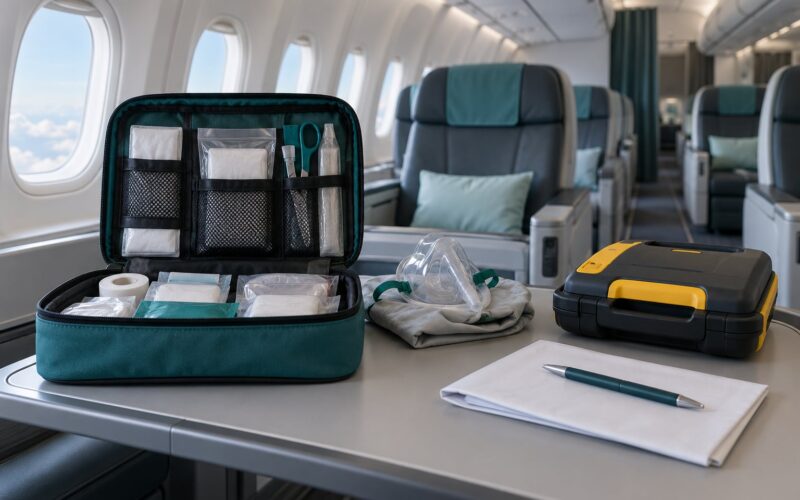
- Emergency equipment: extinguishers, portable oxygen units, first aid kit, flashlights, megaphones and the emergency oxygen supply.
- Life vests and safety equipment on every seat, checked for tampering and correct placement.
- Galley and storage: safety equipment secured, trolleys loaded, cabin secured against take-off.
- Safety equipment at exit rows, including briefing cards and any special kit.
- Special assistance passengers confirmed, including unaccompanied minors, wheelchair users and passengers travelling with service animals.
- Service planning: what is being sold, how many meal rounds are needed, and who is on which service.
Alongside this sits the paperwork. Crew confirm the passenger count, review any special requirements on the flight file, note what a colleague flagged on the previous sector, and check who is assigned to which doors. Once boarding starts, the cabin gets reported as ready to the flight deck.
What Happens During Boarding and Taxi
Boarding is fast, controlled work rather than a queue at the door. Crew work in assigned pairs at specific doors, greet passengers, direct them down the correct aisle, and solve the small problems that eat most boarding time: a bag that will not fit, a passenger in the wrong row, a child who will not sit down.
Some airlines check travel documents at the aircraft door, others at the gate. Where it happens at the door, crew may also seat passengers needing assistance near accessible exits, confirm that passengers with duty-free liquids bought after security have the sealed bag, and hand out safety cards or child safety equipment.
During taxi the cabin is not relaxing time. Seatbelts get checked, bag stowage is completed, and crew take their assigned positions. From the moment the doors are armed and the cabin is secure, crew sit down, and their job during the take-off roll is the safest instruction in aviation: brace.
The Main Cabin Crew Duties in Flight
Once the aircraft is at cruising altitude and the seatbelt sign comes off, the working day starts. On most flights it looks like this:
Safety demonstration. Crew play a safety video and repeat the key points in their own words, or give the demonstration live. They cover seatbelts, oxygen, life vests, exits, evacuation and the safest position for turbulence.
Seatbelt and stowage checks. Crew walk the aisles repeatedly, checking that baggaged items are stowed and seatbelts are fastened. It is one of the most visible duties and also one of the most misunderstood.
Service. Drinks, meals, snacks, coffee refills, duty-free sales on some airlines. Crew count what sells, note what is left over and what is damaged, and carry that information to the next sector. Inventory is real work, not an optional extra.
Passenger requests. Anything from a missing blanket to a passenger who cannot find their medication refill or needs help changing a baby at 40,000 feet.
Announcements. Crew make the public address announcements: welcome, safety video, menu options, connecting passengers, cabin temperature. They also answer calls from individual seatphones.
Cabin watch. A senior crew member normally keeps an eye on the whole cabin while others work. Crew rest when the cabin allows it and jumpseats are occupied.
Minor fixes. A jammed overhead bin, a flickering reading light, a broken in-flight entertainment screen. Crew fix what they can and write up what they cannot.
How Cabin Crew Handle Safety Emergencies
Safety duties are why cabin crew are trained as they are. The order of priorities never changes: the cabin, then the passengers, then the service.
Turbulence. Crew are seated and braced before the aircraft hits rough air, and the seatbelt sign goes on early. People who give working cabin crew the most trouble in a bumpy flight are unbuckled passengers and loose items. A handbag thrown across an aisle becomes a projectile, and a standing passenger becomes an injury.
Medical emergencies. Crew carry first aid training, oxygen and, on most aircraft, a defibrillator. They assess, call for a diversion if needed, and ask other passengers for help when someone is trained to offer it. Crew also deal with fear and panic, which are medical situations too.
Fire or smoke. The response is planned and drilled: cut power to the affected area, use the appropriate extinguisher, coordinate with the flight deck, and prepare the cabin for an immediate landing.
Decompression or smoke in the cockpit. Crew put on their oxygen masks quickly, secure the cabin, and get an evacuation started on command. They are not deciding whether the flight can continue. That call belongs to the flight deck.
Evacuation. Crew manage the exit rows, direct passengers to the nearest usable exit, check for anyone left behind and take the cabin safety equipment with them. On long flights, the exit used will depend on where the aircraft comes to rest.
Every scenario gets rehearsed in training and again in recurrent checks. Crew who describe the job say they cover all of it: medicals, turbulence, ditching, evacuations.
What Cabin Crew Do on Long-Haul Flights
A long-haul flight is a working day that happens to be at 38,000 feet. Crew on a fourteen-hour sector will serve more than one meal, rest in shifts, and still have energy in reserve for landing.
Short-haul versus long-haul cabin crew duties
| Duty | Short-haul | Long-haul |
|---|---|---|
| Services | Usually one drinks and snack round | Two or three services, plus duty-free on some airlines |
| Crew rest | Little or none on board | Scheduled rest in shifts during cruise |
| Inventory | Quick check between sectors | Full count between services, written up |
| Passenger load | Often high turnover, short flights | Long dwell times, more medical and accessibility cases |
| Post-flight | Often straight to the next sector | Long turnaround, rest rules before flying again |
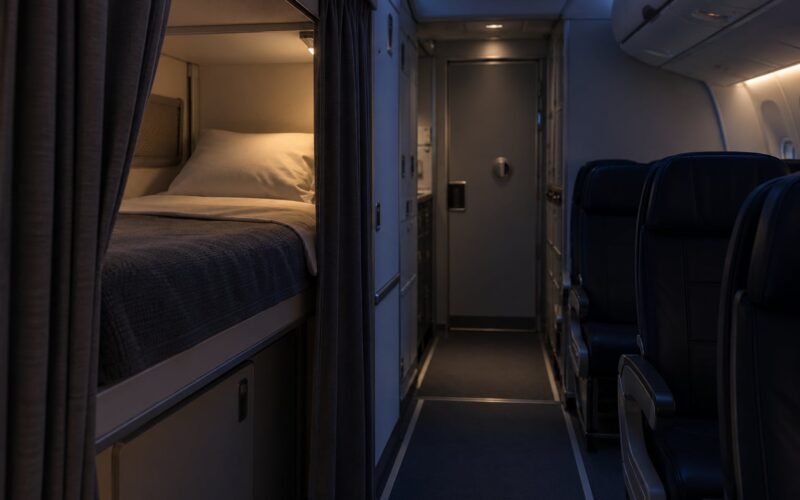
Crew rest is the part passengers almost never see. On long-haul aircraft the rest area is hidden above or behind the cabin, entered through a door designed to look like a lavatory door. On some aircraft it is reached by stairs, on others by a ladder-style stair and a sliding door. A Boeing 777-300ER has eight bunks arranged in two rows of four; on an Airbus A350-1000 the bunks sit next to each other instead.
Crew who talk about this describe a rotating pattern. The first group rests after the first meal service, then comes down to relieve the second group, do the inventory and prepare the second service. People who sleep second usually find it easier, because by the time they go down they are properly tired.
Rest areas are strict no-noise zones. Personal alarms are not allowed, phones stay on vibrate, and waking is a chain reaction rather than an alarm. Under aviation rules, crew are entitled to rest during the flight: around three hours when the flight duty period runs beyond fourteen hours, and around four and a half hours when it exceeds eighteen.
Rest, however, is a scheduled slot, not a guarantee. Cabin conditions decide when a crew member can be off the floor, and on a full cabin with a medical case to deal with, the rest slot simply moves.
What Cabin Crew Do When a Flight Is Disrupted
Most of the work that looks like nothing is actually the job. Disruption is where that becomes obvious.
On a delay, crew stay with the cabin, keep passengers informed, arrange meals or hotel when it is an overnight disruption, and handle a rising volume of questions. On a diversion, they tell passengers what is known, which is usually less than people want, and they handle rebooking and baggage issues alongside the cabin duties.
Missed connections need specific care. Connecting passengers may travel on a single ticket, which means the airline carries responsibility for putting them on another flight and for looking after them in between. Crew identify them, arrange hotels and meals, and hand over details to the next cabin crew or to the airline’s service centre.
A medical diversion is the hardest case of all. Crew are running a patient care situation in a narrow cabin while the aircraft is being repositioned and people around them are frightened. It is long hours, little control, and no guarantee of a simple outcome.
Crew also manage disruptive passengers, from refusing to follow instructions to threatening behaviour. Airlines have procedures for each step, and crew follow them rather than improvising.
One of the biggest myths in this job is that cabin crew fly somewhere nice and stay. They do not. Crew describe rotations as a sequence of sectors ending wherever the roster says, with irregular hours, airport shuttle queues and time spent waiting on the ramp for air traffic control to clear you.
How Cabin Crew Work With the Flight Deck
Cabin crew communicate with the pilots through a call system that works even if the cabin cannot hear the cockpit. Before the doors close, the senior crew member reports that the cabin is secure and how many passengers are on board. If anything changes during boarding, that report changes with it.
During the flight, crew pass on what the cockpit needs: a passenger who needs assistance to the toilet, a medical case, a security concern, a request for information. In return, the flight deck gives operational updates that cabin crew turn into passenger announcements. Crew are told what is happening and are careful never to speculate beyond it.
The limits matter. Cabin crew make no decisions about the route, the altitude, the fuel or whether to continue a flight. Senior crew members manage the cabin and its safety, and they escalate everything above that to the flight deck. That boundary is deliberate and it is trained.
On the ground, cabin crew management handles what the flight crew cannot: coordinating the ground services, dealing with cabin maintenance, handling complaints and, when something goes badly wrong, stepping in to support the passengers and the crew involved.
What Happens After the Flight
After the aircraft lands, the job continues until the cabin is signed off.
Cabin crew confirm that everyone has disembarked, then sweep the cabin for left-behind property, which is passed to the airline’s lost property process. They check for damage, clean and reset the cabin for the next sector, and reconcile what was sold, served, used and damaged.
They also write the reports. A cabin crew report covers anything unusual: a medical case, an injury, a security matter, a delay or a diversion. On long sectors, crew fill in their rest times and inventory counts before they sign off. Last duty of the day is checking nothing was missed and the cabin is ready for whoever flies it next.
Then comes the part that surprises people new to the job. Crew are not done when they land. Training still has to be kept current, a roster still has to be followed, and a base or reserve pattern keeps running. A crew member on reserve reports to the airport and waits to find out whether they are flying that day, which is the single most common question among people considering the job.
Frequently Asked Questions
What is the main role of a flight attendant?
The main role of a flight attendant is passenger safety and cabin management. Crew check emergency equipment before boarding, demonstrate safety procedures, seat and secure passengers, run meal and drink services, answer passenger needs and handle any irregularity, from turbulence to a medical emergency or an evacuation. Service matters, but it ranks behind safety in every decision crew make.
What safety checks do flight attendants do?
Before passengers board, crew check extinguishers, oxygen, portable oxygen units, first aid kit, flashlights and megaphones. They confirm every life vest is in place and untampered, that safety equipment at exit rows is complete, and that the galley is secure. They also confirm the passenger count, review special assistance needs, and report the cabin as secure to the flight deck before the doors close.
Do flight attendants worry about turbulence?
Crew prepare for turbulence rather than worry about it. They are seated and braced before rough air arrives, and the seatbelt sign goes on early so passengers can fasten it. The real danger in turbulence is not the movement. It is loose objects flying down the aisle and standing passengers being thrown, which is why repeated seatbelt and bag stowage checks matter so much.
How long do flight attendants sleep on long-haul flights?
Crew rest on long-haul flights is scheduled in shifts during cruise, usually after the first meal service. The first group rests, comes down to relieve the second group and prepare the next service. Aviation rules provide around three hours of rest when the flight duty period exceeds fourteen hours, and around four and a half hours beyond eighteen hours, in a quiet rest area with no alarms allowed.
What is the highest position in cabin crew?
The highest position in cabin crew is cabin crew management, which is a management and training role rather than a job flying every week. Below that sit senior cabin crew members, also called pursers, who lead a cabin zone and its crew. Regular cabin crew, or flight attendants, handle the cabin and the passengers day to day. Some airlines also have a senior purser grade above purser.
How many flight attendants are on a plane?
The number of cabin crew depends on the aircraft and the cabin layout, and the airline must be able to show enough crew on board to perform a full evacuation within a limited time. A small aircraft may carry two, a narrow-body on a dense domestic layout may carry four or more, and long-haul aircraft with several cabins often carry eight or more, plus a separate crew member dedicated to the lower deck.
Conclusion
What cabin crew actually do during a flight runs in one loop: report, inspect, brief, board, secure, serve, rest, respond, land, reconcile and report. Most of it is invisible, repetitive and unglamorous, and that is fine, because the routine is what makes the rare emergencies manageable.
Next time someone asks you to fasten your seatbelt, stow your bag or stay seated while the seatbelt sign is on, that is the answer in miniature. Safety comes first, service follows, and cabin crew are the people on board trained to hold that line.