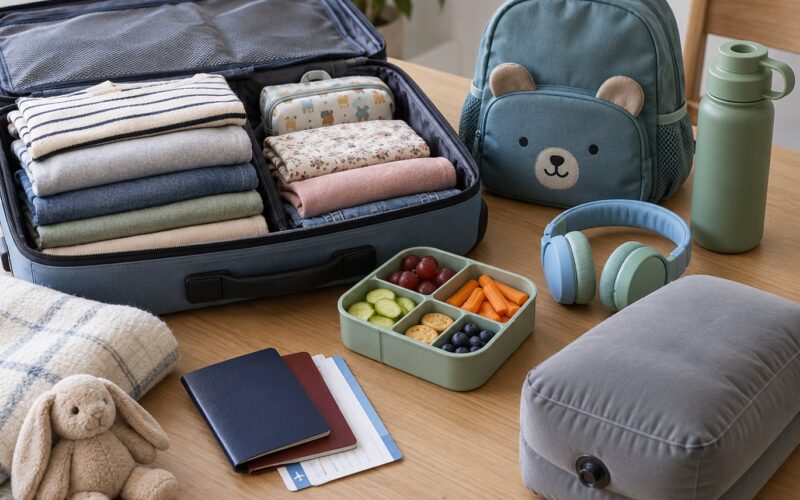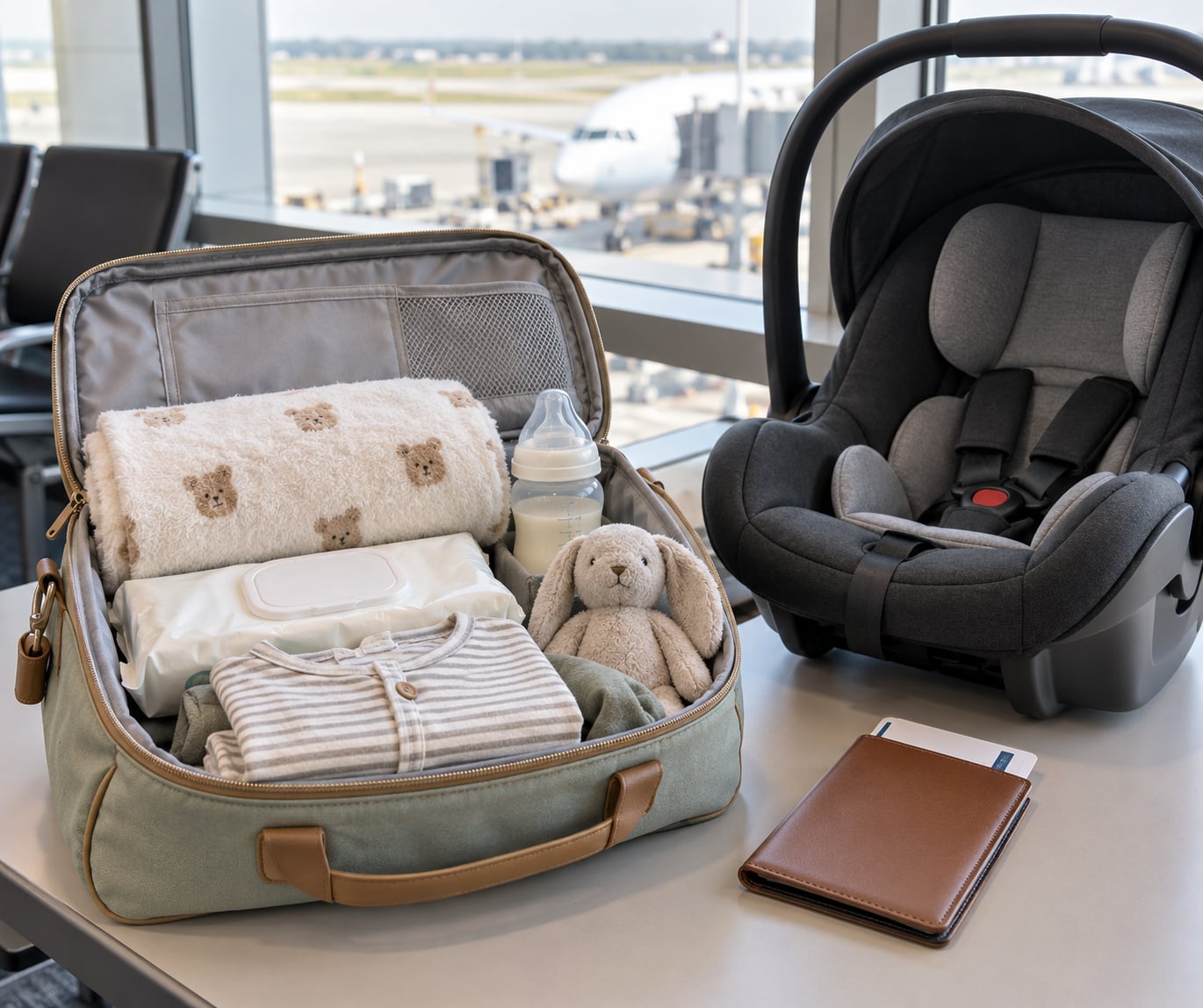
Flying with a baby is mostly an exercise in preparation, not luck. If you know how to travel with a baby on a plane, the flight itself is the easy part: confirm the rules, pack light, feed around takeoff and landing, board last and land with your gear intact. Most of the stress parents describe in the weeks before their first flight comes from unanswered questions about documents, seats and car seats, and those have clear answers once you know where to look.
This guide walks through the whole trip in order, from booking through arrival, and takes roughly ten minutes to read. Airline rules differ, and the destination country matters more than most people expect, so treat everything below as a framework to confirm rather than a fixed rulebook.
Table of Contents
- 1What You Need
- 2Step-by-Step
- 3Check the Airline and Route Rules First
- 4Pack a Compact Baby Travel Kit
- 5Time Feeding Around the Travel Schedule
- 6Prepare for Security and Boarding
- 7Keep the Baby Comfortable in Flight
- 8Land, Collect Everything, and Reinstall the Car Seat
- 9Common Mistakes
- 10Frequently Asked Questions
- 11Can a newborn fly on a plane?
- 12Do airlines allow babies to sit independently during takeoff and landing?
- 13What can I bring for a baby through airport security?
- 14How should I feed a baby during a long flight?
- 15What is the best way to stop a baby from crying on a plane?
- 16Can I use sedating medicine to help a baby sleep on a flight?
- 17Conclusion
What You Need
You need proof of who your baby is, proof of how old your baby is, and the equipment to keep them fed and settled for the length of the flight. That is the short version.
Before you pay for anything, gather four things. First, your child’s identity and age paperwork: a birth certificate, a passport if the trip crosses a border, and any visa or entry paperwork the destination requires for infants. Second, a confirmed booking that names your baby correctly, either as a lap infant or with their own seat. Third, feeding supplies sized for the flight plus one extra serving in case of a delay. Fourth, a safe sleep surface for the length of the trip if your baby still naps on a flat surface at home.
On the equipment side, decide now whether you are bringing a car seat, a stroller, both, or neither. Parents who travel often often leave a spare seat at a relative’s house at the destination, which removes the whole problem of transporting one. That trick came up again and again when I read parent accounts of flying with small babies, and it costs nothing but planning.
One thing to note before you go further: infant policies are set by the operating airline, not by the airline you bought the ticket from, and entry rules are set by the destination country. Always confirm both directly rather than relying on a summary you read somewhere.
Step-by-Step
Six steps cover the trip from booking to the car at the other end. Work through them in order, because each one removes a decision you would otherwise have to make in a hurry.
Check the Airline and Route Rules First
The first thing to do when learning how to travel with a baby on a plane is confirm your infant age limit, because the way your baby is allowed to travel changes on their birthday.
Contact the operating airline and get these answers in writing or in your booking notes:
- What is the age limit for travelling on a lap, and what happens on the day the limit is reached?
- How is an infant added to a booking, and is a separate seat optional or required on your route?
- What identification or proof of age do you need at check-in, and are there routes with stricter requirements?
- Can you bring your own car seat into the cabin, and does the airline supply one if you cannot?
- How does boarding work for families, and can you request early or assisted boarding?
- Which rows have bassinet fixtures, and how do you reserve one?
You will know this step worked when your confirmation shows your baby’s name and ticket type correctly, and when you have a written answer for every question above. If a flight is codeshared, confirm which carrier actually operates the aircraft, since the operating carrier sets bassinet and stroller rules.
Pack a Compact Baby Travel Kit
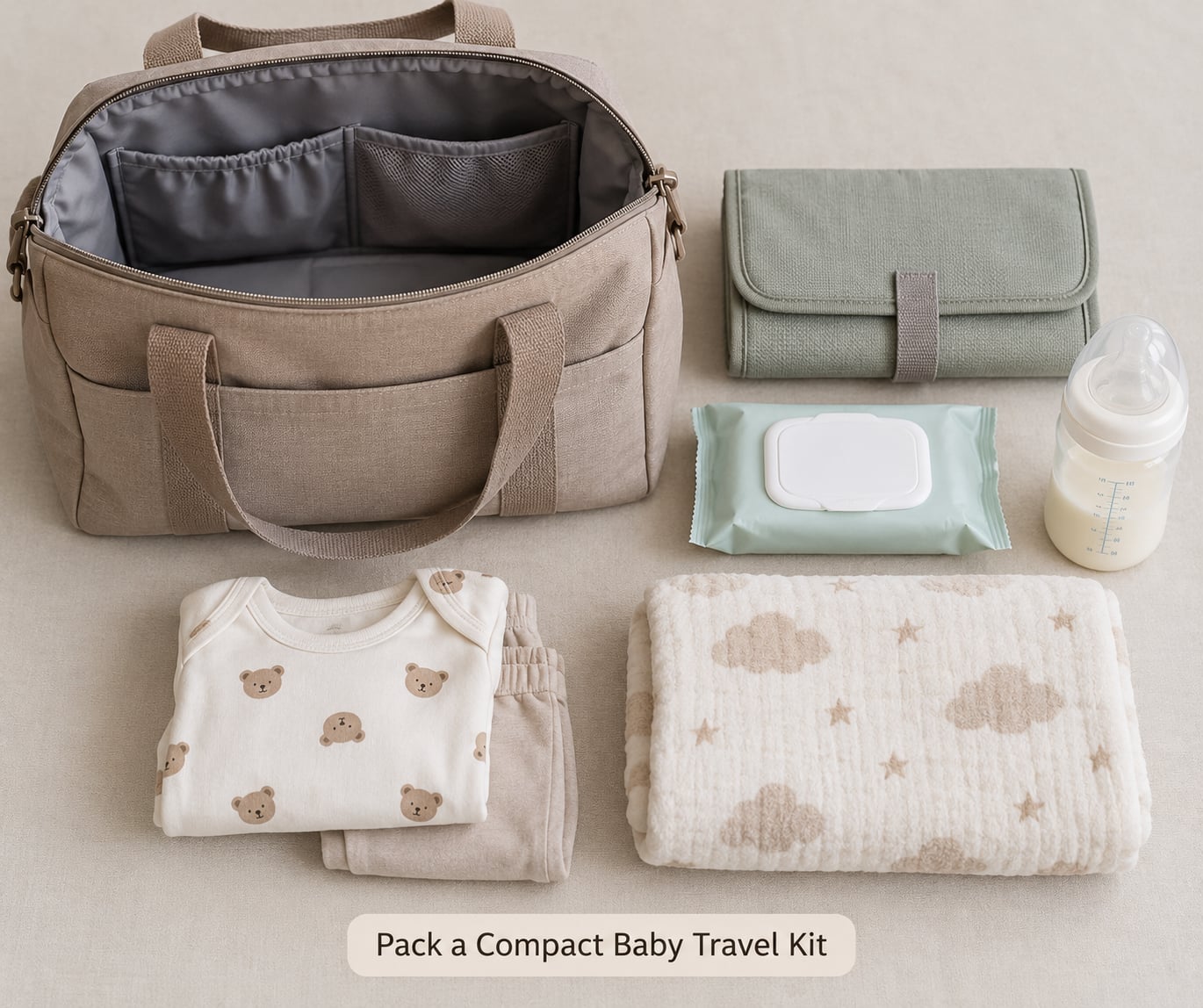
Pack one small bag you can reach without standing up, and keep it under your seat rather than in an overhead bin.
A workable carry-on kit covers five areas:
- Feeding: enough bottles or nursing cover for the flight plus a delay, formula or milk in the amounts your baby actually eats, a burp cloth, and one washable cup or bottle.
- Diapers: one diaper per flight hour plus two spares, wipes, a barrier cream, and small sealed bags for soiled diapers.
- Clothing: a full spare outfit for your baby and a spare top for you. Milk spills on a plane always find clothing.
- Safe sleep: a flat, firm, approved sleep surface if your baby is used to one, plus a familiar blanket or small lovey.
- Health and comfort: any medication already prescribed and approved by your baby’s doctor, a thermometer, hand sanitiser, a small pharmacy of basics, and one quiet toy that will not roll under the seat.
Cabin temperature swings, so dress in layers rather than one thick outfit. Bulkhead armrests on some aircraft do not fold, which limits how much room a carrier gives you.
Time Feeding Around the Travel Schedule
Feed your baby during takeoff and descent, because swallowing is what helps equalise pressure in their ears.
Write down your baby’s usual feeding and nap pattern before you start shifting anything, then work the flight around it rather than the other way around. If they normally eat every three hours, aim for a feed in the first hour of the flight, not right before you walk to the gate, since boarding delays routinely add time you did not plan for.
Allow extra time at the airport for this reason. A hungry baby plus a security queue plus a boarding delay is the combination most likely to end in crying, and it is entirely avoidable.
Give a bottle, nurse, or offer a pacifier during ascent and again during descent. Keep the pacifier within reach from the moment you sit down, because handing it over during a pressure change is a lost argument.
You will know this worked when takeoff happens during a feed rather than during a fuss. Avoid rigid feeding schedules on board: stretch or shorten feeds based on what your baby signals, and take breaks when offered.
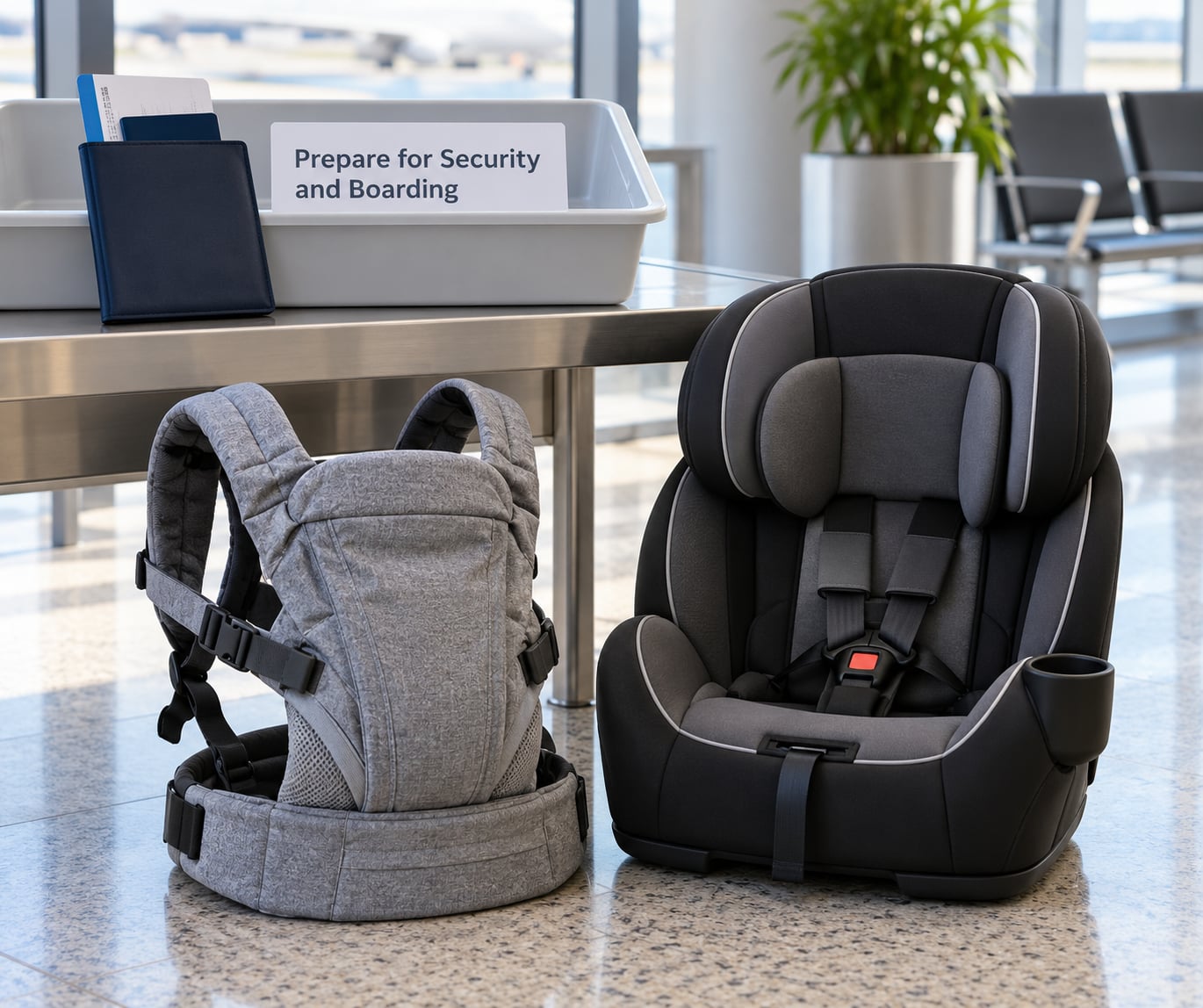
Prepare for Security and Boarding
Security and boarding go smoothly when your documents and essentials are already out before you join the queue.
Check your airport’s current procedure before you leave home, since screening rules and lane arrangements change. Then work in this order:
- Take your baby out of the carrier and remove any outer covering from the car seat before you reach the screening area.
- Send the stroller and car seat through the belt with everything else; they do not need to be emptied.
- Tell the officer what you are carrying when asked: formula, expressed breast milk, toddler drinks and puree pouches are all handled under their own rules rather than the standard liquids limit.
- Repack at the table, not in the queue, so you can find things without unpacking the whole bag on the floor.
- Board with your family group if one exists, or request assistance early, and board later rather than first so your baby spends less time strapped into a seat.
Change your baby’s diaper right before boarding. A clean start buys you an extra hour, which on a three-hour flight is the difference between a manageable day and a difficult one.
If you are flying with a car seat, have it installed and ready to hand over at the jet bridge for gate check. Keep your boarding pass and identification in a hand or neck pouch, not buried in a bag, so nobody has to unpack the stroller to find it.
Keep the Baby Comfortable in Flight
Most crying on a plane is a signal that your baby needs something: food, motion, a position change, or less stimulation.
Work as a team if you can. One adult handles the seat belt, the tray table and the belongings while the other holds the baby, which removes most of the awkward juggling described in parent accounts of feeding on board.
Try position changes before anything else: upright against your chest, facing forward on your lap, or a walk down the aisle when the seatbelt sign is off and the crew has cleared it. Movement settles a restless baby faster than a new toy does.
Keep the seat around you calm. A tray table wiped down, a small washable activity and one quiet toy for the first hour will go further than a bag of twenty items that all end up on the floor. Rotation helps on longer flights, but the object has to be safe to hold and hard to lose.
For noise, infant earplugs or properly fitted noise-reducing earmuffs are the safer option than adult headphones for a baby. Follow the airline’s rules about moving about the cabin, and skip any soothing approach that involves medication your baby’s doctor has not already approved for this situation.
Land, Collect Everything, and Reinstall the Car Seat
Arriving is a transfer operation, not the end of the trip, so plan it like a second boarding.
Check out of the aircraft with your baby and your essentials first, and keep documents in hand rather than in a checked bag. If you gate checked a stroller and car seat, expect them at either the belt or oversized baggage, and allow time for a bag to arrive late.
If you brought a car seat, install it properly before you leave the parking area. Read the instructions again if it has been in a bag for hours, and check the harness height and chest clip position with your baby in it rather than empty. It is normal to need two attempts.
Build in slack for feeding, a diaper change and a slow walk through a station or airport. Everyone arrives tired, including your baby, and rushing the last twenty minutes undoes the careful work you did at the start.
Common Mistakes
Nearly every problem parents describe after a first flight traces back to one of seven avoidable decisions.
- Working from outdated airline rules. Fix: confirm lap infant age limits, bassinet rows and gate check policy with the operating carrier in the week before you fly, and save the answer in your phone.
- Packing for a weekend when you are buying formula, nappies and clothes that are hard to find at your destination. Fix: bring the exact brand and size you use, plus one extra day, and buy only nappies on arrival.
- Feeding right at the gate. Fix: feed earlier, then change the diaper before boarding so your baby starts the flight comfortable.
- Boarding early because it feels safer. Fix: board later when the airline allows it, so your baby is not sitting in a full cabin before the flight even starts.
- Waiting until crying is loud before responding. Fix: watch for early signals such as turning away, fussing with hands, or changes in breathing, and act on those.
- Using medication without professional guidance. Fix: ask your baby’s doctor before the trip about any product you are considering, and follow the dosing for your child’s exact weight.
- Assuming the schedule holds. Fix: carry a change of clothes, feeding supplies and a phone charger, and know the airline’s rebooking process before you need it.
A few small habits pay off repeatedly: carry the essentials in one place, keep one outfit change per travel day in the bag rather than a suitcase, and accept that the flight will not be the calm part. It is the part you can control, and that is enough.
Frequently Asked Questions
Can a newborn fly on a plane?
Most airlines accept infants from around 7 days old, and some require a medical note from your baby’s doctor for very young infants. Many paediatric guidance and airline policies suggest waiting a few months if the trip is optional, because newborns have less mature ear canals and airways. Check the operating carrier’s minimum age rule and ask your baby’s doctor before booking. Rules and medical advice vary by country, so the airline and your doctor are the right sources for your specific trip.
Do airlines allow babies to sit independently during takeoff and landing?
No. Even when a baby has their own seat, airlines require the child to be held securely or properly restrained for takeoff and landing, and a lap infant must stay on your lap for the entire flight rather than being placed in an empty middle seat. A restraint device approved for aircraft use is a different matter and should be confirmed with the airline in advance. Ask at check-in how they want the seat belt and child arrangement handled before you board.
What can I bring for a baby through airport security?
Formula, expressed breast milk, toddler drinks, medically necessary liquids and puree pouches are allowed through security regardless of container size, and screeners may ask to test them. You may bring formula and milk for the whole trip even when passengers usually carry only a small amount of liquid. Items such as medicine, thermometers and basic health supplies are also fine. Strollers and car seats go through the belt without being emptied. Your airport’s own guidance is the definitive reference for your route.
How should I feed a baby during a long flight?
Feed on your baby’s own rhythm rather than a fixed timetable, but plan the first feed to land during takeoff and a second to fall during descent, since feeding helps your baby swallow and equalise ear pressure. Bring enough for the flight plus a delay, keep spare bottles sealed, and take breaks when the crew offers them. If you breastfeed, bring a cover you are comfortable using and note that a quiet seat or an aisle makes feeding far easier. Allow time for a feed and a change after landing as well.
What is the best way to stop a baby from crying on a plane?
Act early. Respond to early fussing rather than waiting for crying, because a settled baby is much easier to settle than a crying one. Try a position change, upright on your chest or facing forward, then a walk down the aisle when the seatbelt sign is off. Check hunger, temperature, a trapped hair or wrist under a strap, and whether the noise level has become too much. One calm adult holding the baby while the other manages the space helps more than any single trick.
Can I use sedating medicine to help a baby sleep on a flight?
No. Sedating a baby for a flight is not recommended, because a sedated infant may be harder to wake if there is a problem, and it does not reliably produce sleep. If your baby is unsettled because of congestion, pain, teething or a recent illness, speak with your baby’s doctor before travelling and before using any product. Ask your doctor about what is safe for your child’s age and weight, and follow their dosing exactly. Jet lag is better managed with routine and timing than with medication.
Conclusion
The smoothest flight is the one that is prepared two weeks out, not two hours before departure. Confirm the airline’s infant rules for the operating carrier, check that every document you need is valid for the destination, and rehearse the airport routine once at home with the bag packed.
From there it is simple: feed around takeoff and descent, keep the essentials in one bag under your seat, board later rather than first, and plan the arrival with the same care as the departure. Start by making one call to the airline.