In the United States, there are firm rules for how airlines accommodate passengers with disabilities, because the law requires it: the Air Carrier Access Act of 1986, enforced by the Department of Transportation under 14 CFR Part 382, and the Airline Passengers With Disabilities Bill of Rights. That covers assistance at the airport and on board, mobility aid handling, priority seating, travel with assistive devices and service animals, and a way to complain when it goes wrong.
Air travel is one of the few forms of transport where almost every part of the journey runs through fixed, narrow infrastructure. Jet bridges, security queues, cabin aisles and compact lavatories leave no room for improvisation, and there is usually no alternative route. That is why a request logged with an airline in advance behaves so differently from the same request made at the gate.
This guide walks through the whole journey, from the first phone call to the moment your chair comes back out of the cargo hold. It is written for US domestic trips and international flights touching US airports, and it flags where Canadian and European rules differ.
Table of Contents
- 1What Airline Disability Accommodation Includes
- 2Where the rules come from
- 3What airlines are not required to do
- 4Who Is Eligible for Airline Assistance
- 5Hidden and non-apparent disabilities
- 6Can airlines ask for proof of disability?
- 7How to Request Assistance Before Your Flight
- 8How Airlines Accommodate Passengers with Disabilities at the Airport
- 9What Help Is Available During the Flight
- 10Rules for Wheelchairs and Other Assistive Devices
- 11Aircraft accessibility rules by size
- 12Manual and powered mobility aids
- 13Flying With a Service Animal
- 14Your Rights if Accommodation Is Not Provided
- 15Frequently Asked Questions
- 16Do I need a doctor’s note to request airline disability assistance?
- 17Can a family member or caregiver travel with me in a cabin seat?
- 18Does buying a separate seat guarantee my wheelchair or assistance animal can fit?
- 19What should I do if my wheelchair is damaged during the flight?
- 20How far in advance should I contact the airline about special assistance?
What Airline Disability Accommodation Includes
Airline disability accommodation is the set of services a carrier must provide on request so a passenger with a disability can complete a trip with equal access: help enplaning and deplaning, transfer or boarding assistance, priority stowage for mobility aids, seating accommodations within the booked cabin, accessible information, assistive devices carried free in the cabin, and a formal complaint process.
It is worth separating that from preference. A free upgrade, a special meal for a dietary restriction, extra luggage or a preferred seat at the front of the cabin are customer-service gestures that vary by airline and by how full the flight is. Disability accommodations are not gestures. They are obligations, and they cannot be sold away, waived at check-in or denied because the aircraft is full.
Where the rules come from
The Air Carrier Access Act applies to any air carrier that sells or offers flights to, from or within the United States, so a foreign carrier operating a US route is bound by it just like a US carrier. Canada has its own Accessible Transportation for Persons with Disabilities Regulations, and the European Union applies Regulation EC1107/2006, which uses the term accompanying person where US law says personal care attendant.
Here is how the main pieces of US protection fit together.
| Source | What it does |
|---|---|
| Air Carrier Access Act of 1986 | The statute that makes disability discrimination in air travel unlawful and sets the broad duties of carriers |
| 14 CFR Part 382, Subpart F | The binding DOT rules on boarding assistance, assistive devices, seating, service animals and complaints |
| Airline Passengers With Disabilities Bill of Rights | The plain-language summary every carrier must publish, covering ten core rights |
| DOT Aviation Consumer Protection Office | The federal office that investigates complaints and can enforce the rules |
| Accessible Transportation for Persons with Disabilities Regulations | The Canadian equivalent, including the One Person, One Fare domestic policy |
| Regulation EC1107/2006 | The EU framework applied by member state authorities and airport operators |
What airlines are not required to do
Airlines do not have to give you a specific seat, do not have to provide personal care in the cabin, and do not have to waive the fare difference if the only workable seat is in a higher cabin class. They also do not have to accept an emotional support animal as a service animal, and they generally may not ask you to prove a disability before they board you.
Flight attendants can open a package, identify food and hand you items, but they are not permitted to feed you. That line trips people up constantly, so it is worth knowing before you rely on crew for help with eating.
Who Is Eligible for Airline Assistance
Anyone with a physical, sensory, cognitive, intellectual or mental-health need that affects their ability to travel can request assistance. That includes wheelchair users, people who are blind or hard of hearing, autistic passengers, travellers with chronic illness or fatigue, and anyone who needs a personal care attendant, extra legroom, help stowing a device, or a seat near a moveable aisle armrest.
You do not have to use the word disability, and nobody is entitled to inspect you. If you need help getting to the gate or need to board before the general line, asking for priority preboarding in plain terms is enough.
Hidden and non-apparent disabilities
Autistic travellers, passengers with chronic pain, invisible gastrointestinal conditions and people recovering from surgery are not a special case. Preboarding, extra time at the gate and written boarding instructions are exactly the tools that help, and they are available on request.
Families travelling with autistic children report that verbal reassurance at the gate is inconsistent, so written step-by-step instructions sent before travel day make a measurable difference. Sensory distress from announcements is real too; there is no rule that lets a carrier mute the cabin, but many will let you board early and board back first, which is usually the bigger win.
Can airlines ask for proof of disability?
Generally no. US rules let carriers ask what assistance you need, but not for medical documentation as a condition of boarding you. Documentation can surface in narrower situations, such as a safety assessment of a service animal, a mobility aid battery, or a request to travel with a safety assistant, but it is not a routine gate checkpoint.
How to Request Assistance Before Your Flight
The single strongest predictor of a smooth trip is a logged request made to a person, not a form. Here is the sequence that works.
- Call the operating airline, not just the website. Phones run through the accessibility desk, and travellers report that roughly 48 hours is the point at which staff can actually act. Later requests tend to be noted rather than arranged.
- Say that you need disability-related assistance. Describe each item separately: aisle-chair transfer at the gate, help to and from the aircraft door, preboarding, boarding assistance at your destination, a caregiver travelling with you, or a service animal.
- Give equipment details. Give the type, dimensions, weight and whether the chair is manual or powered, plus battery type. For a service animal, give the species, size and service tasks the animal is trained to perform.
- Ask for the record number and the name of the person you spoke to. Wheelchair users say the named contact is what turns a request into something that survives a gate change.
- Confirm the request in writing and attach it to your booking, then check the same details in the airline app or website.
- Reconfirm 48 to 72 hours before departure and again the day before. Ask the destination airport to carry the request through if you are connecting.
- Confirm your seating as early as possible, since bulkhead rows and seats with moveable armrests fill quickly and a late change is where requests get lost.
Deadlines and procedures vary by airline and by route. Some carriers publish a 48-hour minimum, others ask for 72 hours on international itineraries, and most will still try to help on the day, with less reliability.
How Airlines Accommodate Passengers with Disabilities at the Airport
Arriving at the airport with a confirmed request means you move through a known sequence rather than improvising. Allow at least an hour before departure for check-in and screening, and add generous buffer on connections.
- Check-in and bag drop. Present your request at the counter or the special assistance desk. Ask whether your chair travels in the cabin or the hold, and get the tag number if it is checked.
- Security screening. Airport staff conduct the screening, not the airline. You may ask for a private screening and for support to reach the checkpoint, and many airports will issue a gate pass for an unticketed person who is walking you through.
- The long wait at the gate. Allow ninety minutes or more. Mobility aid loading routinely happens last, and that delay is the most common reason a wheelchair user misses a connection.
- Preboarding. Boarding starts for passengers who requested it, usually with the door still on the jet bridge.
- Boarding help. Staff will bring a boarding chair to the aircraft door, transfer you if you want that, and move your device separately. Tell them clearly whether you want a transfer or to walk on your own chair.
- Connections and transfers. Requested assistance is carried through when the request was made in advance. Without a logged request, each airport treats you as a new passenger.
- Deplaning and reclaiming the chair. Assistance is provided at your destination airport, not just your origin. Your mobility aid is normally returned near baggage claim or delivered by an airline agent.
Tell staff what you actually need each time. Crew who are told only that a passenger has a disability will guess, and guessing goes wrong in both directions.
What Help Is Available During the Flight
Onboard support covers announcements, transfers, stowage and briefings. It does not cover personal care, and it varies a lot by aircraft type and cabin crew familiarity.
| Provided by the airline | You supply yourself |
|---|---|
| Transfer to and from the aisle seat with a boarding chair and crew assistance | Your everyday wheelchair, walker, cane or transfer board |
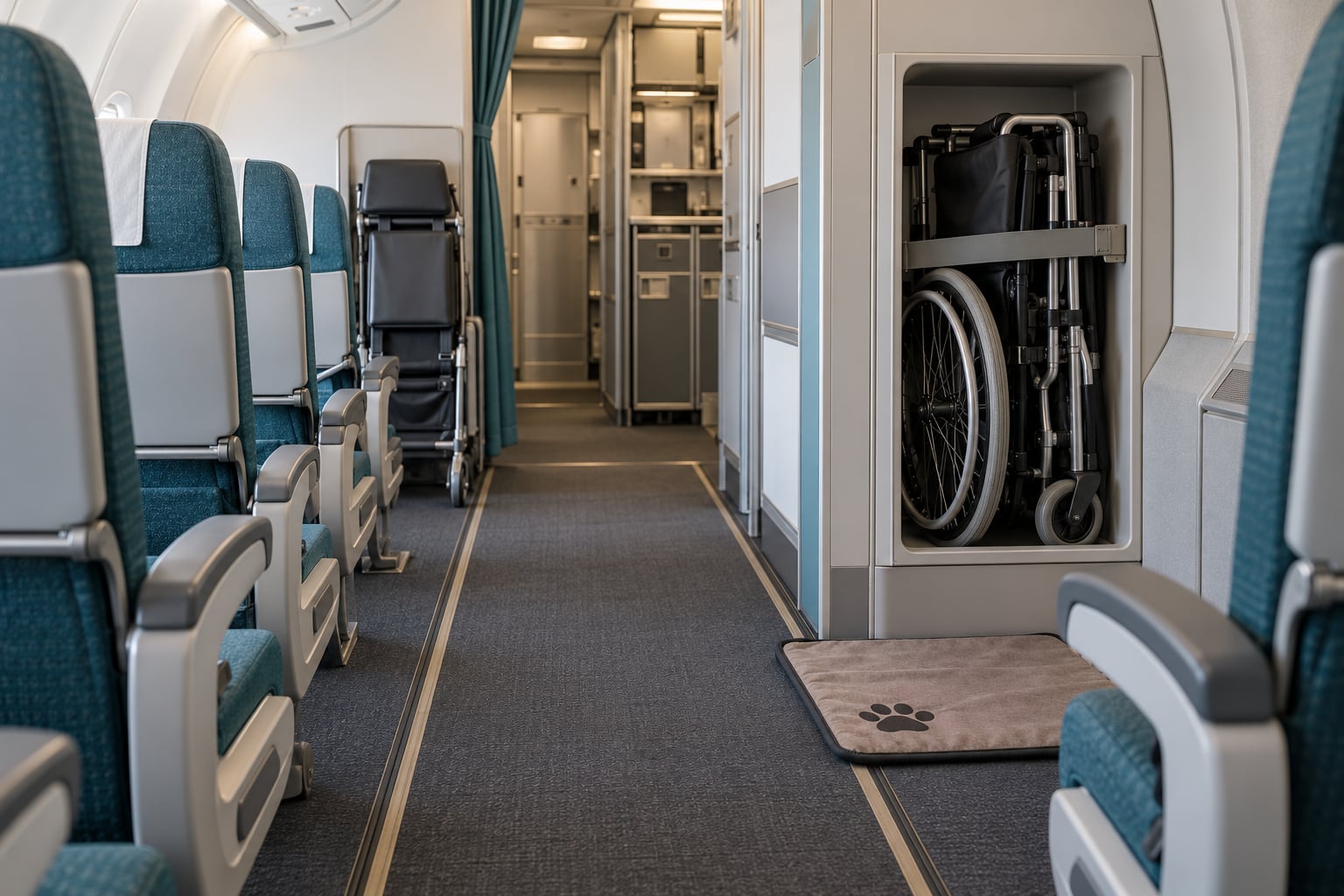
| Stowage of your folding or rigid cabin wheelchair in a cabin closet or bulkhead bin | A removable cushion if your seat needs one |
| Spoken and visual safety briefings, including cabin demonstrations at the door | Your hearing aid, cochlear implant processor and assistive listening device |
| Priority stowage space for a power wheelchair in the cargo hold, loaded first and unloaded last | Assistive devices, which travel free as cabin items and never count against your allowance |
| Assistance with your service animal at boarding, and a relief area before takeoff and after landing where available | Water, food and any medication the animal needs |
| Accessible seating on aircraft that have it, and an onboard lavatory on multi-aisle aircraft | Medical supplies, since no aircraft has a full medical kit for passenger use |
Accessible lavatories are only required on multi-aisle aircraft. On single-aisle planes the answer is no, which is why travellers who rely on them plan timing carefully before boarding and after landing, and some carry their own portable equipment.
Rules for Wheelchairs and Other Assistive Devices
Your mobility aid is not baggage. Under US rules assistive devices are carried free of charge, mobility aids are given priority stowage, and a chair may travel in the cabin if it can be safely stowed and secured.
Aircraft accessibility rules by size
| Feature | Applies to |
|---|---|
| Moveable aisle armrests | Half of aisle seats on aircraft with 30 or more passenger seats delivered after April 1992 |
| Priority stowage space for a passenger’s wheelchair | Single-aisle aircraft with 100 or more passenger seats delivered after March 2010 |
| Accessible lavatory | Aircraft with more than one aisle |
| Wheelchairs and other assistive devices in the cabin | All carriers, provided the device can be stowed safely and does not obstruct service |
Manual and powered mobility aids
A manual chair is the easiest case: give the dimensions so it fits a cabin closet or a first-class bulkhead bin, and ask whether the flight has one. Powered chairs with removable or spillable lithium batteries are permitted with airline approval, and the battery must be handled according to hazmat rules, so declare it early.
Oxygen concentrators are permitted on board with advance notice and set limits on the type and quantity. Walkers, canes, crutches, hearing aids, screen readers and similar aids travel as cabin items without charge. For hearing aids and cochlear implants, check whether the aircraft has an induction loop and whether any seat you want has the right connector, because that is an aircraft feature, not a promise.
If a chair is damaged or lost, report it at the airport before you leave, get a written record, and file a claim. Power chair users describe a persistent fear of getting a chair back with broken wheels or a dead battery, and the fix is photograph everything before you hand it over and again on arrival.
Flying With a Service Animal
Under DOT rules a service animal is trained to perform tasks directly related to a disability, and airlines must accommodate it in the cabin at no charge. An emotional support animal is not covered, and since the federal rules were narrowed most US carriers now treat a pet as a pet, subject to the airline’s own fee and policy.
Airlines can require the DOT Service Animal Relief Attestation forms in advance, and can deny an animal that poses a direct threat, disrupts the flight, or arrives without the required paperwork. Foreign law sometimes conflicts with the US rule on a flight between the US and that country, and in that case the airline does not have to provide the seat to the animal.
Travellers report staff inspecting, weighing or questioning animals, which the rules do not permit as a condition of travel. If that happens, ask for the specific requirement in writing and note the name and position of the employee. For a pet travelling in the carrier’s regular cabin, weight and carrier-size limits apply instead, and those are a separate policy question with nothing to do with disability rights.
Your Rights if Accommodation Is Not Provided
When assistance fails at the gate, the priority is getting on the flight, not winning the argument. Do not refuse to board while a supervisor is called, because a missed flight usually ends the trip and removes your leverage at once.
- Stay calm and state the request plainly. Repeat what you requested, that it is confirmed, and that you are citing 14 CFR Part 382.
- Ask for a supervisor and for the assistance to be delivered, including a gate agent walking you to the aircraft.
- Write down what happened after landing: the date, the flight number, the airline, the names and positions of every employee you spoke to, and what was refused.
- Contact the airline’s accessibility office or its Complaint Resolution Official. Airlines must designate a CRO and give you their name and contact details on request.
- File a written complaint with the DOT within 45 days of the incident. Airlines generally have 30 days to respond.
- Call the DOT Disability Hotline at 1-800-778-4838 if you need to talk it through with someone before you file.
This is general information about how the complaint process works, not legal advice. If a claim involves significant money or a discrimination allegation, a disability rights organisation in your state can help you file it properly.
Frequently Asked Questions
Do I need a doctor’s note to request airline disability assistance?
No. US rules let airlines ask what assistance you need, but not for medical documentation as a condition of boarding you. Documentation can come up in narrower situations such as a service animal safety assessment, a mobility aid battery, or a request to travel with a safety assistant. Describe the assistance you want, and give yourself at least 48 hours so staff can arrange it.
Can a family member or caregiver travel with me in a cabin seat?
Usually yes, and in four defined situations US rules require the airline to provide an adjoining seat without charging the passenger for it: the traveller needs the cabin to use an assistive device, needs the cabin because of a disability the traveller does not cover, has a service animal, or needs a personal care attendant or safety assistant. Otherwise you buy the seat like any other passenger.
Does buying a separate seat guarantee my wheelchair or assistance animal can fit?
No. A separate seat pays for a seat, not for stowage or cabin space. Your wheelchair travels in the cabin only if it can be safely stowed and secured, which depends on the aircraft and the seat you buy, so ask about closet and bulkhead space before choosing a fare. A service animal does not consume a seat in most cases, but airlines still require the relief forms.
What should I do if my wheelchair is damaged during the flight?
Report the damage before you leave the arrivals area, ask for a written damage report, and photograph the chair as it comes off the belt. Keep your equipment tag number and file a written claim with the airline as soon as you can. If the response stalls, contact the Complaint Resolution Official and file with the DOT within 45 days of the incident.
How far in advance should I contact the airline about special assistance?
Around 48 hours is the practical minimum for US domestic flights, and 72 hours is safer for international itineraries and multi-leg trips. Ask the operating airline, get the reference number and the name of the person you spoke to, then reconfirm a couple of days before departure. Airports vary widely, so more notice beats less.
Start with one phone call at least 48 hours before departure, list every assistance you need as a separate item, and ask for the reference number and the name of the person who logged it. That single habit is the difference between how airlines accommodate passengers with disabilities as a policy on paper and how they handle you on the day.
Rules change, and they differ outside the US, so check the operating airline’s current accessibility page and your departure airport’s services before every trip rather than relying on what worked last time.