Long haul flights fail for boring reasons: boredom, an aching ear on descent, a missed nap, and a toddler who has finished every activity you packed. Learning how to travel with kids on a long haul flight comes down to preparation, and you can do almost all of it before you leave the house. A flight of eight hours or more crosses time zones and drains everyone, so treat the trip like a small expedition rather than a commute.
What follows is the system I hand friends with two under-fives: what to sort out weeks ahead, how to pack, how to run the airport, what to do at 30,000 feet, and how to get everyone back onto a normal clock on the other side. It takes about 30 minutes of planning per hour of flight time, and it works.
I am not going to tell you it is easy. Parents on travel forums describe the honest version: flying with a toddler is doable, but only with military-grade planning. Delays and cancellations are harder than the flying itself.
Table of Contents
- 1What You Need
- 2Documents and bookings
- 3Health supplies
- 4Comfort items
- 5Calm and entertainment
- 6How to Travel with Kids on a Long Haul Flight: Step-by-Step
- 7Choose Flights That Fit Your Child
- 8Pack for the Flight, Not Just the Destination
- 9Prepare for the Airport and Boarding
- 10Keep Children Comfortable During the Flight
- 11Handle Sleep, Jet Lag, and the Arrival
- 12Common Mistakes to Avoid
- 13Frequently Asked Questions
- 14What is the hardest age to fly with a child?
- 15How to survive a long haul flight with a toddler?
- 16Should I give my toddler melatonin or antihistamines to sleep on a plane?
- 17How do you get through airport security faster with kids?
- 18Can I bring baby food and formula through airport security?
- 19How do I request a bassinet on an international flight?
What You Need
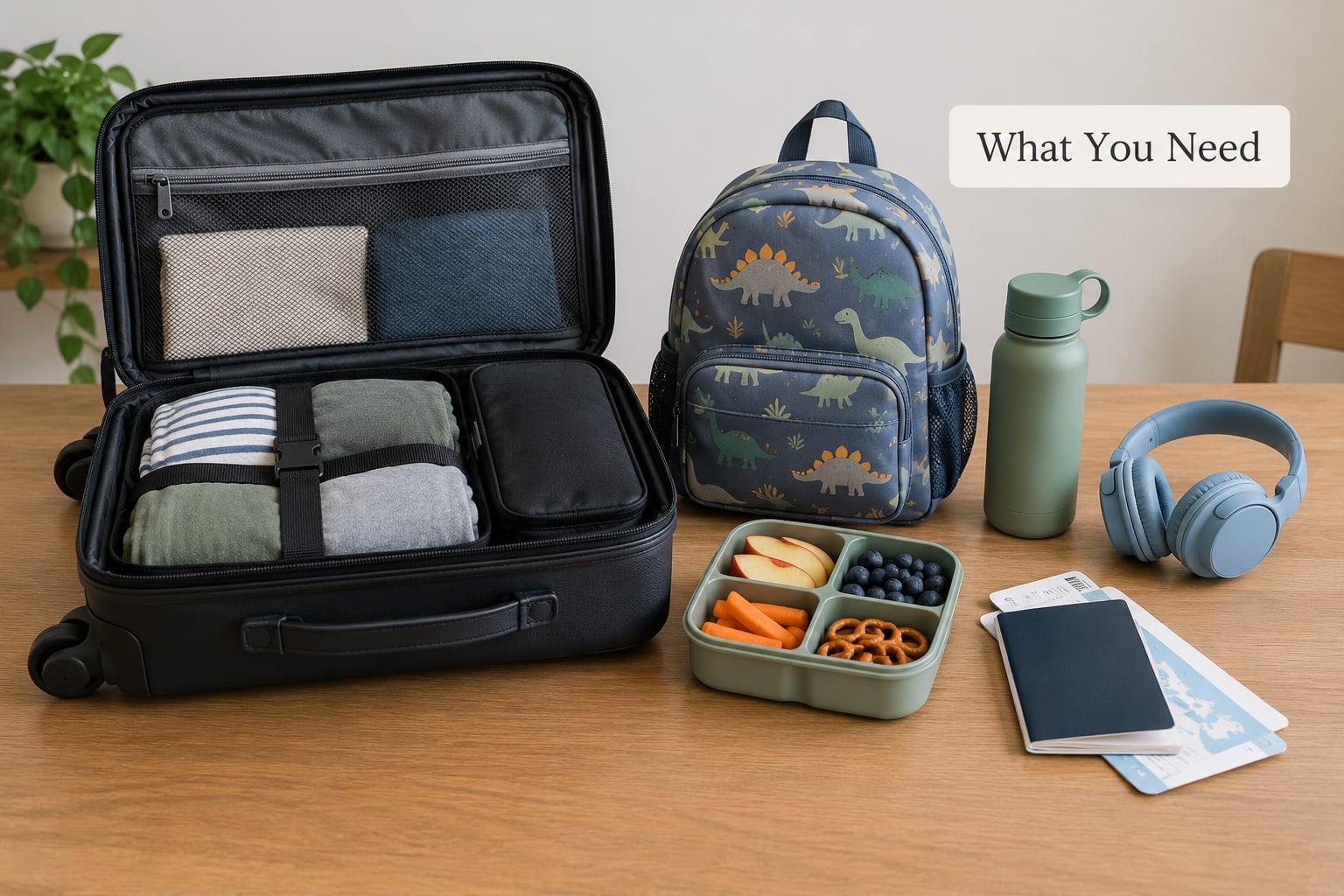
The list below is what you arrange before departure, because almost nothing on it can be bought once you are in the air. Sort it in four groups: documents, health, comfort, and calm.
Documents and bookings
- Passport for every child, valid for the required period beyond your travel dates.
- Visa paperwork for the destination, plus any transit-country visa for connecting airports.
- Consent letter from the non-travelling parent, especially for solo travel or international routes.
- Birth certificate copies, useful when an airline or border officer asks for proof of age.
- Medically assisted traveller form if an infant needs oxygen or has a specific medical need. Airlines ask for this in advance.
Confirm the seating, meal requests and any special service through the airline directly, not only the booking site. Bassinet requests are the classic example: you ask at booking, get a reference, and reconfirm by phone or message 48 hours before departure.
Health supplies
- Any prescription medication in original packaging, plus a copy of the prescription.
- A small first aid kit with plasters, antihistamine suitable for your child’s age, and anything they use for travel normally.
- Dose timing written down in flight hours, not clock hours.
- Motion sickness advice from your child’s doctor, in advance. Not every option suits every age.
Keep medication in your own carry-on, never in a checked bag. If a bag goes missing at the far end, you still have it.
Comfort items
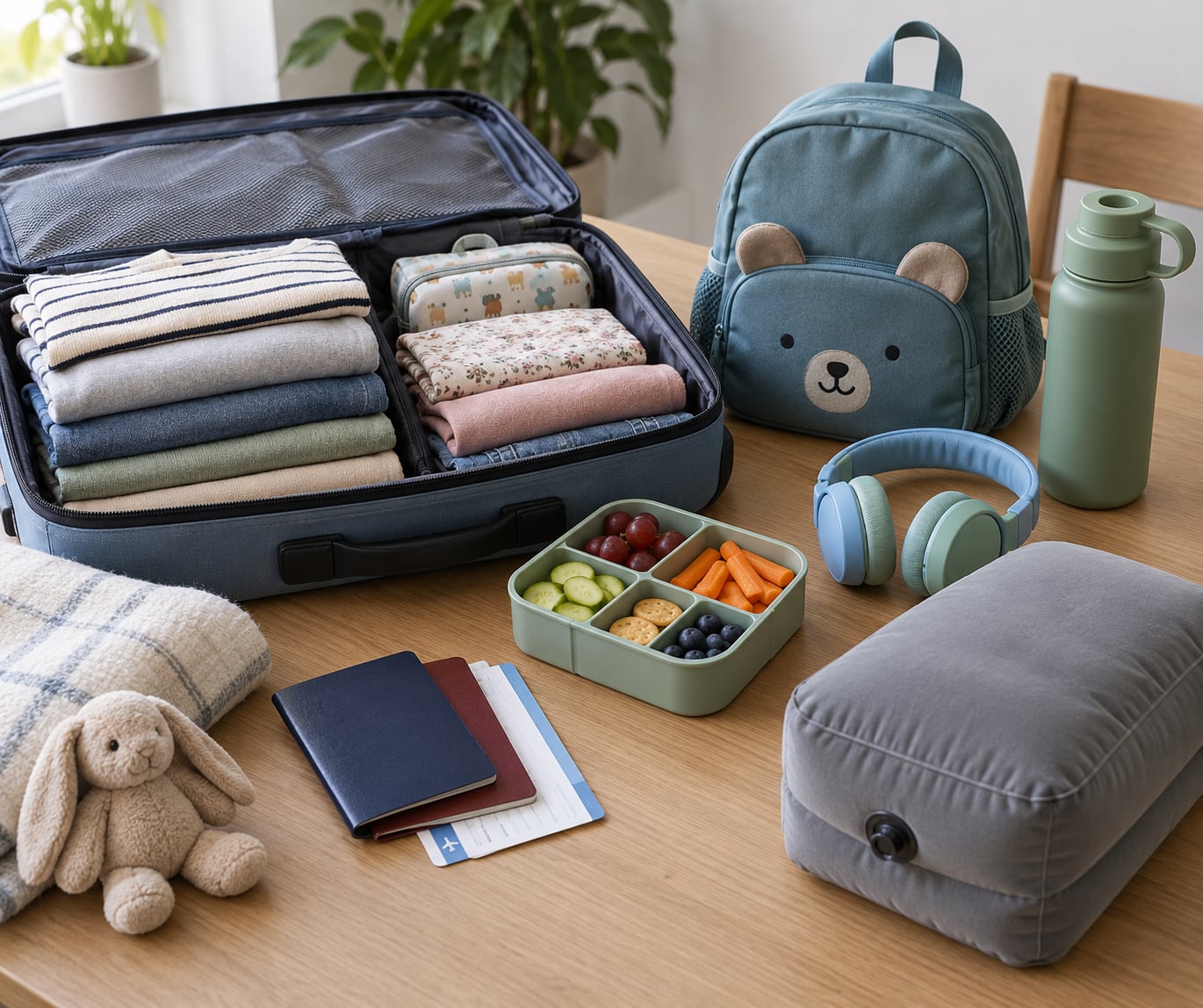
- An inflatable footrest, because most economy seats are too deep for a small child to sit flat and their legs dangle uncomfortably.
- A wrap-around travel pillow rather than a horseshoe one. The horseshoe shape pushes a child’s chin forward and a sleep position they cannot hold.
- A soft, wipeable tray table cover with pockets for crayons and small toys.
- A refillable water bottle that clips to the bag. Cabin air is dry and children dehydrate quietly.
- A bento-style snack box with separate compartments, so nothing crumbles into the seat crevices.
Calm and entertainment
- Child headphones that fit small ears, for the engine noise and for screens.
- A tablet with downloaded shows and games, plus headphones for each child.
- A power bank, since seat power is unreliable and your own battery is the family’s backup.
- A small novelty toy they have not seen in a week or two. Familiar favourites get boring by hour three.
- A Bluetooth tracker in the checked bag, so you know where it is when it vanishes on the carousel.
How to Travel with Kids on a Long Haul Flight: Step-by-Step
Choose Flights That Fit Your Child
Pick nonstop routes and give yourself at least three hours between connections when small children are involved. Most families underestimate how long a connection takes with a tired toddler, a stroller and a bathroom stop. If you must connect, look for the shortest possible layover your child can handle rather than the cheapest itinerary.
Departure time matters as much as route. A flight that leaves at the usual bedtime can turn an overtired child into a screaming one in the terminal, and an overtired child rarely sleeps on a plane. Many families book late-morning departures for overnight long hauls so nap time lands mid-flight, which means arriving early enough to enjoy part of the first day.
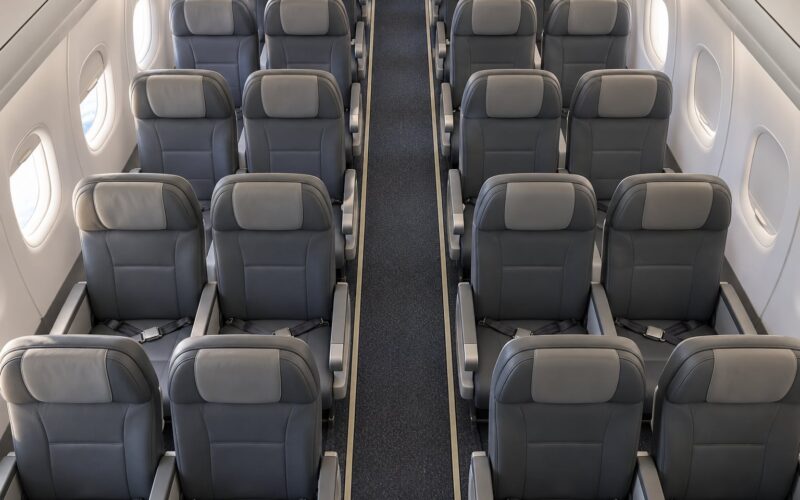
For seat choice, match the seat to the child’s age and temperament rather than to a habit.
| Seat type | Works best for | Trade-off |
|---|---|---|
| Bulkhead | Under-3s who need floor space | More legroom, but the armrests do not lift for lap sleeping |
| Aisle seat | Toddlers and solo parents who need fast toilet trips | More legroom to stand in, less privacy for feeding |
| Window seat | School-age kids, older infants asleep in a carrier | Calmer, but trapped when a neighbour needs to move |
| Under the wing | Any child who needs to nap | Louder cabin, and the steady engine drone works as white noise |
Leave the seat next to you free if you can pay for it, and check whether your airline charges separately for seat selection on long haul. Ask about bassinet availability early, since most aircraft have a limited number and the weight limit is typically around 12 kg with the child inside.
Pack for the Flight, Not Just the Destination
Give each child one personal bag they manage themselves. Toddlers who own their own bag move through terminals faster and behave better, because the bag is a job rather than a thing you are doing to them.
Pack in layers that can be adjusted mid-flight. Avoid jeans on a long haul flight: the fabric is stiff, holds warmth, and offers no stretch when a child needs to curl up across two seats. Soft, loose layers that can be peeled off when the cabin gets warm work far better.
Then build the activity rotation. Bring more options than the flight has hours. In our experience a three-year-old cycles through an activity in 30 to 45 minutes, so a ten-hour flight needs roughly a dozen small items, not three big ones. Rotate rather than present everything at once, and hold two items back for the last two hours.
Put everything within reach in the seat pocket or a personal bag. Nothing that matters goes in the overhead bin, because the bin empties when people board mid-flight and getting a bag down means waking a sleeping child.
For food, pack familiar snacks from home rather than planning to rely on the airline meal. Children routinely reject unfamiliar airline food, and a hungry six-year-old at hour nine is a problem no activity list solves. Choose snacks that survive eight hours: crackers, nut butter packets, dried fruit, cheese sticks, whole-grain crackers. Keep a spill cloth in the tray cover pocket, because yoghurt pouches and juice do end up on clothing.
Finally, plan for the delayed bag. Pack one full day of clothes, medication and nappies in the cabin, and ship nothing essential to a connecting airport you cannot reach easily.
Prepare for the Airport and Boarding
Check in online the night before and keep every document in one folder, on your phone and on paper. Check-in queues with children are one of the most reliable generators of stress, and avoiding them is free.
Build the family a bathroom card before leaving the hotel or home. Young children can handle the next toilet if they know where it is and that they are allowed to go. That one card prevents most of the in-aisle emergencies that strangers find hardest to watch.
At security, put liquids, laptops and tablets in separate bins so you are not unpacking everything with a squirming child. Baby food and formula can go through the checkpoint, but rules vary by country and the liquid allowance for milk and formula often differs from the standard one. Check your departure airport’s rules rather than assuming.
Two boarding strategies work well, and which one suits you depends on your child. Board early to get overhead space and a calm settle before the cabin fills. Or skip early boarding and walk the departure lounge until the last call, which burns off energy and often makes the flight itself easier. A wired-off toddler arriving mid-calm is a losing start.
Whatever you pick, tell your child what happens next in words they can hold: we walk to the plane, you sit in your seat, an adult shows us where to sit down, then we take off. Give it a name they repeat back. Simple, accurate, no surprises.
Have one small familiar item in your hand at boarding. Whether it is a sticker sheet or a soft toy, it buys you the two minutes of walking down the aisle and getting everyone buckled.
Keep Children Comfortable During the Flight
Settle the seat before takeoff: footrest inflated, pillow in place, water filled, tray table clean, headphones on. Ten minutes of setup buys you a much calmer flight than an hour of troubleshooting later.
Move the children early. Cabin crew will usually let families walk the aisle or visit the toilets during the cruise phase, and a ten-minute walk resets a restless child for another hour and a half.
Watch the descent closely for ear pain, which mostly happens on the way down. Offer water, a snack, gum for older children, or a lollipop to keep the mouth moving. For infants, feeding during descent helps them swallow and equalise. A pacifier can do the same job in a baby who is not hungry. The yawning trick works too.
Do not reach for medication to force sleep without asking your child’s doctor first. Melatonin and antihistamines are the two parents ask about most, and both raise real questions about age and dose. General advice for children is to talk to your pediatrician rather than work it out at the gate.
On screens, relax your own rules with a plan. Decide in advance that the flight gets unlimited screens, and tell your child before you board rather than mid-tear. The version of this that works is a rotation: one show, then forty minutes of a physical or hands-on activity, then another show. The rotation is what stops the boredom spiral, not the screen time itself.
For the tray table chaos, keep a small wipe and a fabric cover in reach, and accept that the middle of the flight will be messy. Clean it before the meal service, not after a spill.
If a meltdown starts, lower your voice and shorten your sentences. Statements work better than questions: it is too loud here, we are putting shoes on now. Rewards work poorly mid-flight because the child cannot connect the reward to a later payoff hours away.
Handle Sleep, Jet Lag, and the Arrival
Jet lag is easier to prevent than to cure, and the trick is shifting the body clock before you fly rather than after you land. For trips of more than five time zones, start moving your child’s bedtime earlier or later by 30 to 60 minutes a day for three days before departure, and shift naps the same way.
On the plane, keep the local clock in mind in one simple way: sleep when the destination says to sleep, eat when the destination says to eat. For an evening departure, aim for one long sleep in the middle of the flight. For a daytime departure, plan a nap and keep the evening meal on time at the destination.
Light does most of the work. On arrival, get outside and into daylight as soon as you can, and keep indoor lighting low that evening. Skip daytime naps if your child is fighting the new clock, even when they insist on one.
For the first 24 hours, plan an easy day. No museums, no timed attractions, no car seat install in a hotel parking lot at 11 pm. Feed them on arrival, get them outside for light, and put them to bed at the local bedtime even if that means an early wake-up.
Keep the first meal simple and local. It is not the time to test a new restaurant, especially with a child running on airline snacks and three hours of sleep.
Common Mistakes to Avoid
Most long haul flights go wrong in predictable ways. Here are the seven mistakes I see most, and the fix for each.
- Board early every time. Fix: pick one approach per trip. Early boarding gives you space and a calm settle; last-call boarding burns energy. Alternating strategies leaves you unprepared for both.
- Pack three activities for a twelve-hour flight. Fix: pack twelve small ones and reveal them slowly, keeping two back for the end.
- Plan meals around the airline menu. Fix: bring your child’s usual snacks and treat the airline food as a bonus, not the plan.
- Skip the pre-flight shift. Fix: move bedtimes and naps by 30 to 60 minutes a day for three days before a big time zone change.
- Give sleep medication without a doctor’s advice. Fix: call your pediatrician a week ahead and ask about age, dose and timing.
- Seat a baby on a lap for the whole flight. Fix: consider a separate seat from the start. Families report lap seating becomes painful past four or five hours with any weight, and most aviation authorities recommend an approved child restraint instead.
- Under-pack the carry-on. Fix: assume the checked bag is delayed and pack one full day of everything inside the cabin.
Two more habits help more than any gear. Walk the airport to burn energy before boarding, and stay polite to the crew. Flight attendants control boarding priority and where you can sit with a bassinet, and they are more helpful than the internet suggests.
If your child will not sleep no matter what you pack, stop trying after hour two. A quiet, calm, low-stimulation hour with a blanket and a slow movie beats an hour of white-knuckled forcing. Sleep on the flight is a bonus, not a goal.
Frequently Asked Questions
What is the hardest age to fly with a child?
Most parents point to age two, and a lot of the difficulty lands between 18 months and three years. The child is mobile, has strong opinions, and often cannot sit through a meal or a movie. Under-twos also tend to fight sleep in an unfamiliar seat. Babies under one are usually easier in a carrier, and children over five can be genuinely good travellers with a screen and a book.
How to survive a long haul flight with a toddler?
Aim for rotation rather than one long activity: a screen, then forty minutes of something physical, then a snack, then another show. Move the toddler early and often by walking the aisle during the cruise. Bring snacks they recognise from home instead of the airline meal, and pick a seat with easy aisle access. Accept that some flights are simply hard and lower the bar to surviving, not enjoying.
Should I give my toddler melatonin or antihistamines to sleep on a plane?
Ask your child’s doctor before you travel, not at the gate. Both melatonin and antihistamines are used for travel sleep, but suitability and dose depend on age, weight and health history. Doctors generally prefer starting with a schedule that matches the destination bedtime, then using a familiar comfort routine. Never use medication to force sleep without advice for your individual child.
How do you get through airport security faster with kids?
Check in online the night before, keep documents in one folder, pack liquids and laptops in separate clear bags, and let your child carry their own backpack. One adult works the bins while the other stays low and keeps them settled. Departures with young children can use a family lane where one is available, and most airports have a toilet within a short walk of the security queue. Leave fifteen extra minutes rather than rushing in.
Can I bring baby food and formula through airport security?
In most countries, yes. Baby food, formula and milk are generally allowed through the checkpoint for infants and young children, and rules commonly apply a separate liquid allowance to them. That said, limits differ by airport and destination, and some countries ask you to declare food or hold it for inspection. Check the departure airport’s rules before you pack, and keep everything sealed and labelled.
How do I request a bassinet on an international flight?
Request it when you book, then reconfirm with the airline at least 48 hours before departure. Most aircraft carry a limited number, and the weight limit with the child inside is usually around 12 kg. Bassinets are normally assigned at the gate for infants who can still sit unsupported. If your infant has moved on, ask anyway, since requests sometimes open up due to cancellations.
Start with one thing before you book anything: decide your children’s bedtime for the night before the flight and protect it. Everything else in this guide supports that decision.