A flight number is the short code an airline uses to identify one scheduled service: a two-letter code for the airline, usually its IATA designator, followed by one to four digits. That pair, written as AA 100 or DL 482, is what you type into a flight tracker, what appears on your boarding pass, and what a gate agent calls out when your plane pulls in.
Most people who search what does a flight number mean already have the number in front of them and no idea what it is. You get an email with six alphanumeric characters and assume that’s the flight. It’s not. This guide breaks the code apart, shows where to find yours, and explains what to do when the number changes. Updated for 2026.
Table of Contents
- 1What Does a Flight Number Mean?
- 2How Airline Flight Numbers Are Structured
- 3Why trackers sometimes show three letters instead of two
- 4What Does the Two-Letter Airline Code Tell You?
- 5Does the Number Tell Me the Route or Destination?
- 6Why Do Flight Numbers Change?
- 7How Flight Numbers Differ from Confirmation and Ticket Numbers
- 8How to Find and Verify Your Flight Number
- 9Frequently Asked Questions
- 10How many numbers are in a flight number?
- 11Can you provide an example of a Delta flight number?
- 12Can you provide an example of a WestJet flight number?
- 13Why would an airline change my flight number?
- 14Is the confirmation number the flight number?
- 15What flight numbers are no longer used?
- 16What to Do First
What Does a Flight Number Mean?
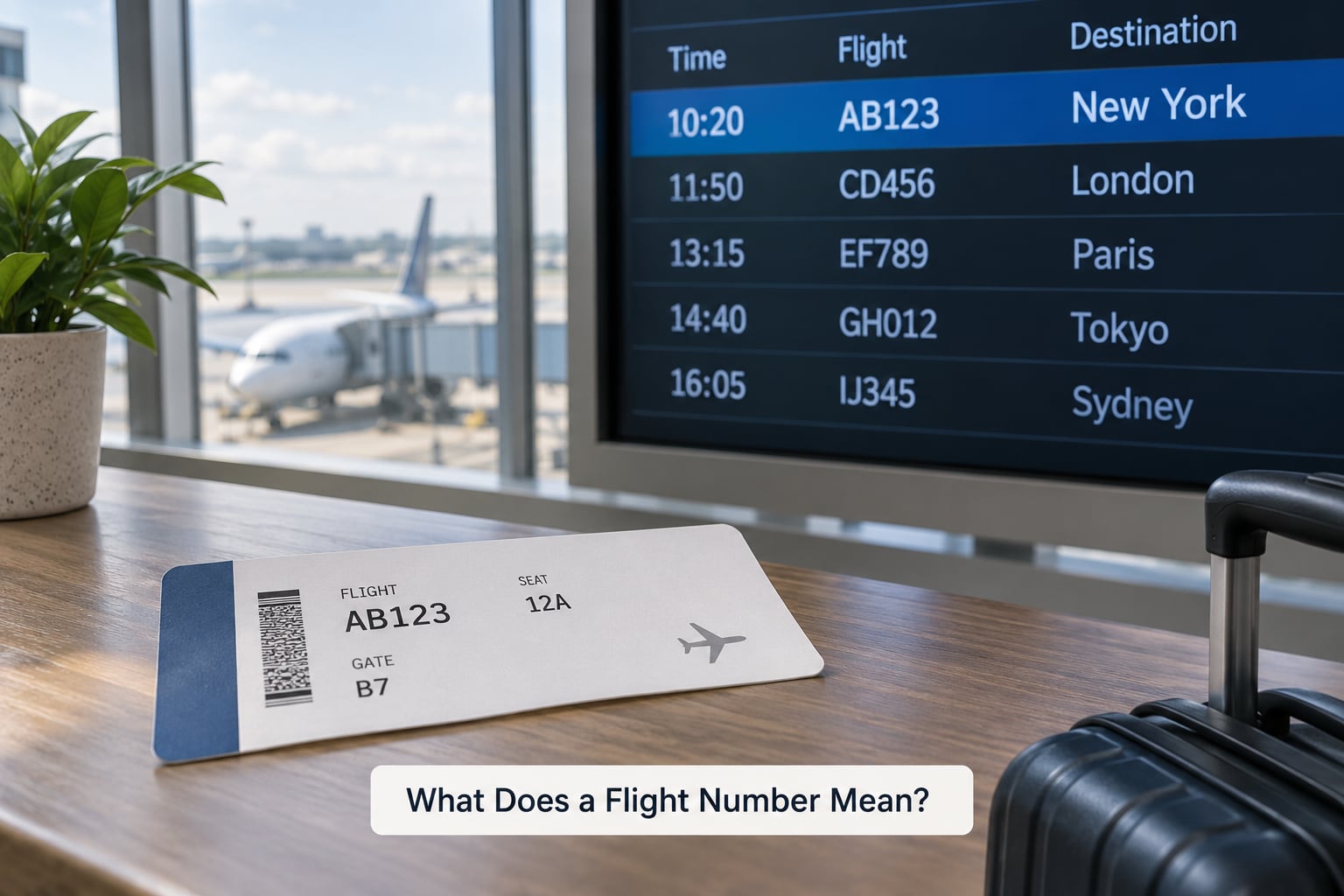
A flight number identifies one specific departure of one scheduled service. The airline attaches it to every seat it sells on that flight, and every airport system, from check-in kiosks to baggage belts, keys off it. Two different flights on the same route at 6 a.m. and 6 p.m. have two different numbers.
That’s the whole idea. Numbers exist so a departure can be named in a handful of characters by an airline, an airport, an air traffic controller and a passenger at the same time. The format breaks into two parts:
- Two letters for the airline, such as AA for American Airlines or DL for Delta.
- One to four digits for that particular flight in the airline’s own numbering scheme.
Those two parts are the entire structure. Everything else people read into the digits, whether the number is lucky, whether it tells you the aircraft type or the season, is convention layered on top by individual airlines. No global body assigns flight numbers, which is why travelers in different countries get slightly different explanations from the same website.
How Airline Flight Numbers Are Structured
The usual pattern is a two-letter airline designator followed by one to four digits, sometimes with a trailing letter. Real examples include BA 98, UA 867 and AA 292. Some airlines add a suffix, so you might see DL 2844 A for the second aircraft on the same rotation, or a code like AA 100 N for the northern version of a route.
How many digits you see depends on the airline and the route. Historically, low four-digit numbers were reserved for smaller regional routes, but frequent flyers on r/americanairlines note that four digits no longer reliably signal a small plane, since major carriers now run many of their regional services under their own mainline numbers.
You will also meet numbers with a leading zero, such as a charter or repositioning flight that is not part of the normal schedule. A repositioning flight moves an empty aircraft from one base to another, and a charter carries booked customers on a non-repeating route. Neither usually appears in the public schedule, which is why a search for that number can come back empty.
Why trackers sometimes show three letters instead of two
IATA assigns the two-letter designator you see on tickets. ICAO assigns a separate three-letter designator for operational and radio use. United is UA on your boarding pass and UAL to a controller; Delta is DL and DEL. Flight trackers often display the ICAO version because it is more unique and less prone to collision.
So if you’re searching for your flight and nothing comes up, try the three-letter form. Same flight, different naming system, no error on your part.
What Does the Two-Letter Airline Code Tell You?
The letters tell you the airline that sold the seat, which is not always the airline flying it. The two-letter designators are standardized industry abbreviations maintained by IATA, and most of them are close enough to the airline’s name to guess: AA for American Airlines, DL for Delta, UA for United Airlines, BA for British Airways, LH for Lufthansa, AF for Air France.
Others are less obvious. WS belongs to WestJet, PR to Philippine Airlines, QF to Qantas, EK to Emirates. If you are not sure, the airline name on your confirmation is a faster lookup than guessing at the abbreviation.
Here are a few you will see most often on search results:
| Airline | Two-letter IATA code | Three-letter ICAO designator |
|---|---|---|
| American Airlines | AA | AAL |
| Delta Air Lines | DL | DAL |
| United Airlines | UA | UAL |
| British Airways | BA | BAW |
| Lufthansa | LH | DLH |
| Air France | AF | AFR |
| WestJet | WS | WSG |
| Philippine Airlines | PR | PRL |
| Qantas | QF | QFA |
| Emirates | EK | UAE |
Does the Number Tell Me the Route or Destination?
Not reliably. The number identifies a particular flight, not a permanent route, and the pairing between number and cities shifts with the schedule. A flight can be retimed, rerouted or renumbered, and the same flight number can turn up on a different pairing next season. Saved numbers from a trip you took two years ago are not a reliable guide to anything.
What the digits do tend to encode, by airline convention, is a few things:
- In North American schedules, odd numbers usually fly north or east, while even numbers usually fly south or west.
- Another common convention pairs the outbound leg of a round trip with one number and the return leg with the next, though plenty of airlines reverse it or number both legs the same.
- Low numbers often mark a flagship or long-haul route, while higher numbers cover regional and short-haul flying.
- Some carriers prefix codeshare flights with the operating airline’s own series, which is why an itinerary bought on one airline can show a number that looks foreign.
Treat all four as habits rather than law. Different carriers handle it differently, and plenty of airlines ignore the odd and even pattern entirely. An airline that later merges or rebrands may adopt another carrier’s scheme partway through.
Why Do Flight Numbers Change?
Yes, your flight number can change, and it usually is not a sign of anything going wrong. Airlines rebuild their schedules several times a year, and every rebuild creates new numbers.
The usual reasons:
- Schedule adjustments, when a departure moves to a different time slot or a different aircraft rotates through the route.
- Seasonal service, where a route that only runs in winter is numbered separately from the year-round schedule.
- Aircraft swaps, when a plane is too small, too large or too maintenance-heavy for the assigned leg.
- Codeshare shifts, when a marketing carrier starts or ends an agreement with the airline actually flying the segment. Australian frequent flyer forums document exactly this frustration when a member’s itinerary suddenly shows a different number.
- Mergers and rebrands, when the surviving airline reorganizes its timetable.
If the number changes, the practical thing to do is simple: your booking reference still works, your e-ticket is still valid, and you re-confirm every dependent arrangement yourself rather than assuming an update propagated. Re-check connecting flights, seat assignments, lounge access, car hire pick-up and hotel bookings that depend on arrival time. Anything time-critical, confirm with a human.
How Flight Numbers Differ from Confirmation and Ticket Numbers
Most first-time confusion comes from lumping every code in a confirmation email together. They look alike and mean completely different things. This is the one table on the subject worth bookmarking.
| Code | What it is | Example | Where you need it |
|---|---|---|---|
| Flight number | Airline designator plus digits for one scheduled departure | UA 867 | Departure board, gate, flight tracking, check-in |
| Booking reference (PNR) | Six-character record locator for your reservation | QK7T2M | Managing the booking, check-in, airline support |
| E-ticket number | Thirteen-digit document number on the issued ticket | Starts with 016 and runs 13 digits | Airline accounting, some claims |
| Seat assignment | Row and seat letter for one passenger | 14A | Boarding, seat preference, upgrade lists |
| Call sign | Spoken name used by pilots and controllers on radio | United 867 | Aviation listening, official tracking data |
| Tail number | Registration painted on the aircraft, tied to one airframe | N840MH | Aircraft history and safety records |
One more to keep separate, because it sits on the same search results: the squawk code. That is a four-digit transponder code the aircraft’s pilot sets, visible to air traffic control and readable on radar and some tracking sites. The three codes travelers search for most, 7500 for an unlawful interference hijack, 7600 for a radio communications failure and 7700 for a general emergency, have nothing to do with your flight number.
How to Find and Verify Your Flight Number
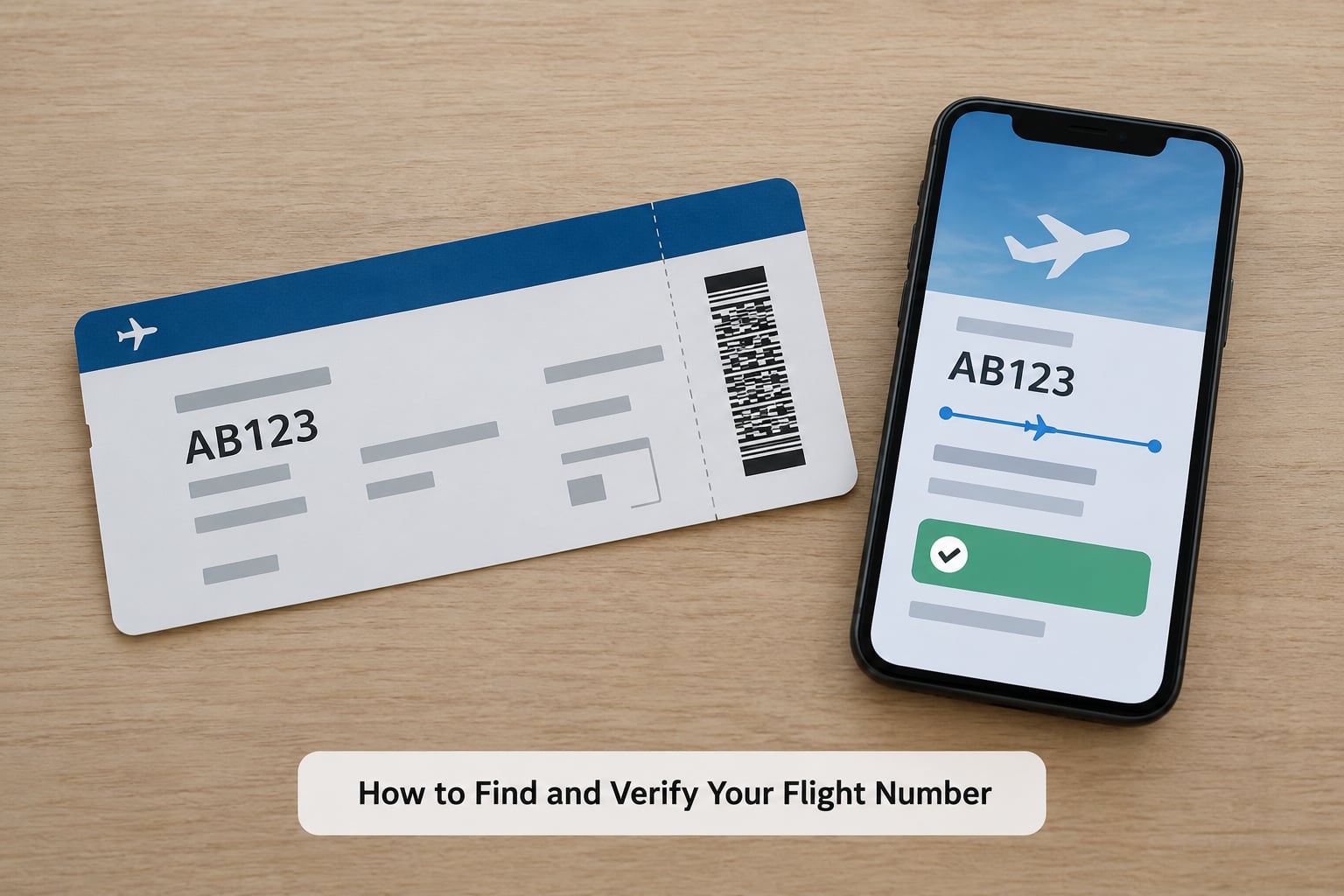
Finding it takes about a minute once you know where to look. Check the confirmation email first, under each segment heading, where the flight number sits next to the departure time and airports. Then the airline app or website, where tapping a trip in My Bookings shows the number beside each leg.
From there:
- Open the airline app and find the trip under upcoming bookings.
- Read the e-ticket or itinerary PDF, where the number appears in the segment detail.
- At the airport, scan the boarding pass or type the number into a check-in kiosk.
- Look up the departure board for your terminal, where the number is printed beside the destination and gate.
Verify four things before you travel: the airline code, the date, the two airport codes and the local time. A number on an email from six months ago may belong to a seasonal schedule that no longer runs, and airports with similar codes, such as KEF and KIR, get misread at booking desks more often than you’d think.
Frequently Asked Questions
How many numbers are in a flight number?
Usually one to four digits, following the two-letter airline code. A flight like AA 100 has three digits, and DL 2844 has four. There is no industry minimum or maximum, so the count depends entirely on the airline’s own numbering scheme. Fewer digits often signal a flagship or long-haul route, but plenty of airlines use short numbers for short hops too.
Can you provide an example of a Delta flight number?
Delta uses DL as its two-letter IATA code, so its flights look like DL 482 or DL 298. The digits are Delta’s own sequence for that route and departure. Delta also operates flights under partners’ codes through codeshare agreements, which is why a trip you bought on Delta can show a different number entirely if a partner airline sells the same seat.
Can you provide an example of a WestJet flight number?
WestJet uses WS, so a typical number looks like WS 202 or WS 1500. WS is the IATA designator and WSG is the three-letter ICAO code you may see on trackers. WestJet has also sold flights under other carriers’ codes through codeshare partnerships, so a booking can show a two-letter prefix that is not WS even when WestJet operates the aircraft.
Why would an airline change my flight number?
Usually because the schedule changed. Airlines rebuild timetables several times a year, swap aircraft when a plane is unavailable, add or drop seasonal flying, or change which partner operates a segment. None of that is a problem with your ticket. Your booking reference and e-ticket stay valid, but re-check connections, seat assignments and car hire times yourself after a change.
Is the confirmation number the flight number?
No, they are different things. The confirmation number, also called the booking reference or PNR, is a six-character record locator that identifies your reservation, and it never changes. The flight number identifies one departure and can change when the airline rebuilds its schedule. Use the booking reference to manage the trip and the flight number to track the aircraft.
What flight numbers are no longer used?
Airlines retire flight numbers after a serious accident on that flight, a crew member is killed, or a route ends for good. Many carriers also avoid numbers tied to superstition, particularly 13 and 666, and some assign lucky numbers such as 888 deliberately. Separately, numbers beginning with 0 usually mark charter or repositioning flights that do not appear in the public schedule at all.
What to Do First
Start by finding your flight number: open your confirmation email and read the two letters and digits under the departure heading. That is the number you type into the airline app, the one you check against the departure board on the day, and the one your gate agent will call. Note the two airports and the local time next to it, and if you have a connection, check the second flight’s number the same way.