Airplane boarding groups are assigned automatically from your ticket: your cabin, your loyalty status, the fare class you bought, whether you hold the airline’s own credit card, and where your seat sits on the aircraft. The airline stamps a letter or a number onto your boarding pass, calls the groups out in sequence, and everyone in a later group waits at the gate until theirs is announced.
Airlines do this for two reasons. The practical one is speed: an aircraft loaded from the front to the back closes faster and pushes back closer to schedule. The commercial one is harder to ignore — boarding order is a tier system, and tiers are how airlines sell the same seat in six different prices.
Nobody decides your group by hand at the gate. It is calculated when your ticket is issued, recalculated if anything changes, and printed before you ever reach the airport. That is also why the answer feels so opaque: the inputs are real but invisible unless you know where to look.
Table of Contents
- 1How Does Airplane Boarding Work?
- 2How Airline Seat Maps Divide Passengers Into Groups
- 3How Airplane Boarding Groups Are Assigned
- 4Who Boards First?
- 5Why Does the Letter on My Ticket Matter?
- 6How Airline Priority Programs Change the Order
- 7Can Families, Friends, or Passengers With Disabilities Board Together?
- 8Why Some Airports Use Separate or Staggered Lines
- 9Do Faster Boarding and Preboarding Guarantee a Better Seat?
- 10Frequently Asked Questions
- 11Is my boarding group printed on my boarding pass?
- 12Can I board early if I have a seat in first or business class?
- 13Why is my seat number the first thing the gate agent checks?
- 14Do parents and children always board at the same time?
- 15What happens if I miss my boarding group?
- 16Can airlines change the boarding order on the day of a flight?
- 17Conclusion: Check Your Group Before You Reach the Gate
How Does Airplane Boarding Work?
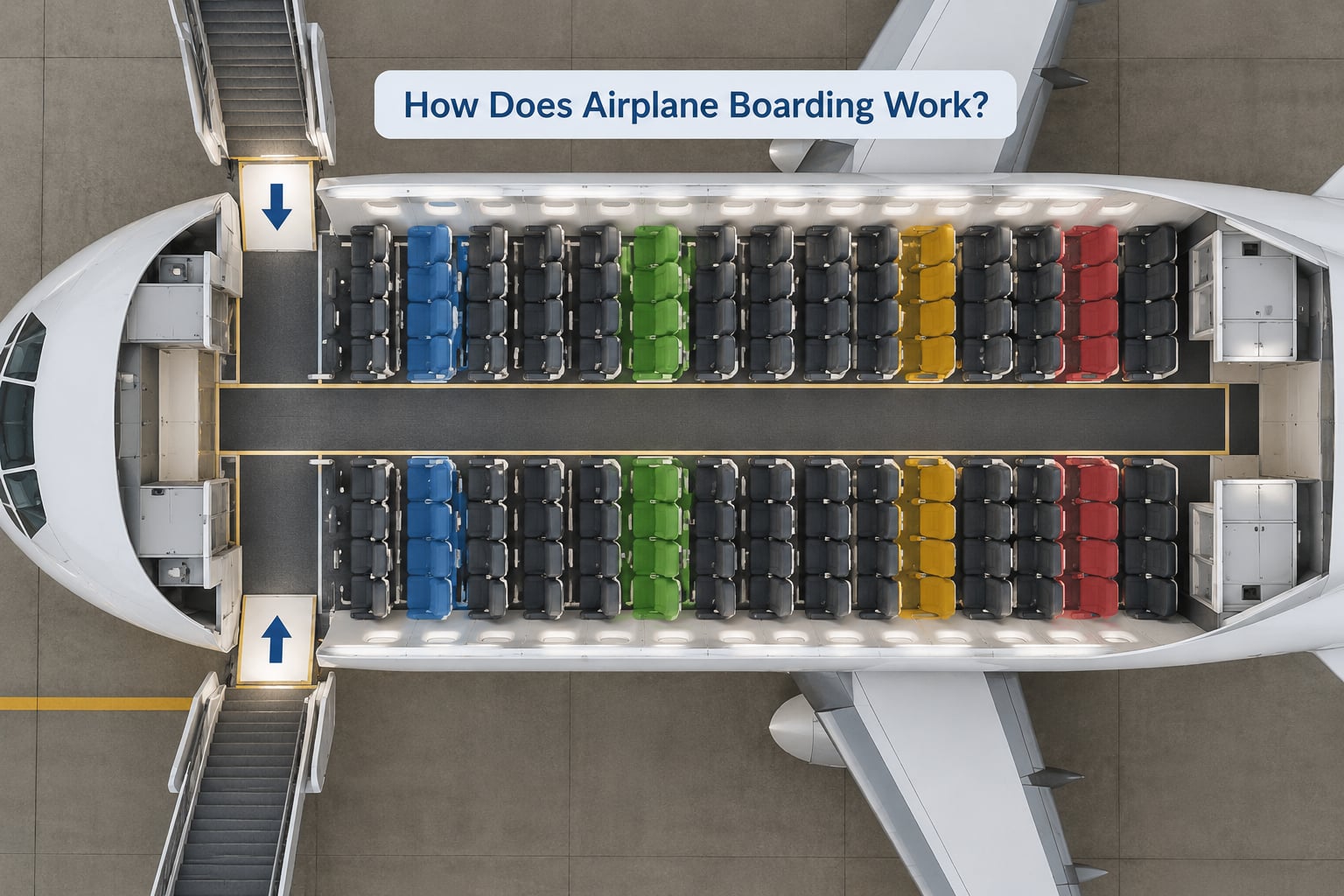
Boarding starts at the gate, not the aircraft. Your boarding pass is scanned, the gate agent checks the group printed on it against the group’s status, and when your group is called you walk down the jet bridge with everyone else holding that same letter or number.
Inside the aircraft, cabin crew work roughly the same pattern: premium cabin first, then the front of the economy cabin, moving row by row toward the back. On most flights the group you are in sets your rough position, and your seat number within the cabin sets your place inside that group.
A few practical things happen in sequence once you are aboard. Roller bags go into the overhead bin first, which is why front-of-plane groups win that space. Then passengers without bins are directed down the aisle and backward to whatever seats remain. Doors typically close around 10 to 15 minutes before the published departure time, not the scheduled one.
How Airline Seat Maps Divide Passengers Into Groups
Airlines split a cabin into sections before they assign anything. The seat map itself — a few rows of first or business at the nose, a block of premium economy in the middle where the aircraft has one, then a long economy cabin — is the skeleton the groups are built on.
| Cabin section | Where it sits | Typical boarding behaviour |
|---|---|---|
| First class | Rows 1 to about 8, at the front | One of the earliest groups, often boarding at or near the front door |
| Business class | Behind first class | Boards early with premium cabin, usually with priority status |
| Premium economy | A short block ahead of the economy cabin | Boards ahead of most main cabin, sometimes merged with business |
| Main cabin, standard fares | The long rear section | Boards in the middle or late groups, usually by seat letter and row |
| Basic economy, where offered | Scattered or rear rows, seat assignment often at the gate | Almost always the final group on the aircraft |
No two airlines draw the line in the same place. Some put premium economy in with business, some treat it as its own band, and on widebody aircraft with a rear galley the premium cabin may use a separate door entirely. Treat this table as the general shape, not a rule you can quote at a gate.
How Airplane Boarding Groups Are Assigned
Boarding groups are assigned in a fixed priority order. Preboarding comes first for passengers who need assistance and active-duty military. Then premium cabin. Then loyalty status, from the top tier down. Then holders of the airline’s credit card and customers who bought priority boarding. Then general main cabin. Basic economy, where an airline sells it, boards last.
Within each of those bands, the seat letter and row do the fine sorting: A through K, then L, then M and beyond, with the lower numbers going first. So a group’s number tells you roughly when you board, and your seat number tells you exactly where in that wave you stand.
One rule catches people: the airline assigns you the highest group you are eligible for, not the group your fare alone would earn. A top-tier flyer holding a basic economy ticket still boards early, because status outranks the fare code.
Who Boards First?
The passengers who board first are, in nearly every case, the following.
- Passengers needing assistance. Anyone who asks the airline in advance for preboarding, plus unaccompanied minors and passengers travelling with service animals, is called before the numbered groups begin.
- Active-duty military. Uniformed service members, generally with their dependants, board ahead of regular passengers. Show military ID at the gate.
- Premium cabin. First and business class, and on most airlines premium economy, board in the first waves.
- Loyalty elites. Top tiers board alongside premium cabin; mid tiers land in the middle groups; entry tiers get a modest bump.
- Credit card holders and paid priority. Holding the airline’s co-brand card or buying priority boarding moves you into a specific earlier band, usually ahead of general main cabin.
- Fare class within a cabin. Among equal-status passengers, the booking class you paid for decides which wave you are in.
Order varies slightly by airline and by aircraft, and gate agents have leeway. On international flights, business class sometimes loads last through a separate door while the front door handles economy. The categories themselves stay the same.
Why Does the Letter on My Ticket Matter?
The first letter of your seat number sets the broad wave you board in. A is early, L is late, and the tail letters are last. That is true on every major US carrier, and it is why a 12A passenger walks past an empty row to stow a bag while someone in 32C ends up asking whether overhead space exists at all.
The front doors open first on most flights because the bins fill from the front. Filling the nose first means fewer bags get checked at the last minute and fewer passengers end up standing in the aisle. Widebody aircraft with two full galleys are the exception: they often open the rear door early too, so the back of the cabin loads at the same time as the front.
Being in an early letter does not give you a better seat. It gives you better odds of finding an empty one near the front, and it is how airlines quietly keep the comfortable seats — the ones with extra legroom and the exit rows — for the people they value most.
How Airline Priority Programs Change the Order
Boarding priority and seat location are two separate systems, and mixing them up causes most of the confusion in travel forums. Your seat tells you where you sit. Your group tells you when you get up and walk down the jet bridge.
Five things feed into the second one. Cabin class is the biggest. Loyalty tier is next. Fare class decides your wave among passengers of equal standing. Cardholder status adds a flat bump. And courtesy boarding — the discretion a gate agent uses for a wedding group, a school trip, or a customer who complained — sits on top of all of it.
Loyalty tier names differ by carrier: Medallion on Delta, MileagePlus on United, AAdvantage Executive on American, TrueBlue on JetBlue, Rapid Rewards A-List on Southwest, and Alaska’s own tiers. The mechanics are the same. Top tier boards near the front of economy, middle tiers land in the middle, entry tiers get a small improvement that regulars often cannot identify from the seat map alone.
The system resets per ticket and per segment. Two people flying the same route, booked on the same day, can hold different groups — and you can hold a different group on the return than you did going out.
Can Families, Friends, or Passengers With Disabilities Board Together?
Families are usually handled as one boarding party. Most carriers will keep a parent and small children together or seat them apart with an adult, and many stage families travelling with a toddler to the side of the preboarding line rather than giving them a printed group of their own. Children old enough to travel alone may be handled separately with a gate escort.
Friends booked together get no special treatment. Two passengers in the same booking can hold different groups, because the group comes from each person’s status, card and fare, not from the reservation.
Passengers with disabilities have a legal floor here. Under the Air Carrier Access Act, US airlines must let a passenger who needs it board early and board with a companion or service animal, and they must take that request made in advance seriously. Say so when you book, and confirm it in the airline’s app, because the requirement attaches to the request rather than to the diagnosis.
Reduced mobility, an oxygen tank, a wheelchair that does not fold, an unaccompanied minor, or a service animal in the cabin all fall into this category. Tell the airline ahead of time and the accommodation is usually automatic. Show up at the gate and ask for the first time, and it depends entirely on how busy the flight is.
Why Some Airports Use Separate or Staggered Lines
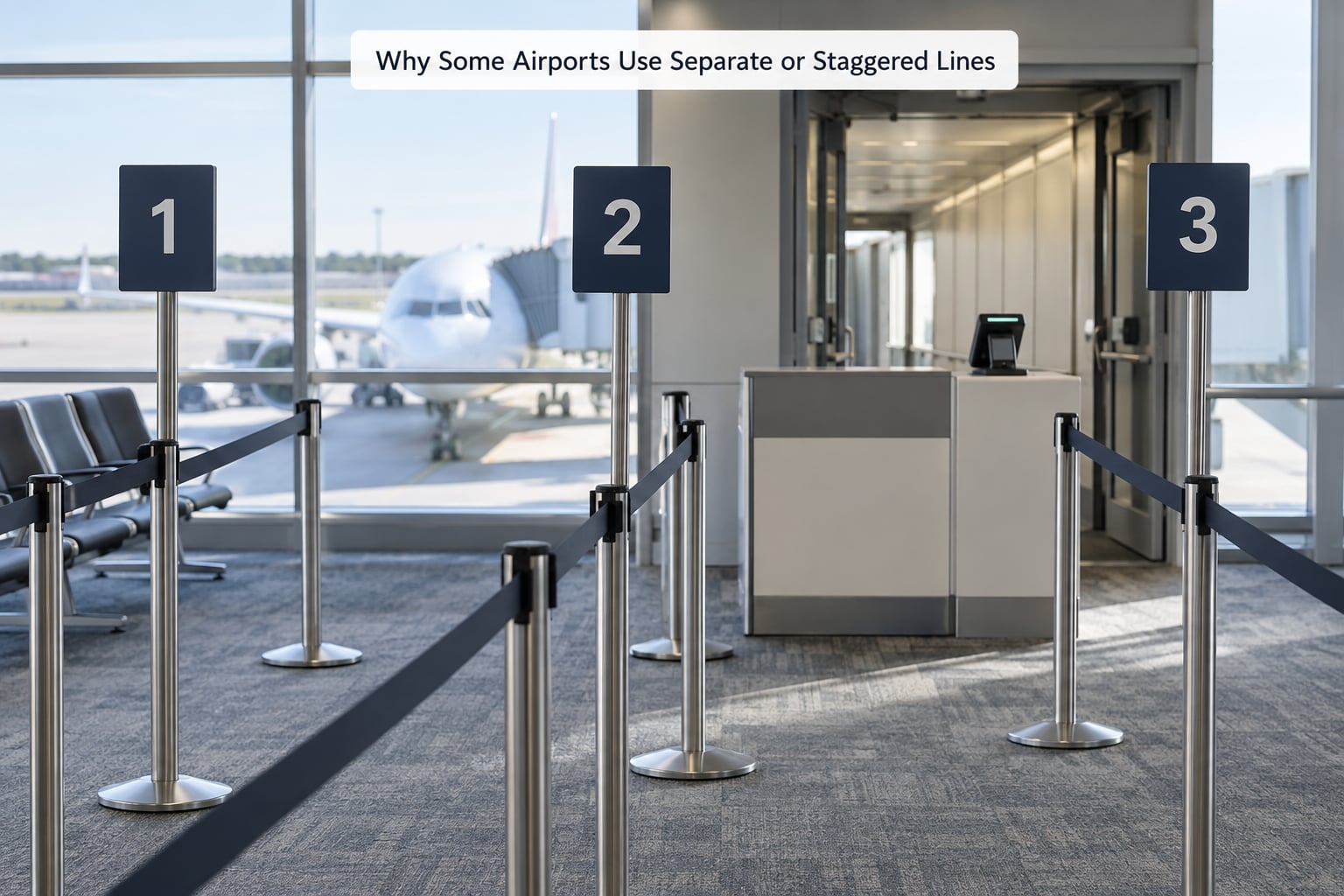
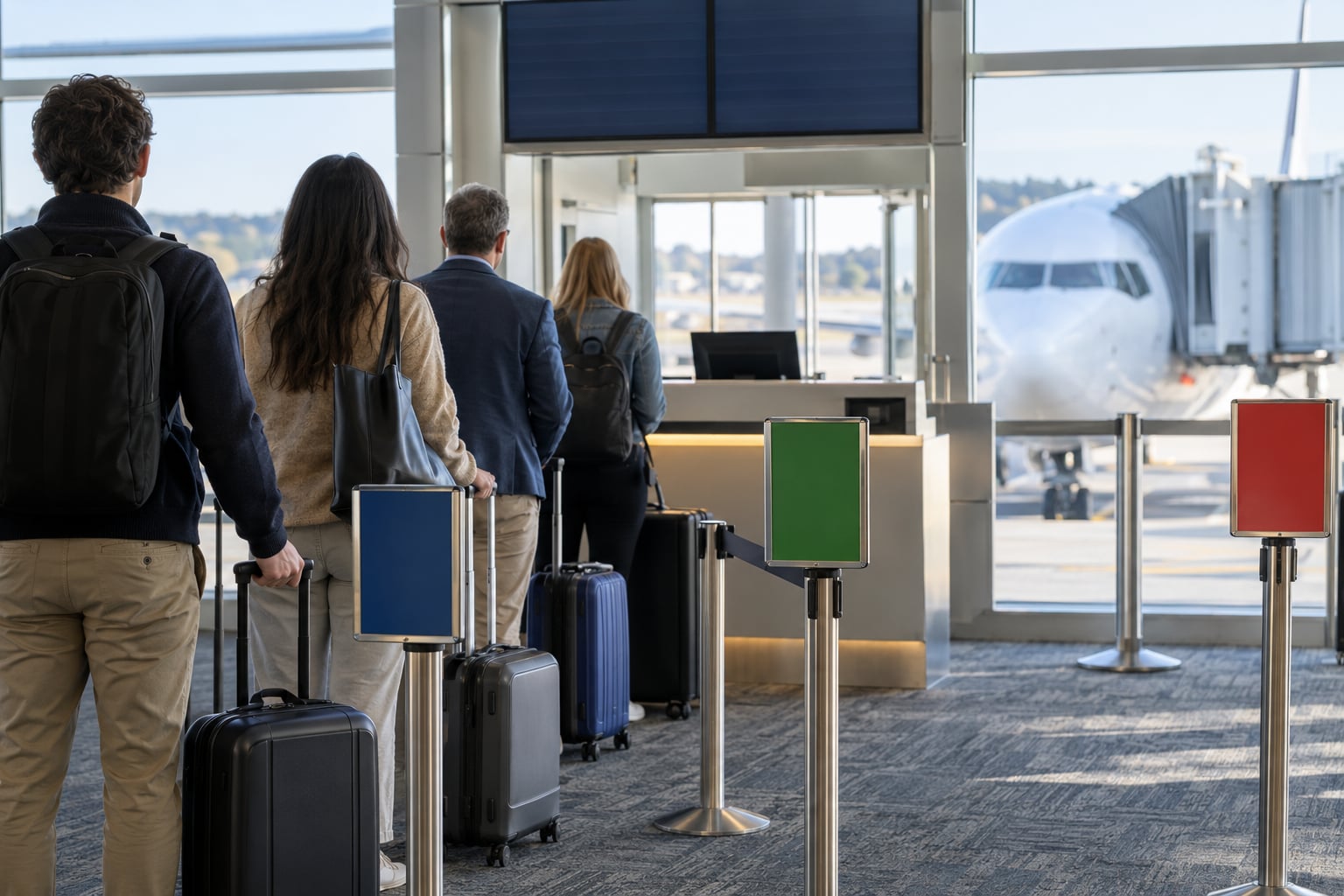
At a busy gate the airline will often split the queue in two: one line for the earlier groups and one for everyone else. Zone placards on stanchions tell you where to stand, and a second podium with its own scanner handles the later group so the first line keeps moving.
Staggered boarding means the airline simply does not call several groups at once. It cuts how long a single wave is waiting in the jet bridge and reduces the pile-up at the aircraft door. On a full flight it also lets the crew load bins in a controlled order instead of all at once.
Gate agents control the pace, and they can re-sequence things on the day. An equipment swap, a crew duty limit, an unaccompanied-minor handoff, or a door balance issue on a connecting aircraft will change the plan. Security and passport control can also shape it: on some international departures, the queue for one group forms outside the checkpoint and forms again on the other side.
Check the departure screens rather than assuming. The screens show the active group and the boarding time, and they update faster than the announcements.
Do Faster Boarding and Preboarding Guarantee a Better Seat?
No. Preboarding and an early group do not move your seat. Your seat is what it is unless someone at the gate offers you a different one, which is unusual.
What an early group does buy you is choice. You board an aircraft with empty bins, empty middle seats and real options about where to sit, and on a full flight that choice collapses to whatever is left at the back. If you want a window and you board in the last group, you are very likely taking a middle seat in row 30.
Preboarding is a bigger deal than most people realise. Getting settled first means you can stow a bag, sit down, and get the armrest before the aisle fills. It also means you are already seated when the people behind you start squeezing past with their bags.
One habit worth dropping: holding a row of empty seats across an aisle. It blocks stowage, slows the walk-in, and gate agents notice. Boarding early and then spreading out does not help anyone, including you.
Frequently Asked Questions
Is my boarding group printed on my boarding pass?
Usually yes. Look for a letter or number near the gate, seat or boarding group field, and on Southwest a position such as A35 or C12. If you are checking in online, it often appears only in the app rather than on a printed boarding pass. If you cannot find it, ask the gate agent or check the airline’s app before the queue forms, because that code is the only thing that decides when you walk down the jet bridge.
Can I board early if I have a seat in first or business class?
Yes. Premium cabin passengers are normally called among the first waves, often before the numbered economy groups begin. Some carriers load a separate premium cabin through a rear door on widebody aircraft, in which case your boarding time can even overlap the front door. Departure screens and the gate agent’s announcement are authoritative, and a premium cabin ticket still has to be scanned at the podium like any other boarding pass.
Why is my seat number the first thing the gate agent checks?
The seat number identifies your booking on the passenger manifest, and the group code printed beside it decides when you are cleared to board. Agents scan the barcode, which carries both. That is also how a crew member finds you if something changes mid-flight, and how the cabin knows which rows are still empty. It is a bookkeeping step, not a judgement about your ticket.
Do parents and children always board at the same time?
Families usually board as one party. Parents travelling with a small child or lap infant are commonly called with preboarding or given a family group, and many airlines seat the children next to an adult. Children within a certain age range can also be seated apart with a grown-up in the same row, which the agent does at boarding. Exact age thresholds differ by carrier, so check your airline’s family policy before you travel rather than assuming.
What happens if I miss my boarding group?
Gate agents often re-announce a group once, especially when the flight is running to time. After that, you are usually told to wait in the general line and board when the agent calls remaining passengers. Arrive at the final call and any checked bag may be gate-checked, which means it travels in the hold and comes out at the baggage belt at your destination. Arriving at the published boarding time, not departure time, prevents all of this.
Can airlines change the boarding order on the day of a flight?
Yes. Gate agents have real discretion and use it. Equipment changes, crew duty limits, door balancing on a connecting aircraft, unaccompanied-minor handoffs and accessibility needs can all reorder the plan on the day. The departure screens and the gate agent’s announcements are the only reliable source of truth, which is why it is worth checking them while you wait rather than trusting the boarding order your app showed at check-in.
Conclusion: Check Your Group Before You Reach the Gate
Boarding groups are not assigned by row alone, and they are not assigned at the gate. Open the airline’s app before you leave for the airport, find the group or position code on your boarding pass, and note when it is called.
Then arrive by the published boarding time rather than the departure time, stand in the line for your group, and watch the departure screens instead of guessing. If your situation is unusual — you need assistance, you are travelling with a small child, or you are not sure why your group changed between segments — say so at the podium before the queue builds. That is the moment the agent has the most room to help you.
Updated for October 2026. Airline group names, counts and policies change often, so treat airline-specific figures here as current to 2026 and check your own airline’s boarding chart when a decision depends on it.