Airline mergers affect passengers in six measurable places: fares on lightly competed routes, the number of nonstop flights, hub connections, frequent flyer status and miles, onboard service, and day-to-day reliability. A merger usually adds connecting options and sometimes lowers prices, while quietly removing nonstop flights and raising fares on routes nobody else serves.
That trade-off is why the same deal produces delighted passengers in one city and angry ones in another. This guide walks through what actually changes, what tends to stay the same, and what you should check on your own itinerary before and after a transaction closes.
Last updated: 2026
Table of Contents
- 1How Airline Mergers Affect Passengers
- 2What Happens During the Merger
- 3How Airline Mergers Affect Passengers’ Flights and Routes
- 4Fares, Tickets, and Booking Rules
- 5Airport Transfers and Connecting Journeys
- 6Frequent Flyer and Credit Card Programs
- 7Cabin Service and the Passenger Experience
- 8When a Merger Helps or Hurts Passengers
- 9What Passengers Should Do Before and After a Merger
- 101. Check the operating carrier and flight number
- 112. Re-check the schedule 48 hours before departure
- 123. Save your booking records
- 134. Read the loyalty conversion terms before transferring
- 145. Move your credit card benefits deliberately
- 156. Watch for hub and terminal changes on your usual routes
- 167. Know what you are owed when things go wrong
- 17Frequently Asked Questions
- 18Do airline mergers always mean cheaper flights?
- 19Will my frequent flyer status survive an airline merger?
- 20Can I be denied boarding because of an airline merger?
- 21What happens to connections when two airlines merge?
- 22Are flights on the same booking protected during integration?
- 23How long do airline merger changes last?
- 24What Passengers Should Watch First
How Airline Mergers Affect Passengers
An airline merger puts two carriers under one owner, and passengers feel it as fewer competitors on a route, a rewritten schedule, a converted loyalty balance, and new aircraft on familiar flights. The combined airline sells more destinations, but the nonstop you booked for years may now be a one-stop itinerary with a different aircraft and a different crew.
Three things get confused constantly, so it is worth separating them. A merger is a legal combination of two airlines under common ownership. A codeshare agreement is a commercial partnership where one airline sells a seat on a flight the other operates, with no change of ownership. An alliance — oneworld, SkyTeam or Star Alliance — is a marketing and loyalty network whose members cooperate without merging at all.
Only the first of those rewrites your reservation system. A codeshare can change your aircraft or your check-in airport without changing who owns the ticket, and an alliance move usually touches nothing you booked.
What Happens During the Merger
A US merger runs through two regulators before it closes. The Department of Justice reviews it for competition effects, and the Department of Transportation applies a broader public interest standard that covers whether the combined carrier can offer service “from a public standpoint.” Mergers can close with conditions, including promised route giveaways, as American and US Airways did.
Between signing and closing sits a long stretch where nothing has changed for passengers and everything has changed for the companies. Systems are mapped, schedules are rebuilt, fleets are planned and pilot seniority lists are negotiated. That work is invisible until it lands.
After closing, the passenger-visible changes usually arrive in waves rather than all at once:
- First 3 to 12 months: schedule rewrites, aircraft swaps, new fare families, reservation system glitches and uneven crew experience.
- Year one to three: loyalty program conversions, co-branded card changes, lounge and catering alignment, new alliance footprints.
- Three years and beyond: permanent capacity decisions, retired hubs, and a route map that reflects the combined network rather than the sum of two old ones.
The closing date is a legal milestone, not the day your experience changes. Assume the first eighteen months are the unstable ones.
How Airline Mergers Affect Passengers’ Flights and Routes
The combined carrier inherits both route maps and then edits them. Overlapping flights get cut, thin regional routes get folded into connecting hubs, and aircraft that belonged to one airline start appearing on the other’s schedule with different seating and different rules.
Passengers lose nonstops most often. A Honolulu thread on r/Honolulu described a booked nonstop out of Puerto Vallarta rerouted through Phoenix and Los Angeles, arriving back after midnight. Nobody cancelled a promised flight outright; the map just got harder.
Not every deal reaches that stage. JetBlue’s agreement to combine with Spirit Airlines drew a legal challenge, the transaction was blocked, and Spirit later exited the market entirely. Its passengers ended up with fewer flights and higher fares on what remained, which is a clear working example of what consolidation does when it fails rather than succeeds.
| What may improve | What often stays similar | What often gets worse |
|---|---|---|
| More one-stop city pairs from a bigger network | Fare classes and the shape of the fare rules | Nonstop frequency on thin domestic routes |
| Aircraft commonality, which can mean a smoother transfer | Awards priced the same way | Connecting itineraries with long layovers |
| Codeshare reach between partner carriers | Your booking reference and ticket number | Hub overconcentration at the surviving hubs |
| Longer daily schedules at secondary airports | Loyalty earn rates on most tickets | Losing the smaller airline’s signature service |
The Alaska Air Group agreement to acquire Hawaiian Airlines, which cleared DOT and DOJ review in 2026, is a live example that passengers have been watching closely. A carrier built around leisure and inter-island flying joined one built around West Coast connections, and passengers on both sides have been comparing the two service cultures ever since.
Fares, Tickets, and Booking Rules
No, a merger does not automatically make flights cheaper. Fewer airlines competing on a route usually means less price pressure on that route, and the strongest evidence points the same direction: DOT fare data reviewed by PwC for 2004 to 2013 showed fares up about 2% a year in nominal terms, and slightly down in real terms after inflation, across the whole post-consolidation market.
The more telling number came from the same research. Where low-cost carriers entered a market between 2008 and 2013, average fares fell about 5%. Where low-cost carriers exited, fares rose about 28%. In other words, low-cost airlines held fares down far more than consolidation did.
A few practical consequences worth knowing:
- Tickets bought before the transaction are still valid. They are re-issued onto the surviving carrier’s flight numbers, usually at no cost to you.
- Your fare is locked at purchase. A merger announced the day after you book does not reprice that ticket.
- Fares get restructured more often than they get cheaper. New fare families, bundle requirements and dropped basic-economy products change what a seat costs on a given day.
- Codeshares and separate operating carriers still matter. If your itinerary is sold under one flight number and operated by another, the operating carrier’s rules on baggage and changes can apply.
Airline competition itself is thin. American, Delta, Southwest and United control roughly 80% of the US domestic market, and no new scheduled passenger carrier entered between 2007 and 2021. Any merger on top of that base starts from a concentrated position, which is why regulators look hard at the routes involved.
Airport Transfers and Connecting Journeys
A bigger network is the clearest upside. Connecting flights that needed two airlines can often be bought on one ticket now, which means one check-in, one baggage system and a single protected itinerary.
The same consolidation creates transfer problems. Hubs get consolidated into fewer, bigger ones, so a connection that used to happen at a compact regional airport may now route through a large hub with long taxi times and security lines between terminals.
- Retimed connections: the merged schedule is rebuilt from scratch, and a 45-minute connection can become 20 minutes or three hours.
- Terminal moves: connecting airlines sometimes move to different terminals, turning a short walk into a shuttle ride.
- Self-transfers: separate tickets across two carriers are not protected. Miss the second flight and you buy a new one.
- Baggage transfer: checked bags are more reliably transferred when both flights are on one booking. On separate tickets, you recheck at your own expense.
If you book a tight connection during an integration period, build in a bigger buffer than usual, and check the airport for each leg rather than trusting the connection time on the ticket.
Frequent Flyer and Credit Card Programs
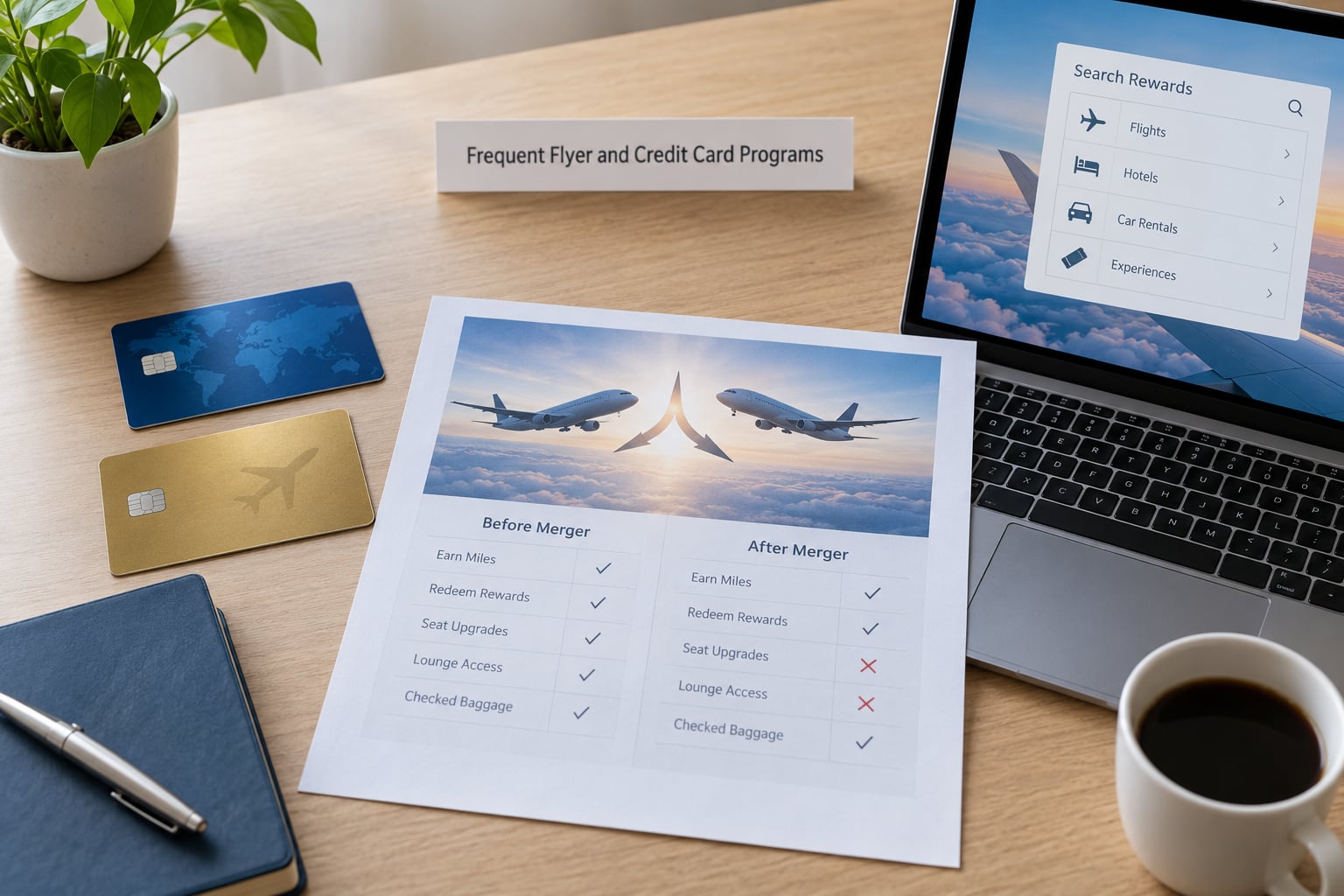
Loyalty is where passengers lose the most concrete value, because a balance is a number on a screen and a program conversion is a change you cannot undo later.
Typical outcomes after a network-plus-network merger:
- Acquired program balances convert into the surviving carrier’s currency, sometimes at a reduced ratio.
- Elite status is often honored for a defined window, and some carriers offer a one-time status match if you were mid-qualification when the deal closed.
- Benefit definitions shift: lounge access thresholds, upgrade rules and companion certificates are rewritten on the surviving carrier’s schedule, not yours.
- Co-branded credit cards usually convert to a new card product, sometimes on new annual terms.
A network carrier buying a low-cost carrier produces a different result. Award seats on the low-cost side were never part of the acquisition bargain, so travelers often lose redemption value without gaining much elite recognition. Two low-cost carriers merging is the same story with a smaller balance to lose.
One friction point comes up again and again: point transfers between the old and new programs sit in a processing state for weeks. On r/AlaskaAirlines and r/HawaiianAirlines, members describe Hawaiian-to-Alaska transfers stuck in processing long after the request. Start those transfers early and keep the confirmation number.
Cabin Service and the Passenger Experience
Service is where integration shows up as a personality question. Two carriers rarely keep two service standards forever; the combined airline settles on one, and passengers on the losing side notice immediately.
The Hawaii integration made that visible. A r/Honolulu thread titled “Passengers Say Hawaiian’s Famous Service Feels Different. What’s Going On?” focused on what travelers miss most: the flower leis, the relaxed greeting, the crew who knew the island runs. Separate threads on r/HawaiianAirlines and r/AlaskaAirlines raise a related worry — that reassigned crews flying new long-haul international routes may lose the traditions that made the original brand distinctive.
What to expect in practice:
- Aircraft interiors are harmonised to one standard, so seat pitch, screens and meal presentation converge on some routes and diverge on others.
- Ground service, check-in and customer-service staffing are the first things stretched when two workforces are combined.
- Lounges are consolidated, which usually means fewer, larger rooms with longer queues.
- On-time performance can dip for a few quarters as crews and aircraft are shuffled between bases.
People with a long history on the route notice more. Losing a small ritual they counted on hurts more than it does to someone who flies that route twice a year.
When a Merger Helps or Hurts Passengers
The honest answer is that the same deal helps one traveler and hurts another. This is the pattern that shows up most often:
| Traveler need | More likely to help | More likely to hurt |
|---|---|---|
| Occasional leisure flyer | More one-stop city pairs and a single itinerary | Nothing much; fares are set by demand |
| Frequent flyer with status | Wider award availability across the combined network | Program conversion, new benefit rules, elite requalification |
| Business flyer with a tight nonstop | Deeper schedule on major business routes | Nonstop replaced by a connection after a schedule rebuild |
| Flyer in a small or single-carrier city | Occasional new international service | Loss of the only nonstop, or of all service |
| Award seeker building an itinerary | Partner airlines inside one search | Fewer award seats on the popular routes |
| Price-sensitive flyer | Overlapping flights cut, which can lower some fares | No competitor left on thin routes |
Community sentiment skews negative, largely because losing a nonstop is the most common complaint, while the offsetting benefit — more connecting options — matters less day to day.
What Passengers Should Do Before and After a Merger
Seven steps, in the order they matter:
1. Check the operating carrier and flight number
Open your itinerary and read the “operated by” line, not just the marketed number. If a segment is flown by the other airline during integration, baggage rules, check-in counters and rebooking can follow the operating carrier instead of the one you booked with.
2. Re-check the schedule 48 hours before departure
Retimed connections and aircraft swaps show up in the airline’s app and on the airport’s departure board. This is the fastest way to catch a connection that has been cut from 45 minutes to 20.
3. Save your booking records
Keep the confirmation number, ticket number and every receipt. If your flight is cancelled, you want the original booking reference in front of you when you contact the airline about a refund or credit.
4. Read the loyalty conversion terms before transferring
Transfer ratios, expiry rules and status-match windows are published by the acquiring carrier. Transfer early, because processing delays are common during conversion, and screenshot the terms in case a dispute comes up.
5. Move your credit card benefits deliberately
Co-branded cards usually convert to a new product. Check the new annual fee and the new earn rates before you keep paying for a card whose benefits no longer apply.
6. Watch for hub and terminal changes on your usual routes
If you fly a secondary city that the combined carrier treats as a spoke, compare the nonstop count before and after. Route maps on the airline’s site are the fastest comparison.
7. Know what you are owed when things go wrong
A cancelled flight on a ticket you paid for is handled under DOT rules: a refund or an alternative, plus compensation for significant delay when the carrier controls the cause. Denied boarding is a separate process with its own rules and priority order. Keep receipts for hotels, meals and transport during a disruption.
Frequently Asked Questions
Do airline mergers always mean cheaper flights?
No. A merger usually removes one competitor from a route, which tends to weaken price pressure. DOT fare data reviewed by PwC for 2004 to 2013 showed fares rising about 2% a year in nominal terms. The bigger fare effect came from low-cost carrier entry, where fares fell about 5% in markets they joined and rose about 28% in markets they left. Expect new routes and restructured fare families more than discounts.
Will my frequent flyer status survive an airline merger?
Usually, for a while. After a network carrier merger, most programs honor the acquired carrier’s elite status for a defined period, and some offer a one-time status match. Long-term, benefit definitions and qualification rules follow the surviving program, so your status may survive while its value changes. Keep your status number, and check the conversion terms before transferring any miles.
Can I be denied boarding because of an airline merger?
Not because of the merger itself, but a merger can make it more likely indirectly. When flights are consolidated, a full flight gets bumped to a later or connecting option more often, and schedule cuts reduce spare seats. If you are denied boarding involuntarily, you are owed a refund or rebooking and compensation under DOT rules, and you can ask the airline to confirm the reason in writing before you accept an alternative.
What happens to connections when two airlines merge?
The schedule is rebuilt from scratch, so connection times change in both directions. Hub consolidation means a connection that once happened at a compact regional airport may route through a larger hub with a longer taxi and terminal transfer. Book the tightest connections as separate tickets with a generous buffer, and re-check the itinerary 48 hours before departure for schedule changes.
Are flights on the same booking protected during integration?
Yes, a single booking on a single itinerary is normally protected end to end even when the operating carrier changes mid-transition. Separate tickets are not: you are responsible for a missed connection, including the cost of a replacement flight. Check the operated-by line on each segment, because the operating carrier’s baggage and rebooking rules can apply during the changeover period.
How long do airline merger changes last?
Plan on eighteen months of real change, with the loudest disruption in the first year. Schedule and aircraft changes arrive in the first three to twelve months, loyalty conversions and co-branded card changes in year one to three, and permanent capacity decisions settle after that. Closing dates are legal milestones, not the date your experience stabilizes, and the first summer after closing is usually the roughest.
What Passengers Should Watch First
If you only check one thing, check the operating carrier and flight number on each segment. Everything else — baggage rules, check-in counters, rebooking and your rights when things go wrong — can differ between the airline you booked with and the airline that actually flies the aircraft.
After that, work outward: the schedule and connection times, then your baggage allowance, then your loyalty status and point balances. A merger rarely breaks a trip in a dramatic way. It erodes options one timetable rewrite at a time, and passengers who check the details keep most of what they had.