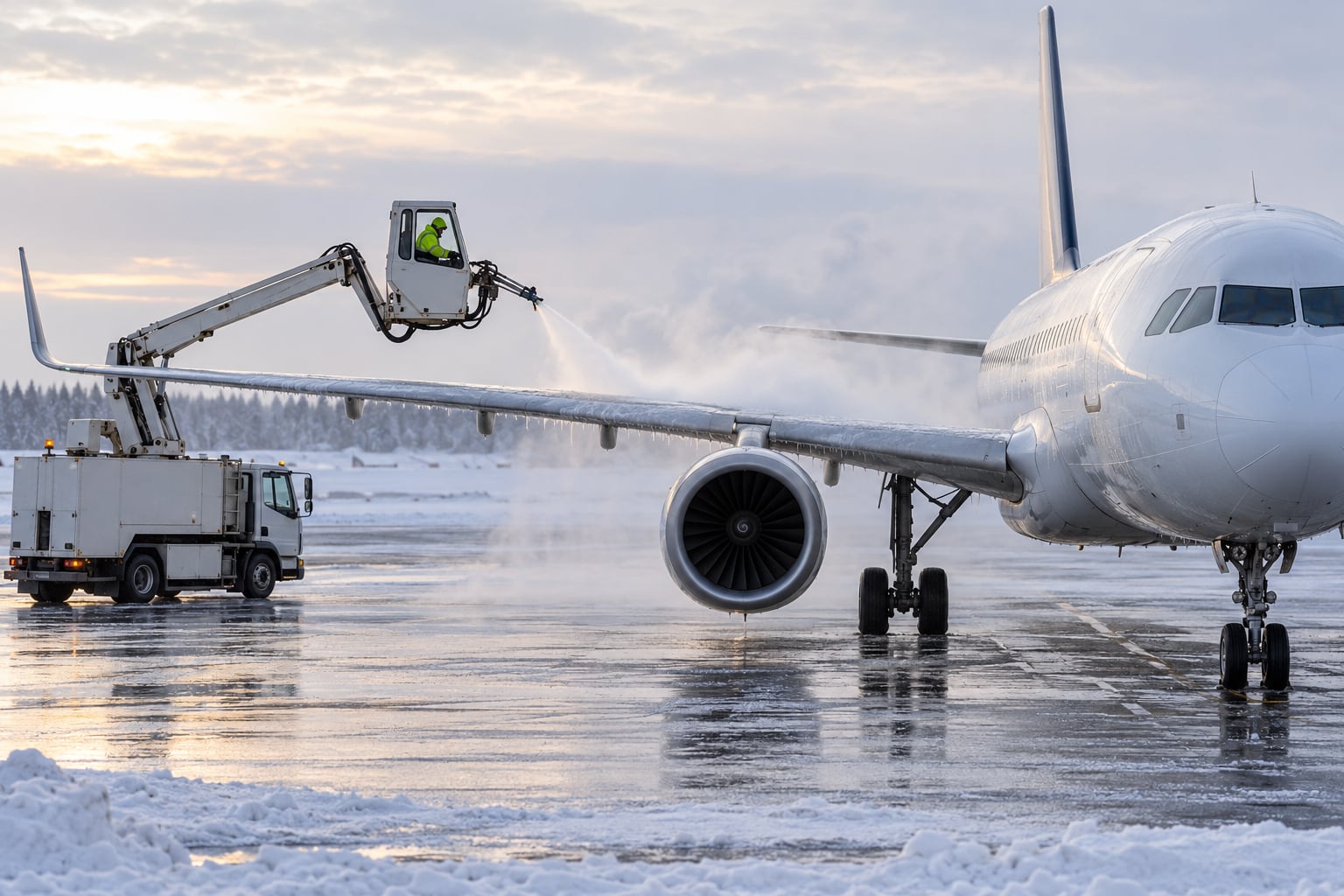
Sitting on the apron while a truck sprays your plane with orange mist is baffling if you have never seen it before. Short version: how de icing works before takeoff is a two-part job, first heated fluid melts and flushes off frost, snow and ice, then a thicker anti-icing layer slows new contamination until the aircraft is airborne.
I have watched this happen more times than I can count from winter windows, and the part crews care about most is not the spraying at all. It is the clean wing check that comes after.
Table of Contents
- 1How De-Icing Works Before Takeoff
- 2Why Aircraft Need De-Icing
- 3Types of De-Icing and Anti-Icing Fluids
- 4The Step-by-Step De-Icing Process
- 5How De-Icing Fluid Removes Contamination Before Takeoff
- 6Why Flights May Be Delayed During De-Icing
- 7What Passengers May Notice
- 8How De-Icing Differs from Airplane Deicing Systems
- 9How Pilots and Crews Verify the Aircraft Is Safe
- 10Frequently Asked Questions
- 11How long after de-icing can a plane take off?
- 12How long does plane de-icing fluid last?
- 13Why don’t airlines de-ice before passengers board?
- 14Who pays for de-icing a plane?
- 15What is the sweet smell when a plane is de-iced?
- 16Can a plane safely take off with ice on the wings?
- 17Conclusion
How De-Icing Works Before Takeoff
Aircraft de-icing works by spraying the wings and control surfaces under pressure with a heated glycol-and-water fluid that melts ice and snow and carries it off the aircraft. If new contamination could form before departure, crews follow with a thickened anti-icing fluid, and the flight crew must then take off within a published holdover time or repeat the whole treatment.
It happens on the ground at a de-icing bay or off-gate pad, usually between boarding and pushback. It is a routine winter procedure rather than a sign that something is broken with your plane.
Why Aircraft Need De-Icing
Ice does not sit politely on top of a wing. It changes the shape, and the rough surface breaks up the smooth airflow a wing depends on, cutting lift while adding drag. The rule aviation uses is the clean aircraft concept: the aircraft must be free of frost, snow, slush and ice before takeoff.
Contamination matters even at small thickness. Guidance treats a layer of about 0.4 mm, roughly the size of a fine grain of sand, as a sign that lift, drag and stall behaviour have all degraded enough to matter. Freezing drizzle and freezing fog are the nastiest cases, because the contamination keeps forming in mid-air after the truck has finished.
The usual trigger is cold soaking. When a jet has sat with fuel below freezing, bringing warm, humid cabin air into contact with the cold skin can create frost in the hold itself, with no weather needed outside.
Crews also treat the horizontal stabilizers, slats, flaps, spoilers, ailerons, engine inlets and pitot tubes. A blocked pitot tube can make an airspeed reading wrong, which is a problem nobody wants to discover at rotation speed.
Types of De-Icing and Anti-Icing Fluids
Two different jobs, two different fluids. De-icing fluid removes what is already there. Anti-icing fluid sits on the surface afterwards and slows the rate at which new ice builds.
Glycol is the active ingredient, either propylene glycol or ethylene glycol. Add water and you lower the freezing point of the liquid, which is what lets it melt ice at temperatures that would freeze plain water.
| Fluid | What it does | How it is applied | Protection |
|---|---|---|---|
| Type I de-icing fluid | Removes existing frost, snow and ice | Hot, pressurised spray that runs off the surface | Minutes, only in clean air |
| Type II anti-icing fluid | Retards ice formation | Cold, thick layer after de-icing | Short window, light conditions |
| Type III anti-icing fluid | Retards ice formation, lower viscosity | Cold, thin layer, suited to moderate rain or drizzle | Moderate |
| Type IV anti-icing fluid | Strongest retention, often dyed green or brick red | Cold, thick layer over the de-iced surface | Longest window of the group |
Regular flyers learn to read the colour. That tinted coating fading back to a clear film is the visual cue that the protection window is closing.
The Step-by-Step De-Icing Process
Five stages, in the order they happen on the ramp.
Step 1: Inspection. A pilot or trained inspector checks the airframe and reports contamination to the de-icing crew, including what kind of frost or snow is present and how heavy it is. That report sets the fluid mix and timing.
Step 2: Heated de-icing fluid. A de-icing vehicle, or sometimes two working together, sprays heated fluid across the wing from leading edge to trailing edge until all contamination is gone and the surface looks wet and clean.
Step 3: Anti-icing fluid. If the weather could recontaminate the surfaces, a thicker cold fluid goes on top. In active snowfall the de-icing step is often repeated as the newer layer builds up and the older one sheds.
Step 4: Engine and intake care. Inlets and probes may be treated separately, and any ice shed from the wing is checked so it cannot be ingested.
Step 5: Takeoff inside the holdover time. The clock starts when treatment ends. If the aircraft is not airborne before that limit passes, it goes back for another cycle.
How De-Icing Fluid Removes Contamination Before Takeoff
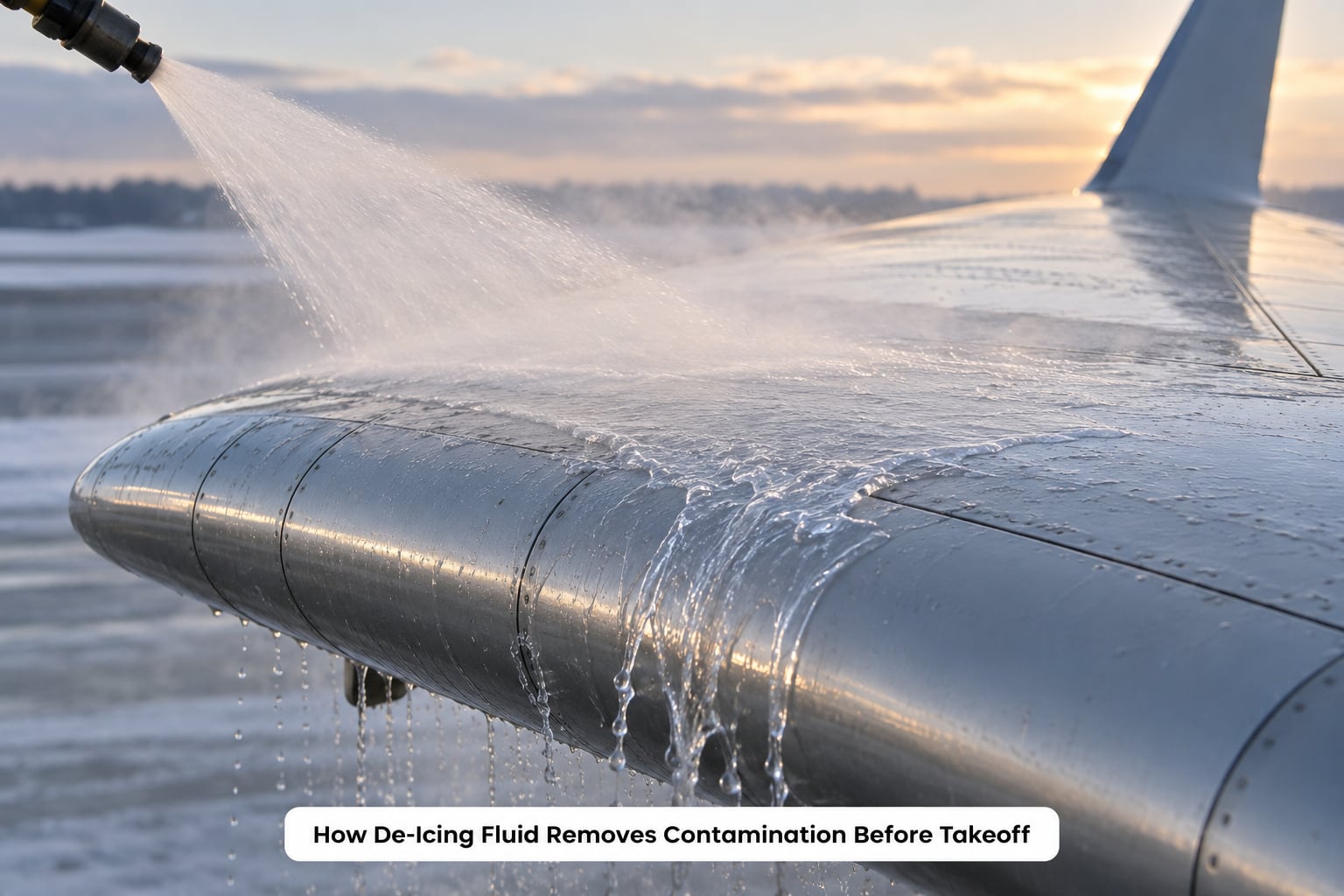
The mechanics are simple once you see them. Heated glycol fluid arrives near the freezing point of water, far hotter than outside air, and its job is to touch the ice and take heat from it. The ice melts, and the extra glycol in the mix keeps the meltwater liquid instead of letting it refreeze on the way down.
Pressure then does the cleaning. The stream is shaped into a fan that sweeps the surface, and gravity plus the air flow over the wing pull the loose water, slush and snow particles aft and off. Runoff takes the contamination with it, which is why you see liquid pouring toward the trailing edge during treatment.
Glycol is hygroscopic, meaning it attracts water from the air. That property is exactly why the anti-icing layer holds: it grabs moisture before that moisture can freeze onto the wing.
Why Flights May Be Delayed During De-Icing
Weather is usually the reason, but not always. Light frost on a clean surface might take six to ten minutes. In active snow, a large aircraft can take twenty to thirty minutes or more, and much of that is the treatment starting again from scratch as the first layer is covered in fresh snow.
Fluid type matters too. Type I alone gives a very short window, so crews keep spraying when snow keeps falling. Off-gate de-icing can free a congested gate, but it also adds taxi time to and from the pad. When every arriving aircraft needs treatment at once, the pad itself becomes the bottleneck.
Sometimes the cause has nothing to do with the weather. A truck delayed, a crew short-staffed or an aircraft held in sequence behind another with a bigger de-icing requirement will show up as a de-icing delay on your boarding pass anyway.
For context, holdover time is guidance from aviation authorities such as the FAA and Transport Canada, not a fixed number. It is published in tables that cross fluid type with conditions like light snow, freezing drizzle and high wind, and it is the table the crew is working against.
What Passengers May Notice
A misty cloud around the aircraft is heated fluid giving off steam, not smoke and not the weather. It shows up whenever heated liquid meets cold air, and plenty of people assume it is natural because it looks like fog rolling in.
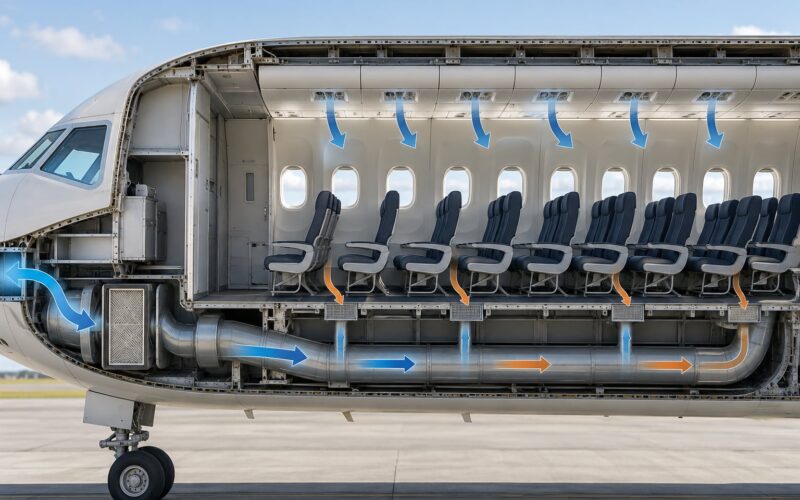
There is usually a sweet, syrupy smell in the cabin when the system is on for cabin pressurisation. It is harmless and temporary. The loud part is the de-icing vehicle engines and sometimes the aircraft engines running during treatment.
Boarding often finishes first, which leaves you watching from a window at close range. On a twin-vehicle job you can see two trucks working around the wing at the same time, one sweeping from each side.
If you are told the doors will close soon, expect to sit. If treatment happens at the gate, the aircraft never leaves the ramp until the surfaces are clean.
How De-Icing Differs from Airplane Deicing Systems
Ground de-icing and an aircraft’s own de-icing systems are different tools for different moments. Everything in the sections above happens with the aircraft parked and a truck alongside it.
Once airborne, the aircraft looks after itself. Wing anti-ice systems use hot air bled from the engines to warm the leading edge, and some aircraft use electric heating elements embedded in the wing surface. Engine anti-ice draws warm bleed air from the compressor to keep inlets clear. Pilots also manage ice shedding, where ice built up on unprotected surfaces breaks away at the right moment so it leaves the wing rather than staying on to distort it.
Ground de-icing is the only thing that removes contamination already sitting there. Onboard systems are preventive. For smaller aircraft and regional turboprops, on-board equipment is limited and the ground treatment often does nearly all the work.
How Pilots and Crews Verify the Aircraft Is Safe
After the spray stops, somebody has to confirm the aircraft actually looks clean. The clean wing check looks for frost, snow, slush and ice anywhere on the wing and critical surfaces, under the lights, before the aircraft is allowed to move.
Timing is the other half. The crew notes when treatment finished, calculates which holdover row applies to the actual conditions, and works the clock against the departure. Weather that is worse than forecast shortens that window, and crews that lose time taxiing behind other aircraft may come back to the fluid.
Communication closes the loop. The de-icing crew tells the flight crew what was applied and when, and the person accepting the aircraft makes the final call. Any doubt about contamination or remaining holdover time means go around, not push back.
Frequently Asked Questions
How long after de-icing can a plane take off?
It depends on the fluid type and the weather. Aviation authorities publish holdover time tables that cross Type I, II, III and IV fluids with conditions such as light snow, freezing drizzle and high wind. Some protection windows run only a few minutes in active precipitation, others last much longer in cold, dry air. If the limit passes before takeoff, the aircraft is treated again.
How long does plane de-icing fluid last?
A heated de-icing fluid by itself lasts only minutes, because it runs off the wing once the ice is gone and leaves almost no protection behind. Anti-icing fluid is what extends the window, staying as a thick layer that slows new ice formation. In falling snow that layer gets buried within minutes, so crews often treat repeatedly rather than trusting the first coat.
Why don’t airlines de-ice before passengers board?
Because holdover time is already ticking once treatment ends. If the aircraft were de-iced at the gate and then waited for boarding, load bags and fuel, the protection window could expire while passengers were still walking down the aisle. Boarding first, then treating, gives the clean wing the longest possible life before pushback.
Who pays for de-icing a plane?
The airline pays, usually through its ground handling or de-icing service agreement with the airport. It is an operating cost of running the aircraft safely in winter conditions and passengers are not billed for it directly. At some airports the service is provided by the airport itself; at others, contracted providers work on a ramp where several airlines share the same bay.
What is the sweet smell when a plane is de-iced?
It is glycol vapour reaching the cabin through the air supply, and it smells faintly of maple syrup. The same heated fluid sprayed outside is what causes it, and cabin air can carry a trace of that odour during and shortly after treatment. It is harmless and clears on its own once the air system refreshes.
Can a plane safely take off with ice on the wings?
No. Aviation rules require a clean aircraft, and contamination of about 0.4 mm or more is treated as significant because lift drops, drag rises and stall speed increases. Frost, snow, slush and ice must be removed from the wings and critical control surfaces before an aircraft moves. Historical accidents, including the 1972 crash of a commercial jet that departed with ice buildup, shaped today’s requirements.
Conclusion
De-icing exists because ice ruins the aerodynamic shape of a wing, and a layer thinner than you would guess is already enough to matter. Crews remove contamination with heated fluid, add a protective layer when conditions demand it, and work against a published clock that decides whether they can depart or have to start over.
If you see the orange spray and the cloud of steam, nothing has gone wrong with your aircraft. It is a scheduled safety step that adds time in winter and buys a takeoff performance the aircraft needs. Book an earlier flight on snowy mornings, keep devices charged for the wait, and treat the de-icing hold as part of the trip rather than something going wrong.