Winter flights get delayed more because cold weather turns a weather event into a chain of slow, mandatory procedures: crews deice the aircraft, airport teams plow and inspect the pavement, pilots redo checks, and air traffic control cuts departure rates. Every one of those steps adds minutes that an airline schedule has no room to absorb. That is the short version of why are winter flights delayed more, and the rest of this guide unpacks each link in the chain, from the deicing pad to the crew duty clock, then covers what you can actually control before and after you book.
Table of Contents
- 1Why Are Winter Flights Delayed More?
- 2How Does Winter Weather Cause Flight Delays?
- 3Why Are Winter Flights Delayed More? The Operational Factors
- 4Why Do Snow and Ice Create More Delays Than Rain?
- 5How Do Deicing and Runway Clearing Slow Down Departures?
- 6Which Airports Are Most Affected by Winter Delays?
- 7Why Are Winter Flights Delayed More on Busy Travel Days?
- 8How Can You Reduce Your Chance of a Winter Flight Delay?
- 9What Should You Do When Your Winter Flight Is Delayed or Cancelled?
- 10Frequently Asked Questions
- 11Can planes still fly in snow after deicing?
- 12How long does deicing fluid last before a plane needs re-deicing?
- 13Why does my flight get cancelled when the airport looks completely clear?
- 14Are winter delays really worse than summer ones?
- 15What are my rights when a winter delay costs me a connection or a hotel?
- 16How to Handle Winter Flight Disruptions
Why Are Winter Flights Delayed More?
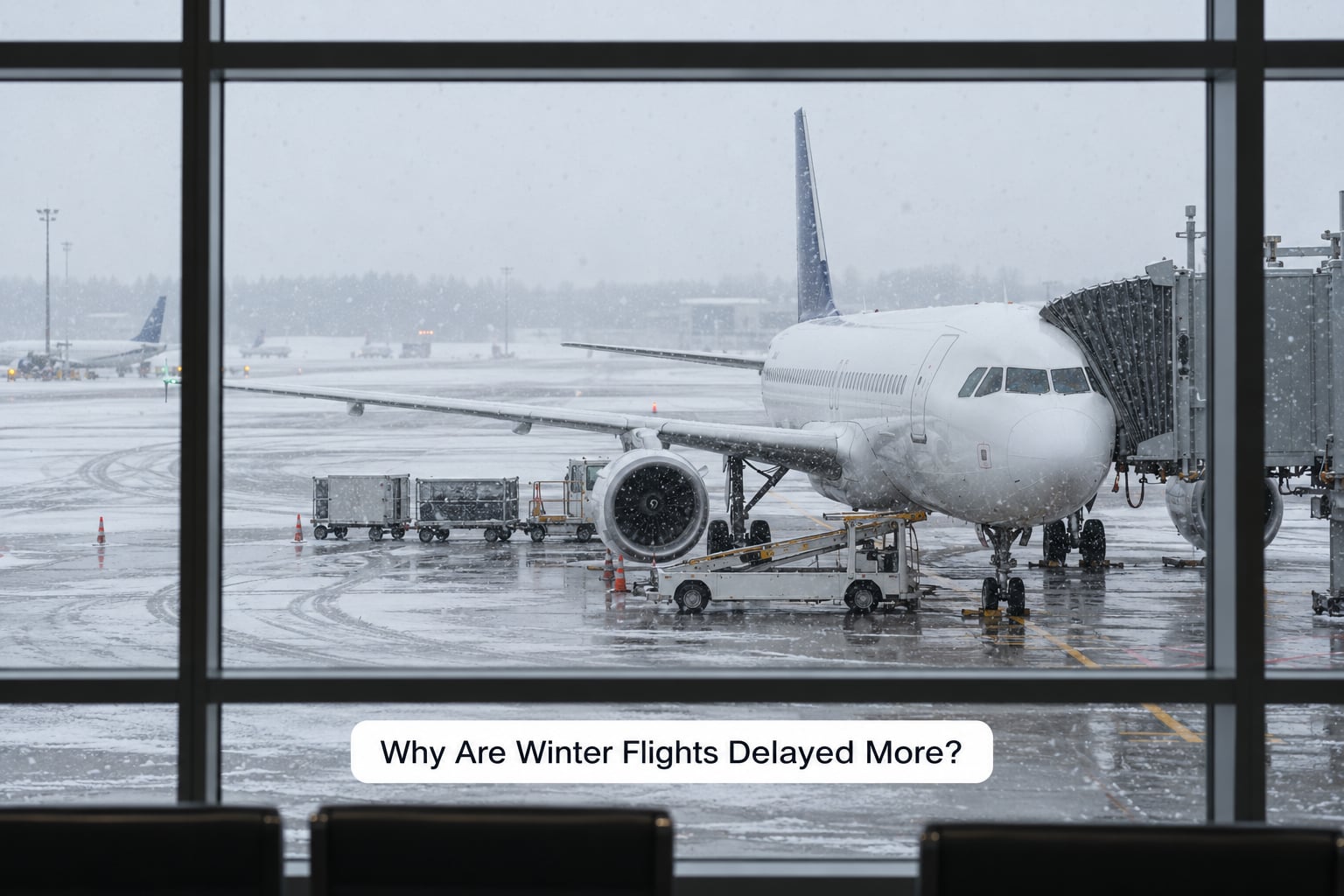
Winter flights are delayed more because snow, ice and freezing rain create ground conditions that require slow safety procedures. Aircraft must be deiced before takeoff, runways and taxiways must be cleared and inspected, visibility drops, and air traffic control reduces how many aircraft can move per hour. Airlines schedule with almost no spare time, so each of those extra minutes spreads to later flights.
The pattern is worst at large northern hubs during storms, and at busy holiday dates even when the weather is only ordinary. Nothing about the aircraft breaks in the cold. The delay comes from procedures that have to happen while the plane is still on the ground.
How Does Winter Weather Cause Flight Delays?
Each winter condition hits a different part of the operation, which is why two flights out of the same city on the same day can behave completely differently.
- Snow. Cuts visibility and blankets runways and taxiways. Departures queue for deicing, taxi speeds drop, and the field’s departure rate falls.
- Freezing rain. Builds ice on the runway surface and cuts braking friction, which brings short closures and long clearance cycles.
- Ice on the aircraft. Contaminates airfoil surfaces before takeoff. The aircraft needs treatment or it does not depart at all.
- Fog and low cloud. Reduce approach and departure visibility, forcing instrument procedures, wider spacing and holding.
- Strong or shifting wind. Limits crosswind tolerance and forces runway selection, which leaves fewer usable runways and heavier workloads for the crew.
- Extreme cold. Affects hydraulics, batteries, seals and engine start, adding inspection time and slowing the preflight.
Wind is worth separating from the rest, because it is not strictly a winter problem. Crosswinds over roughly 25 to 30 knots start to bite on smaller aircraft, and pilots will not always accept a crosswind limit. A gusty day with a shifted runway configuration can slow departures just as much as a fresh inch of snow.
Why Are Winter Flights Delayed More? The Operational Factors
Two identical forecasts can produce two very different days, because the bottleneck is rarely the weather itself. It is everything queued up behind it.
- Deicing pad queues. Travel posts on r/delta describe hubs where a small number of deicing crews serve every airline on the field. Once several aircraft line up for the same pad, waiting time becomes the delay.
- Holdover time pressure. Fluid applied on the ground has a limited effective window. An aircraft that waits too long has to be treated again before it can depart.
- Runway configuration changes. Plowing one runway well often means shutting the crosswind runway, which reduces the number of arrivals and departures per hour.
- Slower ground handling. Fueling, baggage loading and catering all take longer in the cold, and crews work more carefully on contaminated surfaces.
- Gate and aircraft availability. A late inbound aircraft occupies a gate, and the next flight out inherits the problem.
- Crew duty limits. Pilots and cabin crew have legal rest and flight time caps, so a delayed crew cannot simply wait out a storm indefinitely.
- Air traffic control restrictions. When a hub slows down, the surrounding airspace slows with it through ground programs and metering.
That last point is the one travelers find least intuitive. Your flight can be delayed by weather that never touched your airport.
Why Do Snow and Ice Create More Delays Than Rain?
Rain reduces visibility and slows taxiing, but a runway stays usable. Snow and ice change the surface itself, and the difference is operational rather than cosmetic.
Contaminated pavement means reduced braking action, so spacing between aircraft has to grow and braking distances lengthen. Ice also forms on the aircraft, which is the harder problem: the clean aircraft concept requires that an airplane be free of frost, snow and ice before takeoff, or treated.
Heavy rain certainly causes big disruptions, particularly around thunderstorms, and summer convection can stop an airport faster than any snowstorm. But summer weather usually moves through, while freezing precipitation keeps regenerating. Every clearing pass and every deicing treatment buys a limited amount of time before the next round is needed, which is what stretches a one-hour weather event into a full day of irregular operations.
How Do Deicing and Runway Clearing Slow Down Departures?
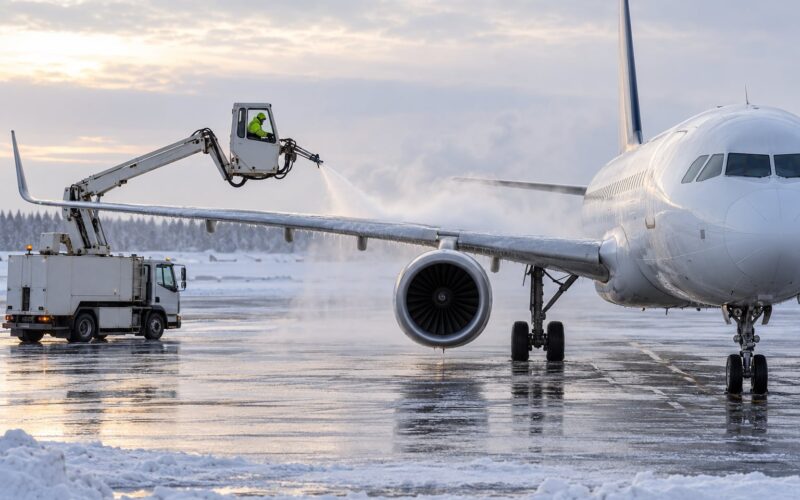
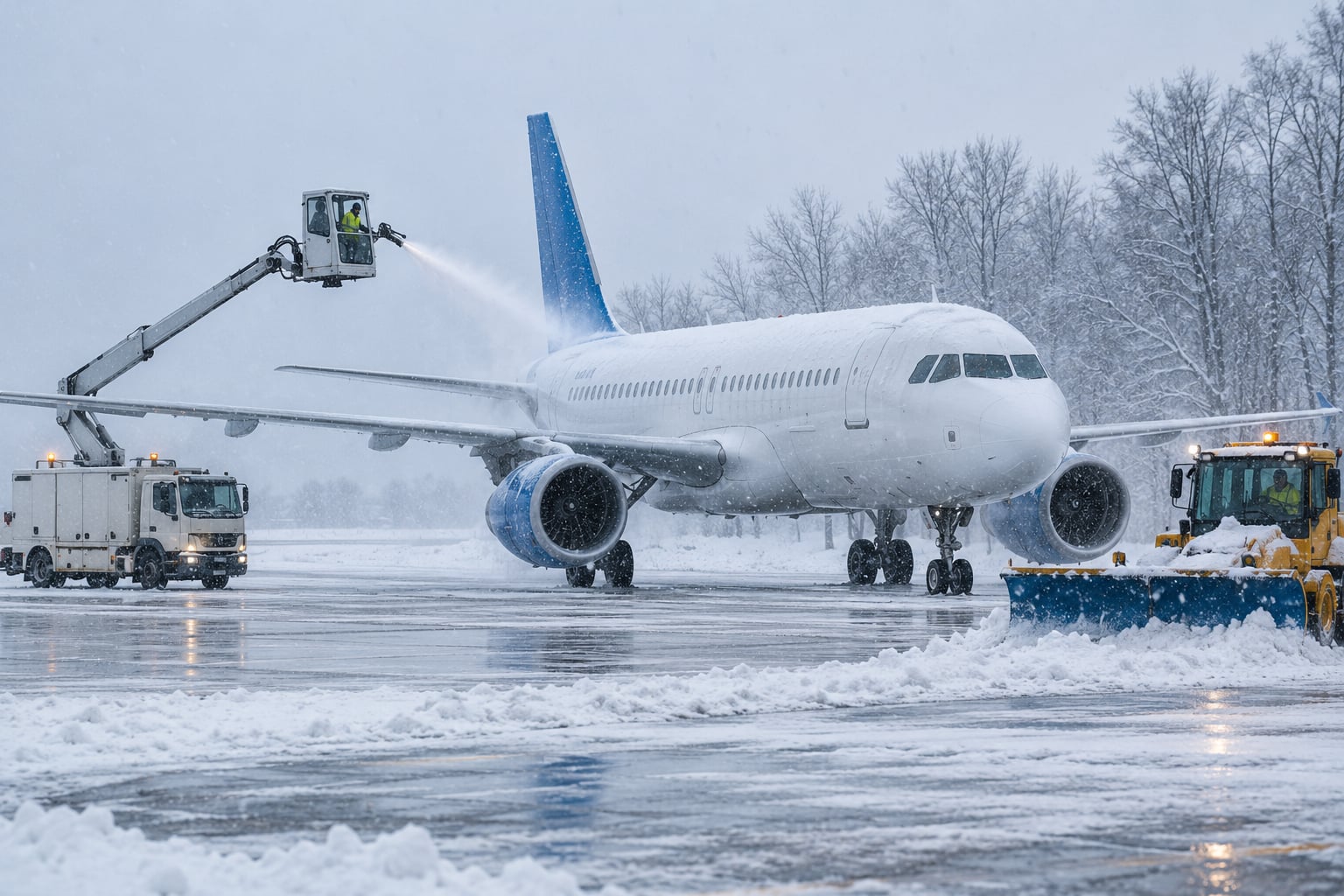
Deicing starts the clock for every departure. A truck applies heated fluid to remove accumulated snow and ice, often followed by anti-icing fluid that resists further accumulation for a short period.
That second stage is governed by holdover time, published in FAA holdover time tables by fluid type and precipitation. The commonly quoted figure of roughly 30 minutes is an average figure for common conditions, not a promise. Severe precipitation, colder temperatures and the fluid type in use all shorten it. When the window expires, or when snow is still falling and contamination is visible, the aircraft goes back for treatment.
Reported deicing times run as high as 40 minutes or more for larger jets, and travelers on forums describe boarding on schedule and then sitting far longer than that. Passenger posts also raise a fair question: fluid protects the aircraft on the ground, so why does it matter once airborne? In-flight icing protection is separate, and the ground fluid is what keeps the aircraft clean enough to generate lift safely in the first place.
On the airport side, plows, sweepers and blowers have to clear priority runways, then taxiways, then the parking aprons, in that order because an uncleared taxiway strands a plane that was already deiced. Runway condition is measured for friction and reported as a condition code, and a runway can be repeatedly closed and reopened within a single shift. Treatment removes whatever is there. Active precipitation puts it straight back.
Which Airports Are Most Affected by Winter Delays?
Risk concentrates where snow is frequent and the infrastructure has to react every time. Regions that cycle through freeze and thaw are harder to plan for than places that get one clean storm and stay cold, because the surface recontaminates overnight.
Large connecting hubs carry a different kind of exposure. More flights share the same pads, gates and crews, so a single bottleneck affects far more passengers. Airports with limited runway capacity have less room to close a runway for plowing, and coastal or exposed locations deal with wind and low visibility on top of snow.
Users on r/airport watch deicing pad operations in real time as storms arrive, which gives a useful ground-level view: the pad, not the runway, is often the first thing to saturate.
Regional effects reach much further than the forecast. A flight can be cancelled at a perfectly clear airport because the inbound aircraft or the crew cannot get in from the storm two states away. Airlines cancel early rather than wait, because a full aircraft with nowhere to go is worse than an empty one.
Why Are Winter Flights Delayed More on Busy Travel Days?
Winter weather lands on the same calendar as the year’s heaviest travel: holiday weeks, school breaks and long weekends. Demand rises, aircraft fly more rotations, and the same weather event now touches many more flights.
That changes the recovery maths. On a quiet Tuesday, a delayed aircraft waits and catches up. On a peak Saturday, the delayed aircraft has passengers, connecting bags and a crew that is already near its duty limit. The airline has fewer spare aircraft and fewer spare crew to swap in, so the delay stops being one flight and becomes a system problem that runs until late in the day.
How Can You Reduce Your Chance of a Winter Flight Delay?
No booking method removes weather or air traffic control risk. What you can do is give the schedule more room to absorb it.
- Fly earlier in the day. Early flights have more aircraft and crew available later to recover with, so they statistically hold up better than later departures.
- Build a real connection buffer. A short legal connection time leaves nothing for a late inbound aircraft.
- Keep a monitored email and the airline app ready. Rebooking through the airline is faster than the airport website or a phone queue.
- Watch the airport, not just the airline. Departure and arrival conditions are published by the airport and drive gate and stand decisions.
- Avoid tight same-day plans. Anything scheduled hours after your flight inherits every minute of the delay.
- Choose flexible fares when the date is uncertain. A change fee is cheaper than a last-minute hotel and a missed event.
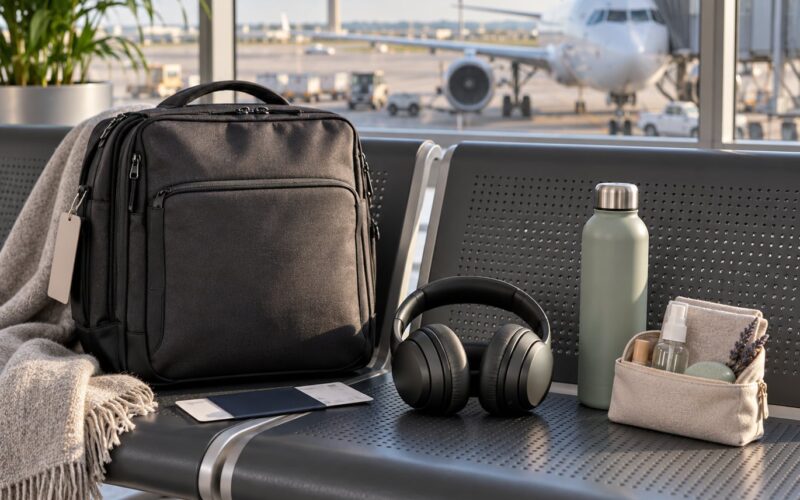
- Pack for a long wait. Food, water, a charged power bank and a change of clothes cover more cases than people expect.
What Should You Do When Your Winter Flight Is Delayed or Cancelled?
Work through this in order, and it stays manageable.
- Check the operating airline first. It controls rebooking, and its app and text alerts update faster than any third-party tracker.
- Check the airport site. Departures, gate changes and a general delay program tell you whether this is one flight or the whole field.
- Ask about alternative routings early. A different airport or a different airline may beat waiting for your original connection.
- Protect your onward connection. Tell the agent about it explicitly, and check whether a through-ticket means automatic rebooking or a refundable leg.
- Handle baggage deliberately. Checked bags on a cancelled flight are often forwarded automatically, but confirm before leaving the terminal.
- Keep receipts. Meals, hotels and transport you pay for yourself are the easiest items to claim back later.
- Know what you are entitled to. In the United States, rules depend on the cause of the delay and whether you bought the ticket directly, and compensation rules differ in Europe under EC 261. This is general information, not legal advice; check your own rights before you accept a voucher.
If a visa, residence permit or passport constrains which countries you can enter on short notice, say so when you ask about rerouting. Agents can only work with routes your documents allow.
Frequently Asked Questions
Can planes still fly in snow after deicing?
Yes. Deicing and anti-icing fluid are designed to hold snow and ice off critical surfaces until the holdover time expires, and aircraft fly in snow regularly after treatment. Fluid only protects the aircraft on the ground; in-flight ice protection is a separate system. Pilots still reject a takeoff when contamination or conditions are outside limits.
How long does deicing fluid last before a plane needs re-deicing?
It depends on fluid type, temperature and precipitation intensity, which is why the FAA publishes holdover time tables rather than one number. The often-quoted figure of about 30 minutes is an average for common conditions. If the window expires or contamination is visible, the aircraft returns for a second treatment, which is a large part of why deicing delays run long.
Why does my flight get cancelled when the airport looks completely clear?
The weather often sits somewhere else in the aircraft rotation. A cancelled flight usually means the inbound aircraft or the crew cannot reach your airport through the storm, so the outbound leg never has a chance to fly. Airlines cancel ahead of time rather than hold passengers at the gate. Check whether a later flight on the same route is still operating before assuming the day is finished.
Are winter delays really worse than summer ones?
Winter delays come from repeated ground procedures and slower aircraft recovery, so they last longer and are harder to absorb. Summer thunderstorms hit harder but usually pass within an hour or two, while snow and freezing precipitation keep regenerating and demand for clearing work. That difference in duration is why winter disruption tends to ripple through a whole day at a hub.
What are my rights when a winter delay costs me a connection or a hotel?
Entitlement depends on where you are and why the flight was delayed. In the United States, the airline’s duty to help depends on whether the cause was weather, and rules for a cancelled flight you bought directly differ from European rules under EC 261. Keep booking confirmations and receipts, and check your specific protections rather than relying on a general rule.
How to Handle Winter Flight Disruptions
When a winter flight slips, act on three things in order: check the operating airline and the airport promptly, protect your onward connection before it becomes a second problem, and keep every receipt for costs you cover yourself.
No booking trick removes the weather. What helps is leaving room in the day, flying early, and treating a winter itinerary as something that can move.