Is turbulence dangerous for airplanes? Short answer: no for the aircraft, and occasionally yes for the people inside it. A commercial jet is certified to handle far more than the atmosphere normally throws at it, so ordinary turbulence leaves no mark on the airframe. The injuries that do happen come almost entirely from passengers and crew who were standing, walking or serving drinks when the plane moved.
That split is worth holding onto, because most of the fear comes from blending the two together. Here is what turbulence actually is, where it comes from, why the wing keeps flexing above you, and the handful of things you can do that actually reduce your risk.
Last updated: October 2026.
Table of Contents
- 1What Is Turbulence, and Is It Normal?
- 2What Causes Airplane Turbulence?
- 3Jet streams and wind shear
- 4Convective turbulence and thunderstorms
- 5Mountain wave turbulence
- 6Wake turbulence
- 7Thermals and clear air
- 8Is Turbulence Dangerous for Airplanes?
- 9How turbulence intensity levels map to safety
- 10Is turbulence dangerous for airplanes in practice?
- 11Why Do Seat Belts Matter During Turbulence?
- 12Myths that make turbulence feel more dangerous than it is
- 13How Do Modern Airplanes Handle Turbulence?
- 14What Should Passengers Do During Turbulence?
- 15When Is Severe Turbulence a Greater Concern?
- 16Is Turbulence a Sign of an Emergency?
- 17Can Pilots Forecast All Turbulence?
- 18Frequently Asked Questions
- 19Has turbulence ever caused a plane to crash?
- 20Can turbulence break an airplane wing?
- 21Why do flights sometimes add more fuel for turbulence?
- 22Do seat belts really make turbulence safer?
- 23Why does turbulence feel worse in some seats?
- 24Conclusion
What Is Turbulence, and Is It Normal?
Turbulence is irregular movement in the atmosphere: changes in the speed, direction and pressure of the air that make an aircraft move up, down or sideways. It is not a hole in the sky, and there is no such thing as an air pocket. Air does not suddenly empty out.
It is also completely routine. Paul Williams, a researcher at the University of Reading who has studied turbulence for decades, puts roughly 3 percent of the atmosphere in the light band, around 1 percent in the moderate band, and a few tenths of a percent in the severe band. That sounds small, but the National Center for Atmospheric Research estimates roughly 65,000 flights a year meet moderate turbulence and about 5,500 meet severe turbulence.
With tens of thousands of commercial flights every day, most people fly through rough air several times a year without noticing it much. You notice it when it is unexpected, and unexpected is the whole problem.
What Causes Airplane Turbulence?
Every bump traces back to air moving unevenly. The unevenness comes from a handful of sources, and pilots treat them very differently depending on whether they can see them coming.
Jet streams and wind shear
The jet stream is a fast river of air, often hundreds of miles wide, running west to east high in the atmosphere where jet aircraft cruise. Where two air masses with different speeds meet, the boundary between them breaks into eddies. Flying along that boundary produces the choppy, irregular movement most people picture when they hear the word turbulence.
Convective turbulence and thunderstorms
Warm air rising off the ground, or air climbing inside a storm cloud, creates columns of rising and sinking motion. Inside a mature thunderstorm the air is violent enough that no airliner flies through it at all, and pilots route around convective cells by tens of miles. The rougher air near the edge of a storm, which is where turbulence usually lives, is very different from the storm core.
Mountain wave turbulence
When a strong wind blows perpendicular to a mountain range, the air is forced up and over, then sinks far downwind in smooth, powerful waves. Mountain wave turbulence is known for being severe, long-lasting, and repeatable, which is why routes over the Rockies, the Andes and the Himalayas have a reputation among crews.
Wake turbulence
Every aircraft leaves behind two invisible helical vortices off its wingtips. A plane following another too closely, particularly in light wind, can be flipped or rolled by the wake of the one ahead. Separation rules exist for exactly this reason, and it is the one kind of turbulence that a crew causes directly.
Thermals and clear air
On a sunny day, bubbles of warm air rise from fields, deserts and hot tarmac. Downwind of those thermals, an aircraft that was flying through perfectly smooth air meets irregular rising and sinking motion with no cloud, no rain and no radar return anywhere near it. That is clear-air turbulence, and it is the reason most passengers have their worst moments.
Is Turbulence Dangerous for Airplanes?
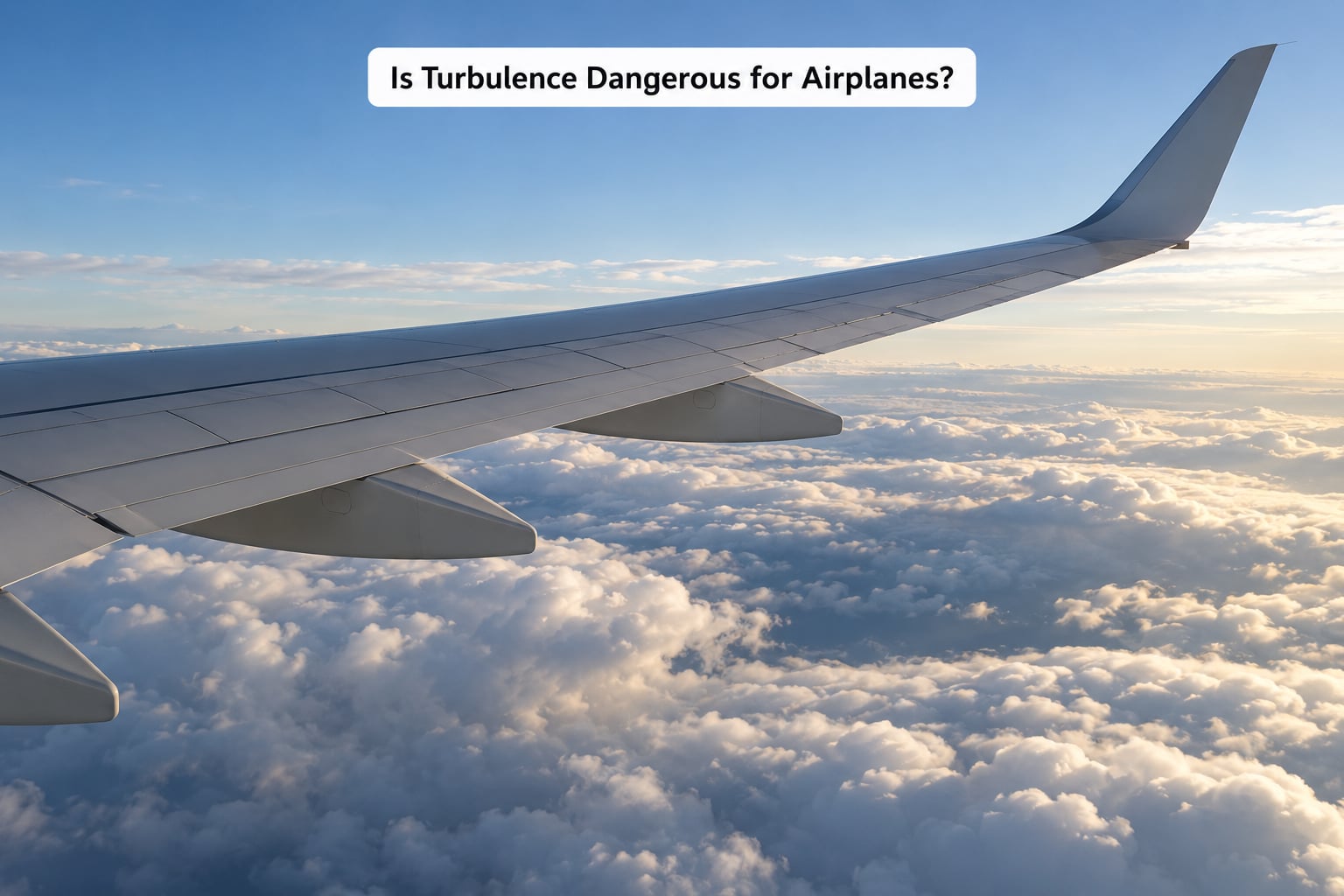
No. Is turbulence dangerous for airplanes is a fair question, and the honest answer is that a certified airliner is built to survive much worse than anything the atmosphere normally delivers. Airframes are tested to loads well beyond the maximum they are expected to meet in service, and the wings are designed to bend. Watching a wingtip rise and fall in rough air is normal behaviour, not a warning.
Structurally, the aircraft is the safest object in the equation. The people are the variable.
How turbulence intensity levels map to safety
| Level | What you feel | What the crew does | Aircraft at risk |
|---|---|---|---|
| Light | Slight bumps, drinks ripple in a cup | Usually nothing; cabin service may pause | None |
| Moderate | Noticeable, feels like driving on a poor road | Seatbelt sign on, service suspended, passengers seated | None |
| Severe | Sudden drops and rises, unbelted people thrown | Seatbelt sign on, flight crew seated, cruise adjustments made | Usually none; inspection may be scheduled after landing |
| Extreme | Rough, sustained and uncomfortable, items airborne | Crew seated, request lower altitude and reduced speed | Rare; aircraft may be taken out of service for inspection |
Extreme turbulence is close to unheard of in airliner service, and it is the only level with any real conversation about airframe inspection afterward. Even then, the aircraft is usually back in service after a check finds nothing.
Is turbulence dangerous for airplanes in practice?
In practice, no commercial jet has been destroyed by turbulence. IATA, the airline industry body, points out that the last clear-air turbulence death involving a major carrier dates to 1997. Serious airframe damage from turbulence in modern airliners has not been a reportable event in recent decades, even in the incidents that made headlines for how violently the aircraft moved.
The honest caveat is this: pilots take turbulence seriously in a different way from passengers. They avoid it when they reasonably can, they report it afterward, and after a severe event some airlines ground the aircraft for a structural inspection before it flies again. That is routine precaution, not evidence of a problem.
Why Do Seat Belts Matter During Turbulence?
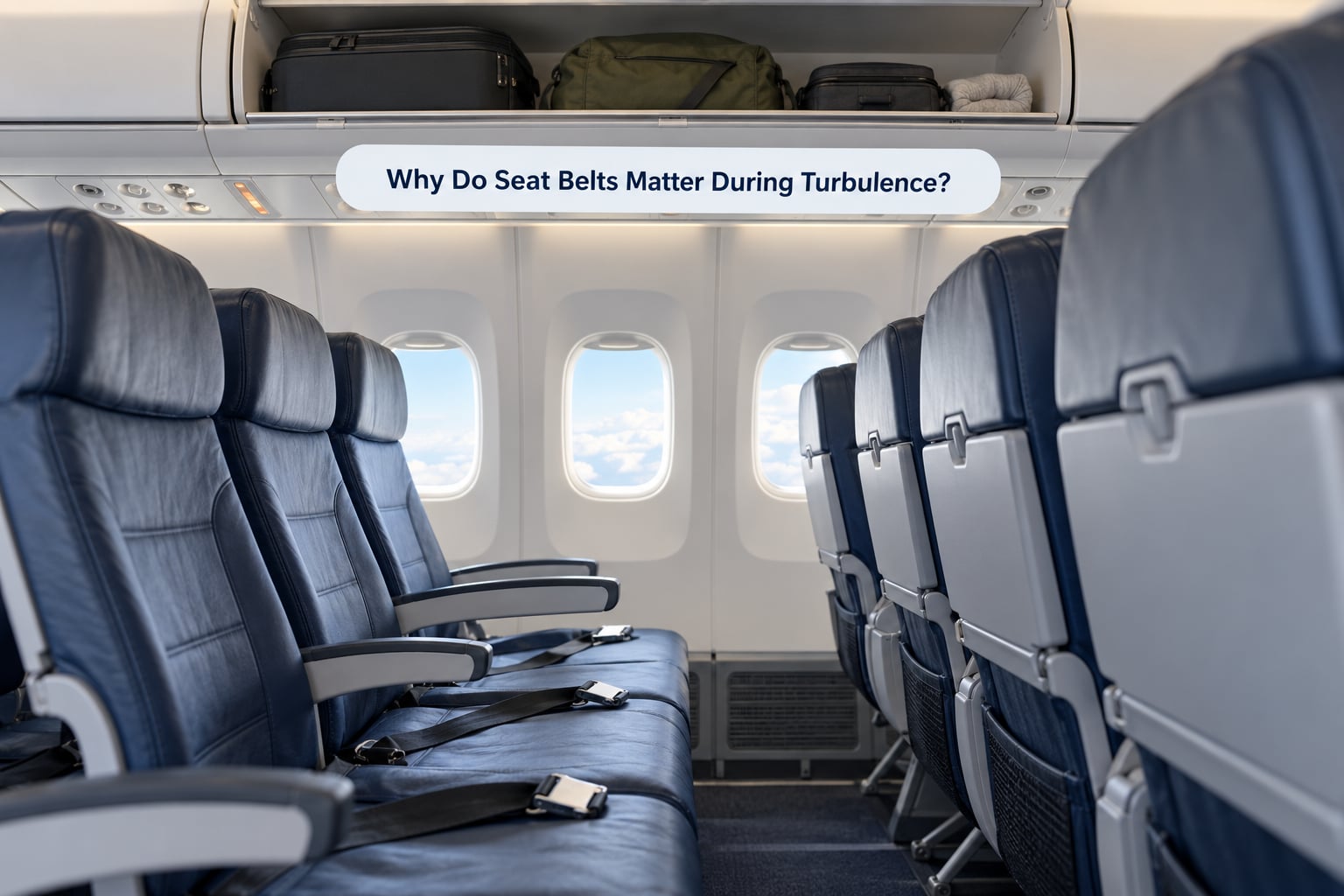
Because the load on a human body is far higher than the load on a wing. A jet can absorb a load that would be unsurvivable for a person standing in the aisle with a tray of drinks.
The numbers from US investigators are worth reading carefully. The NTSB found that turbulence accounted for more than one in three US airline incidents between 2009 and 2018. The FAA counted 30 passengers and 116 flight attendants seriously injured between 2009 and 2021, where serious injury is defined as fractures, internal organ damage, severe burns or any hospital stay of two days or more. A later NTSB tally put the figure at 163 seriously injured people across the same decade, 2009 to 2022.
Two things stand out in that data. Crew are injured far more often than passengers, because they are working when it hits. And airlines are not required to report minor bumps, bruises or sprains, so the true number of scraped knuckles is much higher than the headline figure.
Myths that make turbulence feel more dangerous than it is
| The claim | What is actually happening |
|---|---|
| The plane hit an air pocket | Air pockets do not exist. The aircraft moved through uneven air. |
| The plane fell out of the sky | Altimeters show a few hundred feet of movement, not thousands. Wings flex and absorb the load. |
| The wings might snap off | Wings are tested far beyond expected loads and are designed to bend upward. |
| The pilots lost control | The aircraft remained under control the whole time; the crew chose a speed and altitude that reduced the jolts. |
| Clear skies mean a smooth ride | Clear-air turbulence is invisible. Cloud is sometimes the reassuring part. |
That last one explains a lot of the fear. On a bright blue day with no cloud in sight, passengers assume the flight will be calm, and then the cabin moves without warning and without any visual cue to make sense of it.
How Do Modern Airplanes Handle Turbulence?
Resisting turbulence is not the goal. Letting the aircraft ride it out safely is.
Wings are built with enough span and strength that they can rise and drop substantially without generating a force that threatens the structure. Flight crews sit down and brace before entering rough air, because a restrained pilot is a far better pilot. They will also request a lower altitude or a lower speed, both of which reduce how sharply the aircraft moves through the uneven air.
Onboard weather radar catches precipitation, which is how convective turbulence and the edges of storms get spotted ahead of time. Modern turbulence prediction uses a concept called the Eddy Dissipation Rate, which reads how much energy is in the surrounding air and maps that into expected turbulence intensity. That works well where the air is bumpy but not perfectly clear.
In the cabin, the response is procedural: seatbelt sign on, service suspended, carts and galley equipment stowed and locked, flight attendants seated or holding on. Every turbulence injury to a crew member happens during service, not during a lull in it.
What Should Passengers Do During Turbulence?
Keep the belt on. That one habit accounts for most of the difference between a scary flight and a dangerous one.
- Fasten your seatbelt whenever you are seated, even with the sign off. Most severe encounters begin with the sign off and the cabin walking around. A fastened belt turns a fall into a lean.
- Put the tray table up and stow loose items. A phone, a tablet or a bag of snacks can become a projectile at your row.
- Follow the crew. If the seatbelt sign comes on, sit down and stay down. They know the aircraft, and they have done this a thousand times.
- Hold the armrest and keep your feet flat on the floor. It reduces the whiplash your neck takes in a vertical jolt.
- Do not use the lavatory mid-event. A toilet has no seatbelt, and the walls are hard.
- If you are standing, get to a seat if you can do so safely. If you cannot, brace against a fixed surface and protect your head.
- Stay buckled after it passes. A second bump often follows the first, and injuries cluster in the recovery, not the event.
For anyone flying with a small child, an older relative, or a heart or respiratory condition, this matters more rather than less. A child standing in the aisle during a bump is the single worst combination on the manifest.
When Is Severe Turbulence a Greater Concern?
Three situations raise the odds of genuinely severe turbulence: mountains, extreme weather and aircraft condition.
Terrain routes carry mountain wave turbulence, which can be strong and persistent for hundreds of miles downwind of a ridge. Winter storm routes over the Rockies, the Alps and the Himalayas combine jet stream strength with mountain wave. And a hurricane’s outer bands produce turbulence long before the storm itself is anywhere near the flight path.
On the aircraft side, an unusual loading condition, an unrepaired defect or a bird strike can reduce the margin. Crews and maintenance teams watch for these cases, which is one more reason a seatbelt sign coming on during a flight that seemed ordinary is not a reason to assume something is wrong.
The Singapore Airlines flight SQ321 case from 2024 is the reference point here. A Boeing 777 dropped roughly 6,000 feet in about three minutes over the Indian Ocean after a severe clear-air turbulence encounter, and 12 passengers were hospitalised. Every serious analysis of that flight found the aircraft itself recovered normally and the injuries belonged to unbelted passengers and cabin crew. The investigation found no fault with the plane.
Is Turbulence a Sign of an Emergency?
Usually not. Turbulence is a condition the aircraft is designed to handle, and the crew’s normal response is to change altitude, change speed, or accept the ride.
A real emergency looks different. The tell is usually a decision rather than a sensation: a diversion, a cabin announcement about a technical issue, or a flight that lands early. A smooth ride is not automatically the safe one either, because a smooth flight can be the one flown past weather the crew judged unfit to cross.
What turbulence does often produce is a post-flight precaution. After a severe encounter, some operators ground the aircraft for a structural inspection before it flies again. The crew is checking, not confirming a failure.
Can Pilots Forecast All Turbulence?
No, and pretending otherwise would be dishonest. Turbulence forecasting is good at weather you can see and weak at weather you cannot.
Radar and satellite data give good warning of convective turbulence near storms and fronts. Mountain wave turbulence is well modelled and appears on significant weather charts. Clear-air turbulence is the gap: no radar signature, no cloud, nothing for a forecast to point at. Crews close that gap with PIREPs, pilot reports filed in real time and shared with dispatch and other crews, which is how a patch of rough air over the North Atlantic gets known before the next flight enters it.
On whether turbulence is getting worse, the evidence is mixed and the honest answer has two halves. Research led by Paul Williams found severe clear-air turbulence in the North Atlantic rose by about 55 percent between 1979 and the present, a change he links to a stronger jet stream driven by a warming atmosphere. Larry Cornman of NCAR argues part of that measured increase comes from more aircraft flying more tracks, which means more chances to sample the same rough air.
Both can be true. That is why turbulence forecast apps should be read as a mood, not a verdict. Checking one the night before a flight mostly feeds the anticipation, which tends to make the flight feel rougher than it is.
Frequently Asked Questions
Has turbulence ever caused a plane to crash?
No airliner has been destroyed by turbulence alone. IATA notes the last clear-air turbulence death involving a major carrier was in 1997. Turbulence has caused serious injuries and emergency diversions, including Singapore Airlines flight SQ321 in 2024, but in those cases the aircraft recovered normally and the investigation found no structural failure. The risk is to people who are unbelted, not to the airframe.
Can turbulence break an airplane wing?
No. Transport wings are certified to withstand loads well beyond the highest expected in service, and they are built to flex so they can absorb energy rather than resist it. The upward flexing most passengers notice on a video is the designed behaviour working. After a severe encounter an operator may ground the aircraft for a structural inspection as a precaution, and that check usually finds nothing.
Why do flights sometimes add more fuel for turbulence?
Rough air increases drag and can force an aircraft to hold an altitude longer than planned, burning more than the original figure allowed. Carrying the additional fuel protects against arriving at the destination with less than the required reserve. It is a planning margin for a longer or rougher flight, not evidence that the crew expects the aircraft to be in danger.
Do seat belts really make turbulence safer?
Yes, and it is the single most effective thing a passenger can do. Serious turbulence injuries are overwhelmingly cases of people standing, walking, using the lavatory or serving drinks at the moment the aircraft moved. Keeping the belt fastened whenever seated removes nearly all of that exposure. A fastened belt turns what would be a fall into the aisle into a hard lean in your seat.
Why does turbulence feel worse in some seats?
Two reasons. Physically, the rear of the cabin sits farther from the aircraft’s centre of gravity, so the same movement produces a larger sensation, and rows over the wings move least. Physiologically, your inner ear reads acceleration as a drop, and at 38,000 feet you have no ground reference to tell you how far you actually moved. Both are why an aisle seat over the wings usually feels calmest.
Conclusion
Turbulence is a normal, forecastable-in-parts feature of the atmosphere, and a certified airliner handles far more of it than you will ever feel. The airframe is not at risk in ordinary flight. The risk sits with people who are standing when it arrives, which is why the practical answer to is turbulence dangerous for airplanes is simple: keep your seatbelt fastened whenever you are seated, even with the sign off, stow loose items, and do what the cabin crew asks the first time.
Fly more, fly often, and let the wing flex.