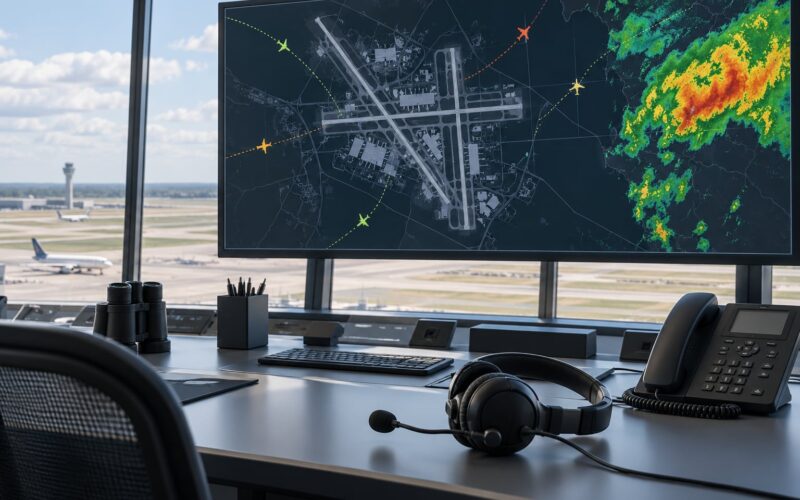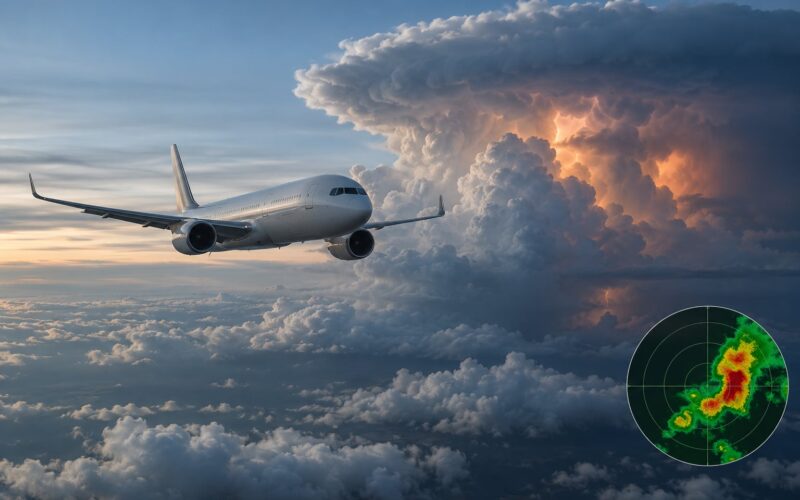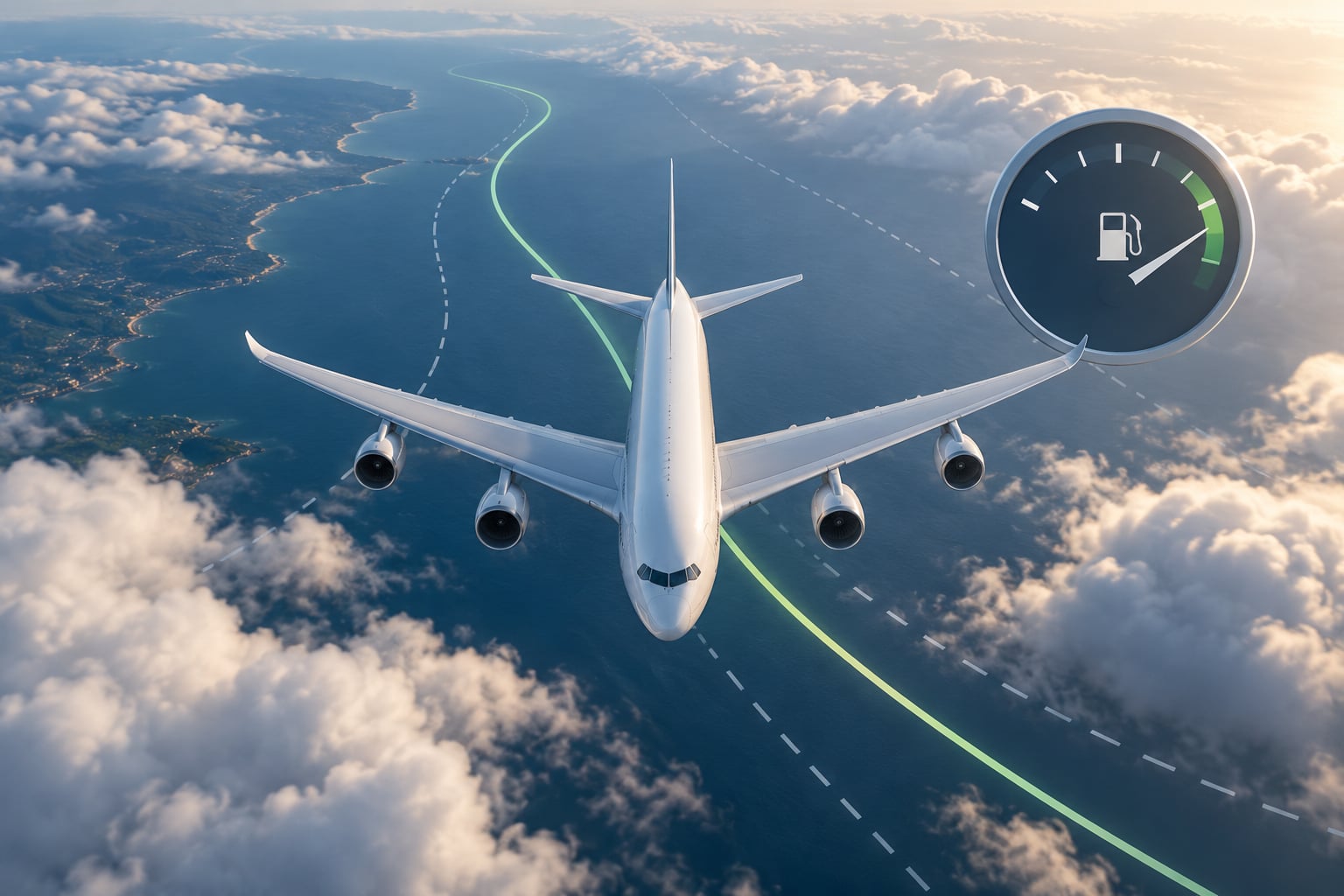
Long-haul flights save fuel the same way any heavy vehicle does: carry less, fight the air less, and waste nothing in the process. Airlines plan routes around the jet stream, load only what the ticket actually pays for, cruise just under the speed that costs the most fuel per mile, climb higher as weight burns off, descend without levelling off, and taxi on a single engine.
Getting the mechanics of how long haul flights get fuel savings matters because fuel is the largest single operating cost in aviation. IATA puts typical consumption at around 3 to 4 litres of jet fuel per passenger per 100 km, and burning a kilogram of jet fuel releases roughly 3.16 kg of carbon dioxide. Every kilogram saved lands on both sides of that ledger.
Table of Contents
- 1How Long-Haul Flights Get Fuel Savings at a Glance
- 2Why Long-Haul Flights Consume So Much Fuel
- 3How Long-Haul Flights Get Fuel Savings Behind the Scenes
- 41. Reduce the Weight Carried on Board
- 52. Choose More Efficient Routes and Altitudes
- 63. Optimize Speed, Altitude, and Step Climbing
- 74. Use More Fuel-Efficient Aircraft and Engines
- 85. Improve Engine and Flight-Operation Efficiency
- 9What Can Make Fuel Savings Harder to Achieve
- 10How Much Fuel Can These Methods Save?
- 11Can Passengers Help Airlines Save Fuel?
- 12Frequently Asked Questions
- 13Do heavier passengers really make a long-haul flight use more fuel?
- 14Do contrails cause long-haul flights to use more fuel?
- 15Does sustainable aviation fuel reduce the amount of jet fuel burned?
- 16Why do some direct flights use more fuel than connecting flights?
- 17Do airlines save fuel by flying at night?
- 18Conclusion
How Long-Haul Flights Get Fuel Savings at a Glance
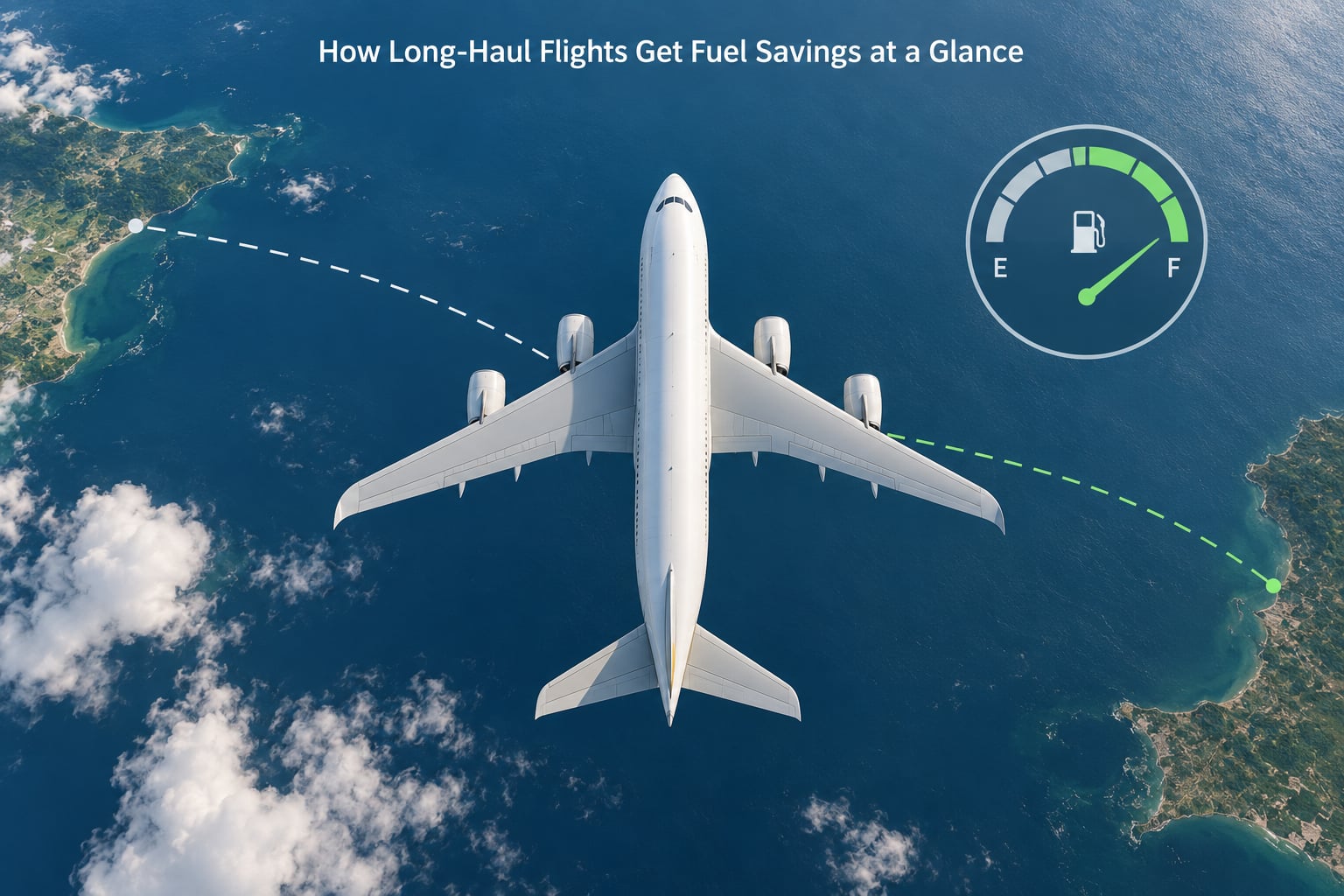
Long-haul flights get fuel savings from five levers: flying less weight, routing around headwinds and into tailwinds, holding the most fuel-efficient cruise speed, stepping up to a higher cruise altitude as weight drops away, and cutting fuel waste on the ground and during the descent. None of it is exotic. It is thousands of small decisions made before pushback and again in the flight management computer, every single flight.
- Carry less weight. Every kilogram not lifted has to be carried for the whole sector, and fuel burn rises with total weight.
- Fly a wind-aware route. A track with a tailwind can beat a shorter track into a headwind.
- Hold the right cruise speed. Slower saves fuel only down to max range cruise; below that, fuel per mile goes back up.
- Step climb as fuel burns off. The best altitude for an aircraft gets higher as it gets lighter.
- Stop wasting fuel on the ground and on the way down. Single-engine taxi, limited auxiliary power unit use, and continuous descent instead of a stepped descent.
The table below is a summary of how each method works and where it runs into trouble. Figures in the third column are typical contributions reported across the industry rather than a promise for any single airline.
| Method | What it changes | Typical contribution | Main trade-off |
|---|---|---|---|
| Weight and payload | Total weight lifted, which drives fuel burn for the whole flight | One of the largest controllable levers | Passengers and cargo pay for the flight, so weight cannot simply be cut on demand |
| Route and wind selection | Distance flown through headwinds and tailwinds | Often a mid-single-digit percentage on affected sectors | ATC routes and North Atlantic tracks may be the only legal or practical path |
| Cruise speed control | Drag per mile, via the cost index the airline sets | Small; cost indices in real operations already sit near max range cruise | Slowing down costs crew time, maintenance and schedule time, which can outweigh the fuel saved |
| Step climbs and altitude | Drag at cruise as the aircraft gets lighter | Automatic in most modern flight management systems | Airspace structure and ATC clearance, not the airline, decide when you can climb |
| Ground and descent operations | APU running, taxi thrust, idle time and holding in the descent | Low single-digit percentage, mostly on short sectors | Depends on airport layout, gate position, traffic and ATC sequencing |
Why Long-Haul Flights Consume So Much Fuel
Two costs stack on top of each other on any flight. The first is moving weight: passengers, checked bags, cargo and the empty airframe itself all have to be lifted for the whole distance. The second is generating lift and pushing air aside, which is aerodynamic drag.
On a long sector the airframe cost dominates in one sense, because it is carried for hours, but the fuel needed to carry it creates a compounding problem. Airlines burn more fuel to fly a heavy aircraft, carry more fuel for the heavy aircraft, and then carry that extra fuel too. Ultra-long non-stop routes hit this hard, which is why the weight penalty of carrying enough fuel for an 18-hour sector limits how many seats can be sold. Wikipedia’s entry on fuel economy in aircraft makes that same point about very long non-stop passenger flights.
How Long-Haul Flights Get Fuel Savings Behind the Scenes
The five methods are really five ways of changing one of four things: how heavy the aircraft is, what path it takes through the air, what the conditions are at cruise, and how much work the engines do for it. Every one of them is tied to the others.
An airline cannot pick an ideal speed if the aircraft is too heavy to reach its best altitude, and it cannot climb to a better altitude if the route is blocked by traffic. That is why fuel performance is judged across a whole flight rather than one lever at a time. The dispatchers who build the flight plan and the crew flying it are solving the same problem at two different moments.
1. Reduce the Weight Carried on Board
Fuel burn scales with total weight, so removing weight reduces burn continuously rather than in one step. The levers airlines actually pull start with the cabin: lighter seat fabrics, thinner trays, fewer paper safety cards, and water loads trimmed to what the route needs. Lighter materials cost nothing at the point of use, which is why cabin retrofit programmes show up in airline fuel reports.
On the ramp it is bags and cargo. Weight and balance has to be calculated before every departure, and the loading plan is built around a strict payload limit set by the aircraft’s maximum takeoff weight. Ask people to pack lighter and buy a holiday with less clothing in it, and the saving looks trivial. Across a full cabin it is not: a few kilograms per bag across hundreds of bags is a few hundred kilograms off a wide-body’s takeoff weight, and that weight is carried for the whole sector.
The other weight lever is fuel itself. Carrying extra fuel above the required figure is sometimes justified by headwinds or a longer route, and sometimes it is just tankering for the next sector, where the fuel is cheaper or the destination cannot supply it. Both are real decisions, and both add weight the flight has to carry. Regulatory floors exist here too, including contingency fuel and final reserve fuel of at least 30 minutes at holding speed, plus extra reserves for over-water flights under ETOPS. Those cannot be trimmed for fuel savings, and nobody sensible proposes it.
2. Choose More Efficient Routes and Altitudes
The ground track matters as much as the schedule. A jet moving against a strong headwind is pushing air it has already accelerated, and it burns fuel to gain a kilometre that costs the same as any other. A tailwind pushes back. Over the North Atlantic, structured track routes such as the ICAO NAT tracks are rebuilt each cycle to follow the jet stream, and crews pick a track whose wind matches the arrival window.
Route optimisation is now largely a software job. Before departure the plan is built around forecast winds; in flight the airline receives updated weather and wind data and can re-plan, sometimes moving the aircraft thousands of kilometres sideways to reach better air. IATA describes fuel efficiency as increasingly a precision-data exercise rather than an intuition.
The point where this gets interesting is that the shortest path is not always the cheapest one. Flying further to sit in a tailwind can arrive earlier and burn less fuel at the same time, and both of those outcomes are worth money. The reason airlines cannot simply do that every time is that the sky is not the airline’s to rearrange, which is the subject of its own section below.
3. Optimize Speed, Altitude, and Step Climbing
Drag rises steeply with speed, which is why cruising faster costs more fuel per kilometre. The popular version of the story stops there: slow down, save fuel. The technically accurate version has a catch that most articles skip, and pilot forums have been arguing about it for two decades.
Below max range cruise speed, fuel burn per kilometre climbs again, because the engines are no longer working near their most efficient point. A classic rule of thumb from the pilot community is the L1011, which burns more fuel at Mach 0.82 than at its max range Mach 0.84. Slowing to that lower speed does not save fuel; it costs it. The forum thread that comes up repeatedly on this topic makes the same point: real operations run cost indices that already sit close to max range cruise, and shaving 0.01 of a Mach number is worth only on the order of 100 to 200 pounds of fuel per hour.
That is the trade the airline makes. A crew is paid by the hour, aircraft are leased and maintained by the hour, and an aircraft held in the air is earning nothing. So the airline sets a cost index, which converts time into a fuel value, and picks the speed that minimises total cost rather than the speed that minimises fuel quantity. On a long sector with a strong tailwind, slowing down is often genuinely worthwhile because the fuel saving arrives early. Into a 300-knot headwind, cruising at 300 knots achieves almost nothing.
Altitude works the same way in reverse. Optimum altitude is not a fixed number on the aircraft; it rises as weight comes off. A fuel-laden 787 departing with a full tank of fuel for 16 hours wants a lower cruise level than the same aircraft three hours later. That is what a step climb is: the crew requests a higher flight level as the aircraft gets lighter, and the flight management system usually handles the calculation. The savings come from flying in thinner air at a Mach number where the engines are happier.
One more technical point belongs here, because it explains why the climb matters more than most people expect. Climbing is the least efficient phase of a flight, and pilots on the forums describe a bad climb schedule as something you cannot recover on cruise, even over ten hours. Flight planning is therefore judged on the whole profile, not the cruise slice.
4. Use More Fuel-Efficient Aircraft and Engines
Aircraft design changes the physics rather than the tactics. Cleaner wing shapes and winglets reduce induced and form drag, composite and aluminium-lithium structures cut the weight of the airframe, and high-bypass turbofans deliver more thrust for less fuel than the low-bypass engines they replaced. New-generation narrowbodies such as the 737 MAX and A320neo are commonly reported to burn around 16 to 20 percent less fuel than the aircraft they replaced, which is why fleet renewal sits at the top of every airline’s efficiency plan.
Maintenance belongs in the same bucket. Engine compressor washes, blade coatings and keeping the underside of the wing and the fuselage clean are unglamorous and effective, because a surface that is not smooth costs fuel for the entire life of the aircraft.
Sustainable aviation fuel is a different lever and is often confused with fuel saving. It is worth separating clearly: SAF can lower lifecycle carbon emissions substantially, but burning one kilogram of it still moves an aircraft the same distance and still throws roughly the same mass of carbon dioxide out of the tailpipe. It changes what is burned, not how much. Schemes such as CORSIA address that gap, and net-zero targets for 2050 are the second reason efficiency work continues even in markets where fuel is cheap.
5. Improve Engine and Flight-Operation Efficiency
The last lever is operational discipline, and it is where a single flight’s numbers actually move. Taxiating out on one engine instead of two is standard practice at many carriers, and the fuel saved per movement is small but the movements add up across a network of thousands of flights a day.
The auxiliary power unit is the other target. APU running burns fuel, so airlines limit how long an aircraft sits with it running at the gate, and large airports with fixed electrical ground power remove the need entirely. Shorter taxi times, faster turnarounds and better gate scheduling all cut idle fuel.
In the descent, continuous descent operations let an aircraft stay in the air and descend steadily instead of levelling off at altitude, waiting for a clearance, then descending again. Each level segment is wasted lift generation, so removing them saves real fuel on every arrival that can use the procedure. Data-driven trajectory optimisation sits in the same category; vendors claim reductions of up to 5 percent on long-haul missions, and the honest reading is that the achievable share depends almost entirely on how much airspace and how many delays you have to work around.
Here is where fuel culture shows up. A dispatcher cutting tankering without telling anyone, or a crew executing a steep arrival they were not expecting, will erase the gains. Pilots who understand the cost index behave differently at cruise, which is why training and buy-in sit alongside the software.
What Can Make Fuel Savings Harder to Achieve
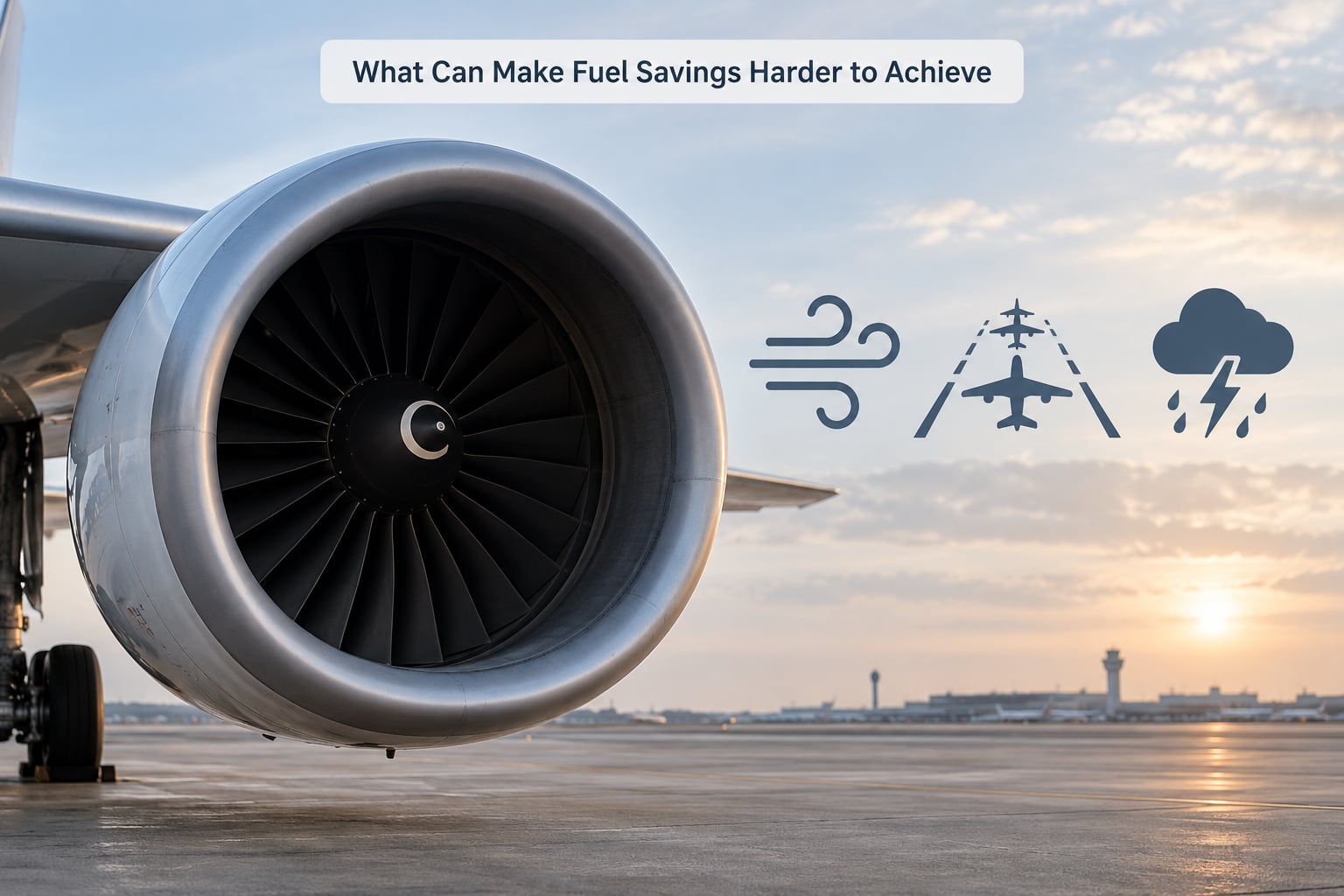
Plenty of good fuel work gets cancelled by things no one on the flight controls. The clearest way to see it is to separate what an airline decides from what the operating environment decides for it.
| Factor | Directly within airline control | Largely imposed by the environment |
|---|---|---|
| Route | Wind-aware path selection, altitude and speed choice | ATC routes, North Atlantic track structure, restricted airspace |
| Time of day | Slot choices, turnaround sequencing | Traffic peaks, holding patterns on arrival, gate availability |
| Weather | Accepting a slightly longer route into smoother air | Headwinds, turbulence, thunderstorms, ice |
| Weight | Loading plan, cabin retrofit, tankering decisions | Passenger demand, cargo commitments, required reserves |
| Ground | Single-engine taxi, APU limits, engine wash scheduling | Airport layout, taxi distance, runway congestion |
| Arrival | Requesting continuous descent where available | ATC sequencing and separation rules |
Two failure modes show up repeatedly. The first is holding: a circuit pattern at 5,000 feet around a congested destination burns fuel at a rate that erases a good climb and a good cruise. The second is late cargo, where a bag loaded an hour before departure forces a weight and balance recalculation and sometimes a fuel decision, which costs time and fuel both.
Concorde used to show what happens without these limits. Cruise at Mach 2 above 60,000 feet put it in the upper atmosphere where drag is thin, but each passenger cost roughly five times the fuel of a subsonic traveller, which is the clearest available demonstration that fuel efficiency and speed are separate goals.
How Much Fuel Can These Methods Save?
There is no honest single percentage for a long-haul flight, and any article offering one is selling something. The saving from a given technique depends on variables that change every time the aircraft is tail-numbered, so here is what actually has to be known before a number means anything.
| Variable | Why it moves the answer | Typical range on a long-haul sector |
|---|---|---|
| Aircraft type and configuration | Drag, engine efficiency and cabin density all differ by type | Wide-body twin, typical long-haul fleets |
| Route distance and winds | Strong tailwinds or headwinds dominate other small effects | Atlantic tracks in winter are the classic worst case |
| Payload and takeoff weight | Burn rises with weight carried across the whole sector | Often well above maximum takeoff weight limits on paper, so real payload sits below the limit |
| Cruise level and step climbs | Thinner air means less drag per unit of lift | Several step climbs on a long ocean crossing |
| Taxi time and APU use | Engine thrust on the ground is expensive idle time | Minutes to tens of minutes on congested airports |
| Delay and holding time | Holding is flown at low speed at low level and burns heavily | Zero on a good day, an hour on a bad one |
Airlines do publish aggregate results, and those are the trustworthy numbers. SpiceJet reported saving roughly 6,200 tonnes of fuel over six months, and around 20,000 tonnes of carbon dioxide with it, after deploying flight optimisation software. That is a real operating result from a real airline, and it is a far more useful figure for a reader than any invented percentage.
The one specific technique with a defensible size is continuous descent and reduced holding, because it removes a phase rather than trimming a margin. Everything else is smaller than the marketing suggests and larger than nothing.
Can Passengers Help Airlines Save Fuel?
Yes, a little, and the size of the effect is worth being honest about. Lighter checked bags are the clearest one: a kilogram is a kilogram on the ramp, and the same kilograms travel the whole route. Not packing for a week you will not use, and weighing hand luggage before the airport, are the two things travellers control most easily.
Choosing a non-stop over a connection helps in one specific way. Two flights mean two takeoffs, two climbs, two descents and two taxi phases, and the climb is the least efficient part of any flight. It also means two sets of crews, two landings and their fees. A long direct flight can be more fuel-efficient per passenger than a shorter hop, which surprises people until they work out that takeoff and climb cost so much more per minute than cruise.
Beyond that, individual choices are small. Travelling less helps far more than travelling lighter, and no passenger decision replaces fleet renewal, better routing or disciplined operations. If you want to see fuel efficiency as a ticket price, watch what happens to fares when oil moves; fuel is the biggest line in an airline’s costs, so it moves fares both ways, and no amount of careful packing changes that very much.
Frequently Asked Questions
Do heavier passengers really make a long-haul flight use more fuel?
Yes, though the effect is spread across everyone rather than loaded onto one seat. Fuel burn rises with the weight an aircraft carries, so a full flight burns more than a half-empty one on the same route. One extra passenger is a small fraction of a takeoff weight measured in tens of thousands of kilograms, but full cabins are exactly why load factor drives how cheaply an airline can fly a sector.
Do contrails cause long-haul flights to use more fuel?
The contrail itself is water vapour and does not cost meaningful fuel. What costs fuel is the avoidance: when air traffic control routes aircraft around forecast convective weather to prevent contrail formation, the aircraft may fly a longer path or sit in different air. On routes where avoidance is common, that detour is a real fuel cost, and research into contrail avoidance is aimed at reducing exactly that.
Does sustainable aviation fuel reduce the amount of jet fuel burned?
Not by itself. Sustainable aviation fuel is chemically similar to conventional jet fuel, so an aircraft burning it covers the same distance and produces a comparable amount of carbon dioxide at the tailpipe. Its benefit is lower lifecycle emissions once you account for how the feedstock is grown and processed. That is a carbon argument, not a fuel-quantity argument, and the two are often confused.
Why do some direct flights use more fuel than connecting flights?
It is possible, and the usual reason is fuel weight. An ultra-long direct flight must carry enough fuel for the whole journey, and that fuel is carried for the entire flight, which makes the aircraft heavier at every point than a shorter sector would be. Weather plays a role too, since one long crossing can sit in a headwind for hours. Connecting flights also duplicate the most inefficient phase, the climb.
Do airlines save fuel by flying at night?
Sometimes, indirectly. Night flying usually means lighter traffic, fewer holding patterns, less air traffic control interference and shorter taxi waits, all of which reduce fuel. Aircraft are not flown slower at night for fuel reasons. The gains come from the operating environment rather than a special night procedure, and the effect disappears wherever night departures are as congested as daytime ones.
Conclusion
The fuel savings on a long-haul flight come from five things working together: a lighter aircraft, a route chosen for wind rather than distance, cruise speed and altitude adjusted to the weight it is carrying, an airframe and engines that waste less, and ground and descent procedures that stop burning fuel for nothing. No one lever delivers a headline number.
If you see a claimed saving, ask what route, aircraft, weather and load it assumed. Real airlines publish aggregates rather than percentages, and those are the figures worth trusting.