Air traffic control is a network of controllers and technology that keeps aircraft separated, sequenced and routed from the taxiway at your departure airport to the runway at your destination. Controllers watch radar and computer displays, talk to pilots by voice radio, and hand out instructions on when to taxi, take off, climb, turn, change height and land. The pilot stays in command of the aircraft the entire time.
That is the part almost nobody explains. From your seat, air traffic control looks like an invisible hand moving the plane around the sky. Knowing how it works turns most of the odd things you notice — a long wait on the runway, a sudden detour, an aircraft circling for twenty minutes — from worry into routine.
Table of Contents
- 1What Air Traffic Control Does
- 2How Air Traffic Control Works for Passengers
- 3How Air Traffic Control Works for Passengers During Each Flight Stage
- 4Who Controls an Aircraft at Each Point in the Flight?
- 5How Controllers Communicate With Aircrews
- 6Why Do Air Traffic Control Delays Happen?
- 7What Does Air Traffic Control Mean for Passenger Safety?
- 8What Can Passengers Notice During Normal Operations?
- 9Frequently Asked Questions
- 10Does air traffic control control the airplane?
- 11Why can a flight be delayed even when the weather is clear?
- 12Can air traffic control prevent turbulence?
- 13What is the difference between a flight plan and a flight clearance?
- 14Why do pilots repeat air traffic control instructions?
- 15Why do planes fly in a curved path across the ocean?
What Air Traffic Control Does
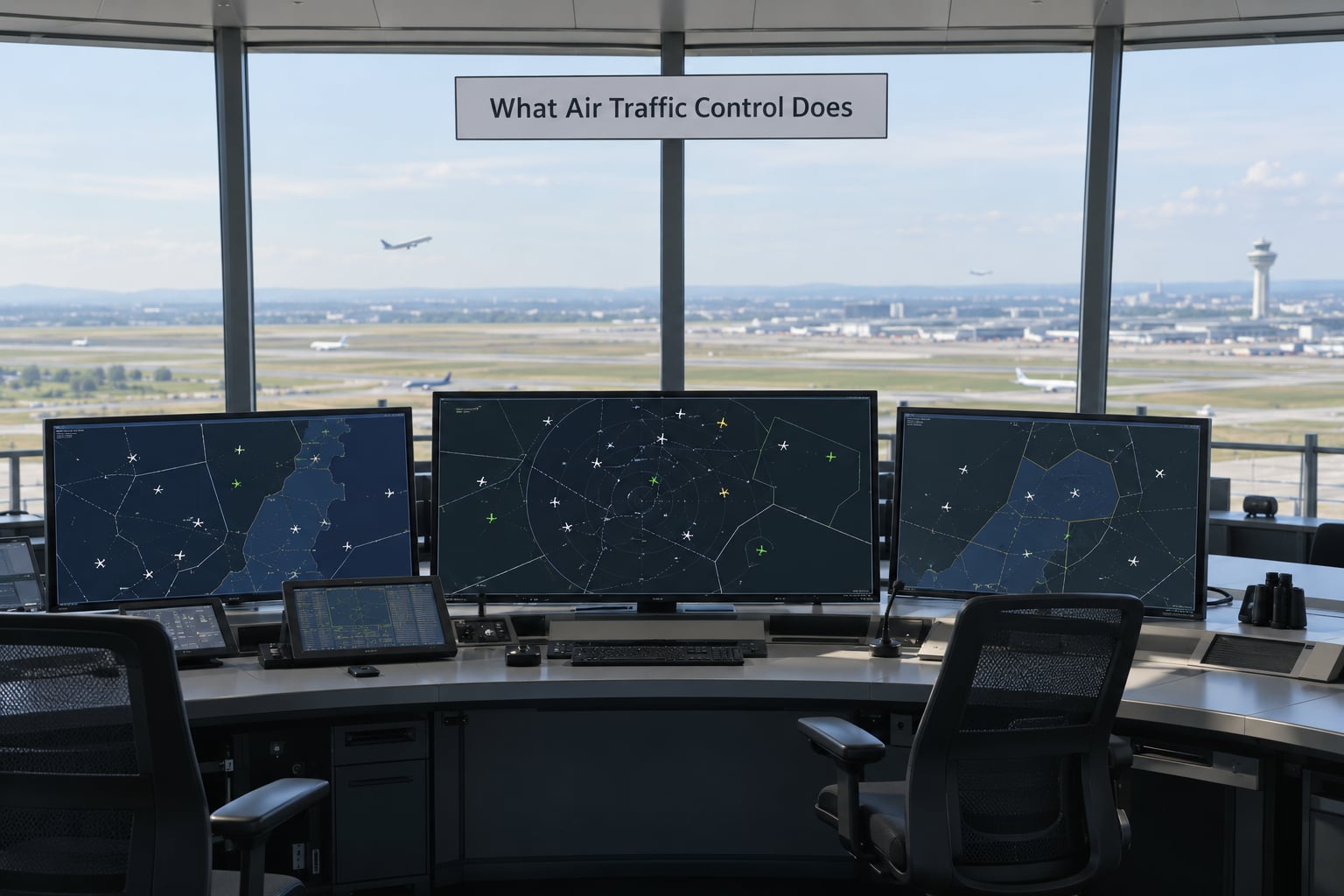
Air traffic control’s job is to keep aircraft apart, in the air and on the ground, and to keep the whole system moving. It does that by telling aircraft where to go, when they can move, and what to expect next.
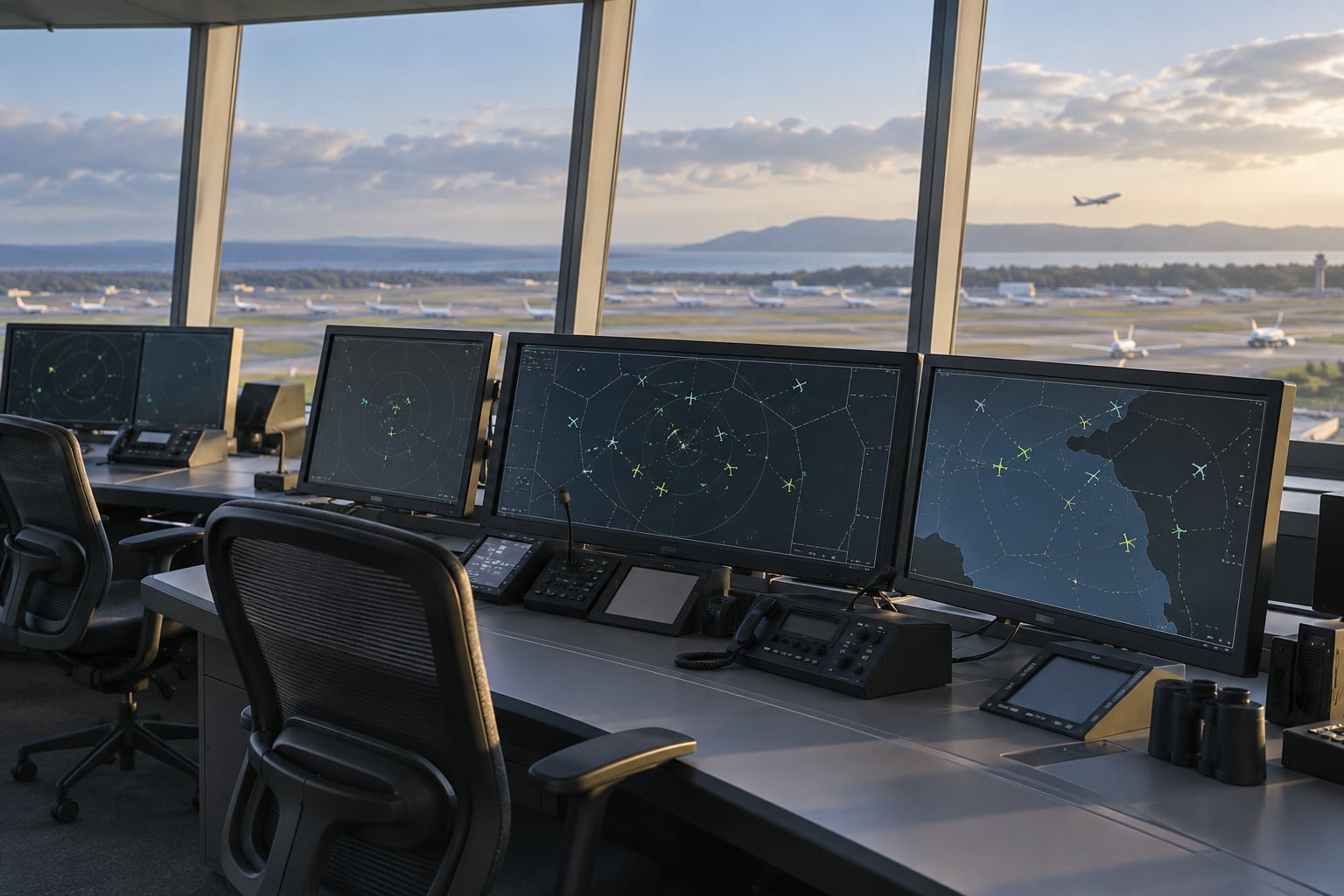
The service is delivered by people, not by satellites alone. Controllers sit in several kinds of facilities, and each one owns a slice of the journey. Tower controllers work in the glass box at the airport. Ground controllers work on the taxiways. Approach and departure controllers hand aircraft off near busy cities. En-route controllers, also called area controllers, look after aircraft on long stretches between airports, often in windowless rooms far from the airspace they are watching.
Three goals drive almost every decision they make: prevent collisions, keep traffic moving, and handle whatever goes wrong that day. Controllers also publish and use NOTAMs, the short notices about hazards, closed runways and radio frequencies that any pilot can check before a flight.
Controllers do not see inside your aircraft. They see a dot on a display, the data your transponder and ADS-B equipment broadcast, and the information filed with your airline. There is no camera pointed at the cabin and no microphone picking up your conversation.
How Air Traffic Control Works for Passengers
How air traffic control works for passengers is easiest to understand as a chain of handovers: one team hands your aircraft to the next, and each handover happens at a predictable point in the flight. Nothing about it is improvised at the last minute, and almost nothing happens to you without a reason someone can explain.
How Air Traffic Control Works for Passengers During Each Flight Stage
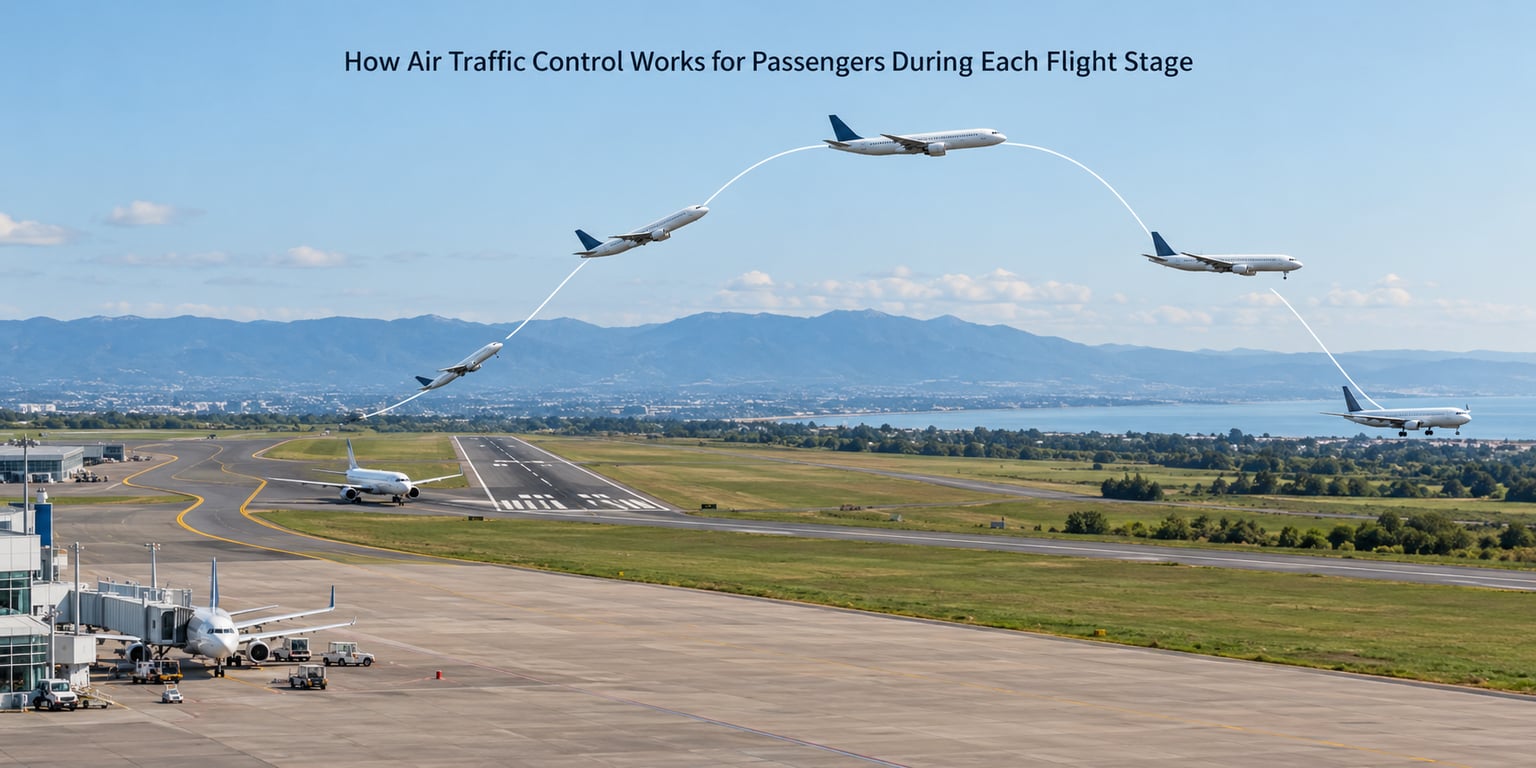
- Filing the flight plan. Before you board, your airline’s dispatchers file a route with the air traffic system. It covers the aircraft type, departure and destination, cruising height, speed and the time the flight is expected to enter and leave controlled airspace.
- Getting clearance at the gate. A clearance delivery controller checks the filed route against restrictions, weather and other traffic. The pilot receives the route, the transponder code to squawk, and the departure instructions before pushback.
- Taxi. Ground control gives taxi instructions and permission to leave the gate. If you sit for ten minutes with the seatbelt sign off and the engines off, this is usually where you are: the aircraft is waiting for a slot rather than for a crew.
- Takeoff clearance. Tower control sequences the runway and issues the takeoff clearance. Aircraft behind you may be held at the threshold or on a taxiway to let a landing aircraft get in first.
- Departure control. Once airborne, departure control gives climb and turn instructions and gets you out of the busy terminal area, often handing you a heading to fly, sometimes saying you are cleared direct to your next waypoint.
- En-route control. Somewhere around the edge of the terminal area you are handed to an area controller who looks after you for the next few hundred miles. This handoff is invisible in the cabin and takes a few seconds of radio.
- Arrival control. Near the destination, approach control slows and sequences the traffic, adds spacing, and may put you into a holding pattern if the airport cannot take another aircraft yet.
- Landing instructions. Tower control clears you onto the runway and gives the wind, the runway in use and, in poor visibility, an instrument approach. After you land, ground control walks you to the gate.
If your flight crosses an ocean, two more things happen. The route is built from published oceanic tracks that move with the jet stream, and any active or planned conflict zone along the way closes part of the sky. That is why a transatlantic or transpacific flight looks like it wanders off a straight line between two cities.
Who Controls an Aircraft at Each Point in the Flight?
Different facilities hand your aircraft from one team to the next, and each team works on a different part of the problem.
| Facility | Where the controllers work | What they handle | What you might notice |
|---|---|---|---|
| Clearance delivery | Airport, often by radio or data link | Reviewing the filed flight plan and issuing the initial clearance | A short wait for taxi start at a busy stand |
| Ground control | Airport, in or near the tower | Taxi routes and movement on the ground | A long taxi, or waiting while traffic ahead crosses |
| Local control (tower) | The tower cab at the airport | The runway and the immediate airport surroundings | Short holds before a runway, or a change of runway for wind |
| Approach and departure control | A terminal radar room, often near a busy airport | Aircraft arriving and departing within roughly 40 miles | Holding patterns, being slowed, being extended around weather |
| En-route (area) control | Large regional centres with big radar displays | Traffic in the high-altitude airspace between terminals | A slightly different route or a smoother ride at cruise |
How Controllers Communicate With Aircrews
Controllers and pilots talk on a very-high-frequency radio, one aircraft at a time, using a call sign and a strict shared vocabulary. Every word in that exchange has a meaning agreed in advance, which is why the recordings sound so terse.
- Call signs. Each aircraft is addressed by a shortened flight number and airline code, so a busy frequency stays unambiguous.
- Standard phraseology. A clearance like cleared direct is read the same way every time in every country, so there is no room for ambiguity.
- The phonetic alphabet. Runway Niner, Victor, Echo replaces the spoken letter N, so it cannot be misheard over a noisy frequency.
- Readbacks. Pilots repeat back clearances involving headings, altitudes or runways, and the controller corrects anything read incorrectly. This is why you hear the same instruction twice.
- Vectors. A vector is a heading instruction. It is how a controller turns an aircraft to make room, line it up with a runway, or keep it clear of weather.
Some airlines also send these clearances as text to the cockpit display before the pilot reads them aloud. On longer flights you will hear the frequency change several times as the aircraft moves between facilities, which is normal.
One thing worth knowing: controllers never talk to passengers. The cabin crew have no radio link to the tower. If you want to follow the conversation yourself, flyers on travel forums point to Channel 9 on the seatback headset, which carries the tower frequency at many airports. It is the simplest way to hear the system doing its job.
Why Do Air Traffic Control Delays Happen?
Delays usually come from a small number of recurring causes, and experienced travellers recognise them faster than they realise.
| Cause | What it means for your flight |
|---|---|
| Thunderstorms and convective weather | Aircraft are rerouted or held well away from the cell. Both departures and arrivals are affected at once. |
| Low visibility or high winds | Runway spacing increases, changeovers slow, and some airports reduce the number of arrivals they can accept per hour. |
| Deicing | Departures wait in a queue while aircraft are treated, which pushes every later departure back too. |
| Late aircraft | An inbound plane that arrived late is followed by every aircraft waiting for its gate, a crew or its turn on the runway. |
| Runway capacity | A single runway can only take one aircraft at a time, and big airports with several runways still reach a limit in the afternoon peak. |
| Airspace restrictions | Military activity, a visiting head of state, a wildfire or an active conflict zone closes routes and speeds everything up elsewhere. |
| Equipment and staffing problems | A radar outage, a navigation aid out of service or an understaffed tower reduces how many aircraft can safely be handled at once. |
Controllers also manage flow deliberately. When more aircraft are lined up than the destination can take, the origin airport is instructed to delay departures through ground delay or ground stop programs. Nothing has gone wrong; the system is simply refusing to create a bigger problem further down the route.
What Does Air Traffic Control Mean for Passenger Safety?
Safety comes from preventing close approaches in the first place, using fixed minimum distances that every controller works to. In en-route airspace, aircraft on the same flight level are kept at least about three miles apart, or separated vertically by a thousand feet or more. In busy terminal areas around airports the horizontal minimum tightens.
Safety does not rest on one layer. The layer above ground control is the on-board Traffic Alert and Collision Avoidance System, which detects a conflict and tells the crew what to do about it. Controllers handle the routine sequencing; the aircraft handles its own last line of defence.
| Who or what | What they do | Who acts in an emergency |
|---|---|---|
| Air traffic controller | Sequences aircraft, issues clearances, separates traffic, warns about traffic and weather | Gives priority, clears conflicting traffic out of the way and coordinates with other facilities |
| Pilot in command | Flies the aircraft, decides when to deviate, and remains responsible for everything on board | Flies the aeroplane, makes the call if a controller instruction does not suit the situation |
| Autopilot | Flies the clearance once it is given, and stabilises the aircraft in routine phases | Is usually disconnected first; the crew flies manually |
| TCAS / ACAS | Detects a collision risk with other aircraft and issues a resolution advisory | Gives the last-resort instruction if two aircraft are closing on each other |
| Onboard weather radar | Shows the crew where the bad weather is so they can ask for a different route | Feeds the crew’s request for a reroute or altitude change |
That split is the single most reassuring fact for nervous passengers: the controller builds the plan, and the pilot flies the aircraft and always has final authority. If an instruction does not work, the crew can deviate and tell the controller why.
What Can Passengers Notice During Normal Operations?
Most of what air traffic control does leaves a trace you can feel from your seat, and none of these things signal a problem.
- Waiting on the runway. Aircraft are frequently held just short of the threshold so one behind them can land first.
- A sudden change of altitude. Controllers step traffic up or down by a thousand feet or more to create spacing, or the crew is dodging weather at the pilot’s request.
- Circling above the airport. A holding pattern is a controlled delay, used when arrivals are stacking up faster than the runways can absorb them. The aircraft is burning a little fuel deliberately rather than descending into a full pattern.
- A route that looks indirect. Vectors, winds aloft and conflict-zone closures all bend the path. The cockpit display shows a course that looks longer than the map distance.
- The seatbelt sign going off early on approach. Normal when there is still a decent stretch of taxi ahead and the crew wants you seated and belted.
- Red-eye flights leaving after midnight. Some slots sit outside peak hours and only get used once the banks recover, which is why a delayed aircraft goes out late at night.
You will also sometimes hear an announcement that the flight is being held for air traffic. That is an honest signal that the sequence at the airport ahead no longer works, and it is usually the truthful reason for the delay you are looking at on your phone.
Frequently Asked Questions
Does air traffic control control the airplane?
Not really. Controllers tell each aircraft where to go, when to move and what traffic to expect, and they keep aircraft separated by issuing instructions. The pilot flies the aeroplane and stays responsible for it, and any controller instruction can be refused if it does not work. The autopilot flies the clearance for a while, but the crew disconnect it and fly manually when the flying gets demanding.
Why can a flight be delayed even when the weather is clear?
Most delays have nothing to do with weather at your airport. The aircraft in front of you may have arrived late, an inbound flight may still be holding for a gate, deicing can stall a whole departure bank, or the tower may be limited by radar or staffing. Controllers also delay departures on purpose when the destination airport has no room for another arrival, a process called flow control.
Can air traffic control prevent turbulence?
Partly, but not entirely. Controllers route aircraft around thunderstorms and known severe weather, and they will give you a different altitude if that helps. Ordinary light-to-moderate turbulence happens in air that shows nothing on radar, so it cannot be avoided by rerouting. Pilots also report the turbulence they fly through, and those reports feed back into the routing decisions for everyone else.
What is the difference between a flight plan and a flight clearance?
A flight plan is what you ask for: the route, aircraft type, cruising height and estimated times filed by your airline’s dispatchers before departure. A clearance is what air traffic control authorises: the route you have permission to fly, the altitude, the departure instructions and the transponder code. A filed plan does not give you permission to fly it; the clearance does, and the pilot can request and receive changes.
Why do pilots repeat air traffic control instructions?
A readback is a required safety habit. Pilots repeat back any clearance that involves a heading, an altitude or a runway so the controller can confirm the numbers were heard correctly, and the controller corrects anything wrong. You will hear instructions twice, sometimes slowly, and that repetition is evidence that the system is checking itself rather than a sign of confusion in the cockpit.
Why do planes fly in a curved path across the ocean?
Oceanic routes are published tracks rather than fixed lines, because they shift with the jet stream each day. Aircraft also stay clear of any active or planned conflict zones, which can push them hundreds of miles sideways. Routes run eastbound one way and westbound another when winds favour it, so the map distance and the distance actually flown are often very different.
The next time your flight sits on the taxiway, holds at the threshold or circles over the destination, read it as part of a system balancing weather, runway capacity and safety across thousands of aircraft at once. One delayed departure at the front of your day is often the reason for the delay behind it, and no single person decided any of it to annoy you. What is worth remembering is that the pilot is still flying, the controller is still sequencing, and the reason is almost always ordinary rather than alarming.