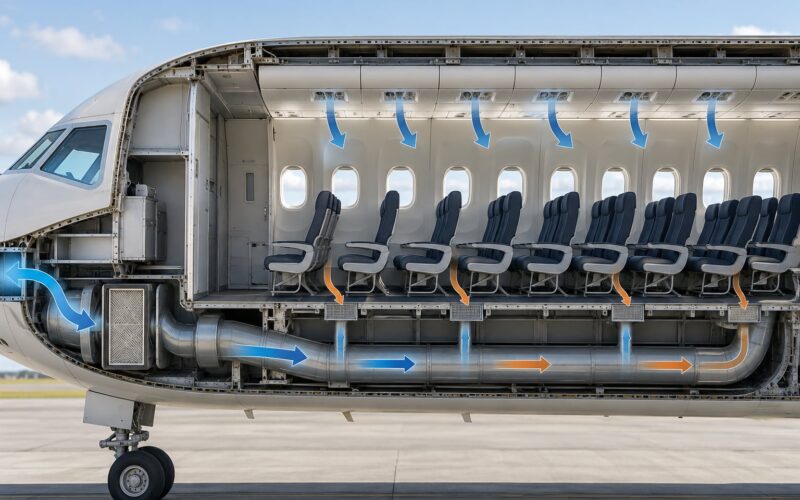
Flight anxiety, also called aviophobia or aerophobia, is an intense fear of flying that shows up as physical and mental symptoms before, during or after a flight, from mild nervousness to full panic attacks. How to manage flight anxiety in practice comes down to four moves: slow your breath, ground your senses, plan each flight phase in advance, and keep flying so the fear keeps losing ground.
It is more common than most people admit. Health guides cite roughly 25 million US adults living with aerophobia, and surveys depending on how the question is asked put the rate anywhere from around 10 percent to 40 percent of adults. The good news is that flight anxiety sits in a category psychologists understand very well: it is treated as a specific phobia, listed in the DSM-5 alongside other phobias, and cognitive behavioural therapy aimed at it works.
One number is worth holding on to before you read the rest of this guide. Risk figures repeatedly cited by behavioural health organisations put the odds of dying in a plane crash at roughly 1 in 13 million, compared with about 1 in 93 for a car crash, according to analysis from the National Safety Council and research into aviation risk from MIT. Your nervous system does not know that. So the strategy below is about giving the body something concrete to do while the mind catches up.
Table of Contents
- 1What You Need
- 2Step-by-Step
- 3How to Prepare Mentally in the Days Before Flying
- 4How to Reduce Anxiety the Day and Night Before the Flight
- 5How to Manage Flight Anxiety at the Airport
- 6How to Handle Fear During Boarding and Takeoff
- 7How to Stay Calm During the Flight
- 8How to Manage Anxiety During a Turbulence or Emergency
- 9How to Build a Plan for Future Flights
- 10Common Mistakes
- 11Frequently Asked Questions
- 12Can breathing exercises really help with flight anxiety?
- 13Should I take medication before flying, and what should I ask my doctor?
- 14Why do I feel more anxious during takeoff and landing?
- 15Is anxiety during turbulence a sign of an emergency?
- 16What if I have a panic attack before boarding?
- 17When should I seek professional help for fear of flying?
- 18How to Manage Flight Anxiety on Your Next Trip
What You Need
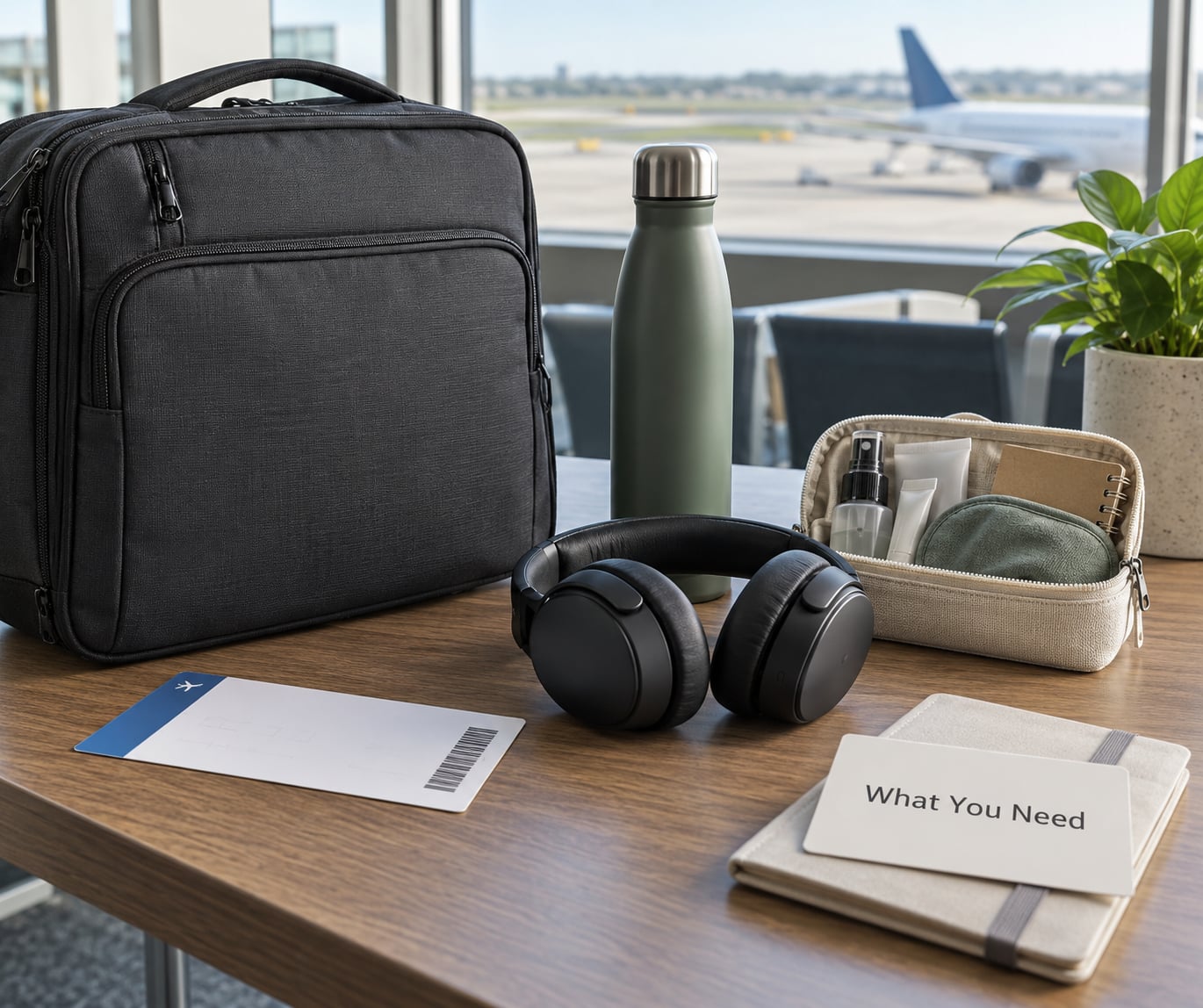
Almost every flight anxiety toolkit is small. The point of gathering it early is that a jolt of turbulence gives you no time to think, so the tool has to already be in your hand.
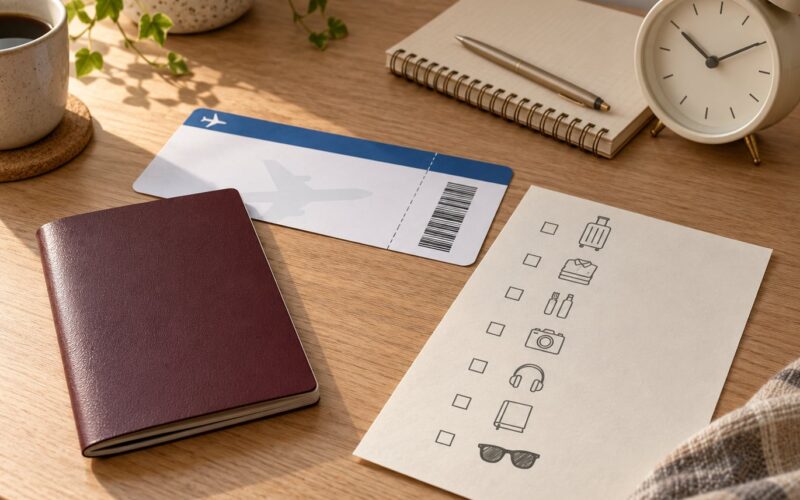
- A one-page itinerary. Flight number, times, seat, terminal, and your connection plan. One page, written out, read once. This is the single most calming item in most nervous flyers’ kits, because most of the fear is fear of not knowing.
- Two breathing patterns, rehearsed. Long-exhale breathing and box breathing. Knowing the counts cold matters more than knowing them on paper, so practise them in the weeks before, not on the day.
- Calming audio downloaded offline. Guided meditation, a bilateral stimulation track, or whatever you already know puts you down. Streaming it at 30,000 feet is not a plan.
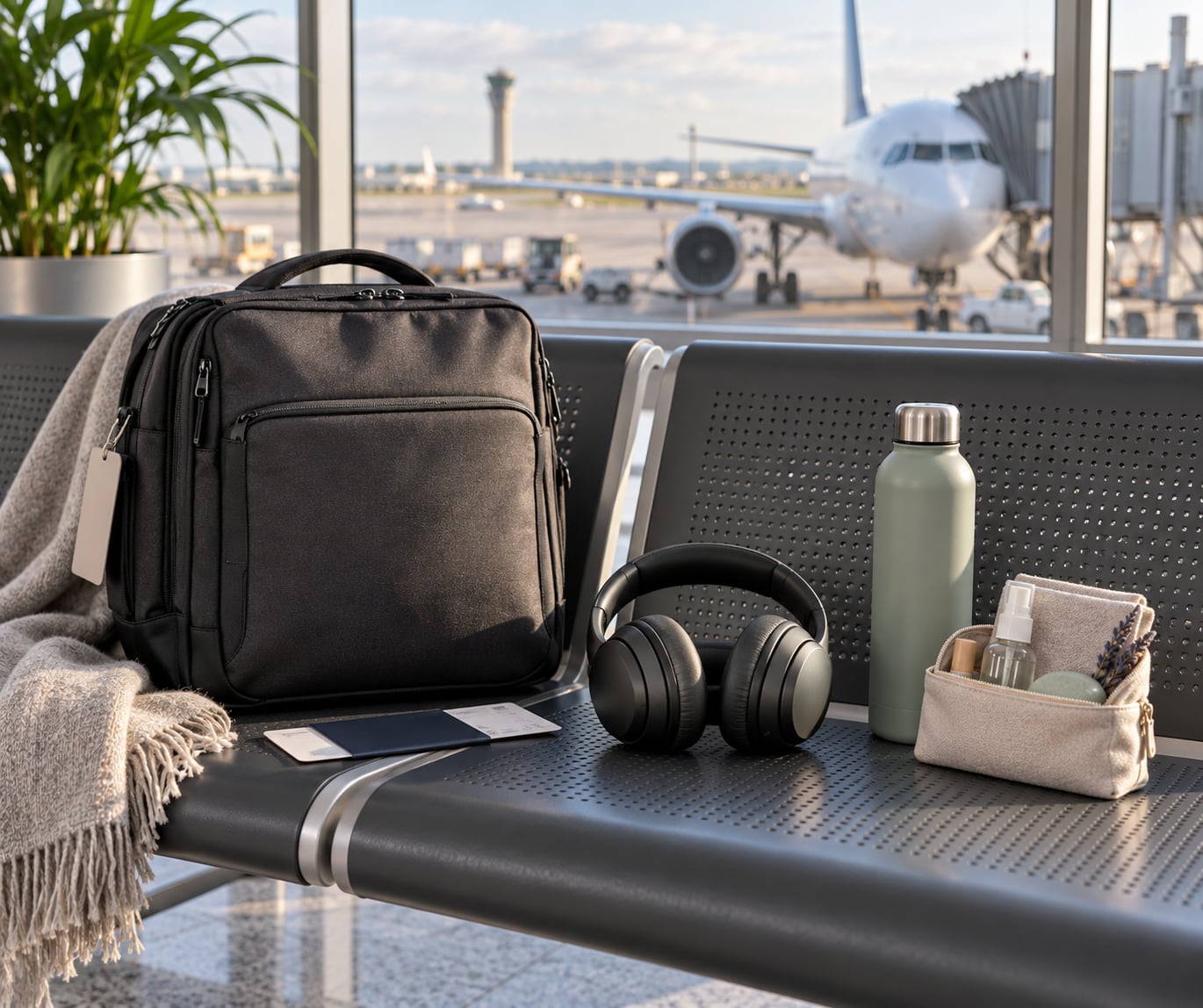
- A sensory kit. Sour candy or ice chips, noise-cancelling headphones, a sleep mask, a stress ball or squishy toy, one small comfort object from home, and a refillable water bottle.
- Anything a clinician has already approved. Prescription or over-the-counter, taken only as directed and only if the original prescriber or your pharmacist says it is appropriate for flying. Never borrow someone else’s.
- One person who knows the plan. A friend, partner or family member with your itinerary and your phone number. Knowing somebody is expecting you somewhere makes the whole trip feel less exposed.
- Airline and airport information. The seat map, whether you can pick a seat in advance, and which terminal and security area you are leaving from.
Step-by-Step
How to Prepare Mentally in the Days Before Flying
Start by writing your fears down as specific sentences, not as a vague feeling. “Something is going to go wrong on the plane” is vague. “I am afraid I will not be able to get out if the engine fails” is specific, and specific fears can be answered one at a time.
Then sort each one into two columns: known facts and predictions. In the facts column goes what you have actually verified, such as your airline’s safety record and the fact that seats have seat belts because loose items move in rough air. In the predictions column go the catastrophic ones, which are guesses your brain invented. You do not have to argue the predictions away. You just have to notice which column they are in.
Time-box your research to about 30 minutes a day and stop. Repeated checking feels productive but it feeds the fear rather than reducing it. Long-time regulars on the r/fearofflying community describe rebuilding their whole fear on the physics of flight, and they usually describe the same limit: information helps up to a point, and past that point you are just procrastinating the flight.
Tell a trusted person your itinerary, your flight number and where you will be staying. Anxiety about being helpless is one of the quieter drivers of fear, and it drains noticeably once somebody at home is holding the details. How you will know this part is working is simple: you stop rehearsing bad scenarios during ordinary moments of the day.
How to Reduce Anxiety the Day and Night Before the Flight
The evening before should be boring on purpose. Lay out clothes, put documents by the door, charge the phone, and do the packing. Then run your breathing pattern for five minutes, twice more than that if you want.
Light movement helps more than people expect. A twenty-minute walk lowers residual tension without raising it the way an intense workout would. Skip alcohol entirely from the night before, and set a caffeine cutoff in the early afternoon.
Sleep is where a lot of nervous flyers go wrong. Staying up late rehearsing or falling into a long daytime nap both leave you hollowed out at boarding. Aim for a normal night: dark room, cool temperature, alarm set for the early start, phone out of reach of the bed. One widely shared 3-3-3 rule of thumb is to start settling three hours before you plan to be asleep, so stop screens and caffeine at that point, relax for three, and be in bed with lights out after three.
Resist re-checking your boarding pass every twenty minutes. One check in the evening, one in the morning, done. Eat a normal light meal the next day and keep sipping water through the day, because low blood sugar and a headache are easy to mistake for rising panic.
How to Manage Flight Anxiety at the Airport
Arrive with cushion. Most airlines ask for two hours for domestic departures and three for international ones in the United States, and nervous flyers routinely want twenty minutes more than the rule says.
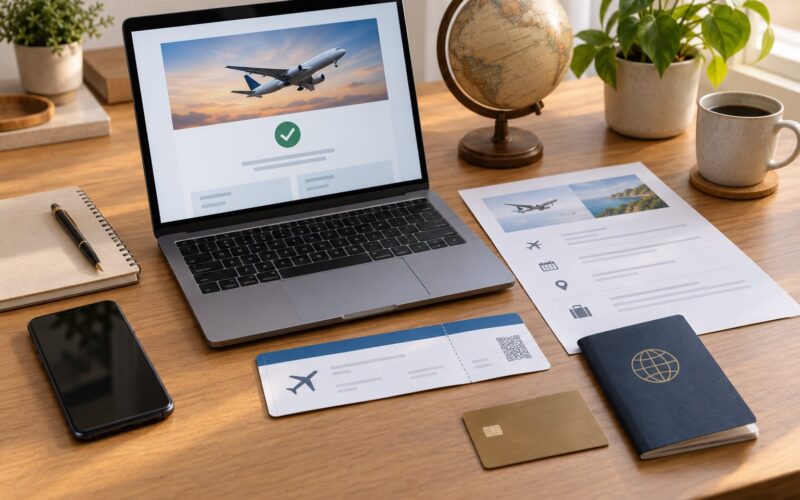
Get the boring logistics out of the way before you get anxious. Have your ID and documents in one hand, your liquids bag packed and unzipped, and your boarding pass downloaded to your phone. Anything that saves a small decision later saves a spike of adrenaline now.
Sit where you feel steadiest: over the wing near the centre of the cabin where movement is minimal, up front by the galley where crew are close by, or on the aisle if being trapped in a row is your specific difficulty. People with claustrophobia often do best sitting forward-facing near an exit; people who find movement soothing prefer the aisle.
Use the waiting time. Run your breathing pattern between gate announcements. Walk the length of the concourse once rather than sitting rigidly. Keep water in hand. And do not read crash or incident news at the gate, which is exactly when the bad outcomes are on every screen around you.
Choose your own monitor. Some people find the departure board calming because it is concrete and orderly. Others find it triggering, because every line is another fact to process. Decide before you sit down, then stick with it.
How to Handle Fear During Boarding and Takeoff
Board early if the airline lets you. A calmer, emptier aircraft is a better first impression than boarding into a queue of people who have already been waiting for hours.
Takeoff is when most nervous flyers have the hardest hour of the trip. The noise is genuinely loud, the acceleration feels sudden, and the aircraft visibly pitches up. All three are normal, deliberate parts of leaving the ground, and pilots are trained and certified to perform that manoeuvre thousands of times. Knowing that does not make the feeling go away, but it does tell your brain the sensation is expected rather than a warning.
Have one small action queued for the moment of rotation: exhale twice as long as you inhale, count eight out. Or press both feet flat into the floor and name five things you can see. Or put your hand flat on your own forearm and count the breaths. Pick it during boarding, not during takeoff, so your hands know what to do.
Stay seated with your belt fastened, sip water, and unclench your jaw. Flight anxiety spams the muscles of the jaw and shoulders without you noticing, and loosening them takes the edge off more than most people expect.
How to Stay Calm During the Flight
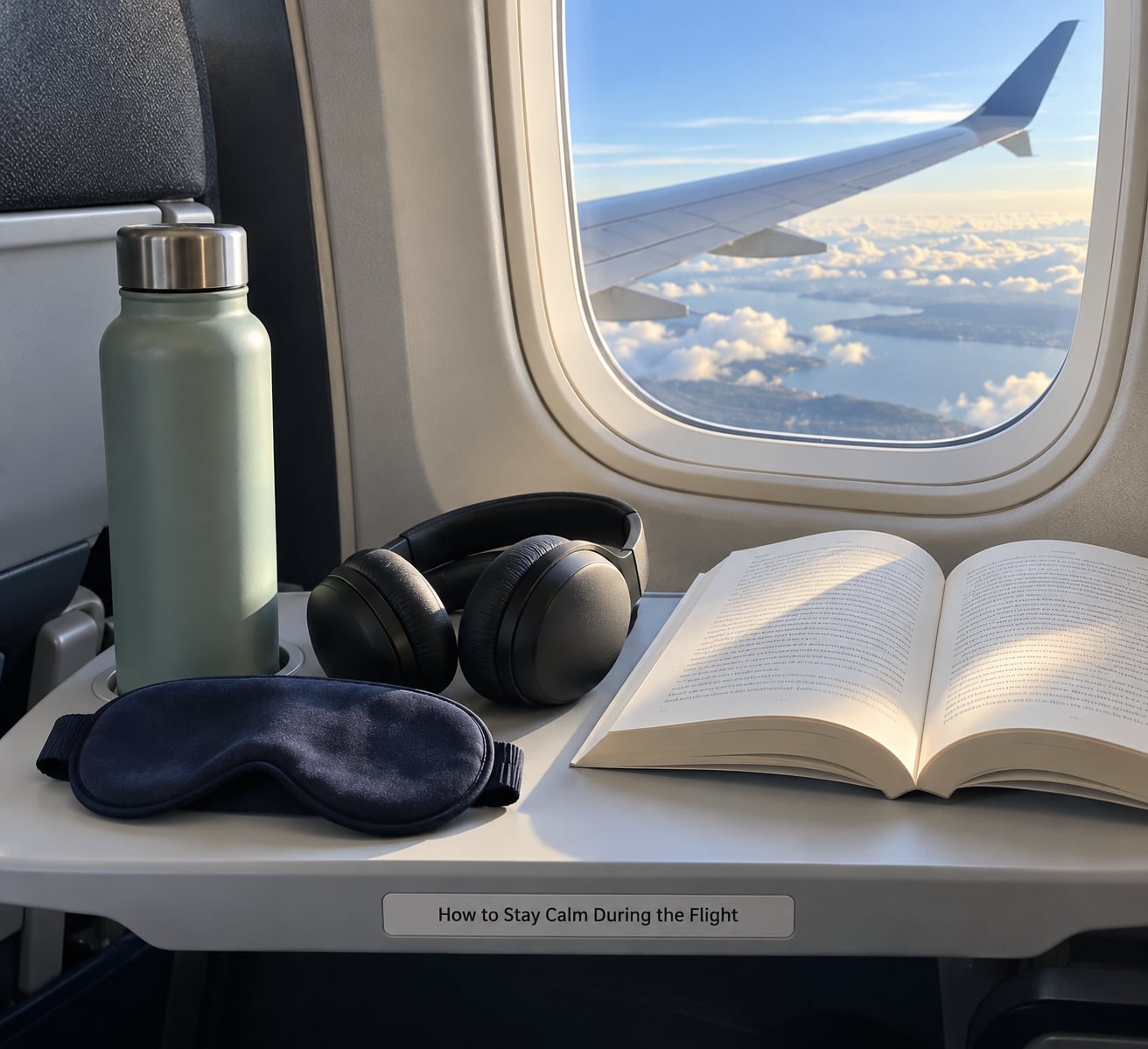
Once you are at cruising altitude, the practical work starts. Stand and walk the aisle every two to three hours, especially on long-haul, because sitting still for hours amplifies every sensation you do not like. Keep drinking water and keep eating something light every few hours, since hunger and dehydration both get misread as anxiety.
Limit caffeine after the first drink and skip the free alcohol. Alcohol numbs you for the first hour and then pays it back with poor sleep, dehydration and a worse landing. If you have ever flown hungover, you already know how that ends.
Line up entertainment before takeoff: a downloaded film, a hidden-object game, a podcast, a music album you have never heard before so it cannot remind you of anything. One r/fearofflying user described getting through a full hour of moderate turbulence during a nine-hour flight to Barcelona by playing a hidden-object game on the seatback screen, describing it as an accidental version of sensory grounding that stopped a panic attack from spiralling. The mechanism is real: an absorbing task occupies attention that would otherwise monitor your body for danger.
Talk to the crew. They fly anxious passengers every week and they cannot be shocked by anything you say. Asking them for a glass of water, a seat swap or just telling them you get nervous is often enough to lower the pressure.
For overnight flights, prepare sleep like you would on the ground: eye mask, earplugs or headphones, comfortable layers, and a plan for waking briefly to move and hydrate. Jet lag and anxiety feed each other, so protecting sleep is half the work of a long flight.
How to Manage Anxiety During a Turbulence or Emergency
First, the physics, because this is where most fear lives. Turbulence is irregular movement of the air. The wing is designed to flex and bend with it, and pilots are trained to fly through conditions that would bend an aircraft beyond what a rigid structure would tolerate. The bend is the airframe doing its job, not failing. It feels violent because the motion is irregular; irregular motion is scary to human balance systems even at a fraction of normal load.
So the anxiety you feel during turbulence and the actual danger are two different measurements, and they rarely point the same way. Severe injuries happen most often when people are not seated with the belt fastened, which is the one part of turbulence advice that is not a matter of comfort.
When a bump comes, use this order: stay in your seat with the belt fastened, put both feet flat on the floor, lengthen the exhale, then run 5-4-3-2-1 grounding by naming five things you see, four you can touch, three you can hear, two you can smell and one you can taste. Long-time posters in the r/fearofflying community suggest letting the motion happen rather than fighting it, treating the rocking the way you would treat being rocked to sleep. Fighting a sensation is what keeps it running.
If your worry is about the possibility of a real emergency, listen to the cabin. Crew who are still taking drink orders and joking have a very different message than crew who have stopped moving and fastened their own belts. If you are not sure, ask a flight attendant directly: “Is this normal right now?” You will get a factual answer, and factual answers are what this whole process is built on.
Stop reading your phone for flight-tracking and accident headlines for the rest of the day. Turbulence pulls incident numbers into view that nobody would have looked at otherwise.
How to Build a Plan for Future Flights
Write down what worked while it is fresh: which seat, which breathing pattern, which technique at the gate. A short note the morning after is far more useful than trying to reconstruct it six months later.
Then fly again, sooner rather than later. This is the part most guides skip, and it is the strongest lever you have. Each avoided flight is evidence that cancelling worked, and avoidance is what teaches a phobia to hold. Graduated steps work: a short daytime hop, then a route you know well, then a longer one, then a night flight, then the route you have been avoiding. Every landing is a data point, and the pattern most people end up with is one smooth flight followed by surprise that they enjoyed it.
If the fear is severe, or it travels with you, treat it with a professional who works with phobias and anxiety. Cognitive behavioural therapy with graded exposure is the well-evidenced route, and a therapist who specialises in aviation will build the hierarchy around actual aircraft and routes. There are structured courses too: the SOAR programme, Flytherwayz, and some airlines run their own classes for nervous flyers at certain airports, which are worth searching for before you assume the help you need does not exist.
Expect a delayed reaction. Many people feel worse for hours or a couple of days after landing than they did in the air, and forum posters describe this clearly enough that it is worth expecting in advance. It is not a sign the flight went badly. It is an ordinary stress response, and planning a quiet evening at home after you land makes it much easier to ride out.
Common Mistakes
Almost every counterproductive habit at the airport comes from one instruction that feels helpful and is not.
- Using alcohol as a treatment. It sedates you early and then rebounds, and it wrecks the sleep you need on landing. Fix: no alcohol from the night before the flight.
- Crashing your sleep the day before. Staying up until 2am or sleeping for nine hours leaves you flat at boarding. Fix: a normal night, one short nap if you need it.
- Skipping food and water. Hunger, dehydration and low blood sugar produce symptoms that look exactly like anxiety and are far easier to fix. Fix: eat light, sip water all day.
- Reading crash news at the gate or in the air. You will see incident headlines you were never going to look for. Fix: check the news once, from a source you trust, a week before.
- Checking for reassurance every few minutes. Each check briefly calms you and then restarts the cycle. Fix: time-box the research and write the facts down once.
- Dropping the routine at the door. The plan falls apart exactly when it is needed, because the boarding queue feels too busy to breathe. Fix: run one eight-count exhale before you reach the desk.
- Arguing with every anxious thought. Debating your brain mid-cabin gives it something to work on. Fix: label the thought (“that is a prediction, not a fact”) and let it pass without answering.
- Avoiding flying to feel safe. It works for one day and costs you the next trip. Fix: book something, even a short one.
A few more that come up constantly. If your fear is partly about being visibly anxious in front of strangers, pick tools that nobody can see: a slow exhale, a foot press, a hidden-object game on your own phone, a small mantra you repeat silently. Headphones solve a surprising amount of this, because they make a visible signal that you are unavailable.
If you are travelling with someone who is panicking, your usefulness is mostly in their nervous system, not the aircraft. Stay on the same side of the row so they are not turning their head, drop your voice and slow your own breathing, because breathing visibly is contagious in exactly the way you want. Give them one task rather than a list of suggestions. And if you need to be the steady one, plan a drink of water for yourself, because suppressing your own reaction takes more out of you than people expect.
Travelling with children adds a layer, because they read your face before they can read words. Modelling a calm routine out loud helps more than reassuring them after the fact. And in that case, focus on them. Long flights with kids have less rumination time, which is genuinely the best side effect of the whole trip.
Frequently Asked Questions
Can breathing exercises really help with flight anxiety?
Yes, because slow breathing is one of the few ways to influence the automatic nervous system directly. Making the exhale longer than the inhale activates the parasympathetic side of the body, and the effect shows up within a minute or two. Use long exhale breathing for the gate, box breathing or 4-7-8 for the night before, and keep the pattern short enough to repeat in a seat without anyone noticing.
Should I take medication before flying, and what should I ask my doctor?
Ask rather than assume. Many people with flight anxiety get real relief from medication their own clinician has chosen with them, and some need nothing at all. Useful questions for your doctor or pharmacist: is this safe for me, should I take it before the flight or as symptoms start, will it cause drowsiness, and does it interact with anything I take. Never take someone else’s prescription, and never use alcohol as a substitute.
Why do I feel more anxious during takeoff and landing?
Takeoff and landing are loud, physically forceful and full of unfamiliar sensations: engine roar, acceleration, a visible pitch upward and, at landing, repeated small corrections. The aircraft is also at its least flexible during these phases, which matters because flexing is how the wings handle gusts. Knowing that these two windows are the least comfortable part of the trip by design helps, but so does having one specific breathing action ready in advance.
Is anxiety during turbulence a sign of an emergency?
Usually not. Turbulence is irregular movement of the air, and the wing is built to flex through it, so what you feel is closer to a rough road than a mechanical failure. Crew behaviour is the reliable signal: if they are still serving drinks and chatting, it is routine. The one serious precaution is to stay seated with your seat belt fastened while the aircraft is in the air, because unrestrained injuries are the real danger in rough air.
What if I have a panic attack before boarding?
Put both feet flat on the floor and exhale longer than you inhale, for about two minutes. Then run 5-4-3-2-1 grounding by naming five things you see, four you touch, three you hear, two you smell and one you taste. Tell a flight attendant or gate agent plainly that you are having a panic attack, which is far more ordinary than it sounds to you. Panic attacks rise and fall, and most people still board.
When should I seek professional help for fear of flying?
Seek help when fear of flying is changing your life: cancelling trips, driving instead, avoiding work travel, having panic attacks, or getting physical symptoms like fainting or severe breathlessness. Cognitive behavioural therapy with graded exposure is the approach with the strongest evidence for specific phobias, and therapists who work with aviation can build the steps around real aircraft and routes. Any new or severe physical symptom deserves a doctor rather than a coping technique.
How to Manage Flight Anxiety on Your Next Trip
If you do one thing, write the one-page itinerary and pick your breathing pattern tonight. Everything else in this guide is worth doing, but those two steps remove the two things that feed most of the fear: not knowing, and not having something to do.
Then fly, and fly again before you feel ready. The fear fades through landings, not through reassurance. Whatever your symptoms turn out to be on the day, a doctor or a therapist who works with anxiety is the right person for anything medical, and no technique in this guide is a substitute for that conversation.