Tipping norms abroad depend less on politeness than on pay. Where restaurant and hotel staff are paid a full wage, a tip is optional or rounding up the bill. Where tipped wages are legal, as in the United States, Canada and Mexico, a gratuity of 15 to 20 percent is normal. And in a handful of countries, tipping is treated as an insult.
Learning how to tip in different countries is mostly a matter of knowing which of those three models you are standing in before you leave a banknote on the table. Get it right and nobody thinks about it. Get it wrong in Tokyo and staff may hand your money straight back to you.
The percentages below are ranges drawn from widely published tipping guides and from what travelers report back from the ground, not fixed rules. Customs shift, and a service charge printed on the bill changes everything, so check the bill first. This guide was last updated in 2026.
Table of Contents
- 1How to Tip in Different Countries: Quick Reference
- 2What Does Tipping Mean Around the World?
- 3The tipped-wage model
- 4The service-included model
- 5The discouraged model
- 6How Much Should You Tip in Common Travel Countries?
- 7North America and the Caribbean: the highest expectations
- 8Europe: service is usually already on the bill
- 9Asia and the Pacific: optional at best, unwelcome at worst
- 10The Middle East, Africa and Latin America: baksheesh and propina
- 11Where Do You Usually Tip When Traveling?
- 12Restaurants, bars and cafés
- 13Hotels and resorts
- 14Taxis, rideshares and public transport
- 15Tour guides, porters and drivers
- 16Hairdressers, spas and caddies
- 17How Do You Tip with Cards, Cash, and Local Apps?
- 18Common Tipping Mistakes Travelers Make
- 19Frequently Asked Questions
- 20Which countries do not like tipping?
- 21Is it rude not to tip in Europe?
- 22Is a 10 percent tip too little or too much?
- 23How does tipping work in other countries?
- 24How do I tip when I have no cash?
- 25How much should I tip a tour guide or trekking porter?
- 26Conclusion
How to Tip in Different Countries: Quick Reference
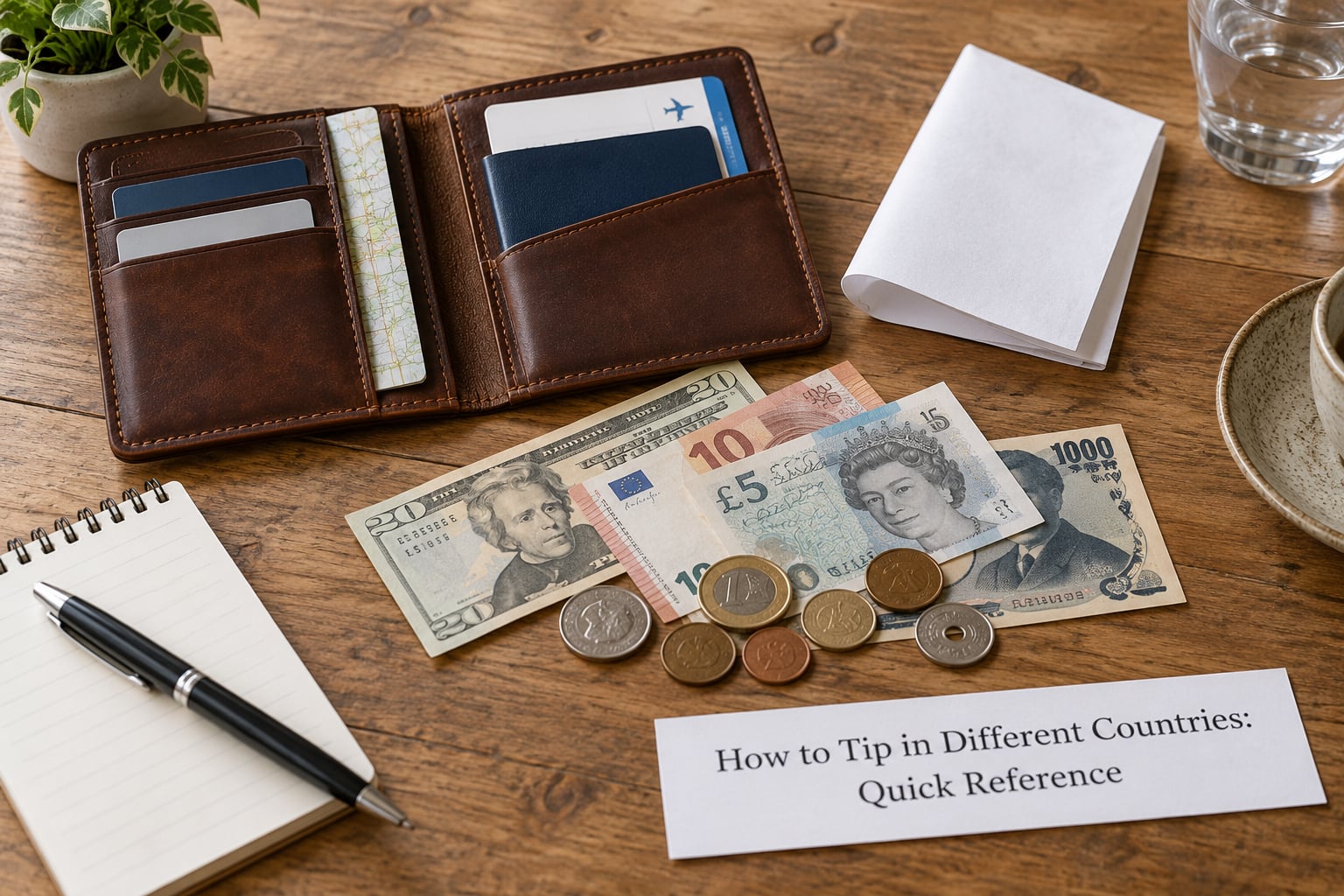
This table is the one to screenshot. The last column matters as much as the numbers, because a service charge already on the bill changes what a reasonable tip looks like.
| Country or region | Restaurants | Hotel staff | Taxi or rideshare | Tour guide | Service charge usually included? |
|---|---|---|---|---|---|
| United States | 18 to 20 percent | 2 to 5 dollars per bag or per stay for housekeeping | 10 to 20 percent | 10 to 20 percent per day | Large restaurants, often 18 percent |
| Canada | 15 to 20 percent | 2 to 5 dollars per bag or per night | 10 to 15 percent | 10 to 15 percent per day | Less common than in the US |
| Mexico | 10 to 15 percent, and check whether IVA tax is added on top | 20 to 50 pesos per bag | Round up, or 10 percent | 100 to 200 pesos per day | Often listed separately as servicio incluido |
| Caribbean resorts | 15 to 20 percent, often all-inclusive staff gratuities | 1 to 2 dollars per bag or per night | 5 to 10 percent | 10 to 15 percent per day | All-inclusive properties add a staff gratuity line |
| United Kingdom | 10 to 12.5 percent, or round up | 5 pounds or so per bag or per stay | Round up to the nearest pound or two | 10 pounds per day is generous | Yes, usually a 12.5 percent service charge |
| France | Round up, or 5 to 10 percent | 1 to 2 euros per bag or per night | Round up | 5 to 10 euros per day | Service compris at 15 percent is standard by law |
| Germany and Austria | Round up to 5 or 10 percent | 1 to 2 euros per bag | Round up, or 5 percent | 5 to 10 euros per day | Usually no, unlike France |
| Italy | Round up, or 5 to 10 percent | 1 to 2 euros per bag | Round up | 5 to 10 euros per day | Coperto cover charge is not a tip |
| Spain and Portugal | 5 to 10 percent, or round up | 1 to 2 euros per bag | Round up | 5 to 10 euros per day | Sometimes, in tourist areas |
| Czech Republic, Poland, Hungary | 10 percent is generous, rounding up is normal | 20 to 50 korun or a couple of euros | Round up to 50 korun or so | 300 to 500 korun per day | Often a flat service fee of around 10 percent |
| Scandinavia | Not expected; rounding up is a kindness | Not expected | Not expected | Not expected | Yes, and staff wages are high |
| Turkey | 5 to 10 percent, or round up | 20 to 50 lira per bag | Round up | 100 to 200 lira per day | Common in tourist restaurants |
| Japan | Do not tip | Do not tip | Do not tip | Do not tip | Not applicable |
| China | Not expected | Not expected | Not expected | Not expected | Not applicable |
| South Korea | Not expected, cards only | Not expected | Not expected | Not expected | Not applicable |
| India | 10 percent, and it is legally optional | 50 to 100 rupees per bag | 20 to 50 rupees | 500 to 1000 rupees per day | Often 10 to 12 percent as a service charge |
| Thailand and Vietnam | Round up or leave 100 to 200 baht; Vietnam tip jars expect small amounts | 20 to 50 baht, 50 to 100 thousand dong | Round up, or 10 to 20 percent | 300 to 500 baht per day | Rarely |
| Indonesia and Malaysia | 5 to 10 percent, more if no service charge | 20 to 50 thousand rupiah | Round up or 5 to 10 percent | 50 to 100 thousand rupiah per day | Some restaurants add 10 percent plus tax |
| United Arab Emirates | 10 percent, usually added as service | 10 to 20 dirhams per bag | 10 percent | 50 to 100 dirhams per day | Ten percent service is standard and compulsory |
| Egypt and Jordan | 5 to 10 percent, or baksheesh | 5 to 10 Egyptian pounds or dinars | Round up, or 5 to 10 percent | 5 to 10 percent per day | Often added in tourist restaurants |
| Morocco | 5 to 10 percent, or baksheesh | 20 to 40 dirhams | Round up, or 5 to 10 percent | 50 to 100 dirhams per day | Uncommon outside tourist areas |
| South Africa | 10 to 15 percent, ask if the tip is shared | 5 to 20 rand per bag or per night | 5 to 10 percent, or round up | 100 to 300 rand per day | Increasingly added as a 10 to 15 percent charge |
| Argentina and Chile | About 10 percent, cash if possible | 2 to 5 dollars equivalent per bag | Round up, or 10 percent | 5 to 10 percent of the tour price | Often, as a 10 percent service charge plus tax |
| Brazil | 10 percent is normally printed on the bill | 5 to 10 reais per bag | Round up, or 10 percent | 10 percent of the tour price | Yes, the 10 percent service is usually on the bill |
| Colombia, Peru, Ecuador | 10 percent, and it is usually already on the bill | 10 to 20 dollars equivalent per bag | Round up, or 5 to 10 percent | 10 percent of the tour price | Yes, at many restaurants |
| Australia and New Zealand | Not expected, round up if you wish | Not expected, tips go into a staff pool | Not expected | Not expected | Not applicable |
What Does Tipping Mean Around the World?
A gratuity is money left voluntarily for service already rendered. That is the plain meaning everywhere, but what sits behind it changes with the labor market.
The tipped-wage model
In the United States, Canada and parts of Mexico, employers are allowed to pay a base wage below the standard minimum and make up the difference in tips. A tip is not a bonus on top of a full wage; it is part of the wage. That single legal fact explains why servers in Chicago expect 20 percent and why the same server in Madrid does not.
The service-included model
Across most of Europe, Latin America and the Gulf, staff are paid a full wage and a service charge is often printed on the bill. In France, a 15 percent service compris is standard by law. Rounding up is the normal gesture, and 10 percent can read as unusually generous rather than generous. People reporting from the Netherlands and Germany push back hard on travel-blog advice that says 10 percent is standard. Locals are describing the standard, not a rule.
The discouraged model
In Japan, tipping can be read as implying the worker has not earned their wage. Money left on a table may be returned to you, and a tip handed directly to a taxi driver can produce genuine awkwardness. China and South Korea sit in the same camp, and much of their service economy runs on card payments with no cash float for tips at all.
So when people ask whether tipping is rude, the honest answer is that rudeness is a category error. Tipping is not rude in most of Europe. It is simply not part of the transaction.
How Much Should You Tip in Common Travel Countries?
North America and the Caribbean: the highest expectations
The United States expects 18 to 20 percent at dinner, 15 to 20 percent at lunch, and a dollar or two per drink at a bar. Tipping a tour guide 10 to 20 percent per day is standard, as is tipping a bellhop a couple of dollars per bag. At resorts in the Caribbean and Mexico, staff gratuities are often folded into an all-inclusive rate, which is why leaving nothing extra is normal.
As for which nationality tips most, Americans and Canadians top any list by volume and consistency, though the driver is a wage system rather than generosity in the abstract. Ask people in Mexico or Japan and you will often hear the opposite claim.
Europe: service is usually already on the bill
Is it rude not to tip in Europe? No. Staff are paid a full wage, and the service charge is printed on the bill in most countries. Round up, or leave 5 to 10 percent for genuinely good service.
France runs on service compris, usually 15 percent. The UK usually adds 12.5 percent, so an extra 10 to 12.5 percent on top is more than expected. Germany, Austria and the Nordic countries do not typically add a service charge, which makes rounding up a genuine courtesy rather than a formality.
Two exceptions are worth knowing. Italy’s coperto is a cover charge for bread and table service, not a tip, so do not treat it as one. And the Czech Republic, Poland and Hungary often add a flat 10 percent service fee; travelers who tip on top of it are the ones being talked about in restaurant reviews.
Asia and the Pacific: optional at best, unwelcome at worst
In Japan, China and South Korea, do not tip. Say thank you warmly instead, and in Japan that genuinely matters more. Elsewhere in Asia the picture varies by income level and by whether staff are included in a service charge.
India runs on a 10 percent model that restaurant staff often describe as their legal entitlement, though mandatory tipping has been restricted by court ruling, so an explicit request for a tip on the bill is not something you have to accept. Thailand, Vietnam, Indonesia and Malaysia usually work on rounding up, or 5 to 10 percent when no service charge is listed. In Nepal and Bhutan, tipping trekking guides and porters is not optional politeness, it is a meaningful share of their annual income.
Australia and New Zealand pay service workers a proper wage and expect nothing. Tips go into a shared staff pool if the team handles them at all.
The Middle East, Africa and Latin America: baksheesh and propina
Egypt, Jordan and Morocco operate on baksheesh, a small handout culture that extends to anyone who helps you, from the man who watches your bag to the guide who walks you through a market. Amounts are small and cash is essential.
In the UAE and most Gulf states, a 10 percent service charge is compulsory and already on the bill, which leaves rounding up at most. South Africa has moved toward 10 to 15 percent, and staff will tell you whether the tip is shared with the kitchen, so ask. Argentina and Chile expect about 10 percent, and in Argentina cash is preferred.
Brazil, Colombia, Peru and Ecuador usually print a 10 percent service charge on the bill already. Add on top of it and you are over-tipping by local standards.
Where Do You Usually Tip When Traveling?
Restaurants, bars and cafés
The full-service restaurant is the highest-stakes tip of any trip. Cash is preferred almost everywhere, and in Argentina and Chile a cash tip signals that the money reaches the person who served you rather than a shared pot.
Bars and cafés are simpler. Round up, or leave a few coins. Street food vendors and market stalls in South America often operate a tip jar or a caixinha-style box, and a handful of coins or a one or two percent addition is plenty.
Hotels and resorts
Two to five currency units per bag for the bellhop, the same again per night or per stay for housekeeping, and a few units for the concierge who actually books something. At resorts, check whether the all-inclusive rate already includes staff gratuities before adding more.
Taxis, rideshares and public transport
Round up in most of Europe. In the United States, 10 to 20 percent is expected and rideshare apps prompt you at the end of the ride. In much of Asia, nothing is expected at all, and in several countries the driver will not have cash.
Tour guides, porters and drivers
This is where under-tipping does real damage. Guides on multi-day trips in Nepal, Peru, Morocco and Jordan often earn a meaningful share of their income from gratuities. Per-day rates quoted by travelers on travel forums for private guides range from about 20 currency units per day in Southeast Asia to 100 or more in North America, and porters on Himalayan routes are usually tipped daily rather than at the end.
Also remember hotel porters, airport luggage handlers, washroom attendants on overnight trains and the staff who clean your table at a food market. Each is a small, specific job.
Hairdressers, spas and caddies
Salons and spas are tipped like personal services, usually 5 to 15 percent of the bill, given to the specific person who did the work. Golf caddies are tipped per round, more after a good day. Barbers in most of Europe and Asia are not tipped at all.
How Do You Tip with Cards, Cash, and Local Apps?
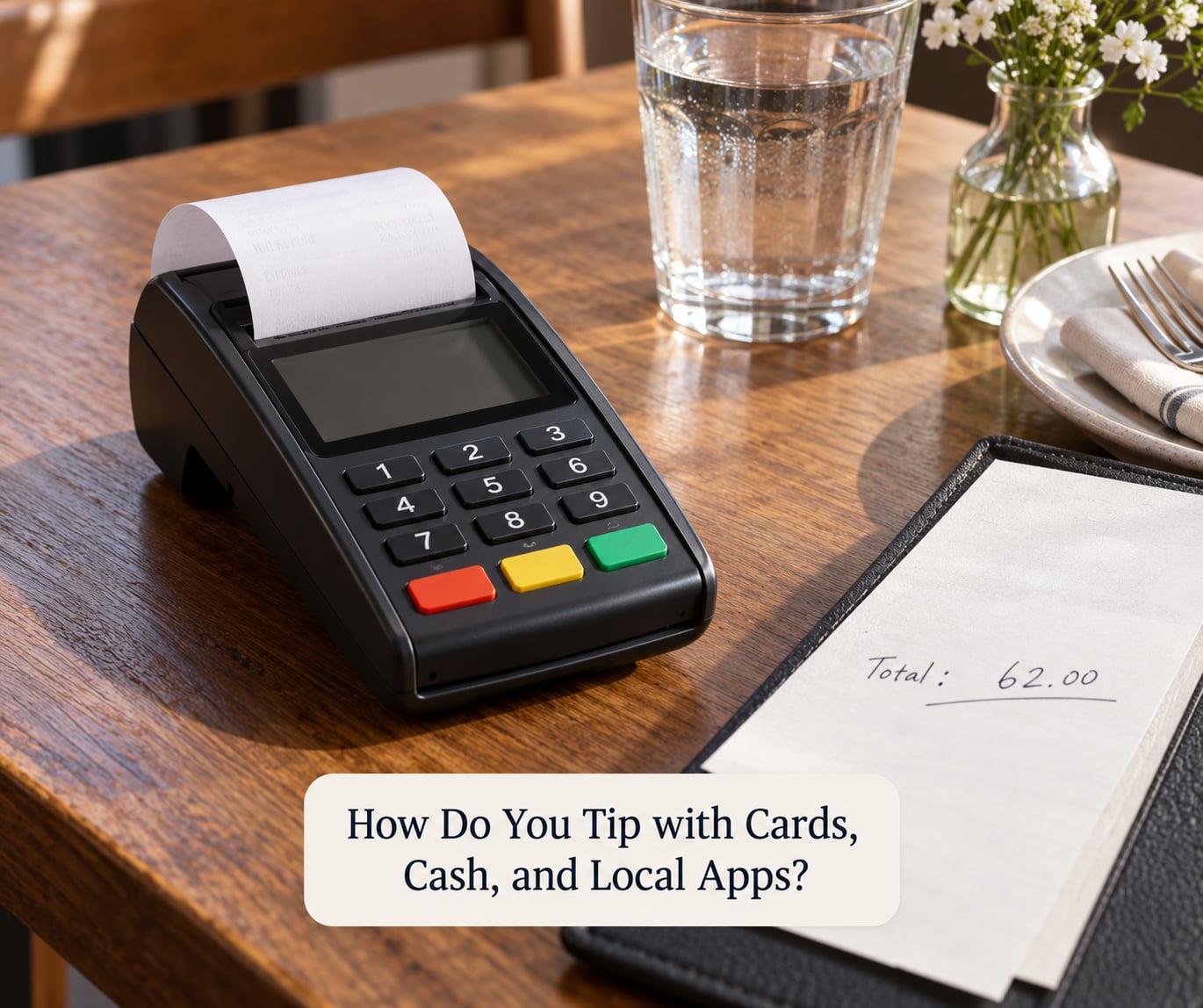
Cash remains the most reliable method abroad, mainly because staff with small tips need denominations, and because cash reaches the individual rather than a terminal.
- Work out the tip from the pre-service bill in countries where the charge is added after your food. A tip calculated on a total that already includes service is how people end up paying double.
- Round up on small bills. On a 340 unit taxi fare, the gesture is 350 or 400 depending on the local scale, not a calculated percentage.
- Hand the money over rather than leaving it. A folded note held out at the till, or handed to the person who served you, lands with the right person and avoids the awkwardness of coins left behind.
- On a card terminal, enter the tip amount as a cash amount and take the change, or add it as a line item and ask the cashier to split it. Some terminals print a paper slip asking you to sign a tip amount and hand the paper back, which feels odd but is the normal process.
- If a tip screen appears before service, as it often does on payment apps, you can skip it. Nothing obliges you to pre-tip a bartender who has not poured anything yet.
- In countries where tipping is not expected, cash may not even change hands. Use your words instead. In Japan, a sincere thank you in the local language is a more valued gesture than a banknote.
- For smaller currencies, request coins at a bank or exchange counter when you arrive, since a tip you cannot pay in the right denomination becomes awkward for both sides.
What if staff refuse the tip? In Japan, China and South Korea they may genuinely refuse it, and the polite response is to accept and thank them. Elsewhere, if a driver follows you down the street holding the money, they are deciding they cannot accept it, so take it back gracefully rather than insisting.
Common Tipping Mistakes Travelers Make
- Assuming every country works like the US. The fix: identify the model first. Tipped wages, service included, or tipping discouraged. That single question answers most situations before you leave the table.
- Tipping on top of a service charge. The fix: read the bill line by line before you decide anything. Service compris, servicio incluido, coperto and a 10 percent service line all change the arithmetic.
- Tipping where it is not wanted. The fix: in Japan, China and South Korea, skip it and thank the person instead. An extra banknote does not read as extra gratitude.
- Leaving 10 percent in a country where nobody tips. The fix: round up. Ten percent in parts of Europe is above the local expectation rather than a baseline.
- Forgetting the people who carry your things. The fix: airport porters, hotel bellhops, station luggage attendants and trekking porters are tipped per bag or per day, usually in small local cash.
- Calculating a percentage on a foreign currency bill in your head. The fix: use a simple round-up or a flat amount in local currency. Nobody expects precise arithmetic at a restaurant table.
Frequently Asked Questions
Which countries do not like tipping?
Japan, China and South Korea are the clearest cases, where tipping is not part of the transaction and money left behind may be returned to you. Australia and New Zealand also do not expect tips, though a refusal is unlikely there. A few resort destinations and staff in some Gulf states calculate a compulsory service charge that makes an extra tip unnecessary. In each case the reason is the same: service workers are paid a full wage.
Is it rude not to tip in Europe?
No. Staff across most of Europe are paid a full wage, and a service charge of 10 to 15 percent is often printed on the bill. Not tipping is simply normal there. Rounding up is a warm gesture, and 5 to 10 percent for good service is more than the local baseline. Check the bill for a service charge before you add anything, because tipping twice is the mistake Europeans actually notice.
Is a 10 percent tip too little or too much?
It depends entirely on the country. In the United States, 10 percent at dinner reads as an insult. In Germany, Austria, the Netherlands or Scandinavia, 10 percent is generous and sometimes reported locally as more than standard. The rule that holds everywhere: when in doubt, round up generously or pay a flat amount in local currency rather than reaching for a percentage that was designed for a different labor market.
How does tipping work in other countries?
It works in one of three ways. Where tipped wages are legal, such as the United States and Canada, a 15 to 20 percent gratuity completes the wage. Where a service charge is already on the bill, which covers most of Europe, Latin America and the Gulf, rounding up is the normal gesture. Where workers are paid a full wage and tipping is discouraged, such as Japan and South Korea, no money is exchanged and thanks do the work instead.
How do I tip when I have no cash?
On a card terminal, enter the tip as a cash amount and take your change, or add a separate tip line and ask the cashier to split it with whoever served you. Some terminals print a slip for you to sign and hand back. In countries where tipping is not expected, having no cash is convenient rather than a problem. Keep a few small notes anyway, because porters, market attendants and guides rarely have a terminal.
How much should I tip a tour guide or trekking porter?
Think per day rather than per trip, and check whether the amount is shared with the group. Travelers frequently ask for benchmarks because the rules are rarely published. In Southeast Asia, 20 to 50 currency units per day is normal; in Morocco, Peru and Jordan, 50 to 100; and for private North American guides, 100 to 150 per day is generous. Porters on trekking routes are usually tipped daily, not once at the end.
Conclusion
The safest approach is dull and it works every time. Read the bill before you tip, identify which of the three models the country follows, and choose a simple amount that suits the service rather than the number you used at home. Rounding up is always acceptable, a sincere thank you goes further than you would think, and tipping a trekking porter properly is one of the most useful things a visitor can do.