To avoid foreign transaction fees, do three things: use a card that charges 0% for overseas purchases, always choose the local currency when a terminal or ATM offers to convert for you, and plan cash withdrawals carefully so you are not paying both an ATM fee and a conversion margin. Most US cards add somewhere between 1% and 3% on every foreign purchase, and that percentage is charged by your card issuer, not by Visa or Mastercard.
On a two-week trip with 3,000 dollars of card spending, a 3% fee quietly adds 90 dollars for nothing you can see at the register. Getting the card choice and the checkout habit right takes about fifteen minutes before you leave, and it is the single cheapest money decision most travellers make each year.
There is a second cost hiding underneath the fee, and almost nobody explains it. A card advertised as 0% foreign transaction fee can still convert your money at a rate 1% or 2% worse than the mid-market rate. The real math is the explicit fee plus the exchange-rate markup, and you have to check both.
Table of Contents
- 1What You Need to Avoid Foreign Transaction Fees
- 2Step-by-Step
- 3How to choose a no-foreign-fee credit card
- 4How to check the exchange rate before paying
- 5How to choose between paying by card, cash, and ATM
- 6How to review transactions after the trip
- 7Common Mistakes
- 8Frequently Asked Questions
- 9What is the best way to avoid foreign transaction fees while traveling?
- 10Does a debit card have foreign transaction fees?
- 11Are foreign transaction fees tax-deductible?
- 12Should I use dynamic currency conversion when paying abroad?
- 13How can I avoid ATM fees when traveling internationally?
- 14Conclusion
What You Need to Avoid Foreign Transaction Fees
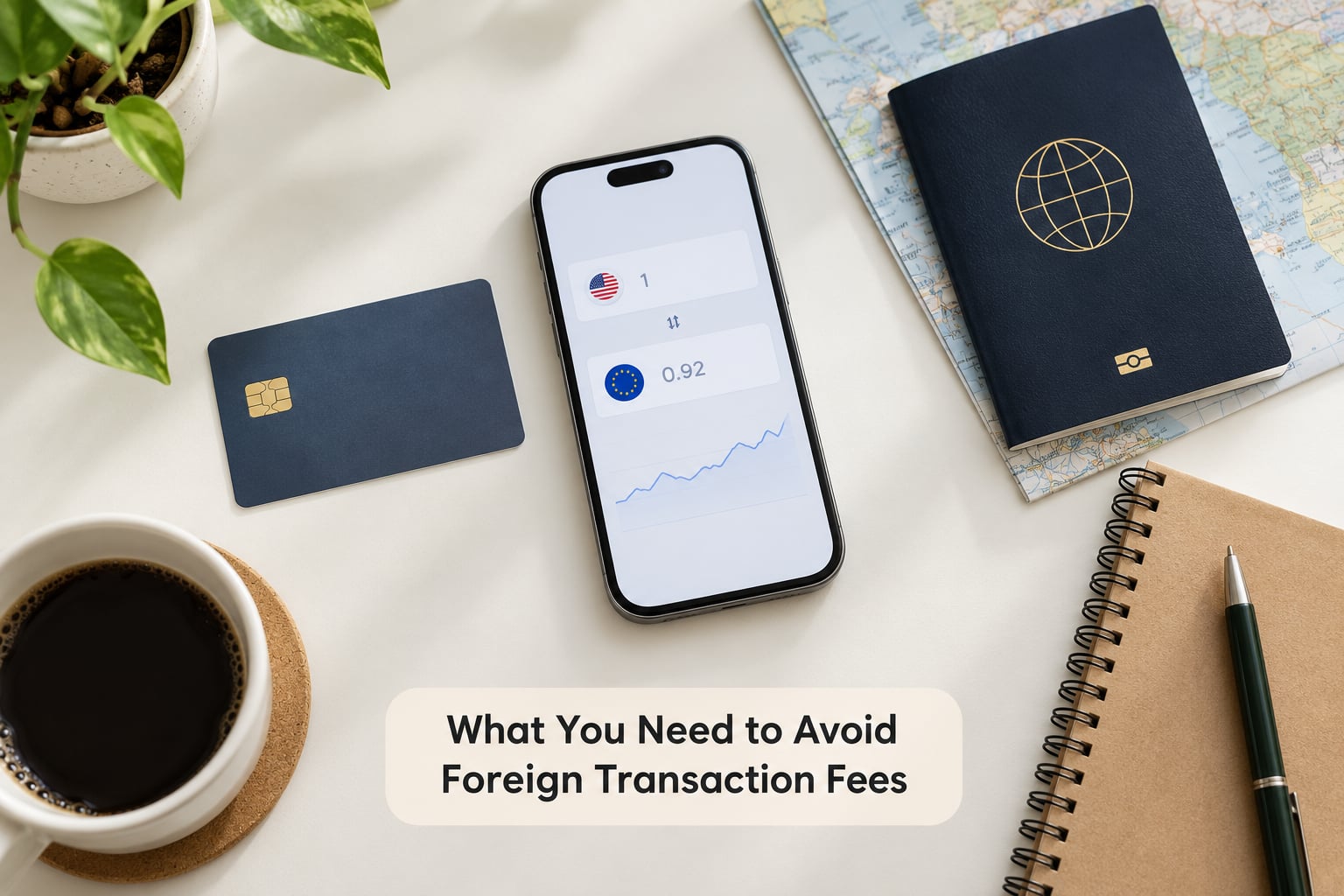
You need a card with a written 0% foreign transaction fee, a backup card, and a way to see your card’s fee schedule before you rely on it overseas. Everything else is preparation around those two cards.
- A 0% foreign transaction fee card. Confirm the 0% claim is written in the card’s fee schedule or terms, not implied by marketing language.
- A second card from a different issuer. If the first one is blocked, lost or eaten by a skimmer abroad, a card from an entirely different network keeps you moving.
- Your issuer’s fee schedule and foreign exchange terms. This is where the percentage, the ATM fee and any conversion margin are actually spelled out.
- The bank’s app and phone number. You will want both for a travel notice and for disputing a charge after you land.
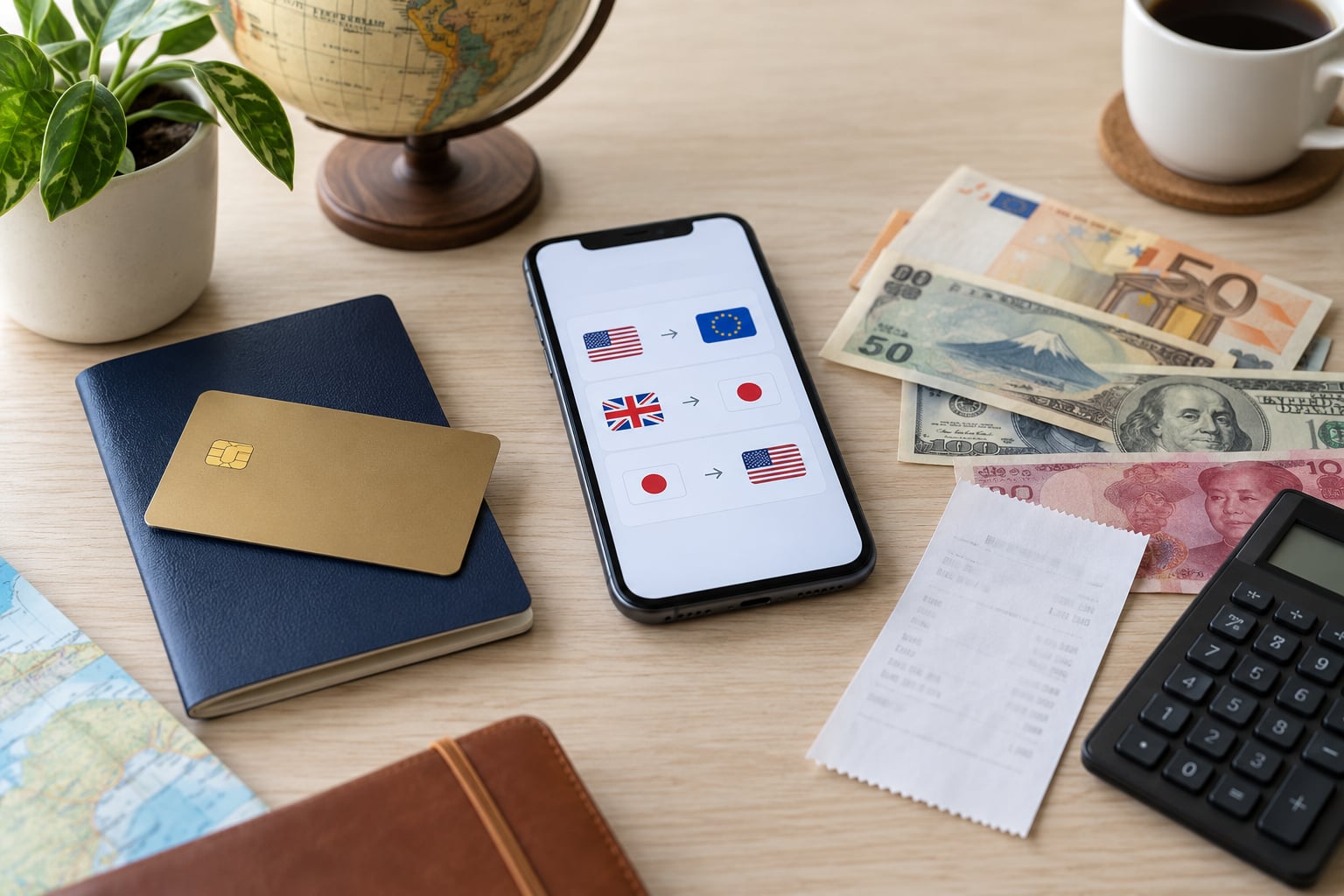
- A currency conversion app on your phone. It gives you the live mid-market rate so you can spot a bad quote at the counter.
- Your itinerary, dates and countries. The bank asks for these when you set a travel notice, and an incomplete notice is a common reason a card gets frozen abroad.
One more thing worth packing: a small note of where your bank’s partner ATMs are in each country. Bank-affiliated ATMs usually charge nothing, while independent ones add both an operator surcharge and a conversion margin.
Step-by-Step
How to choose a no-foreign-fee credit card
A card is genuinely fee-free abroad only when three separate lines in its schedule are all in your favour: 0% foreign transaction fee, no cash advance fee structure you will trigger, and a reasonable ATM refund policy. Check the first one before you care about the reward rate.
Ask the issuer directly, or read the fee schedule published under “disclosures” or “agreements” in the bank’s site or app. The phrase you want is 0% or no foreign transaction fee. If the page instead says international transaction fee, look for a percentage next to it, because a 1% fee and a 0% fee behave very differently across a whole trip.
Three categories reliably waive it. Travel rewards cards built for international spend, premium cards in the same vein, and multi-currency fintech accounts that hold several currencies and convert at the interbank rate. Capital One cards and credit union cards come up again and again in traveller forums as reliable zero-fee options, and N26, Bunq and Revolut are the names that surface most often for European trips on Reddit travel threads.
Then compare the two costs side by side, because “0% fee” and “good rate” are not the same promise.
| Card type | Explicit foreign transaction fee | Typical exchange-rate markup | What else still charges |
|---|---|---|---|
| Standard rewards card | 3% | Small, usually inside the 3% | ATM fee around 3 dollars plus a conversion margin |
| Travel rewards card | 0% | 0% to 1% | Foreign ATM fees, unless the card reimburses them |
| Premium or high-end card | 0% | 0% to 1% | Foreign ATM fees, lounge access, other service charges |
| Multi-currency account | 0% on spending from a balance | Near the interbank rate | ATM withdrawal fees above the free allowance, currency conversion on balances |
| Prepaid travel card | 0% once loaded | Often poor, the cost moves into the load rate | Loading fees, ATM fees, and no chargeback on some issuers |
| Cash advance on a credit card | Cash advances are not purchases | Applies | ATM fee, cash advance fee, and interest from the day of withdrawal |
Prepaid travel cards deserve their own warning. They often advertise no fees, but the cost hides in the rate you get when you load the balance, and some issuers provide no purchase protection at all. For a short trip a plain 0% credit card is simpler and usually cheaper.
How to check the exchange rate before paying
Compare the rate your phone shows with the rate the terminal or ATM quotes, and treat any gap above about 1% as a markup. The phone number is the mid-market rate, the rate banks trade at before fees. The terminal number is what you actually get.
Worked example: a restaurant bill of 80 euros. At the mid-market rate that is 87.20 dollars. If the terminal offers to charge 91.50 dollars for the same meal, you are paying 91.50 for something worth 87.20. That 4.30 dollars, about 5%, buys you nothing except the convenience of seeing a home currency on the screen.
That offer has a name. Dynamic currency conversion, or DCC, is a service the terminal, the payment processor or the ATM operator sells on the side, and the markup is often 3% to 8%. You pay it by tapping Yes, charge me in dollars instead of charge me in euros. Declining costs you nothing at all, because the card network or the issuer converts the payment at a much better rate anyway.
At an ATM the wording is different but the trick is the same. Some screens show a preset Accept Conversion button that looks like the normal confirm option, with Deny Conversion buried lower on the screen. Always press decline, then let your own bank do the conversion.
One important note on booking flights and hotels: if you book on a foreign airline or hotel website from your living room, that is still a foreign transaction. Your card was charged in another currency, so the same rules apply.
How to choose between paying by card, cash, and ATM
Use your 0% card for most things, use a bank-affiliated ATM for cash, and use an exchange kiosk only as a last resort. That is the short version. The tradeoffs below explain when each one wins.
| Method | Typical extra cost | Best for | Watch out for |
|---|---|---|---|
| Card purchase, local currency | 0% on a no-FX-fee card | Restaurants, shops, hotels, transport tickets | Never accept the terminal’s dollar conversion |
| Bank-affiliated ATM | 0 to 3 dollars, sometimes refunded | Cash for small vendors, taxis, tips | A bad rate on smaller local ATM operators |
| Independent ATM | Operator surcharge plus conversion margin | Only when no bank ATM is reachable | Declined conversion screens, skimmers |
| Airport or hotel exchange kiosk | Several percent, often worse | Emergency small amounts only | Bad rates, and large spreads on bigger notes |
| Cash advance on a credit card | ATM fee, cash advance fee, interest from day one | Almost nothing | The most expensive way to get local currency |
Two ATM habits cut the cost noticeably. Withdraw fewer, larger amounts instead of many small ones, and choose an ATM operated by a bank that has a presence in the country you are visiting. Travellers report the difference clearly, because a single 5 dollar fee on a 20 dollar withdrawal costs 25% while the same fee on a 200 dollar withdrawal costs 2.5%.
Country exceptions exist, and they can be expensive. In the Czech Republic, a forum user found local bank ATMs quoting rates roughly 10% worse than the market rate, which pushed that person back to card spending. High-inflation economies such as Argentina break the normal rules entirely, because official and street rates diverge sharply. In places like that, spending a card balance beats holding local cash.
Travelers outside the US face a different baseline. A UK, EU or Canadian issued card often comes with no foreign transaction fee built in, but SEPA transfers, non-SEPA surcharges and ATM charges still apply. The habits in this guide still hold: pay in local currency, decline conversion, use in-network ATMs.
How to review transactions after the trip
Wait a few days after you land, then read the whole statement line by line and compare each conversion against the rate you actually got. Foreign transaction fees often appear days later with no line item at the terminal, so the statement is the only place the real cost shows up.
Look for four things: a fee percentage you did not expect, an ATM charge you do not recognise, a duplicate from a hotel that pre-authorised and then settled separately, and a conversion rate that looks several percent worse than mid-market. A delayed authorisation is not a duplicate charge, and it usually drops off on its own within a few days.
If a fee is there that should not be, contact the issuer and ask for a dispute. Banks can often reverse a foreign transaction fee when the card’s terms say 0% and the fee was applied anyway, and the card network’s chargeback process applies to a purchase charged in a currency you did not authorise. Keep the receipt, note the date and amount, and use the number on the back of the card rather than the one on your statement, which sometimes routes to a general queue.
Set the travel notice next time, and set it through the app rather than by phone where possible. Even a correct notice does not stop every block, since a card used in a country you listed can still look unusual to a fraud filter, so keep the second card in a separate place in your bag.
Common Mistakes
Accepting dynamic currency conversion. This is the expensive mistake, and it is the default-looking option on a lot of terminals and ATMs. Choose the local currency every time, even when your bank charges a small fee for converting later, because the DCC markup is usually several times larger.
Withdrawing cash you do not need. Cards are accepted almost everywhere in cities, and every withdrawal stacks a fee on top of a conversion. Withdraw once a day at most, and in a useful amount.
Using airport or hotel exchange kiosks. Airport counters are the worst rates in the country, and many of them quote a rate only for large notes, so a traveller with 50 dollars has no way to compare. A local bank ATM two days before departure is much better.
Assuming 0% means mid-market. The 0% card is the biggest single win, but the rate on the statement can still carry a margin. Compare one of your own transactions against the mid-market rate and you will see it.
Mixing currencies in your head. Paying in dollars and then mentally converting back to euros is how people talk themselves into a bad rate. Record the local-currency amount at the moment of payment, and the statement comparison later becomes trivial.
Skipping the travel notice. A blocked card costs time, not money, and it happens at the worst possible moment. It also takes under two minutes to set.
Forgetting that cash advances are different. A credit card cash advance is not a purchase. It carries its own fee, an ATM fee, and interest that starts accruing the day you withdraw, which makes it the most expensive way to get local currency.
Frequently Asked Questions
What is the best way to avoid foreign transaction fees while traveling?
Use a card that explicitly charges 0% foreign transaction fees, then always select the local currency at checkout and at ATMs. That cancels the fee and defeats dynamic currency conversion at the same time. For cash, use ATMs affiliated with your own bank and withdraw fewer, larger amounts. Check the rate on your phone before you approve any conversion offer, and set a travel notice so the card is not blocked mid-trip.
Does a debit card have foreign transaction fees?
Usually yes. Most US debit cards from big banks add a 1% to 3% foreign transaction fee, and many charge an additional ATM fee per withdrawal. Some credit unions, online banks and multi-currency fintech accounts do not, and those are the ones to look at if you want to spend from checking abroad. Check the fee schedule before you travel, because the fee applies even when you pay from home on an international website.
Are foreign transaction fees tax-deductible?
In the US, ordinary personal travel foreign transaction fees are not deductible, and neither is the vacation itself. Business travel is different: fees tied to a deductible business trip can generally be claimed as an ordinary business expense, which is one of the few exceptions. Rules vary by country and by individual circumstance, so check with a tax professional before you rely on any deduction.
Should I use dynamic currency conversion when paying abroad?
No. Dynamic currency conversion lets the terminal, processor or ATM convert the amount into your home currency, usually with a markup of 3% to 8% on top of the true rate. Declining costs nothing, because your card issuer converts the payment at a much better rate automatically. Choose the local currency, and if an ATM screen shows Accept Conversion as the default-looking option, look for the decline button.
How can I avoid ATM fees when traveling internationally?
Use ATMs operated by a bank that has branches in the country you are visiting, since those usually charge nothing to the cardholder. Withdraw fewer, larger amounts so any fixed fee is spread over more cash. Decline the ATM conversion screen and let your own bank convert. Some cards and accounts refund a set number of foreign ATM fees each month, so check whether yours does before you assume every withdrawal is a loss.
The cost of getting this wrong scales with the trip. On 900 dollars of spend, a 3% fee costs 27 dollars. On 3,000 dollars it costs 90, and on 6,000 dollars over a long stay it costs 180, which is real money for something that takes one phone call to fix.
| Trip length | Typical card spend | At 0% | At 1% | At 3% |
|---|---|---|---|---|
| Long weekend, 3 days | 900 dollars | 0 dollars | 9 dollars | 27 dollars |
| Two weeks | 3,000 dollars | 0 dollars | 30 dollars | 90 dollars |
| Six months | 6,000 dollars | 0 dollars | 60 dollars | 180 dollars |
Conclusion
Start with the card, not the itinerary. Before you leave, read your card’s fee schedule and confirm it says 0% foreign transaction fee in writing, check what your ATM and cash advance terms say, and set a travel notice in the app. Once you are abroad, the routine is short: pay in local currency, decline every conversion offer, and use your own bank’s ATMs for cash in useful amounts. That is the whole system, and it takes fifteen minutes to set up.