The short answer: for phones, tablets, laptops, cameras and e-readers, a plug adapter is all you need. Nearly every charger made since the mid-2000s is rated 100-240V, 50/60Hz, which means it accepts both North American 120V and European 230V supplies. A voltage converter is only needed for single-voltage appliances such as hair dryers, irons and kettles. Knowing how to charge devices in other countries takes about ten minutes of planning at home and costs you nothing at the airport.
The failure everyone hears about is the same: someone plugs a 110V hair dryer into a 230V wall socket in Rome and the motor burns out. That is a genuine hazard, not a scare story, and it is entirely avoidable. The rest of this guide is the method I would follow.
Table of Contents
- 1What You Need
- 2How to Charge Devices in Other Countries: Step-by-Step
- 3Check the destination voltage and frequency
- 4How to choose the right adapter and charger
- 5Connect the charger and check for safe operation
- 6Use backup charging options
- 7Common Mistakes
- 8Frequently Asked Questions
- 9Can I use my usual phone charger in another country?
- 10Do I need a voltage converter for my phone or laptop?
- 11Is a plug adapter the same thing as a voltage converter?
- 12Can I charge my devices at a hotel?
- 13How should I carry a power bank on a flight?
- 14What should I do if my device gets hot while charging abroad?
- 15Conclusion
What You Need
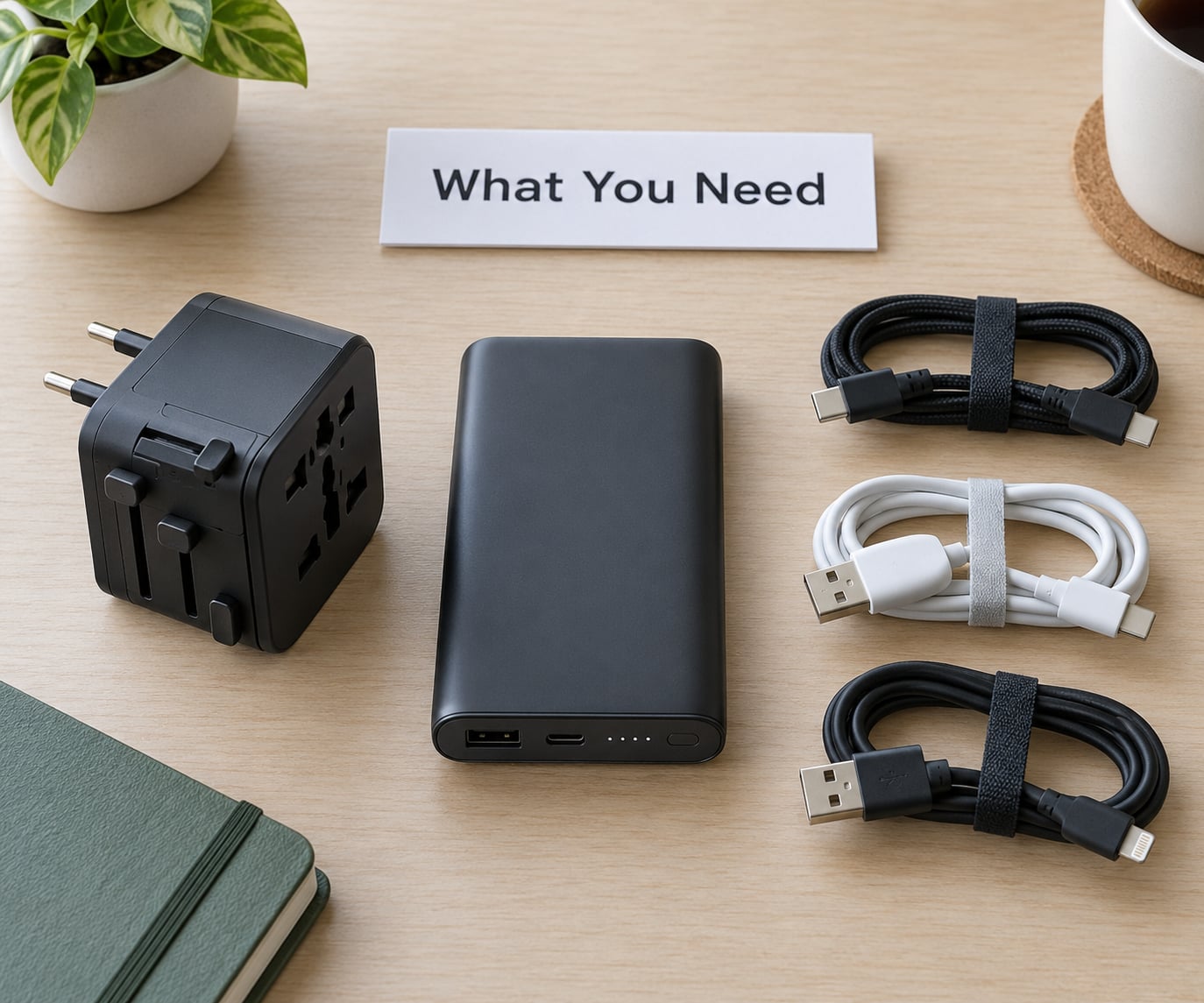
Before you pack, gather five things.
- The destination plug type and mains voltage. Search the country name plus the words plug type and voltage, and write both down. These are separate facts and both matter.
- The input rating of each device’s charger. The number is printed on the brick, usually on the underside.
- A plug adapter that matches the destination plug. One per traveller works better than one big shared brick that gets split up and lost.
- A USB power bank sized for the trip. A 10,000mAh unit roughly covers three full phone charges; 20,000mAh covers closer to six.
- Your own cables, rated for the wattage you need. A cheap cable can quietly limit fast charging to a phone-speed trickle.
What you need depends on the device. A phone and a pair of earbuds need an adapter and a short cable. A laptop needs an adapter plus a charger with enough wattage for its battery, which usually means 45W to 100W and a USB-C cable rated for that power. A camera may need two batteries and a dual-battery charger, which is where the wall-socket gap starts to hurt.
How to Charge Devices in Other Countries: Step-by-Step
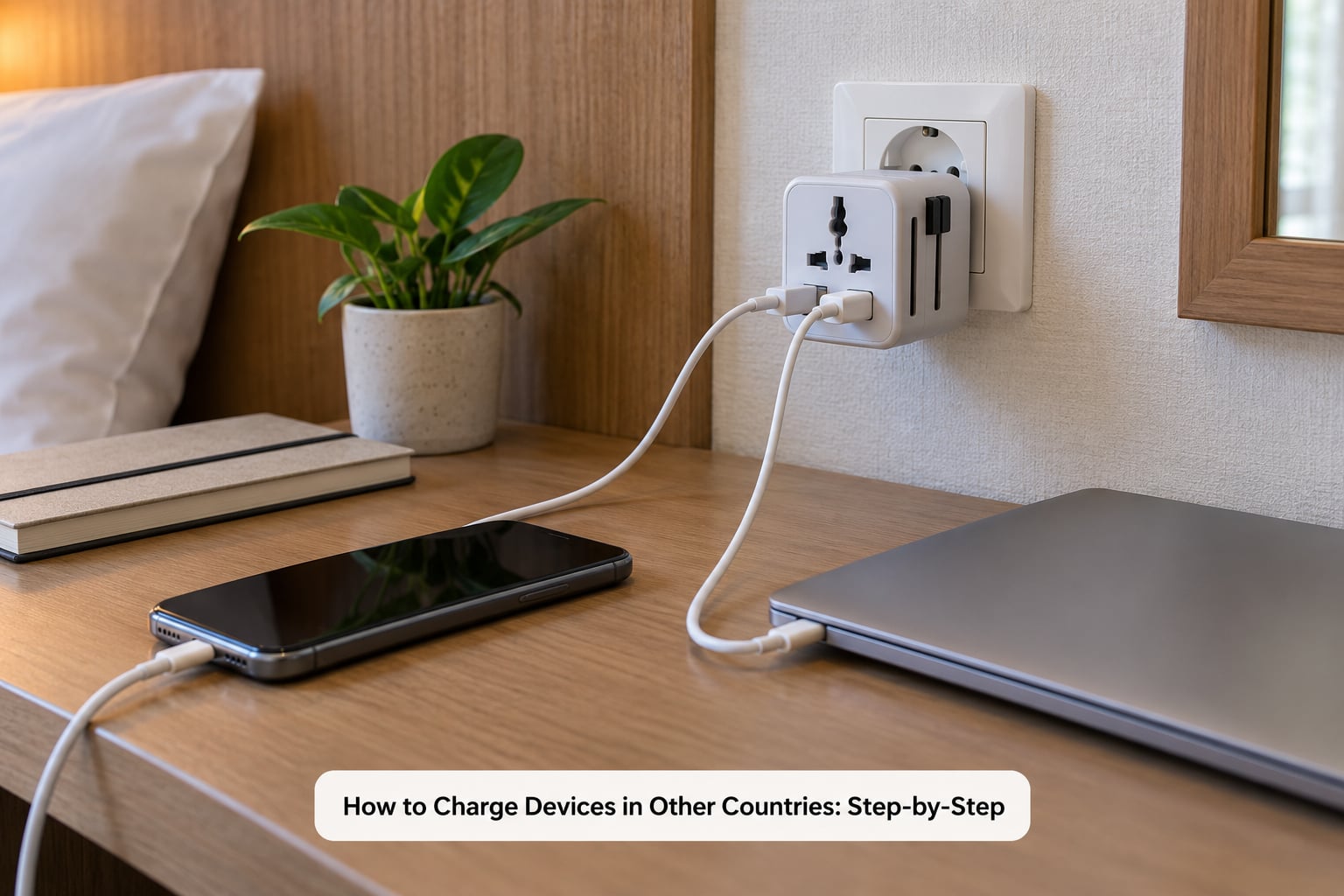
Here is how to charge devices in other countries in four steps: confirm your destination uses a plug shape different from yours, confirm your charger is rated 100-240V, pack an adapter that matches that plug, and keep a power bank as backup. Skip the converter unless you are carrying a single-voltage appliance.
Check the destination voltage and frequency
Three separate things travel under the phrase electrical supply, and mixing them up is what causes damage.
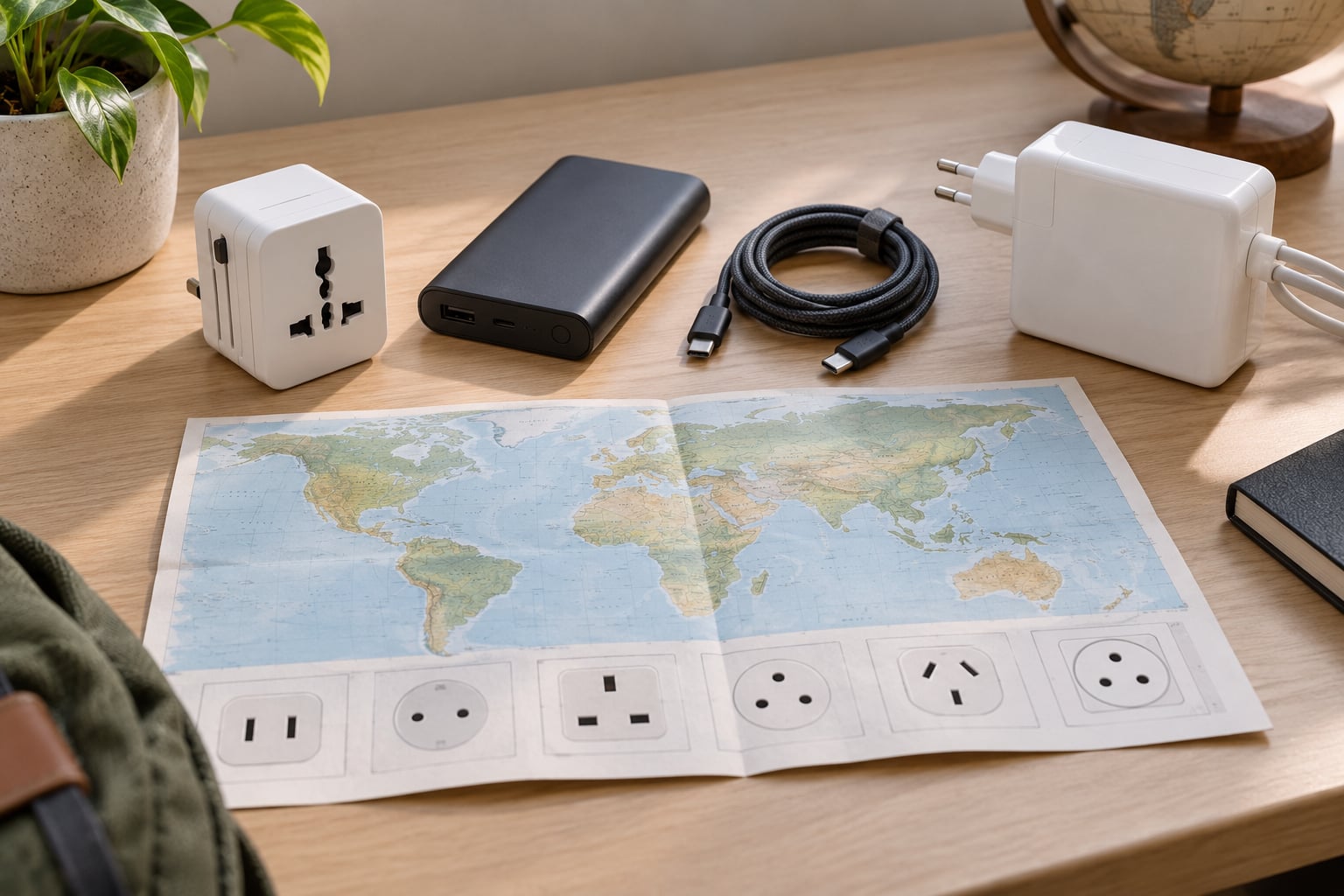
- Plug shape is the physical metal pin arrangement. It is the only thing a plug adapter fixes.
- Voltage is the electrical pressure, written as 120V or 230V. Only a converter fixes this.
- Frequency is measured in hertz, 60Hz in the Americas and Japan, 50Hz across most of Europe, Asia and Africa.
Two countries can use the same plug and completely different voltage. The UK and Kenya both use large three-pin sockets, and they are on opposite ends of the voltage range. So plug shape alone tells you very little.
Now turn your charger over and read the label. Look for a line that reads Input: 100-240V~ 50/60Hz. That range is the whole test. A single number, or a narrow range like 110V or 230V only, means the device is single voltage and needs a converter when you cross between voltage families.
How to choose the right adapter and charger
There are three practical options, and the right one depends on your itinerary rather than your destination count.
A country-specific adapter is the smallest option and the most reliable. You pack one for the Type G socket of the UK or the Type I socket of Japan and you are done.
A multi-country adapter with swappable plug heads covers two or three specific regions in one body. It suits a round trip through Europe plus the UK, where the plug shapes are different but the voltage question is simple.
A universal adapter accepts many plug types through sliding pins. Convenient, and the reason forum threads are full of complaints: the sliding-pin mechanism is exactly the part that breaks, and these units often block the sockets either side of the one you need.
Whatever you choose, remember that the adapter changes the shape of the plug and nothing else. Power still arrives at the local voltage. If your charger is rated 100-240V, that is fine. If it is not, you need either a converter or a replacement charger built for that voltage.
Connect the charger and check for safe operation
Insert the adapter into the wall socket first, firmly, with no wobble. Plug your charger into the adapter next, then connect the cable to your device last. Going in this order means no partially connected adapter is left live in the socket while you fumble with a cable.
Normal operation looks boring: the charging icon appears, the battery percentage climbs, the charger is slightly warm. A little warmth in a power supply is expected. A lot of heat, an unusual smell, a crackle, a scorch mark or a plug that will not sit straight in the socket means something is wrong.
If you see any of those signs, unplug from the wall immediately, stop using that adapter, charger or cable, and move to another outlet. Do not retry it the next day in a different country hoping it behaves differently. Damaged equipment does not repair itself in a suitcase.
One more habit: buy adapters with overcurrent and overvoltage protection if you travel to places with an unstable grid. A cheap market stall adapter that fits loosely is the most likely thing on your trip to damage a laptop.
Use backup charging options
Even with perfect planning, outlets are often in the wrong place or already occupied. A small power strip with surge protection solves the one-outlet-four-devices hotel problem better than anything else, and it lets two people each take a socket.
Airports are the usual source of misery. Power banks must travel in your hand luggage, not checked baggage, and airlines cap capacity for safety reasons. Most carriers use a 100Wh ceiling, which a 20,000mAh bank at roughly 74Wh sits under comfortably. Check your airline’s own limit rather than assuming.
Aircraft seat outlets vary enormously. Some deliver reliable power, many deliver less than the laptop needs, and a surprising number of seats have none. A power bank gets you through a long-haul flight regardless of seat row.
Long transit days and destination towns with limited access to outlets are the other weak spots. A bus station cafe outlet, a hotel reception desk or a business centre in the lobby can fill a phone overnight. Hotels often lend a charger behind the desk, though it is usually a phone cable rather than a laptop charger. On a road trip, a 12V socket in the car with a USB car charger is a genuinely useful option, and one charged power bank covers a whole day of driving.
Common Mistakes
Assuming all plugs are interchangeable. The fix: look up the destination plug type properly. Switzerland is the classic trap, because its Type J sockets do not fully accept the Type C and Type F plugs people assume will fit. Japan, Australia and the UK each catch people out too.
Confusing a plug adapter with a voltage converter. An adapter is plastic and passive. A converter is heavy, warms up, and steps voltage up or down. If it feels substantial and gets hot, it is doing something electrically.
Using a converter on a device that does not need one. Some manufacturers explicitly warn against connecting their power supply to a converter, so the manual matters as much as the label. Extra conversion is heat and risk with no benefit.
Overpacking one adapter for every country. A folder of small adapters weighs very little, works every time, and survives being separated from the group. People on travel forums regularly recommend carrying a spare in a different bag for exactly this reason.
Ignoring laptop voltage requirements. Some older laptops are single voltage. Check before you fly, not at check-in.
Leaving batteries in hot luggage. A power bank generating warmth inside a suitcase in the sun is a poor idea. Carry it in your personal item where temperature is controlled.
Charging with damaged cables or devices. A frayed cable or a bent connector should be retired at home, where replacements are cheap.
A few final tips: test each adapter in a socket at home the night before you leave, so a faulty unit does not ruin the trip. Buy adapters online before departure rather than at the airport. And buy dual-voltage hair tools instead of carrying a heavy converter for them.
Frequently Asked Questions
Can I use my usual phone charger in another country?
Almost certainly yes. If the label on your charger reads Input: 100-240V, or shows two voltages such as 100V and 230V, it works in most countries and needs only a plug adapter to match the wall socket. If it lists a single voltage, or you cannot find a label at all, treat it as single voltage and use a converter.
Do I need a voltage converter for my phone or laptop?
No, for practically any phone or laptop made in the last two decades. Both use low-voltage USB charging, and the wall charger is a dual-voltage unit rated 100-240V. You need a converter only for old single-voltage mains appliances such as hair dryers, straighteners, electric shavers and kettles.
Is a plug adapter the same thing as a voltage converter?
No, and this is the single most common misunderstanding. A plug adapter is a passive plastic piece that changes the physical shape of your plug so it fits the foreign socket. It carries no electronics and changes no voltage. A converter contains a transformer, changes the voltage itself, runs warm, and is noticeably heavier.
Can I charge my devices at a hotel?
Usually, but rooms often have only one or two usable outlets, sometimes behind the nightstand. Bring a short surge-protected power strip so several devices can charge overnight and you avoid awkwardly unplugging the lamp. Many hotel receptions will lend a charger cable at the desk, and business centres usually have a socket you can use for an hour.
How should I carry a power bank on a flight?
Carry it in hand luggage, not checked baggage, with terminals protected or the power off. Most airlines cap spare lithium batteries at 100Wh for carry-on, which a 20,000mAh bank sits comfortably under because of conversion losses. Never pack loose power banks in checked bags, and expect a battery inspection at security.
What should I do if my device gets hot while charging abroad?
Unplug it from the wall at once and stop using that adapter, charger or cable. Do not plug the device into another outlet to see whether the heat comes back, because a hot adapter or charger is the real suspect. Heat, an odd smell, crackling or scorch marks mean retiring that piece of equipment, not troubleshooting it.
Conclusion
The safest order of operations is short: identify the destination plug shape and voltage, confirm every charger is rated 100-240V, pack adapters to match the plug and a power bank for the gaps, and retire any damaged equipment before you leave rather than during the trip. Converters stay home unless a single-voltage appliance is coming with you.
One action you can finish tonight: lay every charger and adapter you intend to travel with on the table and read each input label. Anything that does not clearly say 100-240V gets left out or investigated. Ten minutes now, and no burnt hair dryer in a foreign hotel bathroom.