Cruise ship itineraries are planned by the itinerary and deployment teams inside each cruise line. They pick a homeport, screen candidate ports against physical and commercial limits, then sequence the survivors into a route the vessel can genuinely sail. The work starts roughly 12 to 24 months before a departure date and keeps being revised until the ship sails.
Most people picture that process as a holiday brochure. It is closer to a freight network with a hospitality department attached. Once you see how the pieces fit together, the parts of a sailing that used to look arbitrary start to make sense.
This guide walks through that process end to end, then turns it around so you can use it as a shopping tool. Last reviewed in October 2026.
Table of Contents
- 1How Cruise Ship Itineraries Are Planned
- 2How the planning process moves from idea to booked itinerary
- 3The three objectives every route is balanced against
- 4How cruise lines choose destinations and ports of call
- 5What port capacity and infrastructure mean for a route
- 6Why a good port on the map can still be the wrong port
- 7How season, weather, and port conditions shape the schedule
- 8What changes between warm-weather, shoulder-season and cold-weather deployments
- 9How the onboard experience is built into port days
- 10How operators calculate whether an itinerary works financially
- 11Why positioning a ship is a cost line of its own
- 12Why cruise itineraries can change after booking
- 13How to read an itinerary before you book
- 14Ship first or itinerary first: the debate real cruisers keep having
- 15Frequently Asked Questions
- 16Who has final approval over a cruise ship’s itinerary?
- 17Can passengers request a change to a booked cruise itinerary?
- 18Why does a cruise ship visit the same port several times?
- 19How far in advance are cruise ship itineraries planned?
- 20Does bad weather guarantee that a scheduled port will be skipped?
- 21What Travelers Should Take Away
How Cruise Ship Itineraries Are Planned
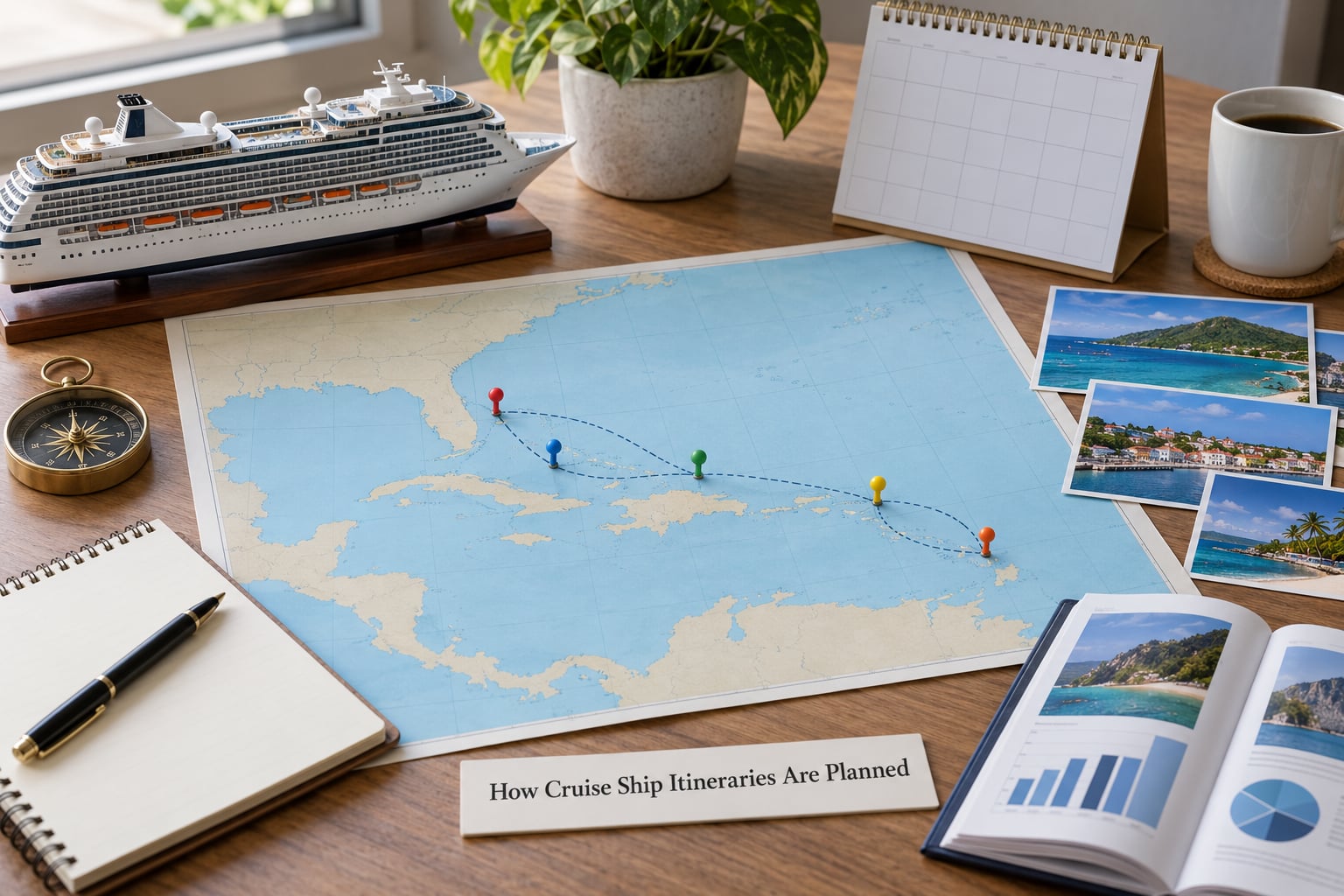
An itinerary is the sequence of ports of call, the nights spent at sea, and the arrival times between them. Planning one means fitting a ship, a season, a berth calendar and a set of commercial targets into a single schedule that works every week of the sailing.
Two different documents sit behind the itinerary you see when you book. The first is a route strategy: a multi-year view of which regions a line serves, which ships belong in each region, and which destinations define the brand. The second is the itinerary for one ship and one departure date, built inside that strategy and reviewed until the day of sailing.
The strategy changes slowly. A line does not abandon a region mid-season. The single sailing changes constantly, because berths get reassigned, ships get repaired, and demand shifts.
How the planning process moves from idea to booked itinerary
No single planner decides any of this. Product, deployment, revenue, marine operations, hotel teams, port agents and commercial all contribute, and a proposal has to survive each of them.
- Define the guest proposition: who is sailing, what they will pay for, and what the line wants them to remember.
- Review booking history, search demand and sold-out performance by region and season.
- Choose the homeport and the deployment window the ship can actually reach.
- Shortlist candidate ports by berth, depth, clearance and infrastructure fit.
- Negotiate berth holds, port fees and service requirements with each port.
- Sequence ports into a feasible route and set the sailing length and sea days.
- Confirm shore-excursion capacity, staffing and onboard programming for each call.
- Publish the itinerary, then keep refining it until departure.
Step six is where most proposals quietly die. A route that looks attractive on a map can require more nautical miles than the ship has sea days allocated, or it can demand a turnaround the port cannot physically deliver.
The three objectives every route is balanced against
Strip away the destination marketing and three targets explain almost every decision.
- Financial performance. The sailing has to cover ship operating costs, port fees and the cost of getting the vessel to its deployment window.
- Customer satisfaction. Ports are scored and compared, and a destination that consistently disappoints guests tends to lose calls to one that delivers.
- Competitive positioning. A line needs something a rival cannot easily copy, and a distinctive destination mix is one of the cheapest ways to get it.
These three pull against each other constantly. The most profitable port on the paper route is often the one that delivers the worst guest day.
How cruise lines choose destinations and ports of call
Port selection is a balancing act rather than a ranking. Lines keep a mix of marquee destinations that guests buy the cruise for, and smaller or complementary calls that give variety and reward guests who want to explore rather than repeat the postcard.
Five things feed the decision: demonstrated passenger demand, how well the destination photographs and markets, how it varies against what the line already offers, whether the ship class suits the port’s infrastructure, and whether the timing lines up with a seasonal event or with local conditions.
The coherence test matters as much as any single factor. Five calls that sit within a day’s steaming of each other can feel repetitive and can burn fuel doing laps; five calls that leap across a basin turn a cruise into a travel day.
One worked example. A scenic harbour call with excellent reviews makes the shortlist for a first-timer-focused sailing, where the appeal is breadth of experience and guest satisfaction scores carry weight. On a repeat sailing aimed at veterans who have already done that region, the same harbour often gets dropped in favour of a longer call somewhere with more shore time, because the returning guest is buying hours ashore rather than novelty.
That is why two sailings on the same ship in the same month can have almost nothing in common. They may be built for different audiences with different revenue and satisfaction targets.
What port capacity and infrastructure mean for a route
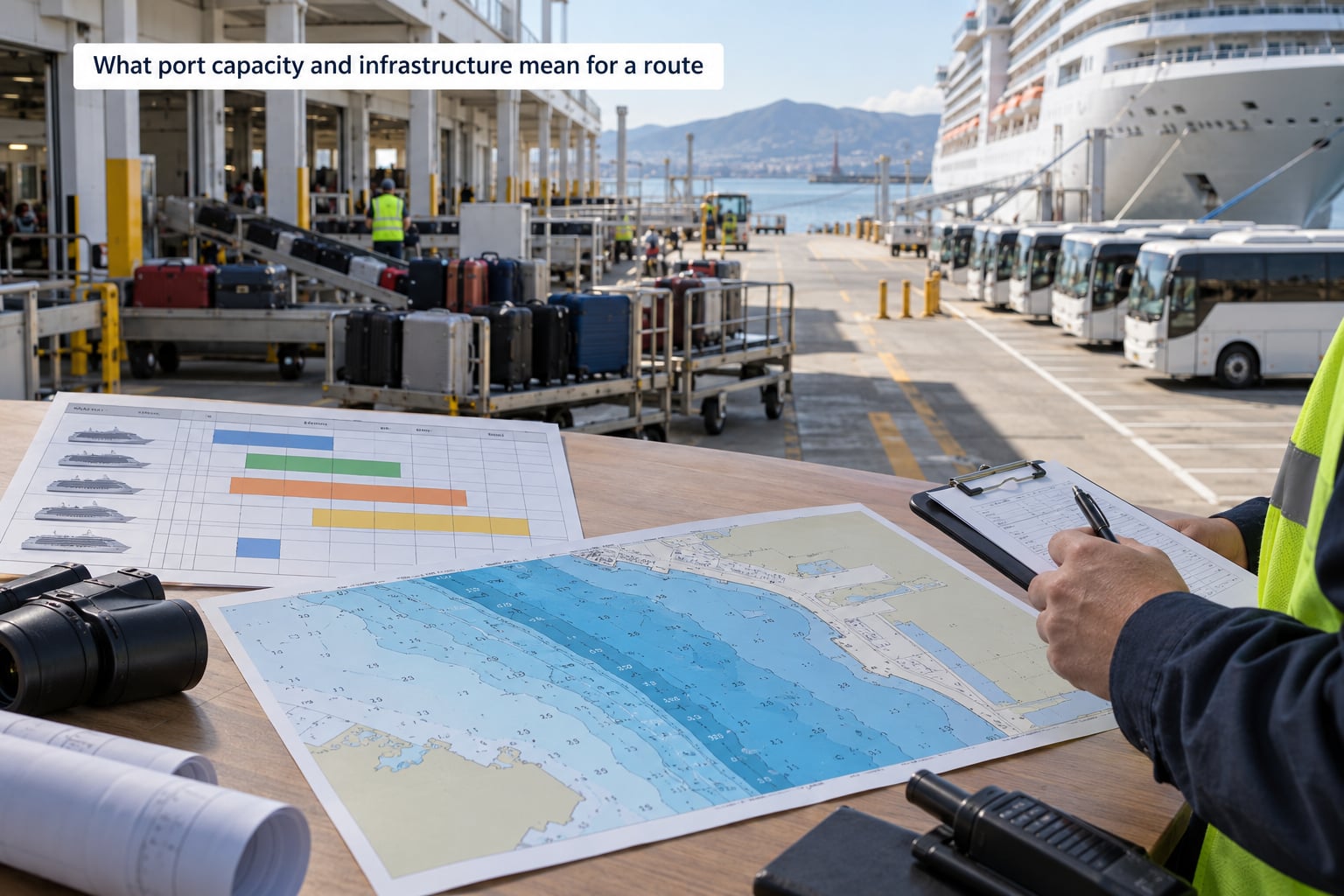
A port is not a stop because it sits near the route. It is a stop because it can physically receive the ship and absorb everyone on it. Geography is the easy part.
| Factor | Why it decides things | What it means for you |
|---|---|---|
| Berth length and depth | A ship only calls where the pier is long enough and the channel and berth are deep enough for its draft. | Very large ships sometimes call at an anchorage instead of a pier. |
| Turning basin | The ship must be able to turn or moor without blocking the harbour. | A port can be close by and still be unusable for a big vessel. |
| Port operating hours | Arrivals outside working hours may not be serviced, which can force an overnight call or a different port. | An overnight call can appear purely because of tide and staffing windows. |
| Customs and immigration clearance | Cruise passengers are processed as a mass movement; capacity here limits how many can be ashore at once. | Long security lines on arrival are a capacity symptom, not bad luck. |
| Fuel, food and provisioning | Ships resupply between ports, and port services vary in what they can handle. | Long port calls can be used for resupply, which is part of why the ship stays. |
| Ground transport links | Tenders, buses, trains and walkable distances determine how many guests can realistically get off ship. | A port with only a few tenders limits independent shore time. |
| Shore-excursion capacity | Tours, coaches and local operators are finite; a big ship needs a lot of them at once. | Popular excursions sell out early on high-capacity calls. |
| Visa and entry rules | Passport validity, entry rules and nationality mix can block or complicate a call. | Check entry requirements before assuming a port will be reachable. |
Why a good port on the map can still be the wrong port
Two common cases explain most of it. A ship may be larger than the berth, so it anchors offshore and tenders guests in; or the berth is fine but the transport network cannot move several thousand people ashore and back within the call.
Tendering is the one passengers notice. Guests ride in small boats from ship to shore, which adds time at both ends and is weather-dependent. Veterans consistently treat whether a port is tendered or dock-accessible as a genuine decision criterion rather than a detail, and that instinct matches the operational reality.
How season, weather, and port conditions shape the schedule
Cruise lines plan routes against regional weather patterns long before a specific sailing. The Mediterranean and northern Europe follow a warm-season window because ports and channels are workable only in calm conditions. Caribbean itineraries move with the tropical calendar and are positioned away from the peak storm season where the schedule allows. Alaskan routes are constrained by ice, daylight length and the short season that permits navigable passages, which is why they operate when they do.
Planners also work around peak tourism periods, port holidays, scheduled harbour works and expected maintenance. Two of those can quietly force a change years before anyone books.
What changes between warm-weather, shoulder-season and cold-weather deployments
| Deployment type | Route priority | Scheduling focus | Main trade-off |
|---|---|---|---|
| Warm-weather | Beach and outdoor destinations, longer daylight for evening calls | Maximising usable shore hours; avoiding the region’s harshest weather window | Highest demand and heaviest berth competition |
| Shoulder-season | Cities and ports with year-round interest | Spreading calls across more destinations with flexible timing | Lower fares, occasional weather disruption |
| Cold-weather | Ice-limited or short-season passages | Working inside navigable water, daylight and lock or tide windows | Tight schedules, less room to absorb a delay |
The same ship rarely keeps one route all year. Between deployments it sails an empty repositioning cruise to reach its next region, which is why a ship you loved in one place may be somewhere entirely different a few months later.
How the onboard experience is built into port days
The route is a plan; the port day is a schedule, and the two are not the same thing. Call time is set around tide, berth availability, port operating hours and the ship’s own arrival speed, then the day is built backward from it.
Arrival time decides a lot. An early arrival means gangway queues and a compressed morning ashore. A mid-afternoon arrival gives guests a lazy onboard day and a short evening ashore. Overnight calls are planned deliberately, usually because the geography demands a long steam and stopping for the night beats arriving exhausted at dawn.
Programming follows the rhythm. On a late-arrival day the ship sells the onboard experience hard, because that is where guests are. On a full port day the gangway, tender fleet and baggage handling become the bottleneck, and the ship has to move thousands of people through them.
Guest preference feeds back too. Ports that consistently frustrate guests get downgraded, and lines watch exit polls and direct feedback to decide whether a call is worth repeating.
How operators calculate whether an itinerary works financially
Nobody publishes the actual numbers, and any figure you see quoted as an internal figure should be treated with suspicion. What is public is the structure of the calculation, which is straightforward enough to reason about.
On the revenue side: cabin demand and fares by sailing, occupancy across cabin categories, onboard spending in bars, restaurants and spas, and shore-excursion revenue. On the cost side: port fees and berthing charges, fuel consumption, crew and staffing, provisioning, agent commissions, insurance and repositioning.
The interesting part is how sensitive the result is to a single assumption. Fuel prices, an extra sea day and a weak excursion season can each swing the same sailing in opposite directions, and those are the levers a planner can actually pull late in the process.
| Changed assumption | Direction of pressure | Likely planning response |
|---|---|---|
| Strong early bookings for a region | Revenue up, but berths scarce | Add a second ship to the deployment and add calls |
| Weak bookings for a season | Revenue down, berths plentiful | Cut sea days, add shorter calls, promote the region harder |
| Higher fuel cost | Cost up on every nautical mile | Cluster ports closer together, trim sea days |
| Longer repositioning move | Cost up before any revenue arrives | Shorten the repositioning, or schedule it inside a season |
| Port fee increase | Cost concentrated on one call | Renegotiate, reduce call length, or swap the port |
| Passenger mix shifts toward onboard spending | Revenue mix changes, not just total | Extend calls for guests, protect evening onboard hours |
Why positioning a ship is a cost line of its own
Moving a ship between regions costs fuel, time and crew, and earns nothing. It has to be justified against the season it delivers. That arithmetic is one reason a deployment looks far more lumpy than a passenger ever sees: the ship has to be in the right region on the right date, which dictates what the season before it had to look like.
Why cruise itineraries can change after booking
Published itineraries are commitments, not guarantees. Some changes are routine scheduling adjustments; others are disruptions. Knowing the difference tells you how much attention to pay.
- Weather routing. Storm systems, high winds, fog and rough seas force earlier or later arrival, anchorage instead of a berth, or a different port.
- Port congestion. Too many ships for the available berths means waiting at anchor, which eats into shore time.
- Mechanical work. A repair that runs long can cost a day or more, and a day has to come from somewhere.
- Port closure or civil disruption. Authorities close ports for safety or infrastructure reasons with little notice.
- Regulatory requirements. New environmental or security rules can limit arrival windows, speed or an entire call.
- Commercial repositioning. A ship may be moved to serve a stronger sailing elsewhere.
Commissions and port authorities typically publish notices, the cruise line posts updates to your booking, and onboard announcements and daily programmes carry the current plan. The daily programme printed on the ship is the operative version of your itinerary, which is why experienced cruisers check it every evening rather than trusting the brochure from home.
What happens to a prepaid excursion or a booked hotel depends on the cruise line’s terms and on the specific change, so check your contract rather than assuming either way.
How to read an itinerary before you book
Two sailings can list the same ports and feel completely different. The differences live in the timing and the format, so read the schedule rather than the destination list.
- Count the sea days. They tell you how much of the trip is moving rather than visiting.
- Check arrival times. A 7am arrival and a 4pm arrival are different days, even at the same port.
- Note tender ports. Any call marked as tendered adds time and depends on conditions.
- Look for overnight calls. These are planned, but they change your expectations about sleeping aboard.
- Watch for repeated ports. Two calls at one port can mean a long second visit or two genuinely different experiences.
- Confirm the homeport. A homeport change ripples through your flights, hotels and transfers.
- Distinguish advertised from confirmed. The daily programme on board is the version that governs.
A single nautical mile on a schedule does not tell you whether a day is short or stressful. Fuel, currents, traffic separation and port restrictions decide that, and only the captain knows on the day.
Two questions worth asking before you commit: what happens to my plans if this port is skipped, and does the line’s terms cover that case. Ask your travel professional the same two questions rather than relying on marketing copy.
Ship first or itinerary first: the debate real cruisers keep having
It is the most argued question in cruise forums. The experienced-cruiser position is consistent: start with the itinerary and the length of the cruise, then choose the line. The counter-argument is that a great ship with a mediocre route is a better week than a fascinating route on a ship you dislike.
Both hold, depending on the person. If your priority is rest, food and facilities, the ship matters more. If your priority is what you see and do ashore, the route matters more. What does not work is choosing a ship you do not care about for a route you love, then resenting the whole week.
Frequently Asked Questions
Who has final approval over a cruise ship’s itinerary?
No single person signs off alone. A proposal passes through itinerary development, deployment, revenue management, marine operations and commercial teams, and berth commitments come from negotiations with port authorities and terminal operators. Final authority usually rests with the line’s senior commercial and operations leadership, since the route has to work commercially, physically and legally at the same time.
Can passengers request a change to a booked cruise itinerary?
Almost never, not for the route itself. Once a sailing is published, its ports of call, homeport and duration are sold products, and changing them would break bookings, flight arrangements and contracts. What you can often do is adjust your own plans: change an excursion, skip a port, or move to a different departure date. Special circumstances are handled case by case under the booking terms.
Why does a cruise ship visit the same port several times?
Three common reasons. A round-trip itinerary out of a homeport naturally returns to that homeport and to regional favourites. A slow-paced sailing repeats a port so guests get a full day rather than a rushed call. And a ship covering a wide region may shuttle between a handful of hub ports because they are the only ones that can berth it reliably, which keeps fuel and distance under control.
How far in advance are cruise ship itineraries planned?
Broad route strategy is set years ahead, and a specific sailing is typically built and published 12 to 24 months before departure, aligned with the brochure and booking cycle. Refinement continues right up to sailing: berth assignments, arrival times and occasionally ports get adjusted as the season approaches and while the cruise is running.
Does bad weather guarantee that a scheduled port will be skipped?
No. A port can be kept with a delayed arrival, a shortened call, or guests taken ashore by tender instead of gangway. Skipping usually happens when conditions make the approach unsafe, the harbour is closed, or an alternative is clearly better for guests. The published schedule is a plan, so expect the daily programme on board to be the version that governs.
What Travelers Should Take Away
An itinerary is the output of six forces pulling together: passenger demand, destination strategy, ship operations, port capacity, seasonality and commercial viability. Remove any one of them and the sailing stops being possible.
Before you book, check the arrival times rather than the destination list, find out which calls are tendered, count the sea days honestly, and read what the cruise line’s terms say about changes. Then pick the version of the trip that matches how you actually like to travel: many early starts ashore, or unhurried days at sea with the ship doing the work.