Most people answer the question of how to get to the cruise terminal from the airport in one of three ways: the shuttle run by the cruise line, a private car service booked in advance, or a taxi or rideshare. Which one actually works depends on your port, how many bags you are carrying, and how much padding you have between your landing time and the all-aboard time. This guide walks through every option, the timing that actually protects you, and what to do when a flight runs late.
The part most first-time cruisers get wrong is not the transport choice. It is the clock. Embarkation usually closes 60 to 90 minutes before the scheduled sailing, and the ship does not wait for anyone. A transfer that looks generous at 45 minutes can eat an entire afternoon if your flight lands late or a checked bag never appears.
Table of Contents
- 1What You Need
- 2Step-by-Step: How to Get to the Cruise Terminal from the Airport
- 3Step 1: Confirm the Cruise Terminal and Sailing Deadline
- 4Step 2: Allow Time for Airport Exit and Baggage Collection
- 5Step 3: Choose the Best Airport-to-Terminal Transfer
- 6Step 4: Check In and Complete Terminal Procedures
- 7Common Mistakes
- 8Frequently Asked Questions
- 9How long should I leave between my flight landing and the cruise terminal?
- 10Can I take a train or bus from the airport to the cruise terminal?
- 11Should I fly in the day before my cruise or the same day?
- 12Should I book an airport-to-cruise terminal transfer in advance?
- 13How many bags fit in a private transfer for a family of four?
- 14What happens if my flight is delayed and the ship is boarding?
What You Need
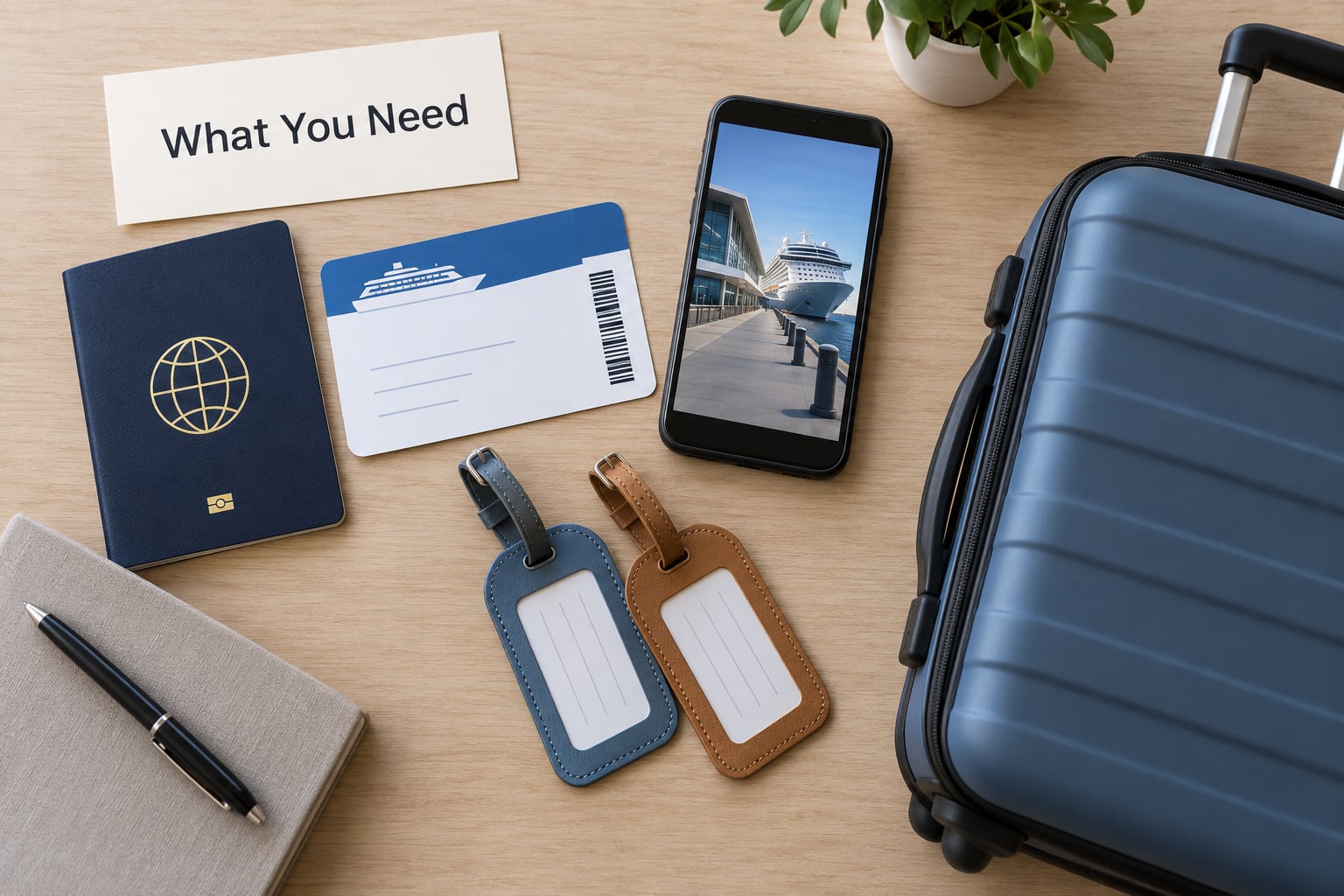
Gather these before you leave the airport terminal. Having them on your phone or in your carry-on saves a lot of arguing with an unfamiliar curb.
- Your sailing details. The exact port, the exact terminal or pier name, the ship name, the date, and the final boarding time printed on your cruise documents. Seattle, for example, has two cruise berths roughly four miles apart, and Miami has several terminals that all look alike from the road.
- Your flight details. Airline, flight number, scheduled landing time, and the arrival airport. Also the terminal your flight departs from, because a connection across a large airport can eat two hours on its own.
- Documents that must stay in your carry-on. Passport for everyone including infants, proof of citizenship for children who do not have passports, your boarding pass, your cruise documents, and any visa or onward travel paperwork. Checked bags get lost; passports in checked bags are how people miss sailings.
- Your luggage count. Every suitcase, every backpack, every stroller and car seat. This number decides your vehicle, not your comfort preference.
- Your transfer booking. Confirmation number, pickup instructions, and a name the driver can hold up on arrival. Pre-booked car services watch your flight and adjust; on-demand rideshares do not.
- Terminal information from the cruise line. Whether they run a shuttle from your airport, whether that shuttle requires a pre-registration card, and whether rideshare drivers can enter terminal property.
Add a few dollars in small bills for porters and tips, and keep your phone charged. You will use it for the transfer confirmation, the greeter sign and the boarding announcement.
Step-by-Step: How to Get to the Cruise Terminal from the Airport
Step 1: Confirm the Cruise Terminal and Sailing Deadline
Open your cruise documents and find the final boarding time, not the sailing time. That number is the deadline for everything else in this guide. Work backwards from it: subtract your transfer time, then add a buffer for the airport, then subtract again for the terminal check-in queue on a busy sailing day.
Most cruise lines publish an arrival window rather than a single time. Arriving inside the window usually means a shorter queue at check-in. Arriving well before the window opens can mean standing in a hot hallway with your bags, so aim for the middle of it.
Confirm the terminal name on the same screen. Ports with more than one cruise berth scatter arriving guests badly, and a wrong terminal on a Saturday morning is a 30-minute detour with luggage.
Step 2: Allow Time for Airport Exit and Baggage Collection
Your transfer clock starts when you land, not when you reach the curb. A realistic estimate for a domestic arrival with checked luggage is 30 to 45 minutes from landing to the curb, and international arrivals with a passport check plus customs can run 60 to 90 minutes. Large airports with train rides between terminals push it further.
Do the math before you book anything: landing time, plus exit and baggage, plus the drive, plus 60 to 90 minutes for terminal processing, should land you inside your arrival window. If it does not, fix one of those numbers now rather than at the curb.
On cruise days, check whether your airline uses a dedicated disembarkation lane or a different bag delivery arrangement. Baggage claim at a hub airport during an evening wave can take longer than the flight itself.
Step 3: Choose the Best Airport-to-Terminal Transfer
There are seven realistic ways to get from an airport to a cruise terminal, and the sensible pick changes with the port. Here is how each one behaves on embarkation day.
- Cruise-line airport shuttle. Usually the simplest option: a dedicated coach from the airport to the terminal, often with a pre-registration card that speeds up check-in. It runs on a fixed schedule, so it waits for the room to fill, and several lines require you to register before boarding.
- Third-party shared shuttle. Independent operators run the same airport-to-terminal route, frequently on a flat rate per person rather than per vehicle. Forum regulars sailing from Port Canaveral regularly point out that these run well below the cruise line’s own shuttle, which is exactly why the option exists.
- Private car service. A car and driver booked for your party only, door to terminal door. This is the strongest choice for families, anyone with mobility needs, or a large group that would otherwise pay per person. It is also the most expensive per seat and the most forgiving of a delayed flight.
- Rideshare. Convenient when you are travelling light and the port lets drivers onto terminal property. Two caveats: surge pricing tends to spike during the same embarkation wave as everyone else, and some ports charge a drop-off tariff or restrict which services can enter, which leaves you unloading on a public road and walking.
- Taxi. Simple, metered and usually present outside arrivals. CruiseCritic threads on Fort Lauderdale transfers show short runs costing very little, but a standard sedan is a poor fit for four adults and six suitcases. Ask for a van or mini-van when the party is large.
- Rental car. Worth it only if you want the car during the cruise. Add parking for a week, toll roads, and fuel, and the total usually lands above a private transfer. Use it for ports with causeway tolls only if you are comfortable with the bill.
- Public transit and rail. Real, and sometimes the cheapest per passenger, but rarely the right call on embarkation day. Suitcases, transfers with a bag, and a fixed timetable work against you. A CruiseCritic thread asking whether public transit exists from Long Beach airport to the port makes the point: on a short run it can work, on anything longer with luggage it is a gamble.
| Option | Typical cost | Best for | Luggage | Reliability on embarkation day |
|---|---|---|---|---|
| Cruise-line shuttle | Mid to high | Cruise-only passengers who want a set arrival | Good, carts available | High, follows a printed schedule |
| Third-party shared shuttle | Low to mid | Solo travellers and couples | Good, shared trunk | High, but fixed departure times |
| Private car service | Highest per seat, lowest per group | Families, groups, mobility needs, delayed flights | Best, sized to your bag count | Highest, flight tracking built in |
| Rideshare | Low off-peak, high during surge | Travellers light on bags | Limited in a standard car | Low, surge pricing and driver unfamiliarity |
| Taxi | Metered, varies by distance | Short runs from nearby airports | Request a van for large parties | Medium, queue varies by time of day |
| Rental car | Base rate plus parking, tolls, fuel | Cruise-and-explore itineraries | Excellent | Medium, you drive the whole route |
| Public transit or rail | Lowest per passenger | Experienced travellers with few bags | Hard with more than one suitcase | Lowest, fixed timetable and transfers |
A simple decision rule helps. If your bags exceed what a standard car trunk holds, or your party is more than four, go private. If you are one or two people with carry-ons and the port allows rideshare drop-off, an app ride is the cheapest sensible option. Everything else points to a shuttle.
One more choice sits above the transport mode: which airport you fly into. Fare differences are often larger than transfer costs, and a smaller nearby airport can save an hour of driving each way. For Port Canaveral, most travellers land at Orlando International, but two closer fields, Sanford and Melbourne Orlando International, cut the drive substantially when the airfare works out even. For Galveston, the two Houston airports differ by roughly 30 miles, so check which one your flight uses before booking the transfer. Weigh the fare against the drive, not against nothing.
| Port | Typical arrival airport | Rough transfer time | Watch out for |
|---|---|---|---|
| PortMiami, Miami | Miami International | Short but traffic-dependent | Causeway and tunnel congestion at peak hours |
| Port Canaveral, Florida | Orlando International, or Sanford / Melbourne | About an hour by road | Highway backups on Saturday mornings |
| PortMiami and Fort Lauderdale area | Fort Lauderdale-Hollywood International | Short run | Pick the correct terminal name in advance |
| Galveston, Texas | Houston Intercontinental or Hobby | About 45 to 90 minutes depending on airport | Roadworks, fog delaying sailings, bridge tolls |
| Seattle, Washington | Seattle-Tacoma International | About 40 to 60 minutes | Two piers about four miles apart, highway interchange queues |
| Long Beach, California | Long Beach Airport | Very short | Limited public transit, harbour traffic |
| New Orleans, Louisiana | Louis Armstrong International | Short to medium | Downtown traffic on embarkation mornings |
| Manhattan Cruise Center, New York | Newark, JFK or LaGuardia | 30 to 90 minutes depending on airport | Tunnel and bridge tolls, traffic on the west side |
Those drive times and port relationships are typical ranges and they change with traffic, season and roadworks, so treat them as planning figures rather than promises. Distance, not scenery, decides the airport.
Step 4: Check In and Complete Terminal Procedures
At the terminal entrance you will meet porters with carts. Hand them your tagged bags, keep your documents and valuables in a carry-on, and note how many bags you gave them. The fewer people handle your luggage, the smaller the chance of something going missing, which is the single most repeated piece of advice across cruise forums.
Inside, the sequence is usually check-in and document verification, then a security screening, then a waiting area with changing boarding times and group assignments. Have your passport, birth certificates for children, boarding pass and cruise documents out and ready.
Listen for the boarding call for your group and stay in the terminal. Guests do sometimes wander out for a meal and come back to a ship that has already cast off. If boarding is called early, go early.
Book your return transfer before the ship sails, while the shuttle and car service schedules are still on your screen. Disembarkation morning works in reverse: bags are often returned to the curb ahead of passengers, so a pre-booked vehicle with waiting time saves you a long stand on the pavement.
Common Mistakes
1. Planning around your landing time instead of the boarding deadline. Build the whole itinerary backwards from final boarding time, then check it against your flight. If the numbers do not work, fly in a day earlier.
2. Assuming every port has a shuttle. Shuttle routes are a cruise line by cruise line and port by port arrangement, and many ports have none from that airport. Check your own cruise line’s travel documents before you count on it.
3. Booking a rideshare before checking port access rules. Some ports charge a terminal drop-off tariff or have an operating agreement with one app but not another. Ask the cruise line or the port directly, or the driver will stop outside the gate with four suitcases in the rain.
4. Underestimating the airport, not the drive. International arrivals, checked bags and long terminal walks add up. Most missed sailings start on the airport side of the trip.
5. Going to the wrong terminal. Check the terminal name before you leave the airport, and screenshot it. Two terminals in the same city can be far enough apart to matter a lot with luggage.
6. Packing everything into a carry-on-sized plan. Count bags first, then size the vehicle. Arriving with more bags than the car holds is an unpleasant negotiation on a hot curb.
Two timing tips worth remembering. First, the all-aboard time printed on your documents is the real deadline; the sailing time is when the ship leaves. Second, if you are already on the road and the flight was cancelled, call the cruise line or your travel agent immediately and keep moving toward the port. The ship will not wait, but the phone call can start the paperwork for what happens next.
Frequently Asked Questions
How long should I leave between my flight landing and the cruise terminal?
Allow 30 to 45 minutes from landing to the curb on a domestic flight with checked bags, and 60 to 90 minutes on an international arrival with a passport check and customs. On top of that, budget the drive time, plus 60 to 90 minutes at the terminal for check-in and security. If your landing is inside that window, fly in the day before instead.
Can I take a train or bus from the airport to the cruise terminal?
Sometimes, and it is usually the cheapest per passenger. A few ports sit on a rail line or a short shuttle-bus hop from the airport, and travellers on those routes do it regularly. The catch is luggage: a suitcase, a timetable and a transfer on foot make it a poor choice for a family with several bags on embarkation day. Use transit for light packing, a private transfer for anything heavier.
Should I fly in the day before my cruise or the same day?
Fly in the day before whenever you can afford it. A delayed flight, a cancelled flight, a lost passport or a missed connection on the same day can end the cruise before it starts, and no cruise line holds a ship. Arriving the night before costs one hotel night and removes almost all of that risk. Same-day arrival only makes sense with a morning flight, a nearby airport and a private transfer already booked.
Should I book an airport-to-cruise terminal transfer in advance?
Yes, and earlier than you think. Pre-booked private car services and shared shuttles watch your flight and adjust the pickup when you are late, which an on-demand rideshare cannot do. Reserve the return leg before you sail too, because disembarkation morning slots fill up. Cruise-line shuttles are cheapest when you register your details ahead of the trip.
How many bags fit in a private transfer for a family of four?
A standard sedan handles two or three large suitcases comfortably. Four adults with full-size cases plus strollers and car seats need a minivan or SUV, and eight passengers with that luggage need a full-size van. Tell the booking company your passenger count and your exact bag count when you reserve, and ask for child seats in advance since they are not always kept on board.
What happens if my flight is delayed and the ship is boarding?
The ship will not wait, and boarding usually closes 60 to 90 minutes before the scheduled sailing. Call the cruise line or your travel agent as soon as you know, keep an eye on the airline’s rebooking options, and head for the port anyway if a later flight exists. Travel insurance that covers trip interruption is worth checking before you buy it, not on the curb.
Start with the boring part: open your cruise documents, note the terminal and the final boarding time, and run the arithmetic backwards to your flight. If the buffer is thinner than two hours, move the flight or add a hotel night. After that, pick the transport that matches your bag count, book it before you leave home, and the rest is just a drive.