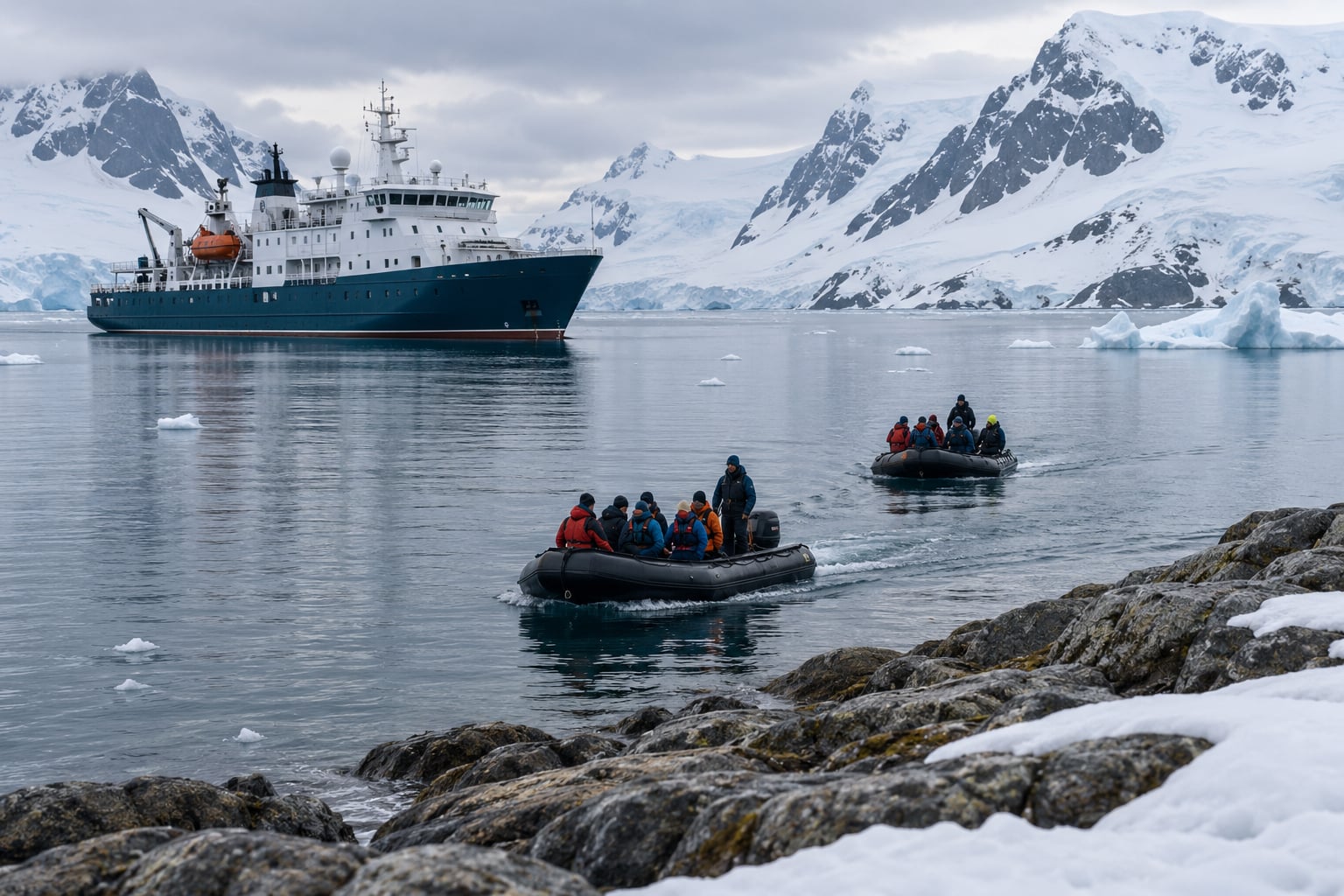
Expedition cruises to remote regions work by putting a small, ice-capable vessel where no roads or runways exist, then moving guests ashore in Zodiac inflatables instead of at a port. The ship is a base camp, not a resort: routes, landings and timings get rewritten daily around weather, ice and wildlife.
Most people picture a big cruise ship when they hear the word cruise, so the first surprise is usually scale. An expedition vessel might carry fewer than a hundred guests, most of its cabins have windows you can actually open, and the gangway scenario is a rubber boat. If you want the mechanism rather than the brochure, here is what actually happens between the gangway and the glacier.
Last updated: October 2026.
Table of Contents
- 1What Is an Expedition Cruise?
- 2How Do Expedition Cruises to Remote Regions Reach Them?
- 3Permits come before itineraries
- 4Season and ice decide the timing
- 5Most trips start with a repositioning leg
- 6Getting ashore is the real constraint
- 7What Happens During an Expedition Cruise Day?
- 8Why Do Expedition Ships Look Different from Regular Cruise Ships?
- 9How Do Guides and Scientists Help Passengers Explore?
- 10What a guide actually does on a landing
- 11What Are the Safety and Environmental Challenges?
- 12How Much Do Expedition Cruises Cost?
- 13Who Is an Expedition Cruise Best For?
- 14Frequently Asked Questions
- 15What is the difference between an expedition cruise and a regular cruise?
- 16Why are expedition cruises more expensive per day?
- 17What happens if the weather cancels a shore landing?
- 18Do I need to be physically fit to go on an expedition cruise?
- 19Will I get seasick on a small expedition ship?
- 20Can I work or get reliable internet on an expedition cruise?
What Is an Expedition Cruise?
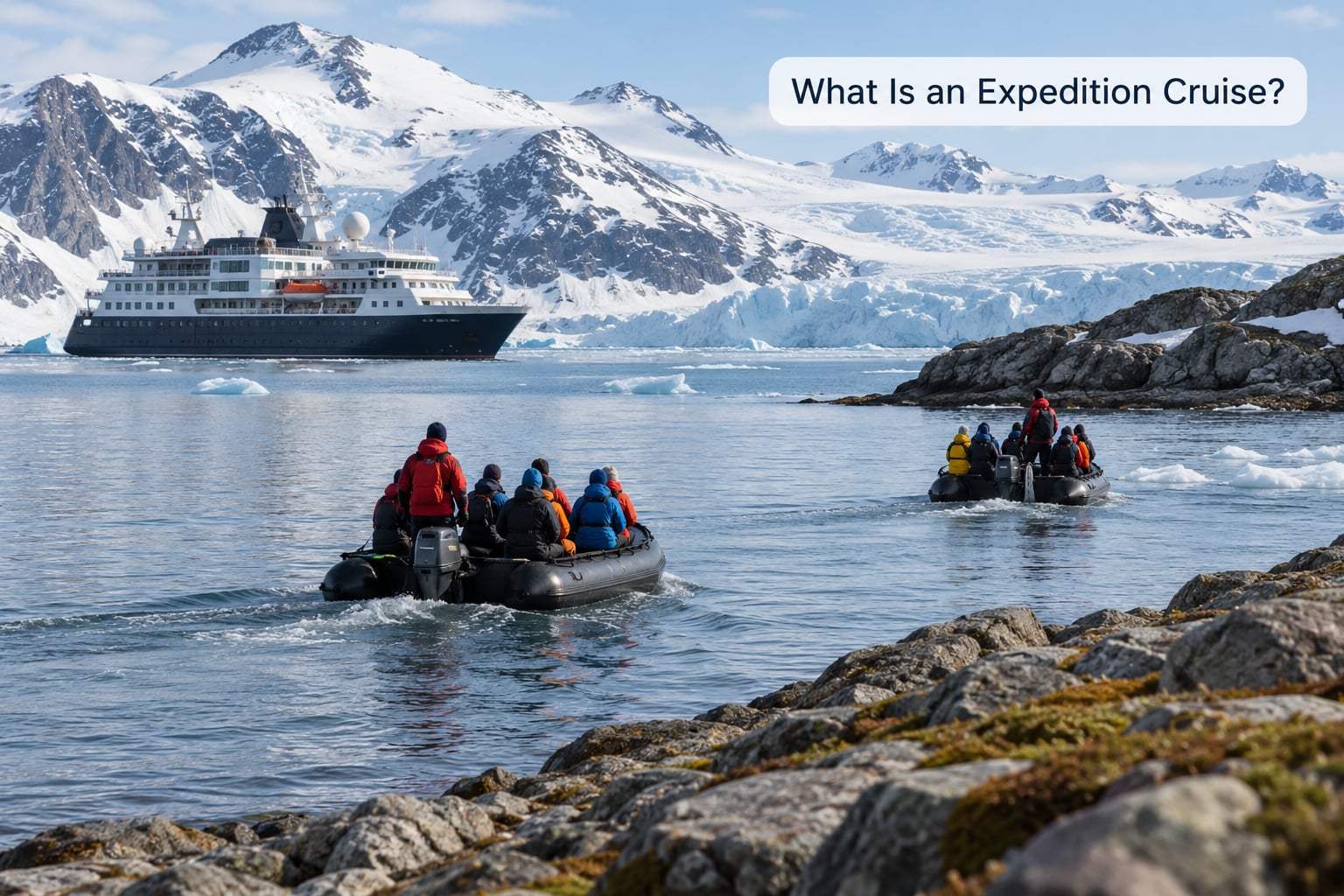
An expedition cruise is a voyage on a small, purpose-built or ice-reinforced vessel that carries a team of specialists onboard, reaches remote coasts by inflatable boat, and adjusts the itinerary to conditions rather than to a fixed port timetable.
Four things separate it from a conventional cruise. The ship is small enough to anchor close to shore and shallow-drafted enough to reach places a big hull cannot. There is no port infrastructure, so every transfer is by tender. The crew is weighted towards naturalists, historians and expedition leaders rather than entertainers. And the published schedule is a plan of intent, not a promise.
Here is the plain comparison most people are after:
| Feature | Expedition cruise | Mainline ocean cruise | Land-based expedition |
|---|---|---|---|
| Typical group size | Fewer than 100 to roughly 200 guests | Several thousand | 10 to 30 people |
| Access | Anchors offshore, goes ashore by Zodiac | Berths at a built port | Roads, trails, airstrips |
| Hull | Ice-class, reinforced bow, shallow draft | Large, deep-draft, open-water | Not applicable |
| Who controls the schedule | Expedition leader and captain | Port authority and pre-sold timetable | Guide and weather |
| Specialist staffing | Core part of the crew | Limited entertainment programming | One or two specialists |
| Bar, casino, buffet, theatre | Small and quiet, often one dining room | Large and open late | Field lodge or camp |
| Itinerary certainty | Low, and the operator says so in advance | High | Medium |
| Physical demand | Moderate, boarding and walking included | Low | High |
| Relative cost per day | Highest | Lowest | Middle |
Small-ship operators such as Quark, Lindblad, Ponant, Hurtigruten, Aurora, Seabourn and Viking all sell this format, and the recent wave of polar-class newbuilds has added capacity without changing the core idea. The vessel gets you there; the landings are the trip.
How Do Expedition Cruises to Remote Regions Reach Them?
Routes are not chosen because they look good on a map. They are chosen because a captain, an expedition leader and the operator’s destination team can prove the vessel can get in, get back out, and land guests legally without damaging what they came to see.
Permits come before itineraries
Most polar and island destinations are governed. In Antarctica, operators work inside the Antarctic Treaty system and the International Association of Antarctica Tour Operators, which sets self-regulatory rules on everything from vessel fuel limits to how many people may be ashore at once. Each site also carries a national or territorial permit with its own conditions.
Landside caps are the part guests notice. On a busy Antarctic site the limit may be fifty people on the ground at one time, so a ship with two hundred guests lands in groups, watches them, and takes the next group in. Nothing is improvised about the numbers.
Season and ice decide the timing
The usable season is narrow. Antarctic Peninsula voyages run from the late austral spring through the first month of summer, because the sea ice retreats and the long daylight hours make shore time possible. Svalbard has its own workable window, and the Northwest Passage only opens in favourable ice years.
Ice charts, satellite imagery and weather forecasts set the outer boundary, and the captain holds the final call. A forecast can allow a passage that becomes impossible in twelve hours, and the ship simply goes around or waits.
Most trips start with a repositioning leg
The vessel has to get to the remote region first, which is why many Antarctic voyages begin in Ushuaia in Argentina and spend two days crossing the Drake Passage, and why Arctic voyages often start from Reykjavik or a West Greenland port. Newer operators increasingly sell the fly-cruise version: you fly to the gateway city, board the ship there, and fly home from the far end instead of sailing back.
Those repositioning days are why per-day comparisons with a Caribbean cruise are misleading. You are paying for fuel and crew time while crossing open ocean.
Getting ashore is the real constraint
A place can be legally visitable and still be unusable on the day. Fog, swell, wind and swell period decide whether Zodiacs can leave at all. The ship may sit offshore for two days at a site it cannot land, and the itinerary is rewritten around that fact.
What Happens During an Expedition Cruise Day?
This is the rhythm most first-timers ask about. Timings shift with the ship’s position and the light, but the shape of the day is remarkably consistent.
- Around 5am, the expedition leader sets the day. A short briefing covers route, expected conditions, which group goes first, what to wear and where the ship will be when you come back. Plans printed the evening before are provisional.
- Breakfast, then gear-up. You collect a parka, waterproof trousers, boots, gloves and a life jacket, usually against a cabin checklist so nothing is forgotten.
- Zodiac boarding. Crew step the inflatable onto the water and count heads. Boats carry a limited number, so a group of fifteen rarely shares with anyone else.
- Transit ashore. The ride usually takes fifteen to forty minutes, and the skipper cuts the engine for wildlife. Seals surface, a whale blows, and everyone stops talking.
- The landing itself. In calm conditions you step onto a beach or a landing stage. In rougher ones it is a wet landing: the crew hold the boat steady, you take the step, and you may be wet to the waist before you reach the pebbles.
- Guided time ashore. A naturalist leads a walk, a hike of whatever the terrain allows, a zodiac safari or a kayak session. Groups are small enough that the guide can answer everyone.
- Back aboard for the reposition. While you are ashore, the vessel moves to the next position, often several hours away. This is why nobody is stranded; the ship comes to you.
- Evening programming. Recaps, lectures, photo reviews, sometimes a film. Then the same decision again for tomorrow.
The honest part of that rhythm is that landings get cancelled. Swell that is fine on the ship can make a Zodiac ride unsafe, and the call is usually made at breakfast with no negotiation.
What you lose is the landing itself, not your money: no excursion is ever sold as guaranteed, and the fare already assumes weather will win some days. Guests who treat the schedule as fluid report far less frustration than those who bought a specific named landing and expected a receipt when it did not happen.
Why Do Expedition Ships Look Different from Regular Cruise Ships?
Every odd-looking feature exists because the ship has nowhere to refuel, resupply or repair.
Size and draft. Smaller hulls carry less fuel and food per guest, which is why crew numbers run higher than you would expect. A shallow keel draft lets the vessel anchor close to shore and slip into coves and narrow channels that are simply not available to a large hull.
Ice class. Polar voyages need a hull with a reinforced bow, a strengthened keel and often a double hull, rated for a defined ice thickness. That is what lets the vessel enter ice that would damage an ordinary ship, and it is why an expedition vessel cannot simply switch to a warm-weather route to save fuel.
Zodiacs and kayaks. A typical expedition vessel carries several rigid inflatable boats with outboard motors, plus inflatable kayaks for escorted paddling. On some polar itineraries the ratio runs close to one crew member per boat, which is the single biggest limit on how many guests can be ashore at once.
Deck and view design. Open observation decks at several levels matter more than a theatre. So do stabilisers, which reduce roll rather than eliminate it, and lifeboats sized for the guest count rather than for a cruise ship.
Science and expedition kit. You will find microscopes, sampling equipment, a lecture room, kayaks, and increasingly submersible programmes in places such as Greenland. Photographers on expedition teams outnumber entertainers, which tells you what the operator thinks the trip is for.
Connectivity. Satellite broadband, including Starlink on some newer and refitted vessels, makes email and messaging workable. It is not a working office. Calls are expensive, bandwidth is limited and coverage drops entirely in high latitudes.
How Do Guides and Scientists Help Passengers Explore?
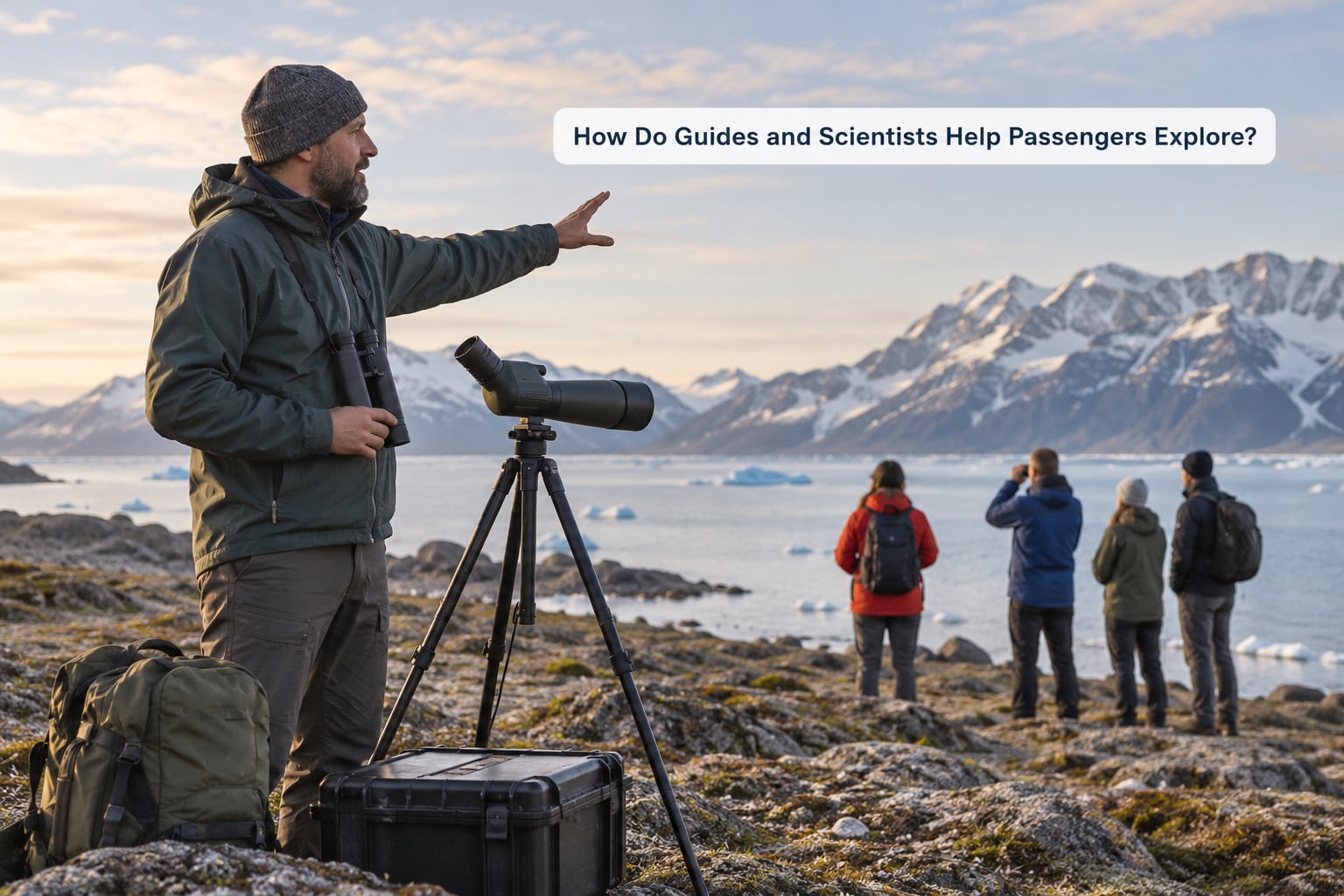
The expedition team is the reason this is not just a boat trip. A voyage typically carries a mix of naturalists, an ornithologist, a geologist, a historian, a marine biologist and photographers, sometimes twenty or more specialists on a ship of a hundred guests.
Everyone has two jobs. The first is the briefing and the shore programme: what you are looking at, why this particular colony breeds here, what changed in the ice since last year. The second is citizen science, and it is genuinely used. Guests help count seals from a distance, record bird sightings, take water samples and log microplastics under a scientist’s protocol, and the data goes to real monitoring programmes.
Naturalists eat in the dining room and come back with you from landings, which is unusual on any cruise ship and is the detail guests mention most often when they explain why the premium felt worth it. You cannot avoid them, and you stop wanting to.
What a guide actually does on a landing
Before anyone steps off, the guide checks the ground, the swell at the landing point and the group composition. Someone who cannot manage the step boards a stable tender boat and watches from the water, and nobody makes a fuss about it.
On the beach the guide sets the boundary, counts the group, watches for animals, and walks backward while talking so nobody gets left behind. Polar bear protocol in the Arctic is stricter still: armed guides, a strict no-food rule, and a head count that does not get relaxed because it is raining.
What Are the Safety and Environmental Challenges?
Expedition cruising is well regulated and generally conservative, but it is not risk-free and it is not riskless in the way a resort is.
Medical evacuation. The real risk in a remote region is not the wildlife, it is a medical event far from a hospital. Crew carry advanced first aid, ships carry doctors on most polar itineraries, and every vessel has a medevac plan that usually means launching a lifeboat to meet a helicopter or transferring to a responding vessel. Insurance that covers expedition travel is worth reading carefully, because standard travel policies often exclude it.
Weather exposure. Guests spend real time in cold, wet and windy conditions, on boats and on shore. Hypothermia is the genuine medical risk on an Antarctic landing, which is why gear-up is mandatory, supervised and taken seriously.
Small-boat operations. Zodiac boarding at sea is the most accident-prone moment of the trip. Lifjackets are worn for every ride, boarding is one at a time, and crews count passengers before and after.
Wildlife disturbance. Rules are blunt. Guests keep a distance from colonies, do not walk through nesting areas, do not approach polar bears, and remove organic material before landing in some jurisdictions. Biosecurity rules are increasingly strict, with boot checks and vacuuming of outer layers for arriving visitors.
Carbon footprint. Small vessels burn more fuel per passenger than large ones, and most operators have moved to heavy fuel oil reductions and banned single-use plastics. The honest summary is that this style of travel has a larger footprint per person than a big ship visiting Mediterranean ports, offset partly by the fact that it goes places few people would otherwise reach.
How Much Do Expedition Cruises Cost?
Expedition cruises sit at the expensive end of cruising, often several times the per-day rate of a mainline ship. Since fares move constantly, treat any figure you find as a dated estimate rather than a promise, and check what the operator quotes for your specific sailing.
Here is what drives the number:
- Vessel size and crew ratio. More crew per guest is the core cost, and it is non-negotiable in the operation.
- Ice class and spec. A reinforced hull, shallow draft and polar equipment cost more to build and maintain.
- Fuel and distance. Long repositioning legs to remote gateways are a large share of the total.
- Port fees, permits and park levies. These vary hugely by territory and are often charged per passenger, per landing and per site.
- Season and demand. Peak wildlife and penguin-chick windows fill first.
- Inclusions. The single biggest factor, and the one to read line by line.
What is normally inside the fare, and what usually is not:
| Usually included | Usually an extra cost |
|---|---|
| Cabin and all meals onboard | Expedition or port fee charged per day |
| Zodiac transfers to and from the vessel | Sea kayaking, paddle sessions |
| Guided shore landings with the expedition team | Submersible or helicopter excursions |
| Guided briefings and evening lectures | Pre- and post-cruise hotel nights |
| Loan of cold-weather gear on polar voyages | Premium dining, wine and gratuities |
| Shore excursions listed in the itinerary | Private zodiac charters and drone use |
The value question people actually ask is worth answering honestly. You are paying for access, small numbers, guiding staff and the fact that most landing sites have daily visitor caps that small vessels respect and big ones cannot. Whether that is worth the premium depends entirely on how much time you spend ashore.
Who Is an Expedition Cruise Best For?
Expedition cruising rewards a specific temperament. You will enjoy it if you want guided time on the ground several times a day, you are comfortable with plans changing at breakfast, and you would rather have one naturalist who becomes a friend than forty facilities.
It suits older travellers who like to travel without walking distances from a liner, and it is one of the easier cruise formats for travellers who get seasick, because stabilisers and small-hull motion suit many stomachs better than a large open-ocean deck. Solo travellers also report that a small vessel removes the usual awkwardness; everyone knows everyone by day two.
Children are welcome on many itineraries with a minimum age, often eight or so, which makes polar voyages workable for families who want a trip together rather than a nursery programme.
Now the harder version. If you want a pool, a buffet, evening entertainment, a large spa and a fixed port every morning, you will be disappointed by a quiet ship of eighty guests with one dining room. Very limited mobility deserves a call to the operator before booking, because boarding and the standard landings need a level of balance that some travellers do not have; you can still join the voyage and stay aboard, but you should know that in advance.
My honest advice for a first-timer is to start shorter and closer. A week in the Arctic, Iceland or Alaska shoulder season gives you the whole format with far less time committed, and it is a much better test than a two-week crossing to a continent.
Frequently Asked Questions
What is the difference between an expedition cruise and a regular cruise?
A regular cruise is a large ship visiting built ports on a fixed schedule. An expedition cruise uses a small, ice-capable vessel with shallow draft, fewer than a couple of hundred guests, and an onboard team of specialists. Guests go ashore by Zodiac rather than at a pier, and the daily plan changes with weather, ice and wildlife instead of following a published timetable.
Why are expedition cruises more expensive per day?
The premium buys reach and staff. Ice-capable hulls, shallow draft, several inflatables per ship, a crew-to-guest ratio weighted to naturalists and expedition leaders, and long repositioning legs to remote gateways all cost more. So do port fees and permits, which vary by territory and are often charged per passenger and per landing.
What happens if the weather cancels a shore landing?
The landing is dropped, not refunded, because the fare assumes weather will win some days and no excursion is sold as guaranteed. The ship usually repositions, the team runs alternative activities such as longer zodiac cruises or lectures, and the itinerary is rebuilt at the morning briefing. Leave a couple of spare days either side if you have fixed plans after landing.
Do I need to be physically fit to go on an expedition cruise?
You need balance and a reasonable level of mobility, not fitness. Standard landings involve stepping down into a tender or a Zodiac that rocks, then walking on uneven ground. Guests who cannot manage that are not required to land and can wait aboard the ship or sit out in a stable tender boat, though they should raise it with the operator before booking. Solo travellers over seventy travel on these ships routinely.
Will I get seasick on a small expedition ship?
Motion is more noticeable on a small vessel, and there is no single trustworthy percentage for how many guests get seasick. Practical advice: book a midship cabin on the lowest available deck, stay near the stabilisers, get fresh air on deck early, and take medication before the rough crossing rather than after symptoms start. Drake Passage crossings bother some people for a day or two.
Can I work or get reliable internet on an expedition cruise?
Barely. Satellite broadband, including Starlink on some newer and refitted vessels, makes email and messaging usable but far slower and pricier than a hotel. Coverage drops in high latitudes and disappears entirely in places. Treat it as a chance to disconnect rather than a plan to take calls at sea.
If you only remember one thing, remember this: the ship is the base camp and the landings are the trip. Book for the shore time, read the inclusions line by line, and build a spare day into either end of the itinerary. Then let the expedition leader change the plan when the weather says so.