Flying west means your day gets longer, and the fix is a phase delay: go to bed later, get bright light later, and eat on the destination clock. Most of the work happens before you leave the house, but the plan below covers the whole trip, from three days out to your first night on the ground. In practice, that is how to avoid jet lag flying west without spending half your trip staring at the ceiling at 4 AM.
Here is the short version. In the days before departure you move your bedtime later by roughly an hour a day. On the day you fly you switch your watch to destination time and stop thinking in home time entirely. After landing you chase daylight late in the local afternoon, eat on local hours, and hold out for local bedtime even if you feel wrecked. Light does most of the work. Everything else just stops you from fighting it.
Table of Contents
- 1What You Need
- 2Step-by-Step: How to Avoid Jet Lag Flying West in 8 Steps
- 3Step 1: Map Your Time-Zone Difference
- 4Step 2: Shift Your Sleep Gradually
- 5Step 3: Use Light at the Right Time (the Strongest Lever for How to Avoid Jet Lag Flying West)
- 6Step 4: Time Meals and Caffeine to Destination Time
- 7Step 5: Protect Sleep During the Flight
- 8Step 6: Prepare Your Body and Environment for Arrival
- 9Step 7: Follow Local Clocks Immediately
- 10Step 8: Avoid Overcorrecting After Landing
- 11Common Mistakes
- 12Frequently Asked Questions
- 13Should I stay awake during a westbound flight?
- 14When should I get sunlight after flying west?
- 15Can melatonin help prevent westbound jet lag?
- 16How do I adjust when a westbound trip has only one or two time zones?
- 17How long does westbound jet lag usually last?
- 18Conclusion: Start With Your First Light Exposure
What You Need
None of this needs a gadget budget. It needs a few facts about your trip and a handful of ordinary items.
- Your departure and arrival local times. Write both down. The arrival local time is the number every other decision hangs on.
- Your current sleep schedule. Actual bedtime, actual wake time, and how consistent they are during the week.
- A watch or phone set to destination time. Change it before you board, not when you land.
- An eye mask and earplugs. Block light and cabin noise so you can actually sleep in the dark hours.
- A water bottle you can refill. Refill rather than downing a bottle at once.
- A light-blocking option for the flight. The eye mask covers this, or wear an eye shade if you prefer.
Optional but useful: a jet lag planner app that generates a light and meal schedule for your exact route, and a night or warm-light mode on your phone so late-night scrolling does not undo your work.
Step-by-Step: How to Avoid Jet Lag Flying West in 8 Steps
Step 1: Map Your Time-Zone Difference
Count the zones you are crossing and divide by one. That gives you roughly how many days your body needs to catch up, and it is a useful expectation setter rather than a rule.
A route with one or two zones usually needs nothing more than a good first night’s sleep. Three to five zones is where a real shift starts. Six or more, such as the US West Coast to Asia or a transatlantic westward crossing, is a genuine phase delay and deserves the full plan.
Keep a written version of the plan in the destination time. Once you have your start time, end time, and target bedtime, the rest of the steps are just checkboxes against those numbers.
Step 2: Shift Your Sleep Gradually
Move bedtime later by 30 to 60 minutes a day for the two or three days before departure. Waking time stays fixed, so the window between them shortens gently instead of you suddenly losing three hours of sleep.
Anchors help. Bright light in the evening on the days you shift, a workout in the late afternoon rather than at dawn, and normal caffeine habits instead of a jump to double espresso to force an early night.
How do you know it is working? You are falling asleep within about 20 minutes of lying down, and getting up without an alarm. You are not trying to starve or deprive yourself of sleep to force the shift. If you are sleeping five hours a night and dragging yourself through the day, the phase delay will cost you more than it gives.
Step 3: Use Light at the Right Time (the Strongest Lever for How to Avoid Jet Lag Flying West)
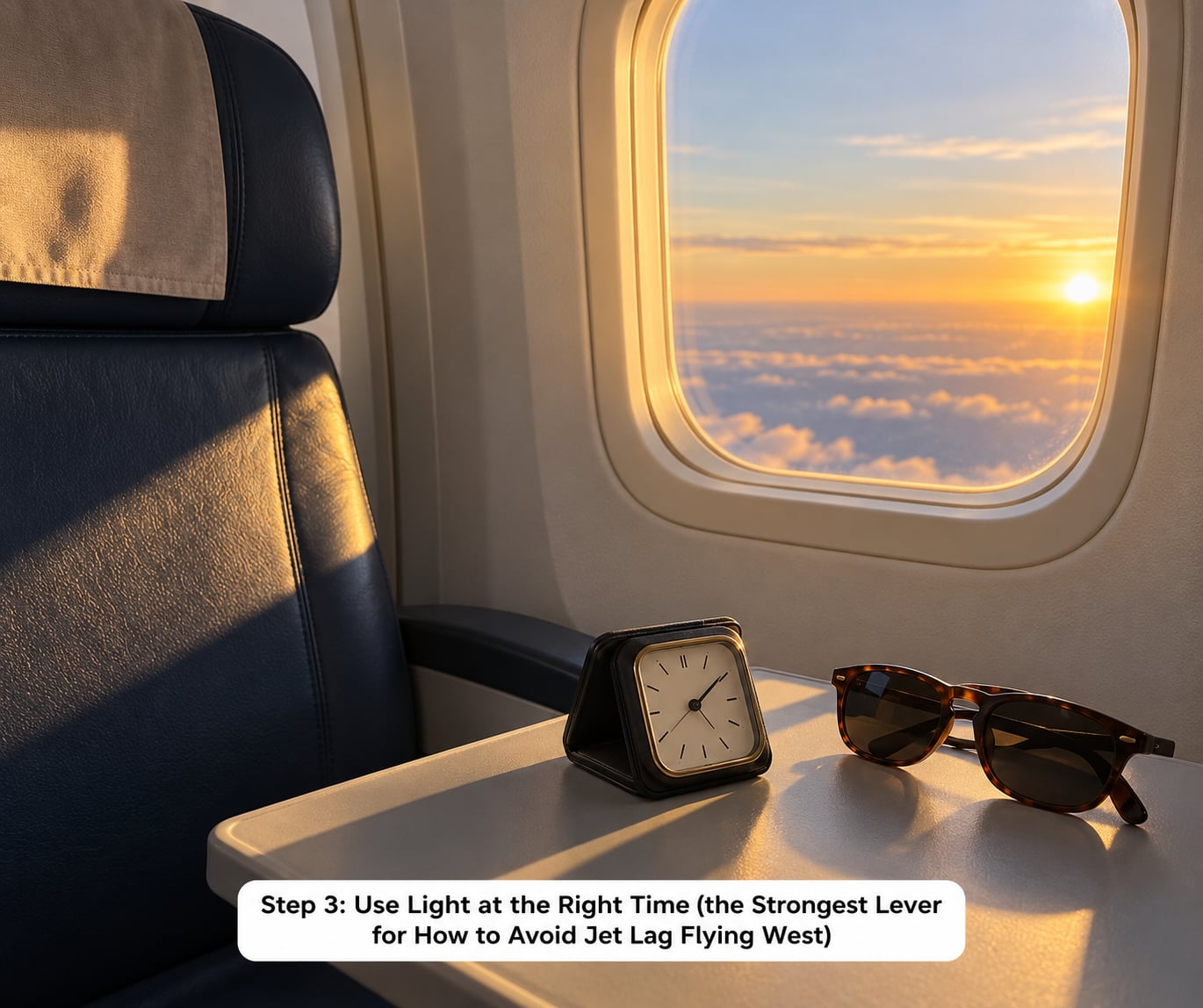
Light is the single strongest signal your body uses to set its clock. Westward travel needs light later in the day, and darkness later in the day. It sounds backwards because the sun comes up in the same place regardless of your schedule, but the principle holds: you are trying to delay the body clock, so you reinforce the later hours.
Before travel, look for daylight late in the afternoon and into the evening. An outdoor walk around 6 PM does more than an hour under office lighting. On arrival, get outside in the local late afternoon. Even twenty minutes of outdoor light around 4 to 5 PM local time is more useful than two hours of indoor light, so a walk to dinner beats sitting in a hotel room scrolling.
Then protect the darkness. When your destination bedtime arrives, the room goes dark: eye mask on the plane, blackout curtains and a phone in night mode at the hotel. Phase delay works in both directions. Bright light when you need to wake up, darkness when you need to sleep.
Step 4: Time Meals and Caffeine to Destination Time
Eat on the destination clock from the day you land, and ideally from the moment you board. Stomach timing is a weaker signal than light, but it reinforces the same schedule and it stops you from finishing dinner at 2 PM and then wondering why you cannot sleep.
In destination terms, a typical day looks like this: breakfast when it is morning where you landed, a normal lunch at midday local, and dinner at local dinner time even if your body is not hungry yet. Skip heavy food when your digestion is off and eat lighter instead of forcing a full meal.
Coffee gets a cutoff about eight hours before your target bedtime. On a flight that lands mid-afternoon, that usually means no caffeine after your morning cup at home. Many experienced travelers keep a hard rule of nothing but water after the second half of the flight. Alcohol is worth skipping entirely: it fragments sleep in a room that is already unfamiliar, and it makes dehydration harder.
One example makes this click. Boston to Los Angeles, leaving at 6 PM and arriving at 9 PM local. Your watch changes at boarding. No coffee after noon home time. Dinner at whatever the airline serves. On the plane, your destination-time bedtime has already passed, so the plan is a short nap only, then straight into local evening and lights out at 10 to 11 PM.
Step 5: Protect Sleep During the Flight
Decide your destination-time sleep window before you board, because the window, not your home-time habits, decides when you close your eyes. If local bedtime falls while you are over the Atlantic, that stretch of the flight is your sleep opportunity. If local bedtime falls after you land, use the flight for light and alertness and save the nap for arrival.
Set two alarms if you plan to sleep: one at the end of your nap window and one about 15 minutes before your destination wake time. Sleep often will not arrive on a plane, so build the plan so that drifting in and out still leaves you awake for the part of the flight that matters.
The setup matters more than people expect. Eye mask, earplugs or noise-cancelling headphones, a reclined seat with the headrest positioned if your neck tolerates it, loose clothing, and feet propped up on the seat in front when there is room. Ask for an aisle seat if you plan to walk during your window.
Step 6: Prepare Your Body and Environment for Arrival
Water is the easy part. Drink steadily through the flight and after landing, and expect more bathroom trips than usual. Movement helps too: short walks every couple of hours, and a proper stretch after landing. A workout early in the local day helps the sleep signal later at night.
Clothing is a small detail with a real payoff. Loose layers, slip-on shoes, and a change of clothes for the arrival night. You want to be comfortable for a bad night’s sleep in a bed that is not yours yet.
Plan the arrival logistics before you land. When is your destination-time bedtime? How long does it take to get to the hotel, to get food, to shower? Do you need an alarm for the local morning? Book the first night with blackout curtains in mind, keep the room cool, and turn off the phone’s brightness before bed. If you take any medication regularly, ask your doctor or pharmacist about timing before you travel, and talk to a doctor before the trip if you have a condition that travel can complicate.
Step 7: Follow Local Clocks Immediately
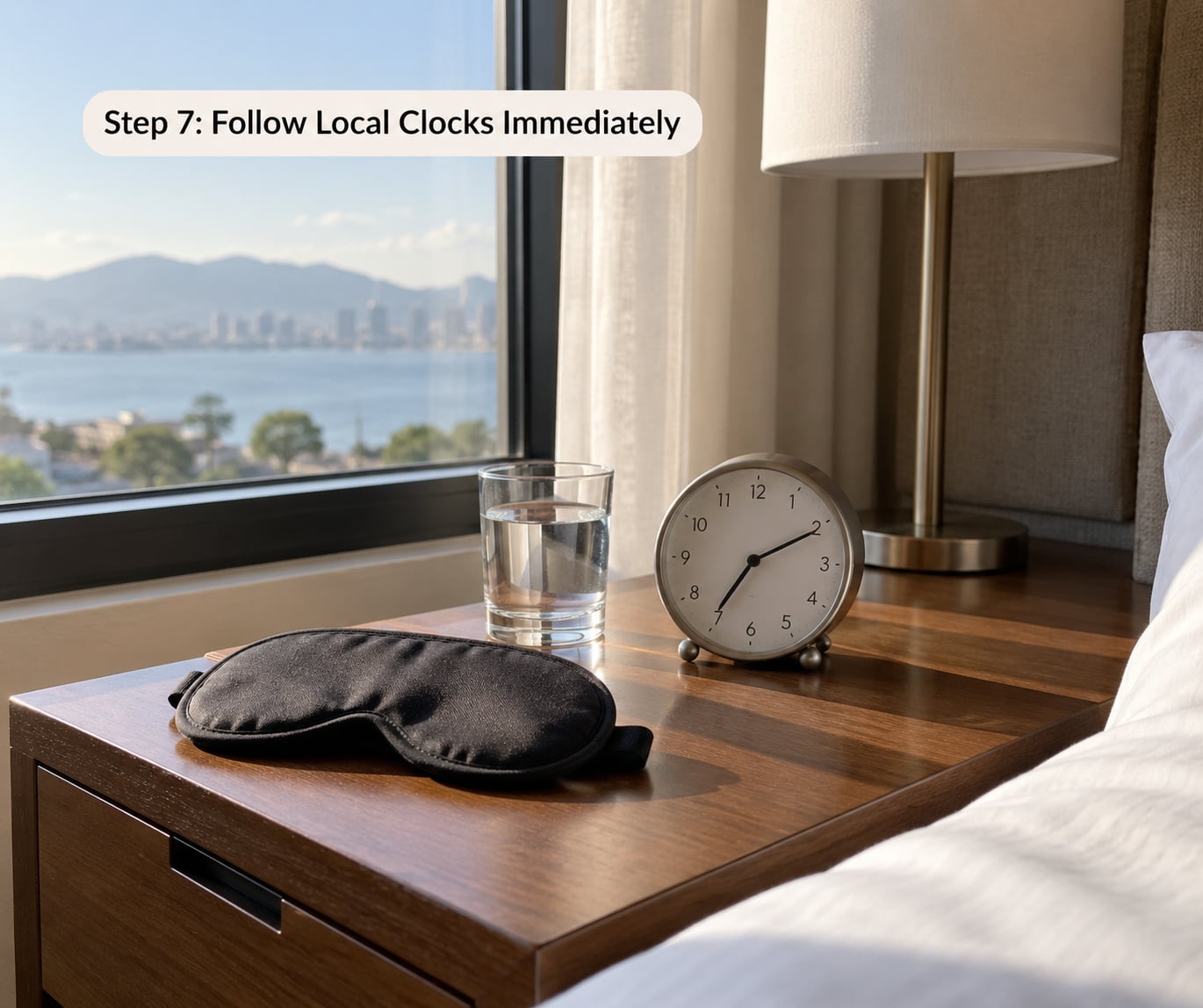
Arrival day runs on local hours from the moment the door opens. Wake at local wake time, even on a bad night. Get outside within an hour of waking if the morning is clear, and again in the late afternoon.
Eat three meals on local hours. If you are exhausted, eat less rather than skip the meal entirely, since meal timing is part of the signal you are trying to shift.
Nap with an alarm and a ceiling. Twenty to 30 minutes, before mid-afternoon, in a chair or fully dressed. A short strategic nap is a useful top-up; a long daytime sleep is how you land on local bedtime wide awake at 9 PM and then reset the whole schedule in the wrong direction.
How do you know it is working? Sleep comes easier on night two than on night one, and getting up becomes automatic rather than an alarm fight. If night three feels identical to night one, check your light timing and your meal hours before anything else.
Step 8: Avoid Overcorrecting After Landing
Hold the local routine for two or three days. That means the same wake time, the same outdoor light window, and the same local bedtime, even on a day when a late night would be more fun.
The usual overcorrections are predictable. A long afternoon nap when you are tired but not sleepy. Alcohol at dinner because everyone else is ordering it. Staying up until 2 AM because your friends are awake in their local time. Each one pushes your clock back toward home time and buys you another day of recovery.
Most people feel functional within a day or two and close to normal by day three or four on a long westward route. If symptoms are severe, if you cannot sleep for several nights in a row, or if you feel disoriented or unwell in a way that worries you, contact a doctor. Get medical advice before the trip as well if you have heart, seizure, or blood-clot history, and talk to a doctor or pharmacist about anything you plan to take for sleep on board.
Common Mistakes
Most westward jet lag is self-inflicted in one of six ways, and each one has a straightforward correction.
- Staying on home time too long. Keeping your phone, meals, and bed on home time for the first day means you start the clock shift after your body is already exhausted. Change everything to local time on arrival day.
- Using light at the wrong hours. Morning sunlight is an advance signal and works against a westward phase delay. Save the big light exposure for late afternoon and evening.
- Relying on caffeine to hold you up. Coffee fixes the hour and wrecks the night. Cut off eight hours before target bedtime instead of stacking cups.
- Sleeping through the entire destination day. Napping for three hours at 2 PM guarantees you are awake at local 9 PM. Cap naps at about 30 minutes.
- Drinking alcohol to force sleep. Alcohol shortens the time to fall asleep and wrecks sleep quality afterwards, which is the opposite of what you need in a strange bed.
- Assuming a supplement solves it. Melatonin can help you fall asleep on local schedule, and travelers report it works better taken at the right hour than at a large dose. It does not shift your clock on its own, and dosing is a question for a doctor or pharmacist.
A few final tips. Book the first night with a request for a dark, quiet room. Turn on night mode across your devices the moment local bedtime hits. Skip the first-morning alarm fight by setting your wake time two days out and sticking to it. And if the trip is under three days, the honest answer is often to stay on home time for the first day and shift once you get home, rather than paying for a full adjustment you will not enjoy.
Frequently Asked Questions
Should I stay awake during a westbound flight?
It depends entirely on what your destination-time bedtime looks like. If local bedtime falls while you are in the air, sleep through that window and set two alarms so you wake before local morning. If you land before local bedtime, stay awake, eat a proper evening meal on local hours, and hold out until local night. Sleeping through a whole local day is the mistake that costs you the trip.
When should I get sunlight after flying west?
Aim for outdoor light in the late afternoon, roughly three to five hours before your target local bedtime, and a shorter exposure early in the local morning. Avoid heavy bright light early in your local day, because morning light pulls the clock earlier and works against the westward delay. Twenty minutes outside beats a couple of hours under indoor lighting.
Can melatonin help prevent westbound jet lag?
Melatonin helps with the timing of falling asleep rather than resetting your internal clock, so it works best taken a few hours before local bedtime and paired with a dark room. Many travelers find low doses sufficient and ask a doctor or pharmacist what is right for them, especially if you take other medications. On its own it will not shift your circadian rhythm.
How do I adjust when a westbound trip has only one or two time zones?
One or two zones rarely needs a formal plan. Keep your normal sleep window, set your watch to local time on arrival, eat on local hours, and get outside during the local day. If you are sensitive, use the late-afternoon light rule on arrival and hold out for local bedtime the first night. You will usually feel normal within a day.
How long does westbound jet lag usually last?
One day per time zone crossed is the rule of thumb, so a three-zone flight lands you functional the next day and a six-zone flight takes three to four. Sleeping badly on night one is normal and does not mean you have done something wrong. If you are still badly disrupted after four or five days, review your light timing and meal hours.
Conclusion: Start With Your First Light Exposure
If you only remember four things: count the zones, start moving bedtime later a few days out, get outdoor light in the local late afternoon, and eat and sleep on local hours from the moment you land. That is the core of how to avoid jet lag flying west, and the rest is just details that make it easier to stick to.