Yes, a full week fits in a carry-on, and the trick is planning outfits before you touch the bag. Most people overpack because they pack seven days of separate outfits instead of a small set of pieces that mix and match. If you build the wardrobe first, pack the bulkiest items on your body, and fill every gap deliberately, a seven-night trip closes with room left over.
The method below takes about 40 minutes once you have the clothes chosen. It is the routine I use on any trip of four nights or longer, and it works whether you are flying a budget line with a strict 7 kg cabin limit or a full-service carrier with a roomy overhead bin.
Table of Contents
- 1What You Need
- 2Step-by-Step: How to Pack a Carry-On for a Week-Long Trip
- 3Step 1: Choose a Seven-Day Outfit Plan
- 4Step 2: Organize Clothes With Packing Cubes
- 5Step 3: Pack Shoes and Bulky Items Smartly
- 6Step 4: Pack Liquids and Toiletries Correctly
- 7Step 5: Add Travel-Tech and Personal Items
- 8Step 6: Fill Empty Space Without Overpacking
- 9Step 7: Do a Final Airline and Access Check
- 10Common Mistakes
- 11Frequently Asked Questions
- 12How many days of clothes fit in a carry-on for one week?
- 13Can I pack a week of laundry in a carry-on?
- 14What is the best way to pack shoes in a carry-on?
- 15What size bag counts as a carry-on?
- 16Can I bring full-size toiletries in my carry-on?
- 17How should I pack a carry-on for a hot or cold destination?
- 18Conclusion
What You Need
Before packing anything, gather four groups of items: the bag itself, travel documents, the clothing and toiletries, and a short list of optional tools. Laying them out on the bed or the floor turns a chaotic pile into a countable list.
Start with the carry-on bag. A 20-inch roller or a 35 to 40 liter soft bag is the sweet spot for a week. Anything larger makes you a candidate for a gate check, and anything smaller turns the trip into a laundry challenge.
Next come your documents: passport or ID, boarding pass, travel insurance details, accommodation confirmations, and any visas or health paperwork your destination requires. Keep these in your personal item rather than in the roller, because that bag is the one you can reach without opening anything.
Then the clothing and toiletries. Lay out every candidate piece, including the ones you are only packing as a maybe. The maybe items are usually the first things to go.
Optional tools earn their place in a small way. A set of packing cubes, a refillable water bottle emptied before security, a laundry bag for dirty clothes, a small steamer or wrinkle-release spray, and a portable phone charger all fit in spaces you would otherwise leave empty.
One warning before you start: size and liquid rules are not universal. Cabin bag dimensions, weight limits, and what counts as a liquid all vary by airline and by country, so check the specific policy for every leg of your trip.
Step-by-Step: How to Pack a Carry-On for a Week-Long Trip
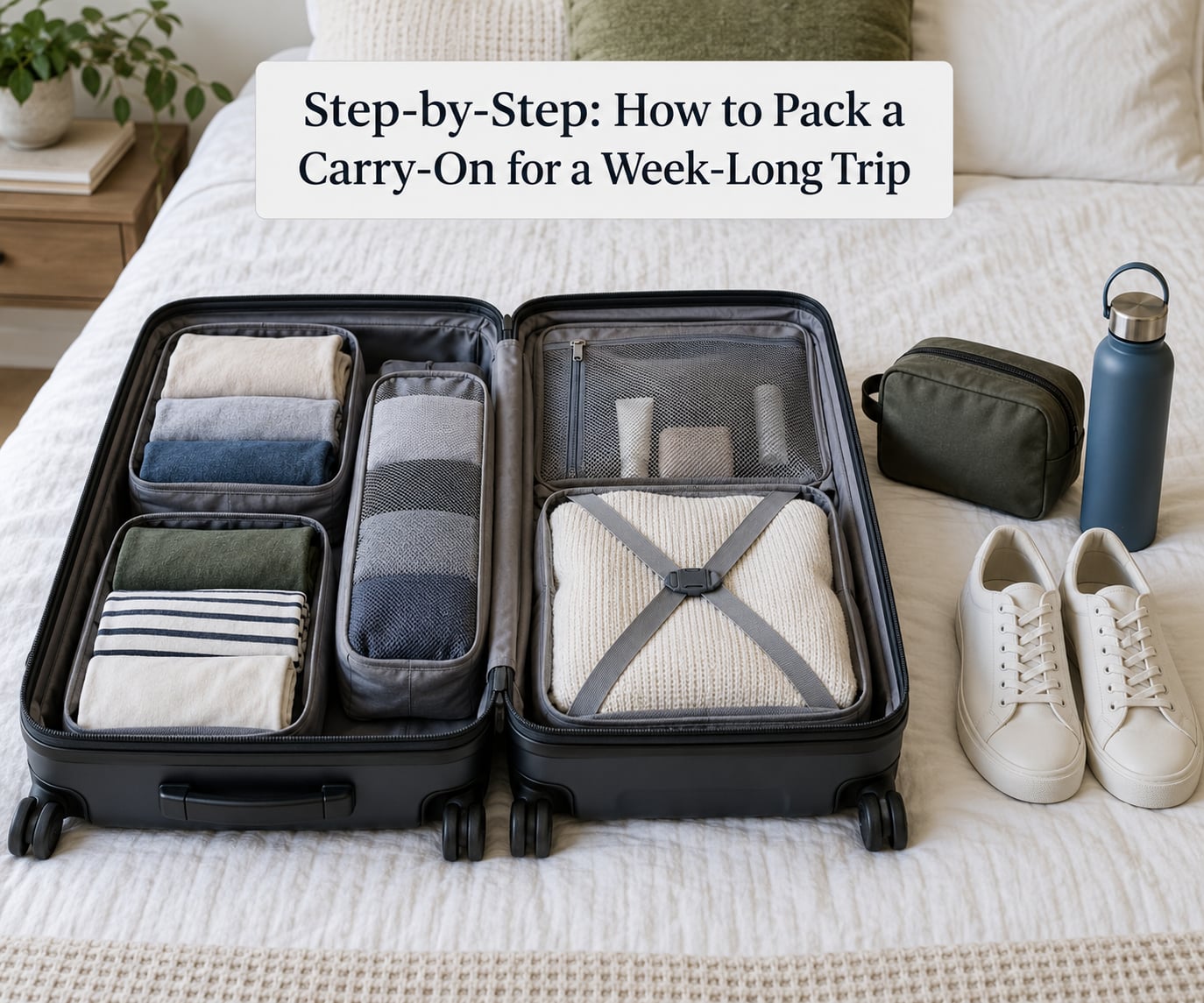
Step 1: Choose a Seven-Day Outfit Plan
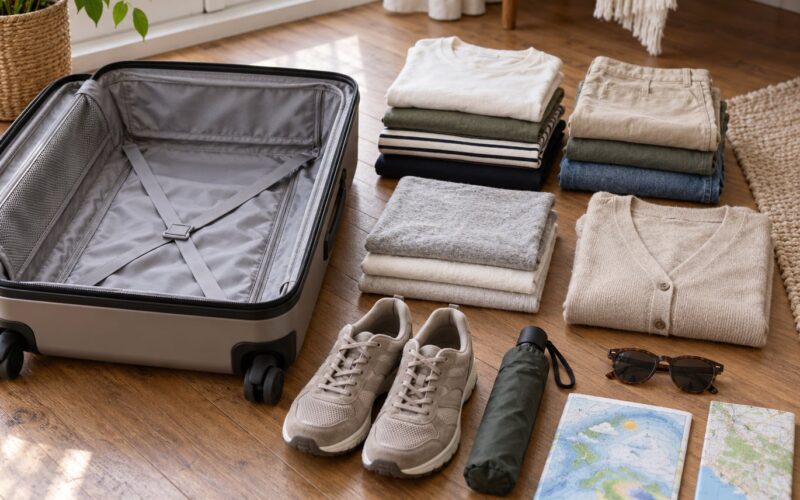
Pick your clothes first, then build around them. A simple formula that most week-long trips run on is 5-4-3-2-1: five tops, four bottoms, three underwear, two pairs of shoes, and one extra layer. That is roughly 15 clothing pieces, and because everything coordinates, they make far more than seven outfits.
Colour does most of the work. Pick one neutral base (black, navy, beige) and one accent you actually like wearing, then keep every piece inside that palette. A white tee, a striped tee and a plain tee in two colours pair with all four bottoms without a single “nothing to wear” morning.
Fabric matters as much as colour. Wrinkle-resistant, quick-dry and lightweight materials buy you back the space a heavier fabric uses, and they dry fast if you wash something mid-trip. Thick denim and heavy cotton jumpers are fine to wear in transit and poor choices inside the bag.
Before you commit, run the mix-and-match test on paper: draw your five tops down one side and your four bottoms across the top. Any square you cannot picture wearing for two hours is a piece that should stay home.
- Day 1: the travel outfit, worn on the plane.
- Day 2: top 1 plus bottom 1, with the layer for cool evenings.
- Day 3: top 2 plus bottom 2, layer left at the hotel.
- Day 4: top 3 plus bottom 1 with the second pair of shoes.
- Day 5: top 4 plus bottom 3, repeating the Day 2 palette on purpose.
- Day 6: top 5 plus bottom 4, with laundry worn in the evening.
- Day 7: fresh underwear and socks plus the travel outfit.
That seven-day run is the proof the list works. Fifteen pieces, zero shopping.
Step 2: Organize Clothes With Packing Cubes
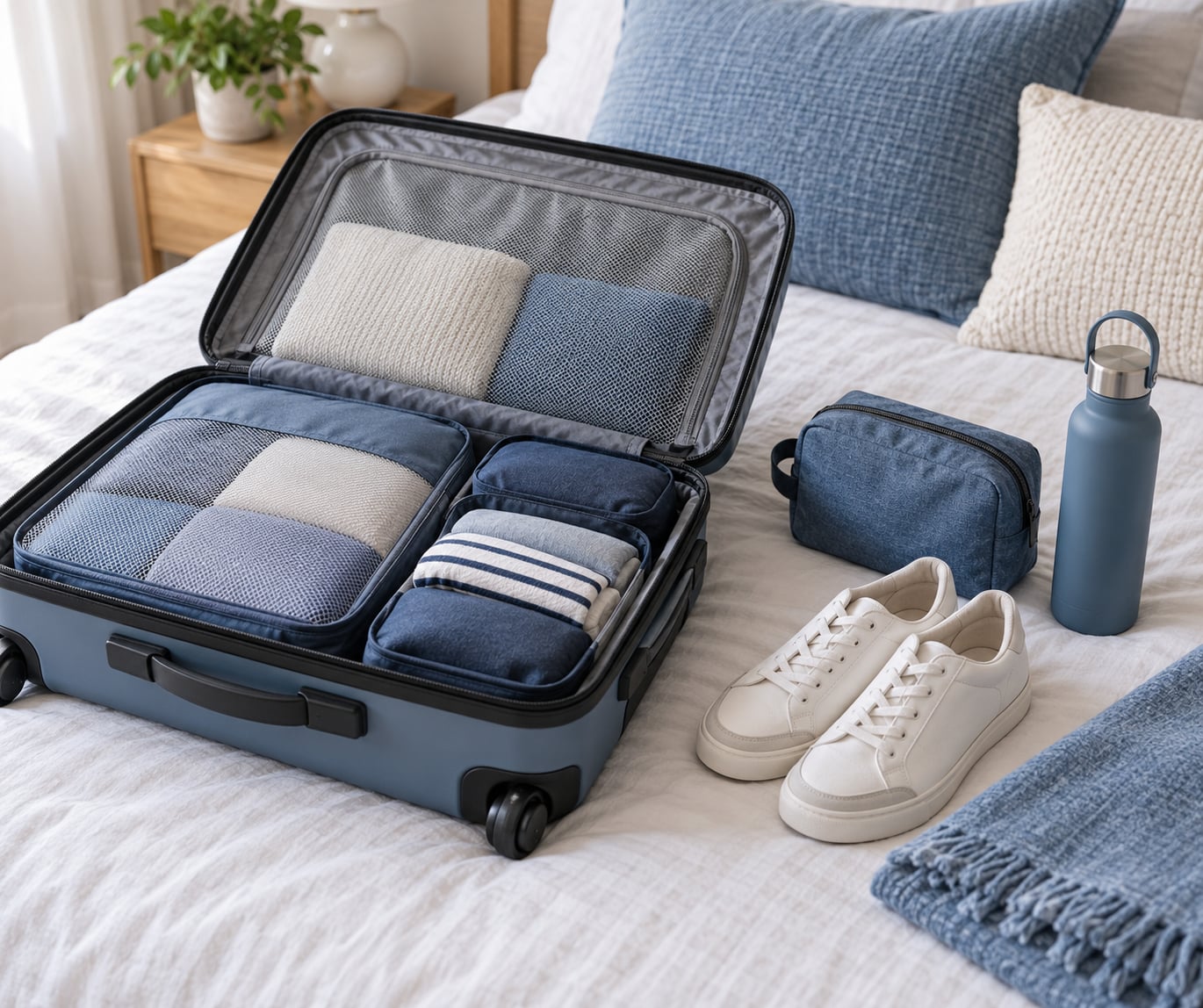
Group clothes by type or by outfit, not by size. One cube for tops, one for bottoms and layers, one for underwear and socks. Labelling them takes five seconds and saves you unpacking the whole bag in a dark hotel room at midnight.
Compression cubes help with bulky soft items like sweaters and jackets, but they are less useful for structured clothing. A rolled shirt inside a compressed cube comes out with a crease down the middle, so use compression where there is loft to remove and skip it where there is structure to flatten.
Put the cube you will need first at the top of the bag. If the flight is long or you land at an odd hour, you want the sleepwear and the fresh underwear reachable without repacking everything.
Step 3: Pack Shoes and Bulky Items Smartly
Limit yourself to two pairs of shoes, and only wear one of them. Bulky jackets, jeans and boots go on your body, not in the bag, which is where most of the saved space comes from.
Pack each pair inside a dust bag or a heavy sock, then use the shoe itself as a container for small items. Socks, underwear and chargers nest into the toe box and the heel without taking separate space.
Build your bag from the wheel end upward. Shoes and the densest items go against the wheels so the bag rolls properly, then clothing layers on top, then the softest and least frequently used items near the lid. You will know the layering worked if the bag closes without anyone sitting on it.
Step 4: Pack Liquids and Toiletries Correctly
Check the airline’s liquid rule for each flight before you decant anything. In the United States the TSA rule is 3-1-1: containers of 100 ml (3.4 oz) or less, one quart-sized clear bag, one bag per passenger. Most other countries use a similar 100 ml limit in a single transparent bag, but not all of them, and rules at connections can differ.
Pour your everyday products into refillable travel bottles rather than buying throwaway minis. Transferring is a two-minute job the night before and it saves the decanted mess going into a plastic bag at security.
Makeup works differently. Powder, lipstick and solid mascara stay outside the liquid rules, while foundation, mascara and cream blush count as liquids at 100 ml or less. Solid shampoo and conditioner bars are the easiest swap for anyone travelling carry-on only.
Step 5: Add Travel-Tech and Personal Items
Run a short tech checklist: phone charger, plug adapter for your destination, power bank, headphones, glasses, and a watch strap if you have one. A power bank travels in the cabin rather than the checked hold, and you still fly with it in your personal item.
Keep medication in your personal item, in the original labelled packaging, with enough supply for a couple of days beyond your return. It is the one category where the “just buy it there” logic does not apply.
Valuables stay on your body or in the personal item: passport, wallet, phone, camera, keys. Fill the underseat bag rather than the roller, because the roller may be pulled down into a hold on a full flight.
Step 6: Fill Empty Space Without Overpacking
The leftover room in a well-packed bag is not wasted space, it is where the flexible items go: a light jacket, a reusable shopping bag, a folded laundry bag, or a soft scarf. Small gaps are ideal for rolled socks and chargers.
The rule is simple: never force the zip closed. A bag that only shuts under pressure is the bag that gets weighed at the gate and charged, and overfilling also crushes the clothes you worked to organise.
If you still have real space left, you have overpacked by two or three items. Take them out rather than finding that out at the airport.
Step 7: Do a Final Airline and Access Check
Many airlines measure cabin bags against a baseline of 56 x 45 x 25 cm including wheels and handles, and the low-cost carriers are often stricter than that. Weight limits commonly sit somewhere between 7 and 10 kg, so weigh the bag at home if yours is strict.
Do a last sweep: liquids sealed in the clear bag, no sharp or restricted items in the cabin, medication where you can reach it, and the personal item closed but not overstuffed.
Stand the packed bag upright and check that it closes without a struggle, then walk it a few steps. A bag that drags behind you usually has the weight in the wrong place, and moving it to the wheel end usually fixes it.
Common Mistakes
- Packing a separate outfit for every day. The fix: build a small palette instead. Fifteen coordinated pieces make more combinations than seven planned outfits, and they take half the space.
- Wearing a cotton hoodie and packing jeans. Dense cotton and denim are the fastest way to hit an overweight bag. Wear the heavy knit and pack one lighter alternative.
- Packing shoes loosely or bare. Unprotected soles pick up dirt and scuff everything they touch. One dust bag or one sock per pair costs nothing and protects the whole bag.
- Ignoring the airline policy until the airport. Size and weight rules change by carrier and even by fare. Ten minutes in the airline’s baggage page saves a gate-check fee.
- Burying essentials at the bottom. Phone charger, passport, medication and one change of underwear belong in the personal item or the top cube, not under the shoes.
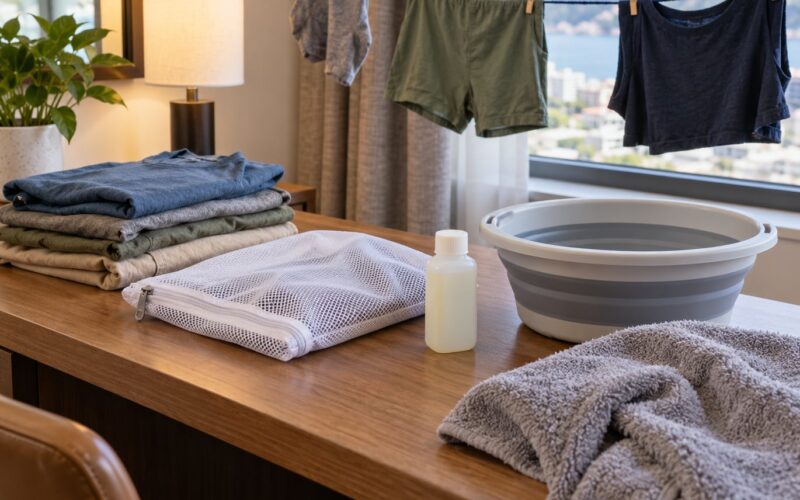
Two habits smooth the rest. Pack three to four days ahead and do one practice pack, which is the single change that most reliably reduces how much people throw in at the last minute. And use the hotel laundry once mid-trip: rewear the outfit from your first or second day in the evening, wash it overnight, and it is clean and dry by morning.
A bag zipped the night before also stops the creep. Anything added in the morning is usually something you bought at home out of panic, and half the time you leave it behind anyway.
Frequently Asked Questions
How many days of clothes fit in a carry-on for one week?
Seven days fits comfortably using roughly 15 clothing pieces: five tops, four bottoms, three underwear, two pairs of shoes and one extra layer, as long as everything coordinates. Plan the outfits first and pack the bulkiest items on your body. A 20-inch roller or a 35 to 40 litre soft bag holds that list with space to spare.
Can I pack a week of laundry in a carry-on?
You can, but you do not have to. Reuse underwear and socks by storing them in a separate pouch or packing cube so you keep unused ones clean, and rewear two outfits in the evening. Washing a couple of items in a hotel sink or machine extends the same list to ten days. Bring detergent sheets and a folding laundry bag.
What is the best way to pack shoes in a carry-on?
Limit yourself to two pairs and wear the bulkier one in transit. Put each pair in a dust bag or a thick sock, then fill the empty toe box and heel with socks, underwear or chargers. Place shoes at the wheel end of the bag so the weight sits low and the bag still rolls upright through the terminal.
What size bag counts as a carry-on?
Most airlines measure against a baseline of 56 x 45 x 25 cm including wheels and handles, and many budget carriers set a stricter limit of their own. A 20-inch roller or a 35 to 40 litre soft bag sits comfortably inside that. Weight caps commonly fall between 7 and 10 kg, so check both numbers for every leg of your trip.
Can I bring full-size toiletries in my carry-on?
Only in containers of 100 ml (3.4 oz) or less, packed in a single transparent bag. In the United States the TSA rule is 3-1-1: three containers or less, 100 ml each, in one quart-sized bag. Most other countries apply a similar rule, but check the airline and the departure airport before you decant anything.
How should I pack a carry-on for a hot or cold destination?
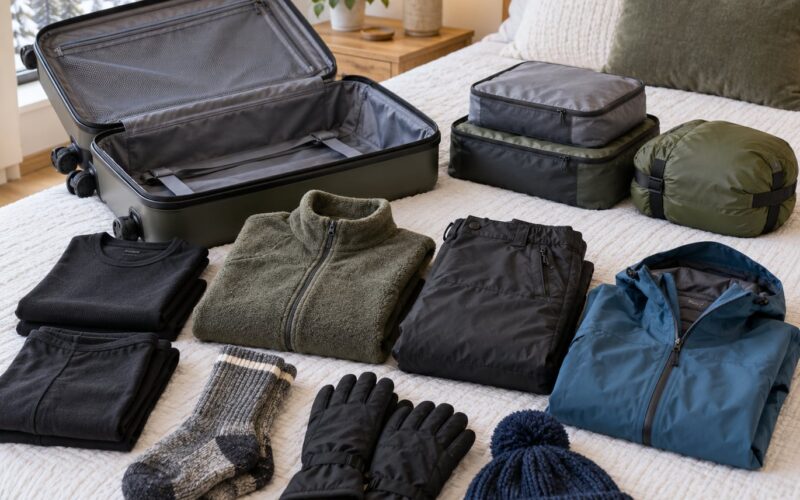
For hot weather, swap a pair of trousers for shorts and lightweight quick-dry fabrics, and always keep one light layer for strong air conditioning. For cold weather, add a packable down or fleece instead of a heavy coat, and use thermal tops that layer under the shirts you already packed. A scarf and a pair of gloves cover most cold snaps without a coat.
Conclusion
Start with the airline’s rules, then choose fifteen coordinating pieces instead of seven outfits, and pack the bag in order: shoes at the wheel end, clothing in cubes, gaps filled with the small stuff. Zipping the bag the night before is what actually makes the system work, because it leaves no room for the panic items. Updated for 2026, this is the same routine I use for any trip of four nights or longer.