Airline standby means asking an airline to put you on a flight you are not booked on, usually an earlier departure to the same destination, and waiting to see whether a seat frees up. You normally need a confirmed ticket on a later flight first, you get a position on a standby list, and the gate agent calls names in priority order once every ticketed passenger and the crew are aboard. There is no guarantee. If nobody calls you, you keep your original seat and fly later.
The confusing part is that standby means three different things depending on who is asking for it. A traveler with a schedule change wants a seat on an earlier flight. A traveler with a missed connection is trying to get re-accommodated. And an airline that overbooked a flight may put a passenger on standby without being asked. All three run through the same list at the gate, but the rules behind each one are different, and the last one is the only one the airline is obliged to sort out.
This guide walks through the whole process, what determines your position on the list, why a checked bag can end your attempt, and what happens if you are cleared and then dropped anyway. Policies change often, so treat everything here as the general shape of how airline standby works, then confirm the specifics with your own carrier before you commit a whole day to it.
Table of Contents
- 1What Is Airline Standby?
- 2Voluntary standby
- 3Involuntary standby
- 4No-show and denied boarding
- 5Who Can Join an Airline Standby List?
- 6How Airline Standby Works Step by Step
- 7Standby Priority: What Determines Who Boards First?
- 8Standby on Full-Service Airlines vs. Low-Cost Airlines
- 9Full-service carriers: American, Delta and United
- 10Low-cost carriers: Southwest, Alaska and JetBlue
- 11What Happens When You Clear Standby?
- 12What happens if you do not clear standby
- 13How to Improve Your Chances of Getting on Standby
- 14How airline standby works best on a weekday morning
- 15The morning-of checklist
- 16Frequently Asked Questions
- 17How risky is it to fly standby?
- 18How likely is it to get off a standby flight?
- 19Do you fly for free if you fly standby?
- 20How do I get on a standby list for an earlier flight?
- 21How do I increase my chances of getting on a standby flight?
- 22Why was I denied boarding on a standby flight?
- 23Conclusion: What to Do First
What Is Airline Standby?
Standby, also called space-available travel, is a request to be seated on a flight without a confirmed reservation for that specific flight. The airline holds no obligation to you. It simply adds your name to a list at the gate and works down that list if seats remain after boarding is complete.
There are three terms travelers mix up constantly, so it is worth pinning them down.
Voluntary standby
This is you asking. You have a ticket on the 6:00pm flight and you want the 2:00pm one instead, so you list for standby. Most carriers require you to be ticketed and check in for the later flight before they will add you.
Involuntary standby
This is the airline’s decision, not yours. When a flight is oversold and not enough passengers turn up to fly voluntarily, the gate agent moves remaining ticketed passengers to a later flight and calls them standby. Those passengers are involuntary standbys, and the airline has to re-accommodate them, which is a completely different process from what you do when you ask for standby yourself.
No-show and denied boarding
A no-show is a ticketed passenger who never shows up. A denied boarding is a ticketed passenger who is refused a seat and bumped. No-shows are the reason standby lists exist at all, because an aircraft that leaves with empty seats is money the airline already earned and never collected.
Who Can Join an Airline Standby List?
Eligibility is narrower than most people expect. In general you need a confirmed, uncheck-in-failed ticket on a later flight to the same destination, added to the standby list on the same day of travel, through that airline’s own channels.
The situations that come up most often:
- Catching an earlier flight. You are already ticketed and simply want to arrive hours sooner, usually after a schedule change or on a long layover at a hub.
- Recovering from a missed flight. Your original departure was cancelled or you arrived too late, and the airline is re-accommodating you onto later flights.
- An upgrade request. The flight is sold out in your cabin, so you ask to be considered if a seat opens in a higher cabin. This uses a priority list separate from the standby list, and the two are often confused.
- A buddy pass. Airline employees and their families travel on passes that are typically standby-only, which is why a whole generation of flyers learned the system from family members.
- Being bumped involuntarily. The airline moved you off an oversold flight, and you are now on a list you did not ask for.
A few hard conditions apply nearly everywhere. Most major carriers will not list you from a basic economy fare, because that ticket has no change or refund rights. Most will not move you to a different departure airport, though using a nearby airport as your fallback plan is a common trick. And international standby is more restricted, because of transit rules, entry documentation, and the fact that a misconnected traveler can be stranded in a country they cannot legally remain in.
How Airline Standby Works Step by Step
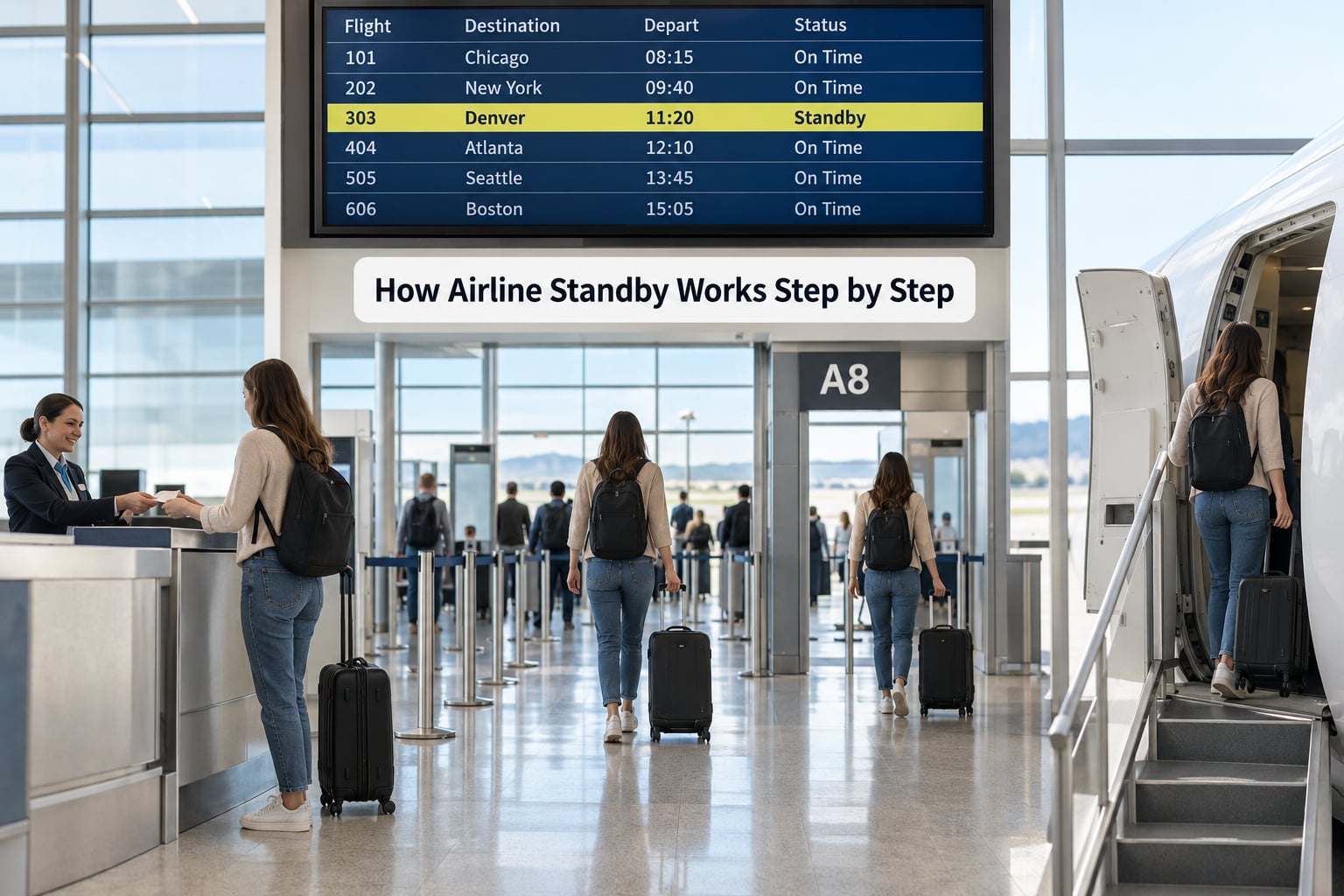
Here is the whole process, with nothing left out.
- Check your eligibility. Confirm you are ticketed on a later flight, that the fare class you hold allows same-day changes, and that your destination and departure airport still match.
- Get on the standby list. Do this through the airline’s app, an airport kiosk, a check-in counter, or the gate agent once you arrive. Check in for the original flight first, because a passenger with no active reservation usually cannot be listed at all.
- Keep your original seat. Your confirmed flight stays active while you wait. You are not giving anything up by listing, and if you do not clear, you simply board the later flight as planned.
- Wait at the gate. Stay near the gate, keep your phone on and loud, and do not plan a long meal or a lounge run. Names get called close to departure, often in a rush at the end.
- Board when your name is called. If you are cleared, you get a seat assignment and board during the process, then the flight departs as scheduled. If the seat goes to someone else first, you go back to your original flight.
One thing that catches people out: the seat count you see on the app or the departure board is not the seat count the gate agent is working with. Users on the Reddit communities for Delta, United and American all describe the same thing, that standby is cleared only after every ticketed passenger and the crew are aboard, so the usable number is often smaller than what the display suggested when you listed.
Standby Priority: What Determines Who Boards First?
Priority order is not a queue. It is a ranking the gate agent applies, and it usually follows this order from top to bottom.
- Ticketed passengers and crew first. Everyone with a seat in economy is aboard before a single standby is considered.
- Involuntary standbys over voluntary ones. Passengers the airline bumped outrank passengers who simply asked to travel earlier.
- Cabin class. Premium cabin, and often premium economy, is worked first, so a business class clearance happens before a main cabin one.
- Fare class and booking code. Flexible and unrestricted fares outrank the cheapest bucket on the aircraft.
- Elite status. Top-tier members are commonly pulled forward, and gate agents will often fill upgraded premium seats with status passengers before anyone on the general list.
- Connection protection. A traveler at risk of missing a tight onward connection may be moved up, though this is discretionary and not something you can demand.
- Gate agent discretion. This is the honest answer to the question. Ultimately the person at the desk decides, and there is no published formula that binds them.
Time of listing matters far less than people assume. A traveler who listed the previous evening is not ahead of someone who listed two hours before departure, because only the gate agent’s list counts.
Standby on Full-Service Airlines vs. Low-Cost Airlines
The broad difference is that full-service carriers will often waive the same-day change fee for eligible fare classes, while low-cost carriers treat a same-day change like any other change and charge for it.
Full-service carriers: American, Delta and United
American publishes same-day standby guidance, allowing customers to stand by for an earlier flight subject to availability. Delta and United run similar voluntary same-day standby programs for eligible tickets, and all three restrict the practice heavily for their lowest unrestricted-economy and basic fares. Elite members get better odds, mainly through fare class and through being worked earlier in the cabin.
None of the three will move you between airports, and all three treat an international standby as a special case handled at the gate rather than online.
Low-cost carriers: Southwest, Alaska and JetBlue
Southwest does not run a formal standby list, but unaccompanied minors and some other categories travel standby-only under specific rules, and its two open seating charts make seat inventory unusually fluid on busy routes. Alaska and JetBlue do not publish a broad voluntary same-day standby program for general passengers. In practice, a same-day change on a low-cost fare is a paid change, which changes the arithmetic completely.
That is the honest tradeoff. On a network carrier, standby on an eligible fare can be free. On a low-cost carrier, the same move usually costs money whether or not you clear, so the attempt only makes sense when a seat is genuinely likely to open.
What Happens When You Clear Standby?
When the agent calls your name, it happens fast. You walk up, show your identification and boarding pass, receive a seat assignment, and board. The rest of the flight proceeds normally, and any loyalty mileage is credited to the operating carrier as usual.
Baggage is the part that catches cleared passengers out. If you are traveling carry-on only, your bag goes in the overhead bin and there is no problem. If you dropped a checked bag earlier in the day, it may already be loaded or may not be able to be moved at all, which is why so many travelers treat carry-on only as a hard requirement for any standby attempt. On an international segment, there is an extra layer: your document and transit requirements still have to be satisfied, and a stand-in cannot be substituted for a visa that does not exist.
What happens if you do not clear standby
Your original ticket remains valid, you board the later flight, and nothing has been lost except the day. The complication is the second bump, which almost no guidance online covers: you can be cleared, board, and then be pulled off in favour of a higher-priority passenger who shows up late or a no-show who was wrongly marked as boarded. Forum discussions on r/delta and r/americanairlines describe exactly this, and it is one of the reasons seasoned travellers will not sit down until the door closes.
If the airline bumped you from a flight you were ticketed on, re-accommodation and, where applicable, compensation are obligations that fall under denied boarding rules, and those apply to involuntary standbys rather than to people who voluntarily asked for an earlier flight.
How to Improve Your Chances of Getting on Standby
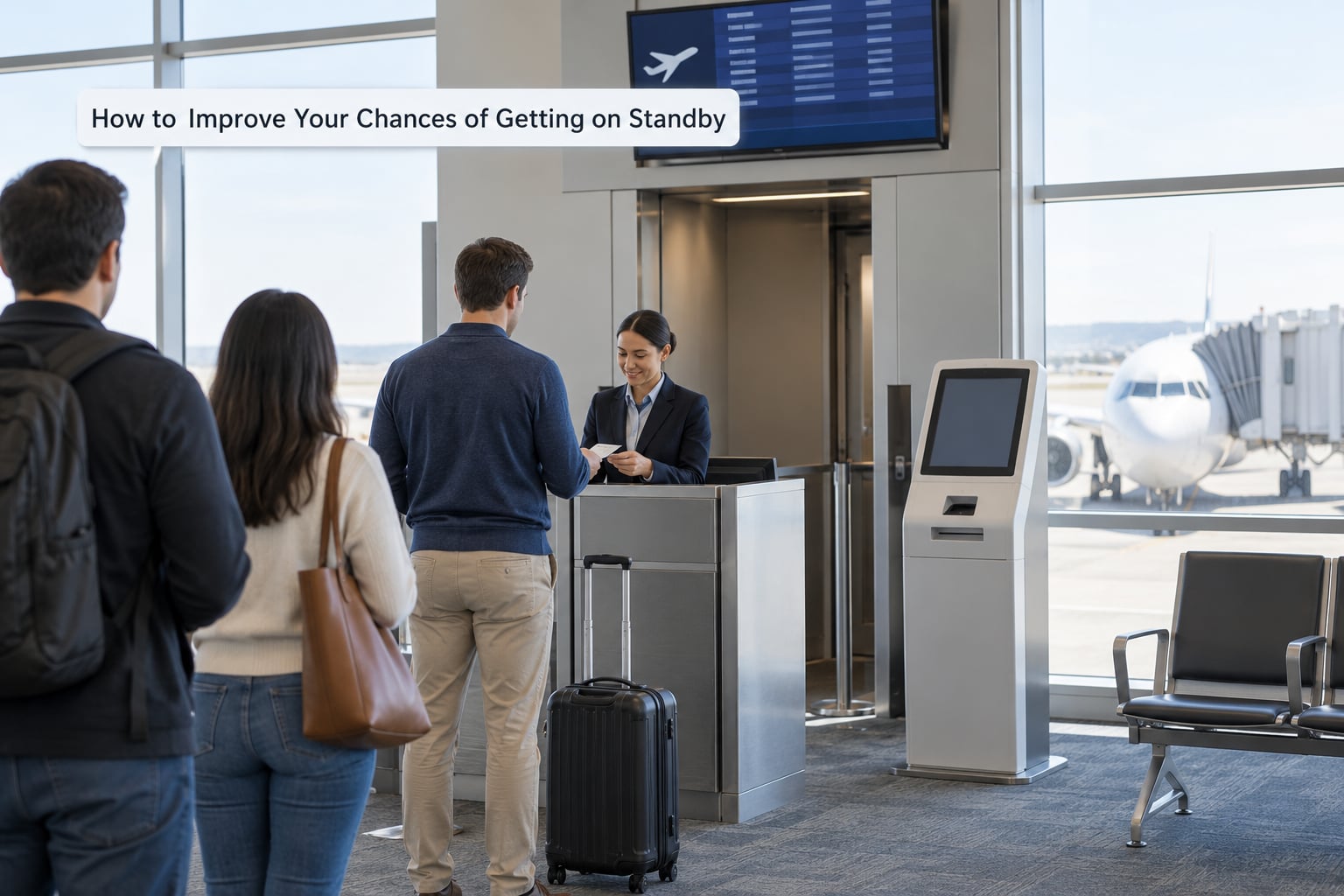
These are the levers that actually move the needle, roughly in order of impact.
- Fly early on a weekday. Frequent fliers report success rates somewhere around 30 to 60 percent on early weekday departures, dropping sharply at weekends and around holidays. The first flights of the morning carry the most no-shows.
- Travel alone. Solo travelers consistently report far better results than a pair or a group, because two seats have to open instead of one.
- Target a bigger aircraft and a leisure route. Larger planes and destinations people book weeks ahead tend to carry the most unused seats at the last minute.
- Carry on only. A checked bag is the single most common reason a cleared passenger is pulled off.
- Check in early and list early. Some apps let you list the night before, though the gate agent may disagree with the app. Listing earlier never hurts and sometimes puts you in the system sooner.
- Stay at the gate. Names are called shortly before departure, often in a fast sequence at the end.
- Keep a nearby airport in reserve. Travelers in the forum threads check alternate airports as a fallback, pairing a big hub with a secondary field.
- Be polite, and ask once. Gate agents work a queue. A single clear question about your position and when names will be called gets you more than repeated asking.
Style helps in a small way. Frequent flyers mention dressing for a long, uncertain day and keeping bags under the seat so boarding is fast, because a slow boarder standing in the aisle while a tight connection forms is not going to win anyone over.
How airline standby works best on a weekday morning
Timing beats strategy more often than not. The early flights of a Tuesday have the highest no-show rate and the lowest competition for the leftover seats, because nobody else is competing for a 6:00am departure unless they have a real reason to. Friday evening, Sunday afternoon and any holiday-adjacent date are the worst, with leisure routes and family travel filling the seats that would otherwise have stayed empty.
The morning-of checklist
- Check your fare class allows a same-day change, before you leave the house.
- Screenshot your later flight confirmation, because the app may drop you from standby once the original flight departs.
- No checked bags.
- Arrive early enough to check in and list, at the counter if the app disagrees with the gate.
- Ask the gate agent, once, what the procedure is and when names will be called.
- Stay close, phone charged, nothing scheduled.
One useful thread to follow: the reddit communities for Delta, United, American and general flight discussion contain the most honest accounts of what actually happens at the gate, including the specific routes and times people got lucky and the ones where they sat for six hours and went nowhere.
Frequently Asked Questions
How risky is it to fly standby?
Standby is genuinely uncertain. You may wait several hours, get cleared and then lose the seat, or clear and be bumped again. If you are voluntary, the worst case is that you fly your original flight as planned. If you were involuntary, denied boarding rules mean the airline re-accommodates you, and you may be owed compensation. The real cost is time and the risk to any onward connection.
How likely is it to get off a standby flight?
Frequent fliers report somewhere around 30 to 60 percent success on early weekday flights, and much lower odds on weekends, holidays and popular leisure routes. Solo travelers do considerably better than groups, and big aircraft with unused seats are your best odds. Nobody gets a guarantee, and the gate agent decides at the door.
Do you fly for free if you fly standby?
Usually, on an eligible fare. A voluntary same-day standby request on an unrestricted main cabin ticket is often free on American, Delta and United, while basic economy and the cheapest fares are not eligible at all. On low-cost carriers a same-day change is treated as a regular change and is charged for, whether or not you clear. Check your fare class first.
How do I get on a standby list for an earlier flight?
You need a confirmed ticket on a later flight to the same destination, checked in for the same day. Then list for standby through the airline’s app, an airport kiosk, the check-in counter, or the gate agent on arrival. You are given a position on the list and your original seat stays active until a seat opens on the earlier flight.
How do I increase my chances of getting on a standby flight?
Fly early on a weekday, travel alone rather than as a group, carry on only so baggage cannot block the seat, and choose a larger aircraft on a leisure route. Check in and list as early as the airline allows, stay at the gate with your phone on, and never plan a meal or a lounge visit. Ask the gate agent once about the procedure and when names will be called.
Why was I denied boarding on a standby flight?
Most often because a higher-priority passenger took the seat, or because you had a checked bag that could not be moved in time. Involuntary standbys and premium cabin requests are worked before general standby, and elite members are frequently cleared into upgraded seats before anyone else. A gate agent can also decline a request outright, since the final call rests with them.
Conclusion: What to Do First
Standby is a free option when your fare class allows it, and it is not a reliable one. The first thing to do is check your own airline’s published standby and same-day change policy, because the eligibility rules differ sharply between carriers and between fare buckets. Then confirm you are ticketed, check in, and list for the earlier flight as soon as the airline opens the list.
On the day, talk to the gate agent once you arrive, keep your bag with you, and stay at the gate until the door closes. That is how airline standby works in practice: a list, a priority order, and a decision made by a person at the desk.