You need about 9 to 12 outfits for a two week trip, not 14. The trick to how to plan outfits for a two week trip is to stop counting days and start counting combinations: six tops and three bottoms give you 18 pairings from a single small capsule wardrobe, and a mid-trip wash on day 5 and day 10 means you never run out of clean underwear or socks.
Most people overpack because they plan one outfit per calendar day, then discover on day three that the trip is hotter than the forecast and everything is wrong. Planning outfits takes about 45 minutes once, and it saves you from hauling a bag you cannot lift.
Below is the process I use: gather the trip details, turn them into a capsule wardrobe, map the pieces onto 14 days, then pack the bag in cubes so each morning takes two minutes instead of twenty.
Table of Contents
- 1What You Need
- 2Step-by-Step
- 3How to Plan Outfits for a Two Week Trip by Destination and Weather
- 4Build a Capsule Wardrobe That Mixes and Matches
- 5Create a 14-Day Outfit Rotation
- 6Pack Shoes, Layers, and Weather-Proof Accessories
- 7Use Packing Cubes and a Simple Daily System
- 8Common Mistakes
- 9Frequently Asked Questions
- 10How many outfits should I pack for a two week trip?
- 11Can you pack two weeks of clothes in a carry-on?
- 12Can you do laundry on a two week trip?
- 13How do I avoid repeating the same outfit for 14 days?
- 14How many pairs of shoes do I need for two weeks?
- 15Conclusion
What You Need
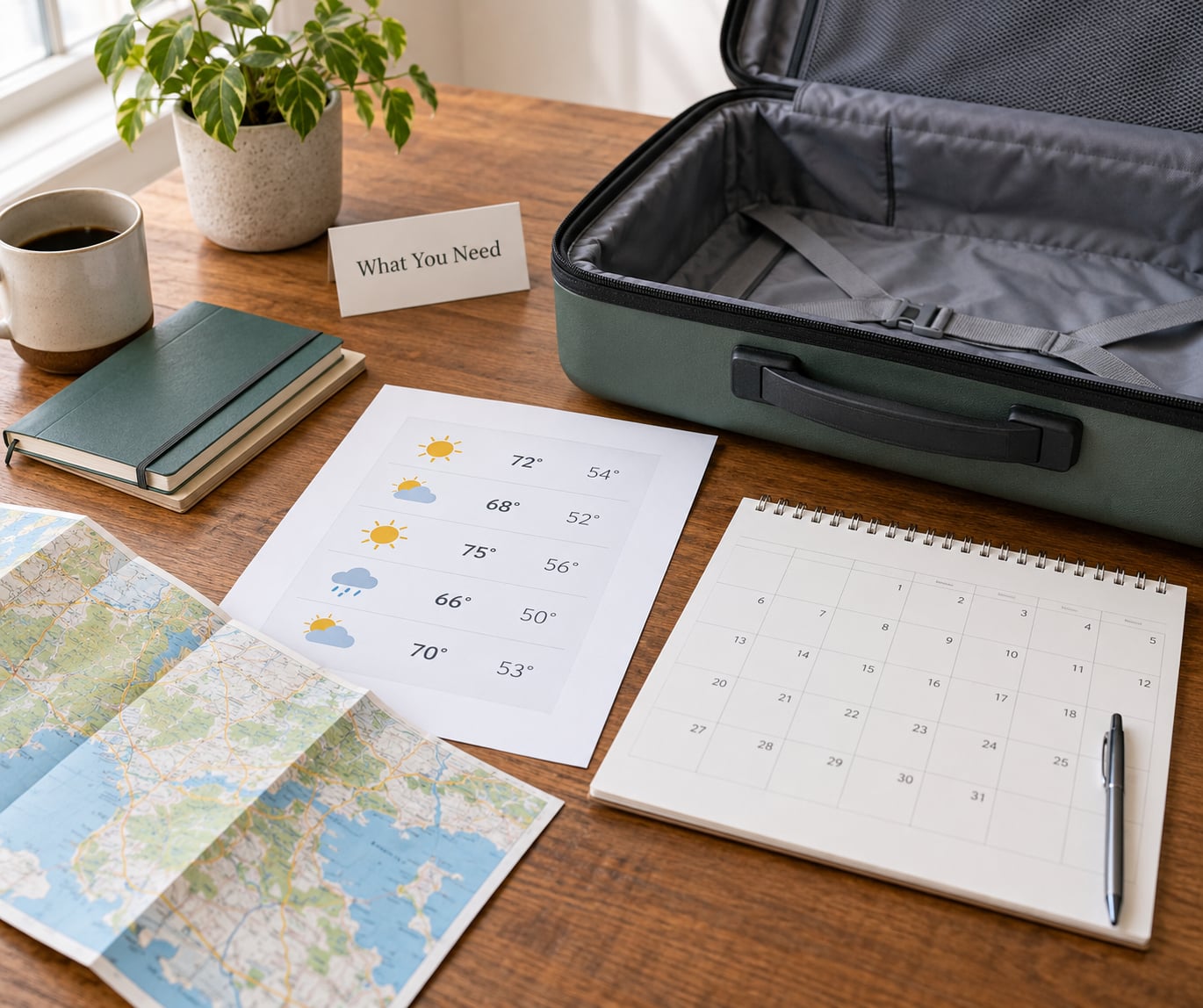
Gather these before you pick a single item out of the closet. Ten minutes here saves a suitcase full of clothes that never get worn.
- Trip dates and night count. Fourteen nights means fifteen outfit slots including arrival day. Count nights, not days, and add one.
- Every destination on the itinerary. A multi-city trip changes the clothing math more than anything else.
- Weather for each stop. Look at the forecast within ten days of departure, and the climate averages before that. Indoor heating matters as much as outdoor temperature.
- What you are actually doing each day. Sightseeing with a lot of walking, a conference, a beach, a wedding, a business dinner.
- Dress codes. Some hotels publish them. Temples, mosques, religious sites and conservative countries have expectations worth checking before you fly.
- Laundry access. Does your accommodation have a machine, or are you relying on a hotel sink or a self-service laundromat?
- Your luggage rules. Airlines publish their carry-on dimensions and weight cap, and they differ. Check yours before deciding how many pieces fit.
- Your own laundry habits. If you only re-wear a top twice, plan for more tops. If you happily wear the same shirt four days running, you can pack less.
Two things from this list drive every later decision: the weather split and the laundry access. A trip with two washes available can be packed lighter than one without.
Step-by-Step
How to Plan Outfits for a Two Week Trip by Destination and Weather
Read your itinerary left to right and label every day with a category. Most two-week trips collapse into five buckets: hot and casual, hot and dressed-up, cool and casual, cool and layered, and one or two days that need real shoes.
Then split your wardrobe by climate rather than by day. A widely used approach is to plan roughly 70 percent of your pieces for the colder part of the trip and 30 percent for the warmer part, then adjust for how you actually feel. If you are cold most of the time, flip it.
| Category | How many | Days it covers | Why it earns a slot |
|---|---|---|---|
| Tops and shirts | 6 | 14 with re-wearing | Each pairs with all three bottoms, so one worn twice is invisible |
| Bottoms | 3 | 14 | Washable and less noticeable when repeated than a top |
| Underwear | 7 sets | 14 with two washes | One clean set per day for the first five days, then wash |
| Socks | 7 pairs | 14 with two washes | Same cadence as underwear |
| Light layer | 1 or 2 | 14 | Cardigan or packable jacket that works over anything |
| Shoes | 2 pairs | 14 | One for walking, one for evenings or weather |
| Day bag contents | 1 small set | 14 | Scarf, sunglasses, hat, chargers, medication |
Packing more tops than bottoms is the standard workaround when combination capacity runs short. Bottoms take more visual space in a photo and less space in a case, so the imbalance pays off.
One rule keeps the planning honest: every item on your list must work with at least two other items already on it. If a piece only works with one other thing, it is not an outfit for two weeks, it is a costume.
Build a Capsule Wardrobe That Mixes and Matches
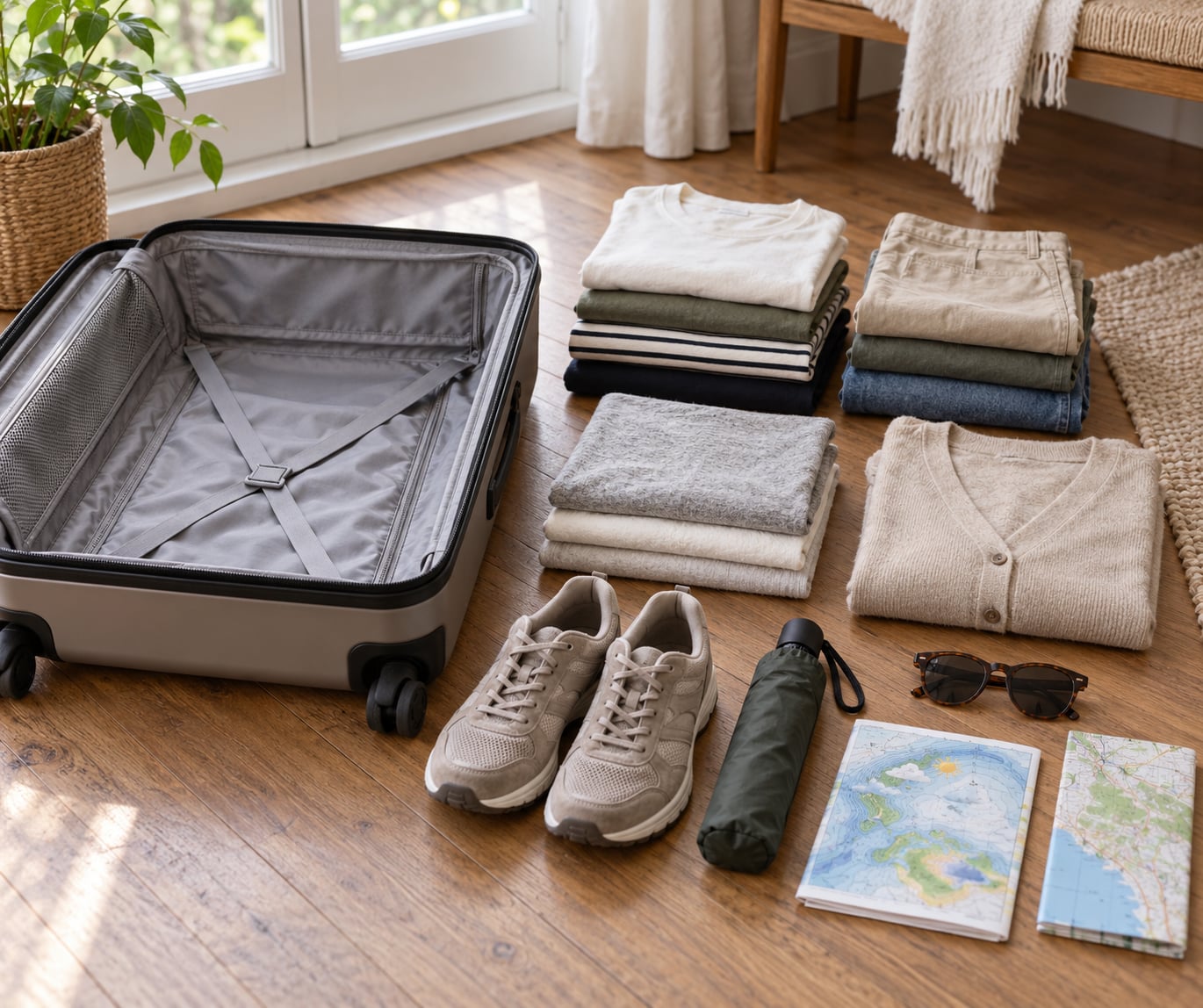
A capsule wardrobe for travel is a small group of pieces that all work together, usually built around two or three neutral colors. Pick your neutrals first, then choose pieces only in colors that sit well against them.
Here is the combination math that makes 14 days work. Six tops times three bottoms equals 18 outfits before you add a layer, a shoe swap or a scarf. You have 14 days. That means you can wear the same pairing twice as long as the layer or the shoes change, and nobody is keeping notes on your closet.
On r/solofemaletravellers, travelers repeat the same advice: cut the dresses and jumpsuits down to one at most, because one-piece items only make a single outfit each and quietly kill your combination count. One statement dress or jumpsuit is plenty.
Start with a closet audit, not a shopping list. Pull everything you own that fits your palette and would survive a long travel day, then count. Most people already own 80 percent of what they think they need to buy.
On fabric, choose for the second wear. Wrinkle-resistant and quick-dry materials hold their shape after a wash in a hotel sink, and sweat-wicking knits dry overnight. A linen shirt that creases badly is fine for day one and frustrating on day six.
Create a 14-Day Outfit Rotation
Now put the pieces on days. Work in this order: transit days first, because they are the hardest to dress, then dressy nights, then everything else fills the gaps.
The plan below assumes one transit day at each end, two dinners that need more than a t-shirt, one conservative day for temples or religious sites, and two laundry evenings on day 5 and day 10. Shift the categories to match your own itinerary.
| Day | Type | Combination |
|---|---|---|
| 1 | Travel | Top 1, jeans, sneakers, light layer in the day bag |
| 2 | Sightseeing | Top 2, jeans, sneakers |
| 3 | Sightseeing | Top 3, trouser 1, sneakers |
| 4 | Dinner out | Blouse, trouser 1, walking shoes, scarf |
| 5 | Laundry evening | Top 4, jeans. Wash underwear and socks in the evening |
| 6 | Site or temple day | Top 5 with layer over, long bottom, closed shoes |
| 7 | Rest day | Wore on day 1 outfit. Nobody minds |
| 8 | Sightseeing | Top 6, jeans, sneakers |
| 9 | Second city | Top 2, trouser 2, sneakers, layer |
| 10 | Laundry evening | Top 3, jeans. Second wash of underwear and socks |
| 11 | Long walking day | Top 4, trouser 3, second shoe pair |
| 12 | Dressy night | Statement dress or blouse with the best bottom, second shoes |
| 13 | Free day | Any combination not yet worn, plus the layer |
| 14 | Travel home | Freshest top, most wrinkle-resistant bottom, layer in the day bag |
Notice what the rotation protects. One pair of jeans goes six days, one trouser goes four, and the two best-looking tops get saved for the days that matter. That is the opposite of one-outfit-per-day thinking, and it is what makes the bag hold.
Wear your heaviest or least flattering piece on travel days. It does the same job in the suitcase and gets the most use between washes, while your better clothes stay in reserve.
Pack Shoes, Layers, and Weather-Proof Accessories
Two pairs of shoes is the working rule for two weeks. One pair built for ten-hour walking days, one pair for evenings, dinner or weather. Three pairs starts eating a quarter of your bag volume, and platform shoes or boots bring weight you will feel at the airport.
On forums.tombihn.com, travelers planning two-week trips talk about merino tights worn under nylon pants for genuinely cold days, which beats packing a second heavy pair of trousers. Thin technical layers solve more temperature problems than bulky ones.
Layers do the heavy lifting on flights and in air-conditioned restaurants. A light cardigan or a packable down jacket that folds into a pouch can be worn, carried and stuffed without taking real space, so you can dress for an outdoor temperature and an indoor one at the same time.
Weather-proof accessories earn their space because they change an outfit rather than join it: a compact umbrella, a wide-brim hat, a packable rain shell, sunglasses and a scarf. A scarf adds a layer of warmth and hides a top you have already worn twice.
Keep the day bag separate from the suitcase. It holds the layer you need on the plane, water, medication, chargers and one extra top, which is what saves you when a spill happens on day 8.
Use Packing Cubes and a Simple Daily System
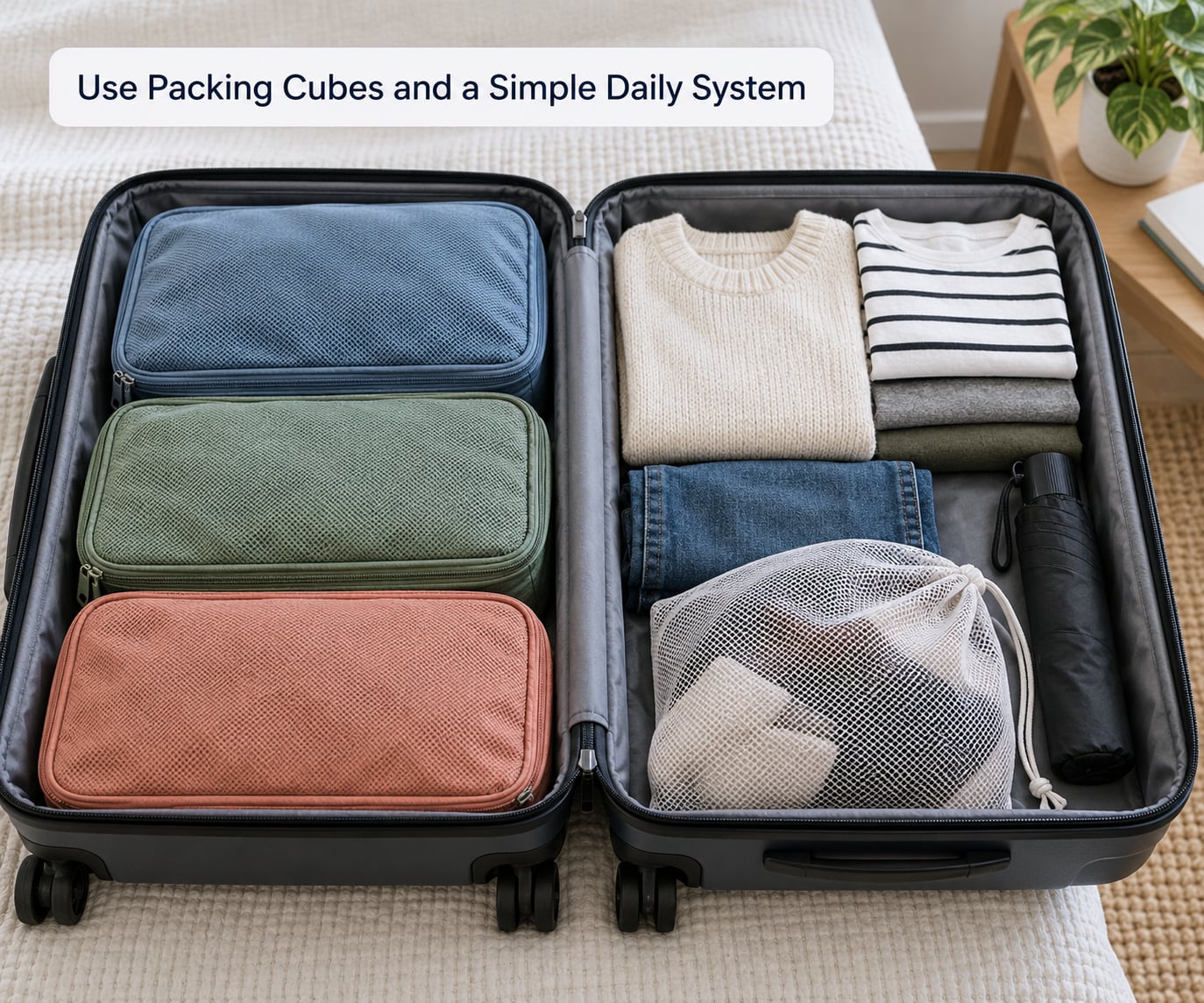
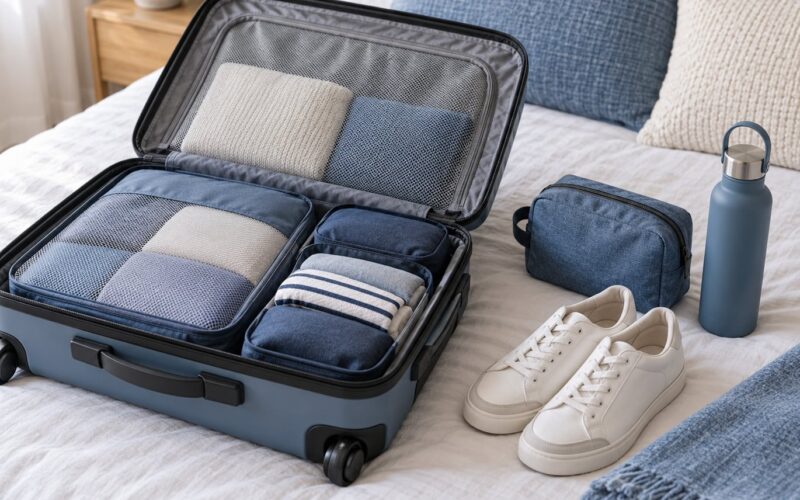
Packing cubes are organizers, not space savers. Compressing clothes into a cube does not reliably add space to a carry-on, but it does let you find the right piece in ten seconds instead of unpacking the whole bag.
Set up five cubes and keep to that system: tops, bottoms, underwear and socks, layers, and shoes. Each day gets its own small cube or a single rolled bundle, so mornings become grab-and-go.
Add a mesh laundry bag for the two wash days. Fill it in the bathroom, carry the wet bag to the washer, and do it again on day 10. This single habit is what removes the need for fourteen sets of underwear.
For a carry-on trip, use the counts above as-is and roll everything. For a checked bag, add two more tops, a proper pair of jeans and a third shoe, and stop there. Plenty of people overpack a checked bag precisely because nobody told them the capsule version already works.
Common Mistakes
Planning one outfit per day. This is the big one, and it is why two-week carry-on packing fails. Fix: count combinations instead. Six tops and three bottoms give you 18.
Packing one perfect outfit and hoping. If an item works with nothing else, it only covers one day. Fix: nothing goes in the bag that does not pair with at least two other pieces.
Ignoring dress codes. Discovering on day 9 that the dinner requires a jacket or that temple visits need covered shoulders ruins a day. Fix: check the venue requirements before choosing clothes, then build one more formal look around it.
Choosing shoes for the photo instead of the pavement. New shoes on a two-week trip is asking for blisters. Fix: wear your walking shoes twice before you go, and keep the second pair something you have tested too.
Assuming laundry will happen. Plenty of travelers never find a working washer. Fix: pack seven sets of underwear and socks so that two sink washes are a bonus rather than a dependency.
Packing five versions of the same shirt. Similar pieces halve your combinations and fill the bag with redundancy. Fix: keep the strongest one and swap it for something that pairs with all three bottoms.
Planning only for the itinerary you hope to have. Forum threads about two-week trips keep circling the same problem: people stop wanting to wear what they packed. Fix: leave two free slots at the end of the rotation, and treat a spontaneous laundry day as part of the plan, not a failure of it.
Two more habits help. Buy detergent sheets instead of a bottle of liquid, since a small solid packet survives the security liquids rule and handles a sink wash in about five minutes.
And protect your anchor piece, the one item that matches everything. It usually is the white top or the black trousers. Wash it on the night before you need it again rather than at the end of the day.
Frequently Asked Questions
How many outfits should I pack for a two week trip?
Plan for 9 to 12 outfits, not 14. Six tops and three bottoms produce 18 combinations before you add a layer, a shoe swap or a scarf, and those combinations are what cover fourteen days. Pack two pairs of shoes, seven sets of underwear and socks, and one light layer. Most travelers need fewer pieces than they expect, provided the pieces all work together.
Can you pack two weeks of clothes in a carry-on?
Yes, a carry-on is realistic for fourteen days if you skip the one-outfit-per-day approach. Six tops, three bottoms, one layer, two pairs of shoes and seven sets of underwear and socks fit comfortably in a standard carry-on case. Roll your clothes, use packing cubes to stay organized, and check your airline’s size and weight rules before you commit to the counts.
Can you do laundry on a two week trip?
Usually, yes, and it changes how much you pack. A hotel sink with a small amount of detergent handles underwear, socks and t-shirts in about five minutes, hung overnight to dry. Plan a wash on day 5 and another on day 10 so clean basics are always available. Treat laundry as a bonus rather than a requirement, because seven sets already cover the full trip.
How do I avoid repeating the same outfit for 14 days?
Vary one element at a time instead of changing everything. The same top and jeans look different with a different layer, a different shoe pair, or a scarf. Save one statement piece for the trip so each half-day outfit is anchored by something different, and keep hair and accessories simple enough to switch in under a minute.
How many pairs of shoes do I need for two weeks?
Two pairs is the working rule. Choose one pair built for long walking days that you have already worn twice to break them in, and one pair for evenings, dinners or bad weather. A third pair is worth adding only for a specific reason, such as snow, water or a formal event, and it costs you a noticeable amount of bag space.
Conclusion
Start with the itinerary, not the closet. Label each of your 14 days by weather and activity, choose one neutral palette, then pick six tops and three bottoms that all work together.
Add two pairs of shoes, seven sets of underwear and socks, one light layer and the accessories that change a look without adding a piece. Map the combination onto a 14-day rotation with washes on day 5 and day 10, pack it in cubes, and the whole two week trip fits in a bag you can lift on your own.