Confirm the cancellation in the airline app and on the departure board, get in line or open the app chat immediately, and ask for every rebooking option they have plus the amenities you are owed for the delay. You then choose: keep flying on a replacement flight, or take a refund for the unused part of your ticket. You are not obliged to accept a voucher, a credit, or the first seat they offer.
What you end up with depends on the country you are flying in, the airport, and why the flight was canceled. A weather cancellation in the United States and a storm cancellation on a flight departing from Frankfurt are governed by different rules, and so is a mechanical fault on a flight out of Sydney. I will walk through the whole recovery sequence, and I will flag the points where the answer genuinely depends on your itinerary rather than pretend there is one global rule.
The single biggest mistake is waiting. Airlines rebook in the order people ask, and the people who ask fastest get the seats that are actually flyable. Everything below takes about ten minutes to set up, and you can do most of it while standing in line.
Table of Contents
- 1What You Need
- 2Identification and your travel documents
- 3Booking confirmation and ticket number
- 4The airline app, logged in and updated
- 5Cards and payment details
- 6Baggage receipts and your bag tag
- 7Travel insurance and credit card details
- 8What to Do When Your Flight Is Canceled, Step by Step
- 9What to Do When Your Flight Is Canceled at the Airport
- 10Contact the Airline and Ask for Rebooking Options
- 11Protect Checked Bags and Connecting Flights
- 12Ask About Meals, Accommodation, and Transportation
- 13Consider Rebooking on a Different Airline or Route
- 14Confirm the New Itinerary and Keep Your Records
- 15Common Mistakes
- 16Leaving the secure area before confirming what happens to your bag
- 17Booking your own replacement ticket too early
- 18Treating a voucher as the same thing as reimbursement
- 19Missing the deadline for claiming
- 20Handing sensitive information to strangers offering help
- 21Not documenting expenses as you go
- 22Waiting for the airline to solve it without doing anything
- 23Frequently Asked Questions
- 24Can I choose my own replacement flight after a cancellation?
- 25Will the airline pay for a hotel if I cannot fly that day?
- 26What happens if I do not accept the airline’s replacement itinerary?
- 27Are meals, baggage, and compensation always provided after a cancellation?
- 28Can I rebook later instead of traveling on the same day?
- 29Conclusion
What You Need
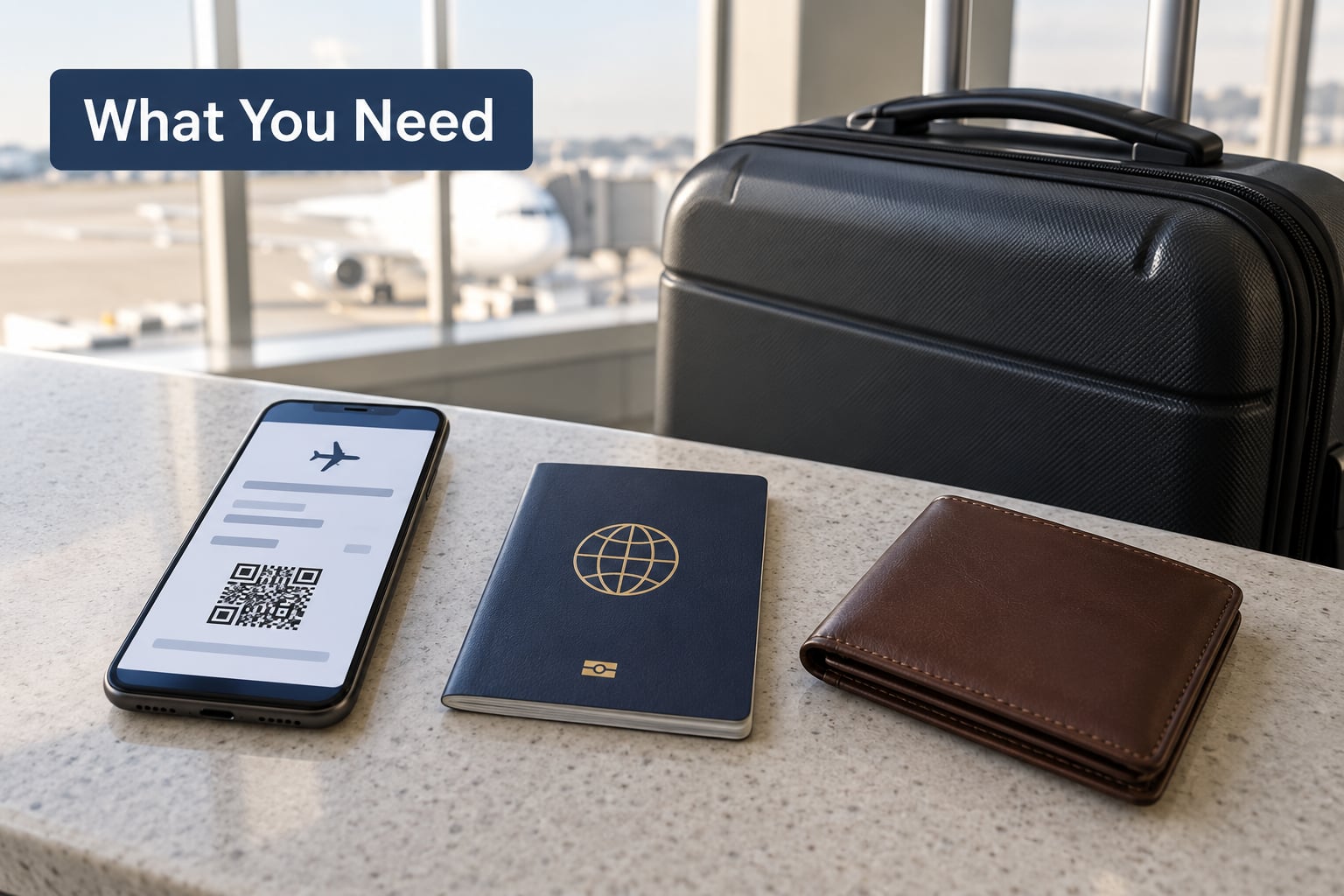
A cancellation is the worst possible time to dig for a confirmation number in an email inbox you cannot reach. Set up these six things before you ever leave for the airport, and every step that follows gets faster.
Identification and your travel documents
Your passport or ID, your visa or entry clearance for the destination, and any onward travel documents. Airlines will not rebook you onto an international segment without them, and a passport buried in a checked bag is a passport you do not have.
Booking confirmation and ticket number
A screenshot on your phone beats an email every time. You need the six-letter airline code and the ten-digit ticket number, because that is what the agent will ask for first. If you booked through a travel agency or a third-party site, keep their contact details open too, since the agency is usually the contractual holder of your ticket.
The airline app, logged in and updated
Download the app before you fly and sign in. Travellers report that working the app while standing in the queue produces faster rebooking than waiting for a counter agent, because the app shows live seat availability and lets you select a specific flight instead of accepting whatever comes up.
Cards and payment details
Keep the card you paid with nearby. Refunds, hotel reimbursement and meal vouchers usually go back to the original form of payment, and an agent who cannot see that payment method cannot process anything. Bring a second card too, in case your replacement flight goes onto a different carrier with a different payment system.
Baggage receipts and your bag tag
If you already checked a bag, photograph the tag before it goes under the belt. If your bag is on a connecting flight, keep every tag from every segment. These photos are the difference between “my bag was somewhere” and “my bag was checked through to Zurich under tag 0043”.
Travel insurance and credit card details
Pull up your policy document, not the marketing page. You are looking for the trip interruption, travel delay and baggage delay sections, the per-day limits, and the claims deadline. If you paid with a credit card that offers travel protection, find the benefits guide for that card as well, because those benefits often fill the gap when the airline declines to cover an expense.
One more thing: keep your phone charged and bring a charger. Most of this guide happens on a phone, in an airport, for several hours.
What to Do When Your Flight Is Canceled, Step by Step
Here is the recovery sequence in the order it actually works. Each step below says what to do, what usually gets in the way, and what visible confirmation tells you the step landed.
What to Do When Your Flight Is Canceled at the Airport
Before anything else, verify the status through at least two official channels: the airline app and the airport departure board, plus the airline website or a member of airport staff. One channel showing a cancelled flight is not always a cancelled flight. It can be a delayed aircraft being reassigned, or a schedule change that the board has not refreshed yet.
The difference matters. A delay still has a boarding time. A cancellation means the flight is not operating and needs replacing. If you act on a delay as if it were a cancellation you will waste time in a queue for a boarding pass that was never going to be issued.
Photograph the departure board showing your flight number and the word cancelled. That single photo does more for a later claim than anything else you will collect all day, and travellers who keep documentation of the board itself report having an easier time getting expenses approved.
Ask the nearest airline representative for one specific thing: when the next update is coming, and by what channel. That single answer stops the refreshing and tells you when to act again. You have confirmation this step worked when your flight shows as cancelled on two independent sources and you know the time of the next update.
Contact the Airline and Ask for Rebooking Options
Reach the airline through the fastest channel available to you, and work down this order: the app’s chat or self-service rebooking, the app while you are in the queue, then the airport service desk, then the phone line. Travellers consistently report two to four hour hold times on domestic phone lines, so treat the phone as the fallback, not the default. International call centres are a common exception and are often answered faster.
Ask for every option, not the first one. Say explicitly: “What are all the flights you have available to me today?” An agent who assumes you will take the next departure and moves on has done you a disservice. Ask about the flight after that one too, and about departures from a nearby airport.
Say who you are early if any of it applies: travelling with an infant, a passenger with reduced mobility or a medical need, a service member, or a passenger booked on an international itinerary with a visa deadline. Airlines rebook unaccompanied minors, wheelchair users and passengers with tight connections first because they are the ones the delay breaks hardest.
Write down the representative’s name and the case reference number before you hang up or walk away. Then confirm what you got in writing. A boarding pass, an itinerary confirmation, or an email with the new flight numbers is the result to aim for. A vague promise that “someone will call you” is not an itinerary.
Protect Checked Bags and Connecting Flights
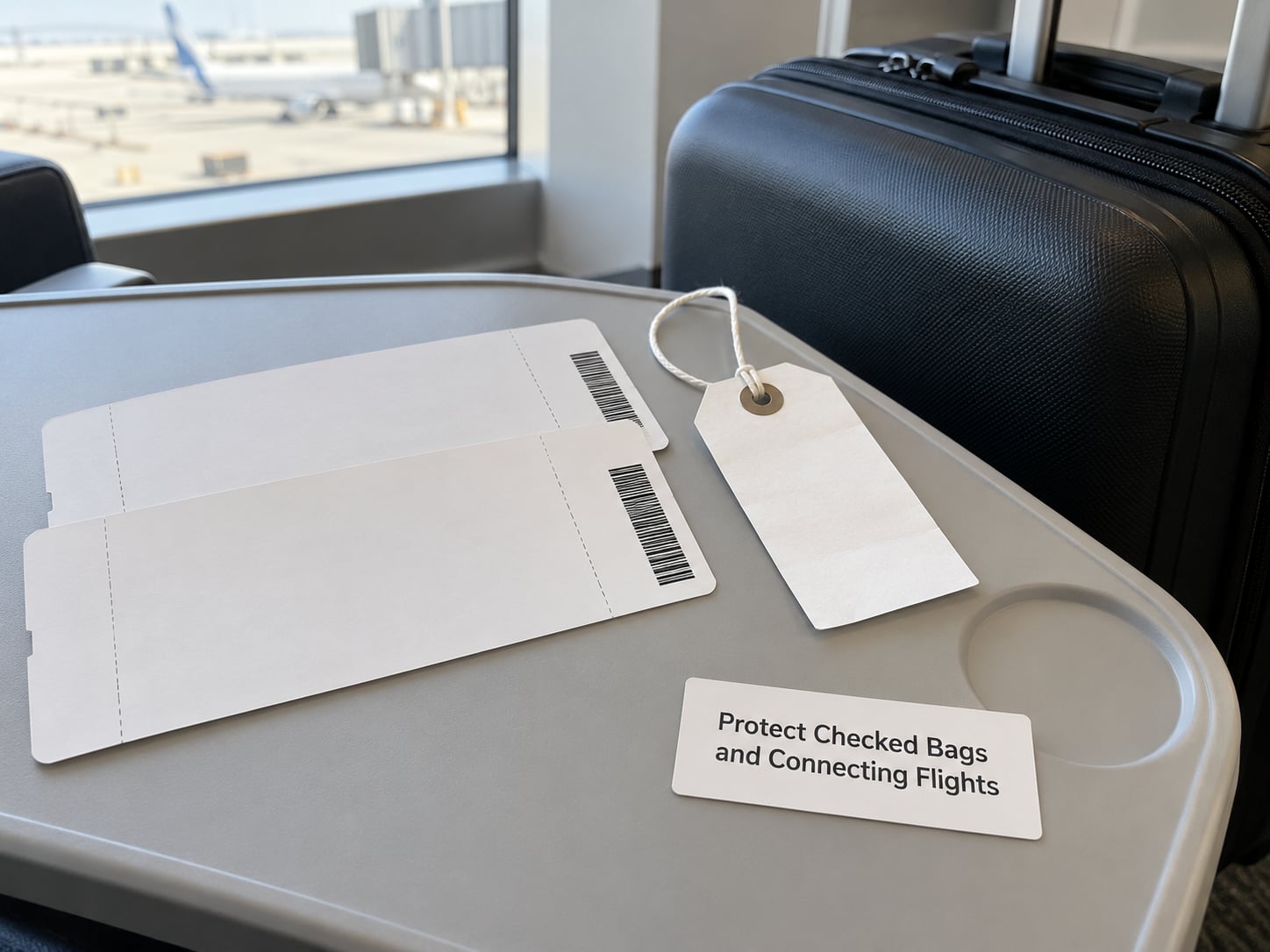
Checked bags on a single cancelled flight are usually reloaded onto the replacement flight automatically. Bags on a connection are where it falls apart, because a cancelled flight often breaks the through-ticketing that put your bag on the second aircraft in the first place.
Ask directly: “Is my bag tagged through to my final destination, or do I need to collect it?” If the answer is that you need to collect it, ask what happens to it when you land, and get the answer in writing. Then check the new boarding pass or bag tag to confirm the routing actually reflects what the agent told you. The final destination printed on the tag is the confirmation you want.
If your replacement routing makes you a self-transfer, find out now whether the airline has agreed to it. Travellers who rebook themselves onto separate tickets without approval lose their checked bag, their connection protection, and any right to have the second leg put on hold when the first is late. The airline accepting the risk in writing is what keeps the booking whole.
On the other side, if you are already on a through-ticket and the first flight is cancelled, the airline is responsible for getting you to your final destination. You are entitled to be rerouted, not to be told to buy your own second ticket and claim later. Both of those situations look identical at the counter and produce completely different outcomes, so establish which one you are in before you pay anyone.
Keep every bag tag, especially if you plan to claim that a bag never arrived. Bags that travel on separate tickets after a self-transfer are logged as an initial rather than a delay, and that distinction can decide a claim.
Ask About Meals, Accommodation, and Transportation
Amenities are where airline policies differ most, so ask rather than assume. What may be on the table depends on the country of departure, the airport, how long until the replacement flight leaves, whether the cancellation is inside the airline’s control, and whether you bought the ticket directly or through a travel agency.
The distinction that comes up constantly is between cancellations the airline controls and cancellations caused by weather or air traffic control. Mechanical faults, crew shortages and scheduling problems generally sit on the controlled side. Weather, volcanic ash, airspace closure and security restrictions usually do not. Airlines are far more willing to hand out meals, hotel rooms and ground transport when they caused the problem.
That said, many carriers still offer meals during a long weather delay regardless of fault, because it costs less than an angry customer. Ask politely and see what you get. Travellers note that being firm but pleasant gets better results than hostility, which is roughly what you would expect from any customer service desk.
Ask for each item separately rather than asking “so what am I entitled to”. Name meals, then a hotel room if you cannot get home tonight, then ground transport between the airport and that hotel. If they say no to one item, ask about the next one.
Take the voucher if one is offered, but always ask for a receipt for anything you pay for yourself, including the hotel, meals and the taxi. A voucher is not reimbursement. Photograph the receipt before you leave the front desk. Then ask how the reimbursement works: which form to submit, to whom, and by when. Vouchers expire and restrictions vary, so a voucher you never use is worth less than the receipt you kept.
Consider Rebooking on a Different Airline or Route
When your own airline has nothing workable, another carrier or a different airport may get you there. Rail connections, intercity buses and even a rental car beat staying in a terminal hotel when your meeting is tomorrow morning. This is a real option, not a consolation prize, and it works better than travellers expect.
The question that decides everything is whether you are on a through-ticket. If the airline rebooks you onto a partner under an interline agreement, your checked bag usually follows and the partner is contractually responsible to the airline for getting you there. If you buy a separate ticket yourself, you are now two independent bookings, you pay the difference yourself, and you lose the protection that came with the first one.
So ask the airline to do the interline rebooking before you book anything yourself. Get confirmation that the new carrier will accept your existing ticket and will transfer your bag. Ask what fare difference applies and how it will be charged, since a difference owed by you can often be settled at the airport counter rather than in advance.
Then check the international angle before committing. A different routing can change your entry requirements: transit without passing through immigration in one airport can mean passing through it in another, and some nationalities need a visa for a connection they never needed on the original route. Check with the destination country’s embassy or consulate, or with an airline that flies that route daily, not with a forum post.
You have confirmation this step worked when an airline or agent has confirmed in writing that the new plan is valid, your bag is checked to the right final destination, and the fare difference is settled or documented.
Confirm the New Itinerary and Keep Your Records
Before you leave the desk, read the new itinerary out loud against your original plans. Check the airline and flight number, the date, the departure and arrival times, the departure airport, the baggage allowance in both weight and number of pieces, your seat assignment, and the connection time at each stop.
Connection times deserve real attention. A ninety-minute connection that used to work may not work in winter, and a replacement flight that puts you on the last flight of the day means missing your onward connection with no one to fix it. If the connection is too tight, ask about the alternative now rather than discovering it at the gate.
Then save everything: the new confirmation, the original booking, every receipt, the photos of the board, the case reference, and the agent’s name. Set a status alert on the new flight so you hear about a further change before you reach the terminal. And keep a backup plan, because a rebooking is itself a booking that can be canceled.
You are done with the immediate crisis when you hold a coherent written itinerary and you know when to be back at the airport for it.
Common Mistakes
Most of the pain after a cancellation comes from a handful of avoidable errors. Each one has a straightforward fix.
Leaving the secure area before confirming what happens to your bag
Passengers routinely wander out to buy food or find a hotel and discover afterwards that their bag was still on the belt, or that nobody had tagged it through. Fix: before you leave the gate area for anything, confirm the bag’s routing and where it will be delivered, and photograph the tag.
Booking your own replacement ticket too early
Spending your own money on a new flight before asking about interline rebooking is the costliest mistake on this list. Fix: ask the airline to place you on a partner carrier under your existing ticket first. If you must buy separately, get that decision in writing before you pay.
Treating a voucher as the same thing as reimbursement
Vouchers come with expiry dates, blackout rules and restrictions on who can use them, and many expire within days. Fix: accept a voucher if it is genuinely useful, but always ask for receipts for anything you pay for yourself, and never surrender your right to a refund just because a voucher was offered first.
Missing the deadline for claiming
Refund and compensation claims have windows, and they are short on some policies. Insurance claims have deadlines measured in days from the incident, not months. Fix: note the claim deadline on the day it happens, and set a reminder the same evening.
Handing sensitive information to strangers offering help
People who approach you in a terminal offering to “sort out” a rebooking, or who message you claiming to be from the airline, are almost never from the airline. Fix: use the airline’s app, its website, or a desk with staff identification. Never give your booking details to someone who approached you first.
Not documenting expenses as you go
Reconstructing a hotel and meal bill from memory, three weeks later, is how claims die. Fix: photograph each receipt immediately and keep a running list of what you paid and why, in the notes app, while it is still fresh.
Waiting for the airline to solve it without doing anything
Fix: keep working the app while you wait, recheck availability every fifteen minutes, and ask the desk to note that you are waiting. Passive waiting costs you the seats that were there an hour ago.
A general habit covers most of this: write down every update as it happens, with the time and the channel. A ten-line note with timestamps turns a chaotic afternoon into a clean record, and it is the difference between a claim that is processed and one that sits unanswered.
Frequently Asked Questions
Can I choose my own replacement flight after a cancellation?
Usually yes, within what the airline has available. When the airline cancels your flight, it must offer you a rebooking on the next available flight or a refund for the unused part of your ticket, and you choose which. You can also ask to be placed on a partner airline under your existing ticket, which keeps your bag protected. Buying a completely separate ticket yourself is an option, but you then pay any fare difference and lose the connection protection that came with the original booking.
Will the airline pay for a hotel if I cannot fly that day?
Sometimes. Hotels are most likely when the cancellation is within the airline’s control, such as a mechanical fault or a crew shortage, when you cannot reach your destination that day, and when you are stranded away from home. Weather and air traffic control cancellations usually fall outside that obligation, though many airlines still offer a room voluntarily. Ask early rather than after you have already booked and paid, and always keep the receipt.
What happens if I do not accept the airline’s replacement itinerary?
If you choose not to travel, you are entitled to a refund of the unused portion of your ticket rather than a travel credit. In the United States, refunds on a significant change or cancellation must be issued automatically within seven days for credit card payments and within twenty days for other payment methods. You are not required to take a voucher instead, though a voucher you choose to accept is yours to keep. Rules vary by country and itinerary.
Are meals, baggage, and compensation always provided after a cancellation?
No. Meals, hotel rooms and ground transport depend on the country of departure, the airport, the cause of the cancellation, and how long until the replacement flight leaves. Cancellations the airline controls generally carry more support than weather or airspace closures. Compensation for a delay is a separate question from compensation for a cancellation, and rules differ sharply between US domestic flights, EU flights and international itineraries.
Can I rebook later instead of traveling on the same day?
In most cases you can, if you decline the same-day replacement and take a refund of the unused ticket instead. If you want to keep your seat and travel later, say so explicitly before you leave the desk, and get the new date in writing, because a voucher without a booking attached is not a reservation. Whether the airline keeps your original fare or reprices it depends on the fare rules attached to your ticket.
Conclusion
The sequence that works is short: confirm the status through two official channels, stay in the queue or keep working the app, ask for every alternative on offer, protect your bags, claim the amenities you are owed, and write down every change and every receipt along the way.
If you take one thing from this guide, make it the first three. Confirm the cancellation, get in the official channel, and gather the alternatives before you spend a cent of your own money. The passengers who recover a disrupted itinerary fastest are the ones who started documenting at hour one, not the ones who argued hardest at hour six.