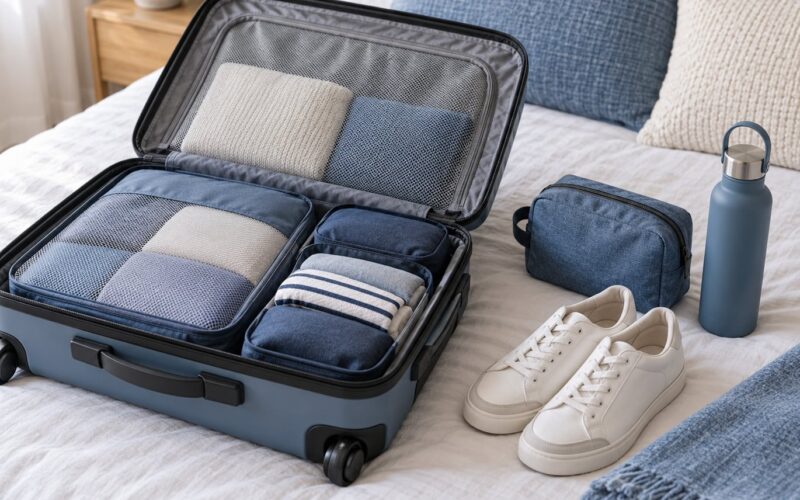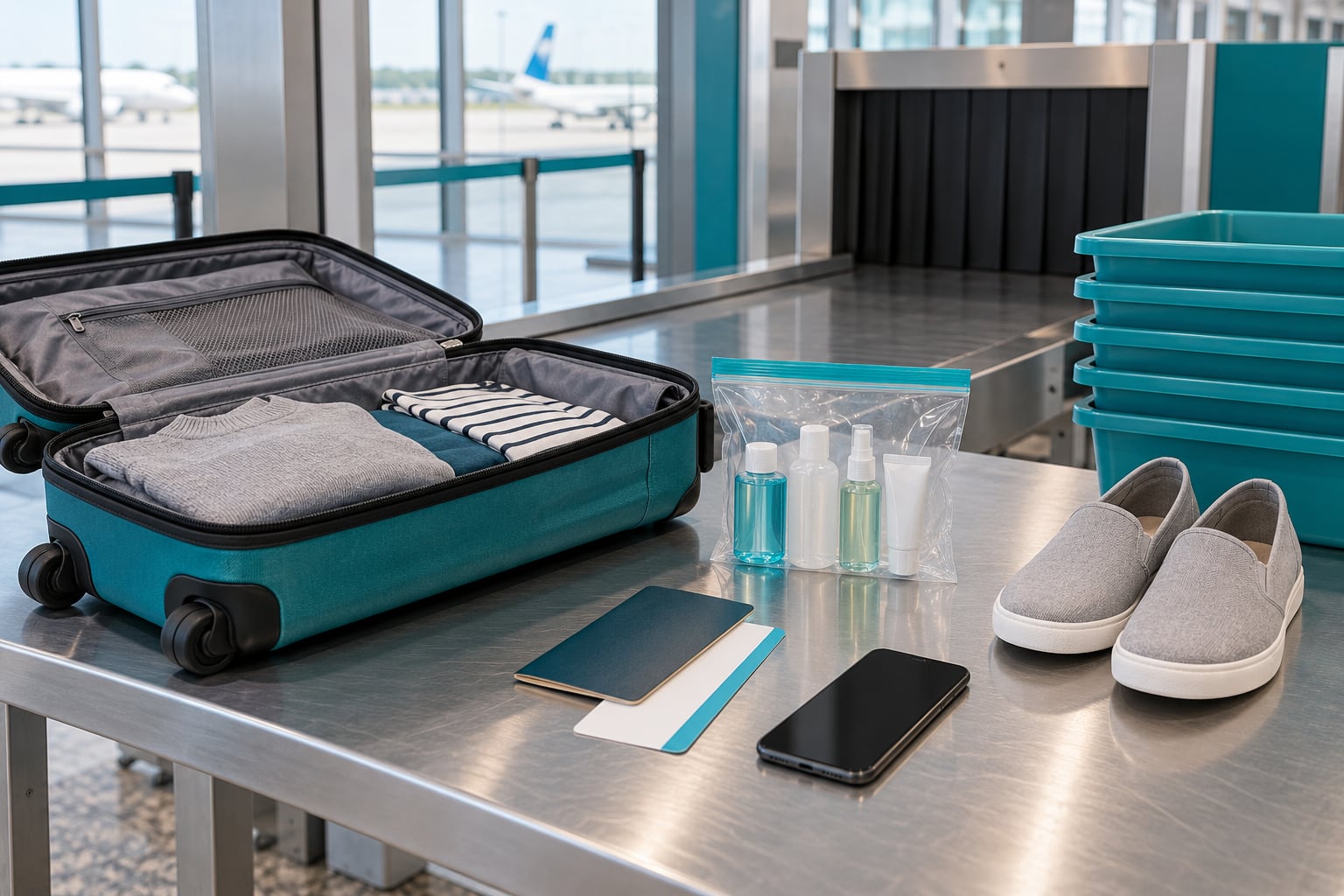
To get through airport security faster, you cut down on the two things that actually cost time: the queue at the document check and the repacking at the divest table. Have your ID and boarding pass in hand, pack liquids into one clear quart bag, and wear clothes and shoes that do not need to come off, and the checkpoint becomes a five-minute stop instead of a thirty-minute one. Most travelers lose their time in the first two minutes of the line, not at the scanner.
I fly often enough that the checkpoint is the part of the trip I plan around, and the routine below is the one that survived a dozen trips of trial and error. It works in the United States and, with small adjustments, at checkpoints overseas.
One honest note before we start. Nobody can skip security, and an expedited lane is not a guarantee. If the PreCheck queue is spilling into the terminal on a busy afternoon, an empty general lane will move you through sooner. Plan the routine below and you will be fast most days; on the worst days nobody is.
Table of Contents
- 1What You Need
- 2Step-by-Step: How to Get Through Airport Security Faster
- 31. Check the Airport and Airline Rules Before You Leave
- 42. Keep Your Documents and Boarding Pass Ready
- 53. Pack Liquids and Electronics for Inspection
- 64. Wear Simple, Easy-to-Screen Clothing and Shoes
- 75. Use the Right Queue and Prepare for the Document Check
- 86. Remove Only What You Are Asked to Remove
- 97. Recheck Your Bag and Leave the Security Area Promptly
- 10Common Mistakes That Slow Down Airport Security
- 11Digging through a bag at the podium
- 12Forgetting that liquids are bagged, not binned loose
- 13Wearing something you know is awkward
- 14Ignoring airport-specific instructions
- 15Leaving items behind after screening
- 16Expecting an expedited lane to always be fast
- 17Believing the screening is random
- 18Believing officers can wave you onto a late flight
- 19Frequently Asked Questions
- 20How early should I arrive at the airport to allow time for security?
- 21Can I bring a full-size water bottle through airport security?
- 22Do I need to remove my laptop and other electronics at screening?
- 23Does PreCheck or another trusted-traveler program guarantee faster security?
- 24What should I do if I am selected for a secondary screening?
- 25Can I skip airport security with a family or group?
What You Need
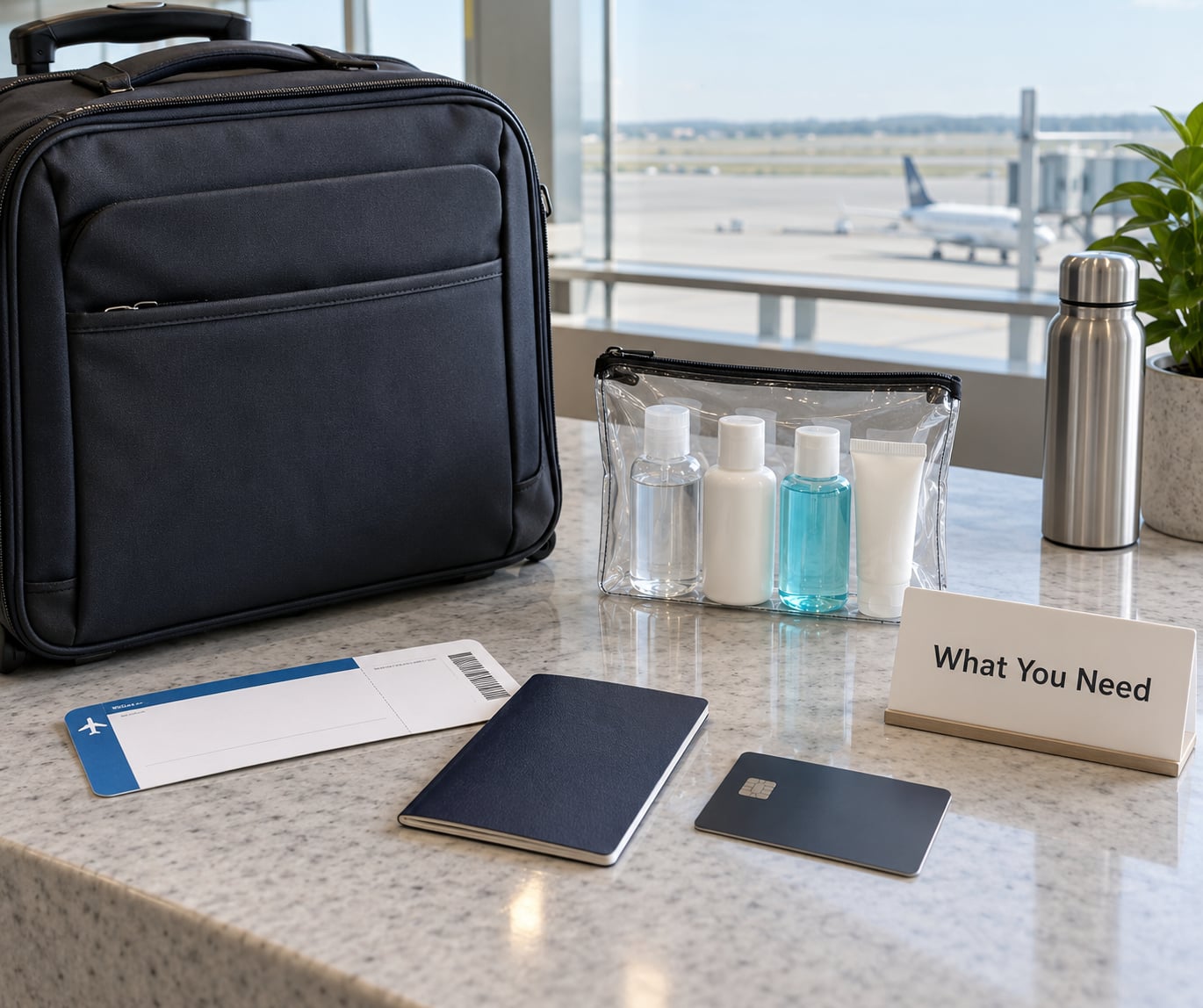
Everything below has to be reachable without opening the bag you are trying to keep closed. That is the whole trick.
- One photo ID that matches your booking, or two if your airline asks for a secondary document. Passports, resident IDs and driving licences are accepted at most checkpoints, but the accepted list is not identical everywhere, so confirm before you travel.
- Your boarding pass on your phone with the screen brightness turned up, or a printed copy. Screenshots are better than a locked phone in airplane mode.
- Your Known Traveler Number, if you enrolled in TSA PreCheck or Global Entry. It lives in an email or app, so pull it up before you leave home rather than at the podium.
- One clear quart-sized bag holding every liquid container: bottles, tubes, sprays, lotions and makeup, each one within the size limit and all of them inside that single bag.
- Medication and medical devices in your carry-on, kept in original labelled packaging, with any device the checkpoint may ask about easy to reach.
- Laptop, tablet and large electronics, plus the cable pouch, if the airport still asks you to remove them. At many US checkpoints you no longer need to, but smaller airports sometimes still do.
- A pen, which sounds trivial and is not. It helps with labels and with filling out any form you are handed.
- A quick rule check on the airport and airline websites before you leave the house: checkpoint locations, operating hours, document rules for your nationality, and any seasonal measures.
If you travel with a child, add their documents and any comfort item they will not surrender without a fight. Put it in the personal item, not the bin.
Step-by-Step: How to Get Through Airport Security Faster
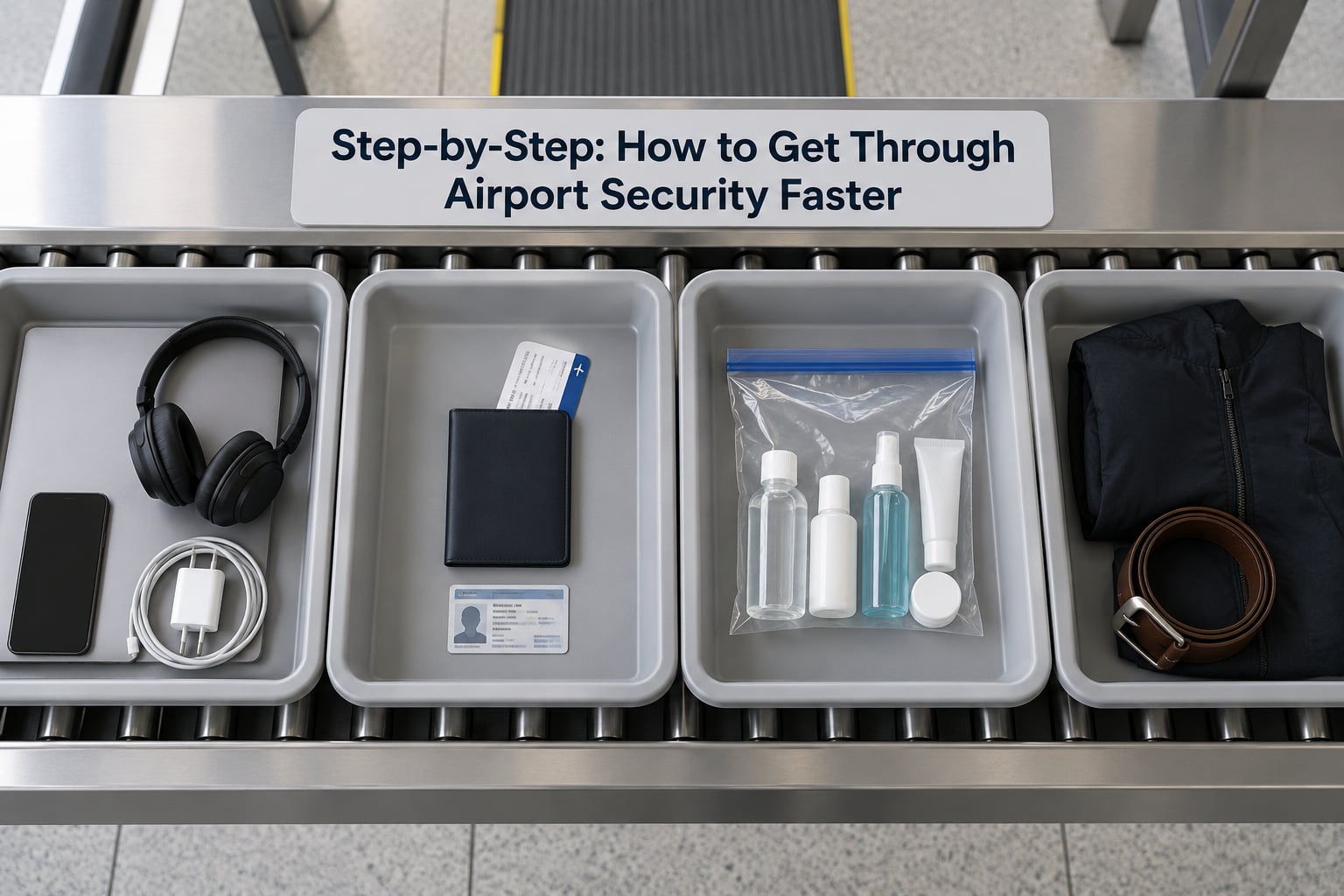
Seven steps, in order, from the night before to walking out the far side. Each one has a signal that tells you it worked.
1. Check the Airport and Airline Rules Before You Leave
Rules are not the same at every airport or in every country, and they change. Check the operating hours of your terminal’s checkpoint, whether your ID type is accepted, and whether your airline requires a specific document for your nationality.
Check one more thing while you are there: where the checkpoint actually is. Huge hubs often have several, and the one that looks closest from check-in may be a forty-minute walk through a concourse. It worked if you know which checkpoint you are aiming for before you land at the terminal.
2. Keep Your Documents and Boarding Pass Ready
This is the step people learn the hard way. The document check is where lines form, and it happens while you are still standing in the queue.
Slide your ID and boarding pass into one folder or photo in your handbag before you join the line. Empty your pockets into that same place while you wait: keys, phone, wallet, coins, boarding pass, pen. Doing it in the queue rather than at the divest table means you walk up to the officer already holding everything.
If you have an Apple Watch or similar, rotate your wrist flat against the reader instead of fumbling for a physical card; people who pair it with a digital ID do it without breaking stride. It worked if you reached the podium and never had to open a bag.
3. Pack Liquids and Electronics for Inspection
The 3-1-1 rule is the short version: each container three ounces or smaller, all of them in one bag, and that bag fits in a quart. In practice it means one clear bag per person, kept at the top of your carry-on so it comes out in one motion.
Beyond that, keep electronics easy to reach and know whether this checkpoint wants them out of the bag. If it does not, leave the laptop in and save yourself a step. If it does, set it on top of your bag rather than in a separate bin; most officers will repack it for you if they can see it clearly.
Empty water bottles are the item people argue about most. A veteran routine described on r/onebag is to take the lid off a bottle so the officer can see it is empty, which removes the conversation entirely. That worked for them, and it costs nothing.
Move solid items out of the liquids bag where you can. A solid shampoo bar or a stick of deodorant is not measured against the limit. It worked if your quart bag holds every liquid in the bag and nothing about it looks improvised.
4. Wear Simple, Easy-to-Screen Clothing and Shoes
Every metal thing is a conversation. Belts with big buckles, chunky jewellery, watches with steel bands, keys clipped to a belt loop and metal-heavy shoes all send travellers to the divest table or secondary screening.
Wear shoes that slip on and off without untying, or elastic laces. Skip the heavy belt in favour of a thin one, take metal accessories off at home rather than in the queue, and if you are wearing something with studs, sequins or dense rhinestones, expect it to be looked at.
A good number of travellers also keep a light jacket on rather than removing it, since the walk-through metal detector rarely flags zippers and thin fabric. It worked if you went through the detector without stopping to undress.
5. Use the Right Queue and Prepare for the Document Check
Look at the lanes before you commit to one. There may be a staffed lane, a PreCheck lane, a lane for passengers with boarding passes only, and a lane for people who need help. Walkers and families with young children are often routed to a shorter accessible lane.
The honest counterpoint, widely reported in r/Atlanta, is that when the PreCheck lane overflows into the terminal it can be slower than the empty general lane. If the general lane has no queue and PreCheck does, take the general lane. Nobody will stop you.
When you reach the podium, answer questions directly and keep your bag closed until you are told otherwise. It worked if the officer handed your ID back without asking you to open anything.
6. Remove Only What You Are Asked to Remove
Follow the officer’s instructions rather than a routine you rehearsed. Some checkpoints want laptops out, some want liquids out first, some want both. Listening takes less time than guessing.
Place items in the bin rather than on the belt, and leave the bin beside the roller so it can ride with you. If you are asked for a bag check, unpack deliberately rather than throwing everything in at once; a bag that is easy to see is a bag that closes in ten seconds.
If you are directed to secondary screening, that is a separate process and you will be told what is happening. It is not a punishment, and it is not a sign you did something wrong. It worked if you stayed calm and answered the officer’s questions, and in my experience that is the only variable you control.
7. Recheck Your Bag and Leave the Security Area Promptly
Before you repack, count your items against what you carried in: phone, wallet, keys, passport, cards, laptop, chargers, medication, liquids bag. Proceeding while quietly convinced you lost something is the worst way to start the rest of the flight.
Walk away from the belt, sit down somewhere out of the flow if you need to repack calmly, and then move on. Loitering at the table or in the corridor creates the next bottleneck for whoever is behind you. A steady pace out of the security area is the last free minute you get back.
Common Mistakes That Slow Down Airport Security
Digging through a bag at the podium
The most common failure by far, and the easiest to fix. One document folder, filled in advance, removes it entirely.
Forgetting that liquids are bagged, not binned loose
Loose bottles mean a full unpack and a repack. One clear quart bag, at the top of the carry-on, everything inside it, no exceptions.
Wearing something you know is awkward
If you already know the belt and the boots are a problem, swap them before the trip rather than explaining it to an officer at 6am.
Ignoring airport-specific instructions
Boarding pass-only lanes, staffed lane closings and seasonal measures all change without warning. Two minutes on the airport site saves a reroute through the terminal.
Leaving items behind after screening
Almost always a laptop or a phone left on the belt. Count your items in the fifteen seconds after you clear the table.
Expecting an expedited lane to always be fast
Travel programmes genuinely help, particularly when queues are long and the lane is short, but they are a tool rather than a promise. Check the queue before you commit.
Believing the screening is random
Passengers sometimes ask why they were pulled aside, and the honest answer is that additional screening uses a mix of factors and officer discretion, so no pattern exists for travellers to reverse-engineer. The practical takeaway is simple: some days you will be pulled aside, so leave a buffer in your schedule rather than betting you will not be.
Believing officers can wave you onto a late flight
They cannot. Security staff have no authority to move you through faster, which is exactly why the buffer matters more than the packing advice.
A few smaller truths round this out. Travellers with a body scanner can decline it and request a pat-down instead, though the alternative takes longer. Children aged 12 and under typically do not need to show ID, and they usually walk with their adult through the screening process. And at some US airports, Touchless ID lets some enrolled travellers confirm identity with a face scan instead of presenting a physical document, which removes the handoff at the podium.
On timing, the pattern that repeats across traveller reports is simple: the earliest departures and the late-afternoon bank are the worst, while mid-morning through early afternoon is calmer. If you have any flexibility in your booking, that is free time you are not using. Where you need assistance, accessibility channels and medical accommodation requests exist at most checkpoints, and asking ahead is smoother than explaining at the podium.
And be courteous. A traveller who empties their pockets in the queue and answers the first question asked moves faster than one who is confused, hurried or arguing with the officer. It is not a trick. It is just less friction.
Frequently Asked Questions
How early should I arrive at the airport to allow time for security?
Aim for roughly two hours before a domestic departure and three for an international one, then add 30 to 60 minutes on peak travel days such as holidays or school breaks. That figure assumes an average queue, and a bad one can double. If you fly often, arriving closer to two hours for a short-haul flight is usually enough.
Can I bring a full-size water bottle through airport security?
No. A full bottle breaks the 3-1-1 liquids rule, so it has to be emptied, refilled after screening or checked. Nearly every airport has a free bottle-filling station past security. A partly empty bottle in your bag is one of the most common reasons travellers get pulled for a bag check.
Do I need to remove my laptop and other electronics at screening?
It depends on the checkpoint. Many US airports now let you keep laptops, tablets and large electronics inside your bag, while smaller airports and some other countries still ask you to remove them. Check the airport’s own guidance before you fly, and keep cables in a small pouch at the top of the bag so removal takes seconds if it is required.
Does PreCheck or another trusted-traveler program guarantee faster security?
No program guarantees a time, because queue length depends on the airport, the hour and how many people are in front of you. Members usually get into a shorter dedicated lane, which helps most at busy times. Reports of the expedited lane being slower than an empty general lane are common enough that it is worth glancing at both before you join one.
What should I do if I am selected for a secondary screening?
Stay calm and cooperative, tell the officer before you move if you have a medical device, implant or mobility aid, and ask for a private room if you need one. It is an additional check, not an accusation, and it usually adds several minutes. Do not volunteer explanations nobody asked for, and keep your documents and phone accessible for the rest of the trip.
Can I skip airport security with a family or group?
There is no group fast track, but travelling with a child does help in practice. Children aged 12 and under usually do not need to show ID, and at many airports a family is directed together through a shorter lane, sometimes the accessible one. Every person still passes through the checkpoint, and each needs their own boarding pass and liquids bag.
Prepare the night before: documents in one folder, liquids in one quart bag, shoes and belt chosen for easy screening. Then leave a real buffer for the unexpected, because the queue you cannot plan for is the one that decides your day.