Learning how to avoid jet lag flying east comes down to one honest fact: you cannot fully prevent it, but you can shrink it to one rotten afternoon instead of three ruined days. Flying east means phase-advancing your body clock — sleeping earlier, not later — and the fastest way to move that clock is bright outdoor light in the first hour after you land. Every other step below exists to support that one lever.
This matters more than most “jet lag tips” lists admit. Crossing time zones eastward costs roughly a day and a half of adjustment for every zone, compared with about a day going the other direction. A New York to London trip is five or six zones east. That is why so many people spend their first two days in Europe slightly drunk on fatigue, misjudging prices, and calling it the flight.
What follows is a plan you can run from three days before departure to the first night at your hotel: when to shift your sleep, when to seek light and when to block it, what to eat and drink at altitude, and what to do in the first twelve hours after landing. It also treats melatonin honestly, including why it feels useless to a lot of people and who should skip it entirely.
Table of Contents
- 1What You Need Before an Eastbound Flight
- 2Step-by-Step: How to Avoid Jet Lag Flying East
- 3How Many Days Before Flying Should I Shift My Sleep?
- 4How to Avoid Jet Lag Flying East: When to Seek Light and Avoid It
- 5How Do I Sleep Better on an Eastbound Flight?
- 6What Should I Eat and Drink on an Eastbound Flight?
- 7How Do I Adjust After Landing in the New Time Zone?
- 8Common Mistakes That Make Eastbound Jet Lag Worse
- 9Frequently Asked Questions
- 10Can you completely prevent jet lag when flying east?
- 11How many days before an eastbound flight should I change my sleep schedule?
- 12Should I stay awake for the entire flight to avoid jet lag?
- 13Does staying hydrated prevent jet lag?
- 14What is the best strategy for a long overnight flight east?
- 15When should I seek daylight after arriving east?
- 16Conclusion: What to Do First
What You Need Before an Eastbound Flight
Most failed jet lag plans fail because they were generic. Before you do anything else, pull up five specifics for your actual itinerary, because the plan changes completely between a three-zone hop and a nine-zone crossing.
- The time difference. Count the zones, not the hours of flight time. Three zones need a light nudge; nine zones need a structured week.
- Your arrival clock time. What time is it locally when the wheels touch? This single fact decides whether you sleep on the plane or stay awake through it.
- Flight duration and departure time. A 6 a.m. departure and an 11 p.m. departure are two different problems.
- Your normal wake time and how well you sleep. Shifters, parents of young kids, and light sleepers need a gentler version of this plan.
- Light-blocking gear. A blackout eye mask, a neck pillow, and sunglasses you can wear over your eyes during the flight. A good eye mask matters more than any gadget.
One more thing worth checking: whether your hotel can give you a dark, quiet room on arrival night, and whether you have a dark room at home for the pre-flight shift. Adjusting your sleep earlier is far easier somewhere you can keep the lights off.
Step-by-Step: How to Avoid Jet Lag Flying East
How Many Days Before Flying Should I Shift My Sleep?
Start three to five days out, and move your bedtime earlier by 30 to 60 minutes per day. That is the whole method: a gradual phase advance that lets your clock follow you instead of being shoved.
Do it by degrees. Shift wake time first if you can, because an earlier wake with the same bedtime is the fastest way to build sleep pressure and pull sleep onset forward naturally. Dim the lights in the last two hours of the evening, put screens on a timer, and be in bed with the lights off by your new time.
A five-zone example, New York to London: five days out, lights out at 22:30 instead of 00:30. Four days out, 22:00. Three days out, 21:30, with breakfast moved to 07:00 and dinner to 18:00. Two days out, 21:00. On departure day, a 21:00 bedtime gives you three of the five hours you gained, and the flight covers the rest.
A harder case, six to eight zones east, such as Los Angeles to Tokyo: give it the full five days and accept a 21:00 or 21:30 target bedtime. Packing that much advance into two days means sleep deprivation, which is not adjustment. You will be tired before you board, land wrecked, and blame the flight for something your own alarm did to you.
If your trip continues further east — land in London, fly on to Dubai — repeat the shift for the second leg rather than resetting to home time in between. Frequent flyers who keep their whole itinerary on one clock usually have a much easier second destination than those who go back to origin time on arrival.
How to Avoid Jet Lag Flying East: When to Seek Light and Avoid It
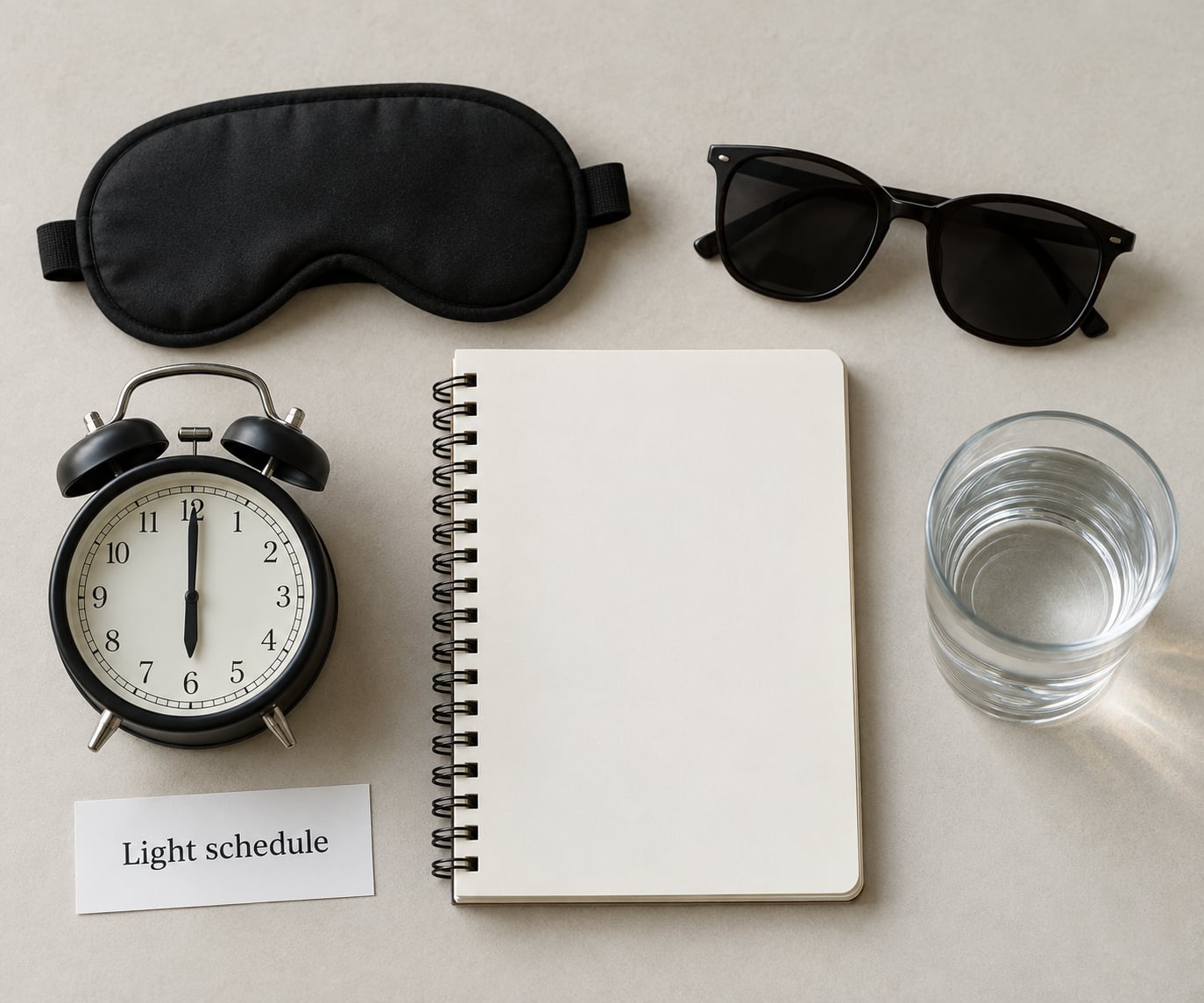
Light is the primary signal your body clock uses, and it is the one lever that can move the clock quickly. Morning light advances it, which is exactly what you want when flying east. Evening light delays it, which is the opposite of what you want.
So the eastbound rule has two halves, and people only ever hear the first one.
- Seek light early in the destination day. Outdoor light within one to two hours of waking at your destination is the strongest single action in this guide. Go outside rather than sitting by a window; the intensity difference is large even on an overcast day.
- Avoid light late in the destination day. Keep the evening dim on arrival. Skip the bright dinner, the 11 p.m. work block, and the hotel room with every lamp on. This half is what stops you from undoing your own progress.
| When | Flying east | Flying west |
|---|---|---|
| Evening before departure | Bright light, dim later | Dim light from early evening |
| During the flight | Block light with an eye mask or sunglasses to avoid late-day exposure | Stay in bright cabin light if the clock needs delaying |
| First morning at destination | Outdoor light within 1-2 hours of waking, the key step | Avoid bright light in the morning, seek it late |
| First destination evening | Keep it dim, screens low, be in bed at local bedtime | Light exposure in the evening is helpful |
The in-flight light rule is the most east-specific thing in this guide, and almost nobody gets it right. If you are on an overnight eastbound flight and it becomes destination late evening or night, block the light. An eye mask does it. If you do not have one, sunglasses over the eyes at the window seat does the same job, which looks strange and works.
Now the contradiction everyone hits: “should I sleep on the plane or stay awake?” The answer depends on arrival time. If you will land in the local morning, stay awake and use caffeine. If you will land in the local evening or at night, sleep for most of the flight, because staying awake until a 10 p.m. arrival guarantees you will be exhausted and unable to sleep. Long-haul crew and seasoned travellers converge on this: sleep on the flight when the destination bedtime is the one you need.
How Do I Sleep Better on an Eastbound Flight?
Pick your sleep window from the destination clock, then protect it like you are guarding a meeting. The first two hours after boarding are usually the easiest to sleep in if the lights go off, so change your watch at the door and use that early window.
Your kit matters more than people expect. A blackout eye mask that seals around the nose and cheekbones, earplugs or noise-cancelling headphones, and a neck pillow that stops your head tipping forward are the three things that make in-flight sleep actually happen. Cabin dry air dries the throat and nasal passages, so water and a slow steady hydration rhythm help you stay asleep rather than waking with a headache.
On caffeine, use it deliberately and stop early. Coffee or tea on boarding and around the middle of the flight is fine; caffeine after the midpoint of the flight lands in your bloodstream near destination bedtime, which is the opposite of what you want. On alcohol, skip it entirely: it fragments sleep, promotes dehydration in dry cabin air, and helps you wake at 3 a.m. feeling worse.
Get up and move every couple of hours. A walk down the aisle, some calf raises at the seat, and a few ankle circles cost you nothing and help with circulation on any long flight.
On melatonin: if you want to use it, low doses are the convention. Sleep clinics commonly suggest a small dose in the evening before departure, then a small dose at your destination bedtime for the first few nights, stopping once you are sleeping through. The dosing below is a summary of ranges that circulate in clinical guidance, not personal medical advice.
| Timing | Commonly cited range | Note |
|---|---|---|
| Evening before departure | 0.5-3 mg, taken 1-2 hours before your home bedtime | Aim for a nap, not a full night of sleep |
| On the flight, if you plan to sleep | 0.5-3 mg after boarding, at your destination bedtime time | Only useful if arrival is local evening or night |
| First nights at destination | 0.5-3 mg 30-60 minutes before local bedtime | Stop after 2-4 nights once sleep is normal |
| Long trips, 7+ zones east | Often continued for up to 5 nights | Discuss with a clinician before extending it |
Why does melatonin feel useless to so many travellers? Usually the dose is too high and the timing is too late. More is not better with this hormone, and 5 or 10 mg produces grogginess that can outlast the flight, which is exactly what a business traveller cannot afford. It also does nothing for the body clock on its own: it nudges sleep timing, while light exposure does the real phase shifting. Take it with a light plan or it will disappoint you.
Ask a doctor or pharmacist before taking it regularly if you are pregnant, take anticoagulants or other blood-thinning medication, have autoimmune disease or epilepsy, or are giving it to a child. Melatonin is a supplement, not a sedative, and supplement quality varies widely between brands.
What Should I Eat and Drink on an Eastbound Flight?
Eat on the destination clock, not the origin one. If the plane leaves at 18:00 for a 6 a.m. arrival, have your main meal then and keep snacks small. Eating a heavy dinner at midnight because that is your home clock hands your digestion work it should not be doing at the wrong time.
On hydration, pace fluids rather than flooding yourself. Dry cabin air and altitude cause real discomfort, and steady water intake helps more than a litre at once. Spread it across the flight, and include something with electrolytes if you are drinking a lot of coffee. Overcorrecting with nothing but large volumes of water leaves you needing a bathroom at 30,000 feet.
Skip alcohol, as above, and avoid heavy or greasy food right before and during the flight. Something like a sandwich, a grain bowl, or fruit is easier on the body than a rich meal at altitude.
What about fasting or feasting diets marketed for jet lag? They circulate widely and the evidence behind them is genuinely contested; researchers disagree about whether meal timing moves the clock at all. If you enjoy them, they are harmless enough as a habit. Just do not expect them to replace the light timing that does the real work.
How Do I Adjust After Landing in the New Time Zone?
The first twelve hours decide how long the rest of the trip feels rough. Here is the version that works for a morning landing, which is the easiest case.
- Get outside within one to two hours of waking. A walk, a coffee on a terrace, anything outdoors. This is the most important item on the list.
- Eat breakfast on local time, even if you are not hungry. Meal timing is a secondary cue that helps the clock settle.
- Caffeine before early afternoon local time, then stop. A late coffee is a nap you will pay for at 4 a.m.
- Keep naps to 20 to 30 minutes, and set an alarm. A long nap on arrival day guarantees a 3 a.m. wake-up.
- Stay awake until local bedtime, then treat it as fixed. Even if you are not tired. Do not go to bed at 21:00 because you are exhausted, and do not stay up until 02:00 because the bar is good.
- Keep the evening dim. Low lamps, warm bulbs, phone brightness down. The second most important item on the list.
If you land in the evening instead: do not go to bed at your normal home bedtime, and do not force yourself to stay up until midnight. Have a light meal, keep the lights low, and sleep at a time that is close to local night. Landing at 22:00 local with a 04:00 body clock is a losing hand, and the best recovery is simply to go to bed a few hours earlier than feels natural and reset tomorrow morning.
On day two, repeat the pattern: outdoor light early, meals local, naps short, lights low at night. Most people doing this properly feel roughly functional by day two and properly aligned by day three or four for a five- or six-zone trip.
Common Mistakes That Make Eastbound Jet Lag Worse
- Staying up for the whole flight. Fine if you land in the destination morning. Ruinous if you land at 10 p.m. and spend nine hours telling yourself you are tough.
- Sleeping through the entire flight and landing at 3 a.m. You will wake at local midnight with nothing to do and nowhere to be until an unreasonable hour.
- Forcing an early bedtime on arrival. If you are exhausted but cannot sleep, stay up until your normal time rather than lying awake for three hours. Then sleep at local bedtime.
- Treating a 48-hour trip like a long one. Below about 48 hours or two zones, skip the pre-flight shift entirely and just use caffeine and light. Shifting your sleep for a long weekend is more disruptive than the trip.
- Taking 5 or 10 mg of melatonin. You get grogginess, not adaptation. Low doses work better for most people.
- Treating a supplement as the plan. Melatonin, magnesium, and appetite-based diets are additions. Light timing and sleep scheduling are the plan.
- Arriving without an anchored morning. Nothing on the arrival schedule works if there is no outdoor light appointment in it. Put it in your calendar before you fly.
- Drinking heavily in the air. Alcohol plus dry cabin air is the standard route to waking up at 04:00 local feeling worse than when you boarded.
- Buying a jet lag app and nothing else. Planning apps such as Timeshifter or Uplift are useful for computing light and sleep timing for your specific route. They do not do anything on their own.
Some extra notes for particular travellers. With children, light timing still works and melatonin should only be used with a paediatrician’s advice, usually as a small dose on a night flight. For older travellers, the risk is not the clock so much as daytime naps, dehydration, and falls at odd hours, so keep the room dark and the route short. For business travel with a meeting on arrival day, work backwards from the meeting: if it is at 09:00, you need outdoor light by 08:00, which means an early night before the flight and no long lunch nap.
Frequently Asked Questions
Can you completely prevent jet lag when flying east?
No. Your body clock can be moved faster than it moves on its own, but you cannot skip the adaptation entirely. Travellers who follow a light and sleep schedule usually lose half a day rather than two or three full days. Short trips of two zones or less, and trips under 48 hours, often need no adjustment at all.
How many days before an eastbound flight should I change my sleep schedule?
Start three to five days before departure and move bedtime earlier by 30 to 60 minutes each day. Three or four zones can often be handled in three days; six zones or more deserve the full five. For nine-zone crossings, more than a week is worth it. Do not try to compress it by staying up all night.
Should I stay awake for the entire flight to avoid jet lag?
Only if you will land in the destination morning. Staying awake through a flight that lands at 10 p.m. means going to bed exhausted at an hour your body does not recognise, and waking at 3 a.m. If arrival is evening or night, sleep for most of the flight and treat your wake time as the destination bedtime you need.
Does staying hydrated prevent jet lag?
No, but it prevents the headache and grogginess that people often mistake for jet lag. Dry cabin air and altitude make you uncomfortable and mildly dehydrated, and steady fluid intake eases both. Drink at a normal pace across the flight and include electrolytes if caffeine is high, rather than trying to overcorrect.
What is the best strategy for a long overnight flight east?
Change your clock when you board, block light with an eye mask, and sleep during the window that matches destination night. Skip alcohol, keep caffeine to the first half of the flight, and walk the aisle every couple of hours. Get outdoor light within one to two hours of waking at your destination, then keep the local evening dim.
When should I seek daylight after arriving east?
As early as you reasonably can, ideally within one to two hours of your local wake time, and outdoors rather than by a window. Morning light advances your body clock, which is what eastbound travel needs. The flip side matters just as much: keep the local evening dim, or you will undo the morning gain after dark.
Conclusion: What to Do First
Start with three things. Count your time zones, because three zones and nine zones need completely different amounts of preparation. Begin moving your bedtime earlier 30 to 60 minutes a day, three to five days out, without depriving yourself of sleep. And put an outdoor light appointment in the morning after you land, because that single habit does more for eastward jet lag than any supplement on the market.
Everything else — melatonin, apps, meal timing, hydration — supports those three. Get them right and the trip usually costs you a rough afternoon instead of two lost days, which for a business traveller is the whole point.