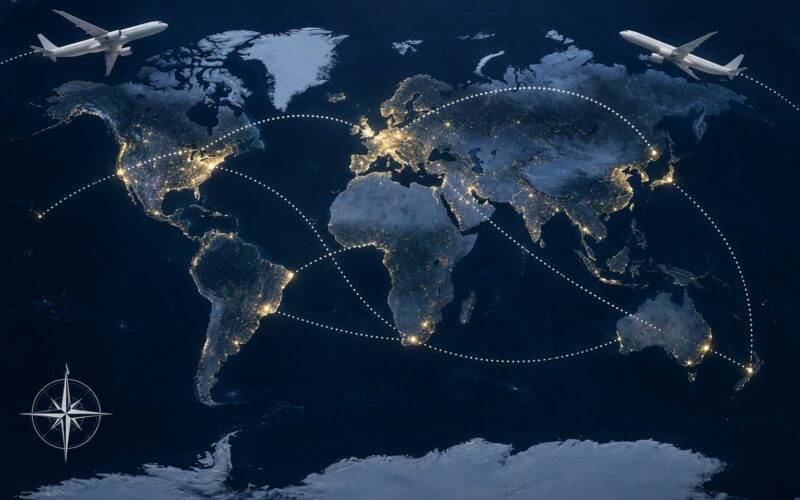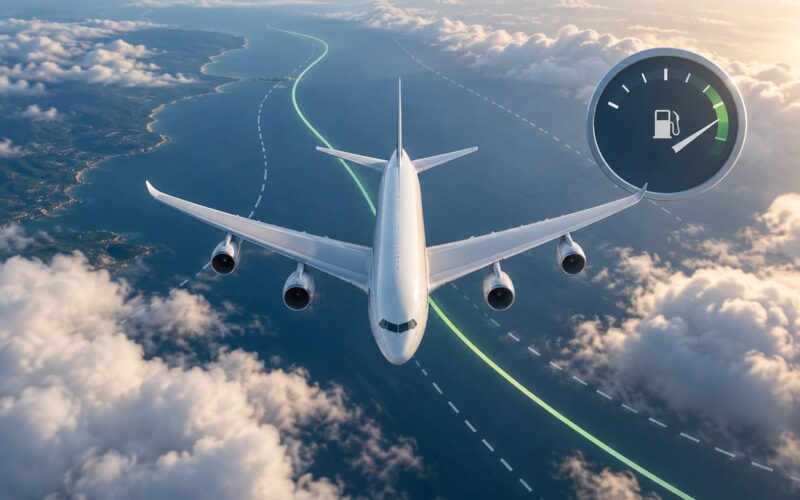
Understanding how the longest nonstop flights are operated comes down to a chain of decisions that has to hold together from the load sheet to the arrival gate. An airline selects an ultra-long-range wide-body, files an oceanic flight plan routed around the jet stream, loads fuel to the tank and weight limits while cutting payload, augments the flight deck crew so pilots can rest, confirms a suitable diversion airport under ETOPS rules, and runs a bunked cabin service plan for the whole sector.
That answer holds in 2026 more than it ever has, because the aircraft now flying these sectors are purpose-built for them and the routes have become routine rather than experimental. Schedules and equipment still change, so treat any specific flight time you read as a snapshot rather than a fact to plan a trip around.
Below is how the operating chain actually works, from the first load sheet to the arrival turn. It is the explanation most “longest flight” lists skip, and the part that explains why a fifteen-thousand-kilometre hop takes eighteen hours rather than fourteen.
Table of Contents
- 1How the Longest Nonstop Flights Are Operated
- 2Aircraft choice and why ultra-long-range variants exist
- 3The regulatory ceiling: ETOPS, reserves and alternates
- 4Why airlines choose a specific route for an ultralong nonstop
- 5How aircraft range is calculated for these flights
- 6What dispatchers check before the aircraft departs
- 7How the Longest Nonstop Flights Are Operated Step by Step
- 8How the Longest Nonstop Flights Are Operated, Hour by Hour
- 9How the flight crew and cabin crews work in shifts
- 10What happens if the weather or route changes
- 11What passengers experience on flights lasting 17 to 20 hours
- 12Frequently Asked Questions
- 13What is the difference between longest nonstop distance and longest flight time?
- 14Why do some very long routes have a flight shorter than expected?
- 15Do airlines carry enough fuel to return to the departure airport?
- 16What happens if a passenger becomes seriously ill on an ultralong flight?
- 17Can one airplane type always operate the same ultra-long-haul route?
- 18Why do flight attendants sit down for much of a long flight?
- 19What to understand first about these flights
How the Longest Nonstop Flights Are Operated
Short version: the crew picks an aircraft whose certified range covers the sector with margin, plans a route through favourable winds, carries fuel for the trip plus the legally required reserves plus extra contingency, flies with more pilots than a short sector needs so they can rotate rest, and keeps one or two airports identified at all times as places to land if something goes wrong.
Every part of that is constrained. Range has to be earned with fuel weight, passengers weight, cargo weight and reserves all competing in the same aeroplane. The crew complement is set by regulation, not by preference. The diversion airports exist because a twin-engine jet over open water has nowhere to go at short notice. Nothing about the sector is improvised in the air.
Aircraft choice and why ultra-long-range variants exist
The workhorses are wide-body twin-engine jets in long-range or ultra-long-range forms. Published figures vary with configuration and payload, so treat the numbers below as orientation rather than specification.
| Variant | Approximate published range | Role on these sectors |
|---|---|---|
| Boeing 777-200LR | around 15,000 to 16,000 km | Long-standing choice for heavy long-haul and cargo combinations |
| Airbus A350-900ULR | around 15,000 km | Bought specifically to reach thin long-haul markets nonstop |
| Boeing 787-9 | around 14,000 km | Good fit where lower fuel burn matters more than maximum reach |
| Airbus A350-1000ULR | around 16,000 km | The next reach step up, aimed at routes that today still require a stop |
The ULR label means ultra long range, and it usually signals a specific market: an airline that decided flying the long way round was worth the cost of a fleet that can only do one thing exceptionally well. Those aircraft often carry reduced payload and reduced fuel reserve margins compared with the standard variant, which is the trade-off behind the marketing.
The regulatory ceiling: ETOPS, reserves and alternates
ETOPS is the framework that decides how far a twin-engine aircraft may be from a diversion airport. Its category determines the planned single-engine cruise time to a suitable runway at the assumed diversion altitude. Longer approval means longer stretches with one engine shut down still covered by fuel, which is what allows an oceanic sector of this length to exist at all.
On top of that sit fuel reserves the airline is not allowed to spend on the flight itself, an alternate airport with a runway long enough and an approach that works for the aircraft in the expected conditions, and often a second alternate for a different wind pattern.
Why airlines choose a specific route for an ultralong nonstop
A route only works if several things line up at once: enough passengers and cargo between two airports, an aircraft that can fly it legally, a partner airport with suitable slot availability, an alternate somewhere sensible, and a schedule that arrives when people want to arrive.
Winds matter as much as geography. A jet stream blowing west to east at high altitude can add or subtract a couple of hours from the same pair of cities, which is why an eastbound flight often lands sooner than a westbound one covering identical distance. Dispatchers plot the forecast winds aloft for the whole flight and choose a track that uses them.
Distance is also not a single number. Great-circle distance is the shortest path over the earth’s surface. The distance actually flown is longer, because the aircraft follows airways, avoids restricted areas and weather, and takes a path that matches the wind field. Schedules advertise block time, which includes taxi, climb and descent rather than just the airborne portion, and that is why published hours look longer than the cruise math suggests.
How aircraft range is calculated for these flights
Still-air range is the distance the aircraft covers in calm conditions at long-range cruise speed with no wind. It is the marketing figure. Stage length is what an airline actually plans for. Dispatch range is the distance remaining after reserves, contingency and any required holding are subtracted, and it is the number that has to clear the route.
Because fuel weighs what it weighs, every kilogram of passenger, baggage or cargo eats distance. That relationship is the payload-range trade-off, and it is why these flights are not simply full:
- Passengers and baggage. A full cabin on an ultra-long sector is uncommon; load factors are often managed down to protect the fuel figure.
- Cargo. Belly-hold freight is priced against the fuel it consumes, so on the longest sectors some carriers limit what they will carry.
- Weather. Headwinds, colder-than-forecast air and air traffic control routing all consume the margin.
- Reserves. Final reserve fuel, alternate fuel and contingency fuel are carried but never planned to be used.
- Routing. A longer flown track, or one forced around weather, directly reduces available payload.
| Factor | Effect on the distance actually available |
|---|---|
| Larger fuel load | More range, less payload capacity |
| More passengers aboard | Less range for the same tank |
| Strong tailwinds aloft | Less fuel burned, more margin left |
| Strong headwinds aloft | More fuel burned, payload may be cut |
| Route longer than the great circle | Range reduced in proportion |
| Extra contingency fuel carried | Payload reduced |
A dispatch release may show a planned figure with very little spare. When the forecast winds deteriorate, the answer is usually not to carry more fuel, because the tanks and the weight limits have already been set. It is to reduce the load, delay the departure, or operate the flight with fewer people and bags.
What dispatchers check before the aircraft departs
Dispatch is where the sector is actually made to work, and it happens hours before anyone pushes back. The flight plan follows a sequence that looks roughly like this.
- Weather and wind analysis. Surface conditions at both ends, winds at every level, and the jet stream structure for the whole route.
- Forecast turbulence and significant weather. Convective cells, clear-air turbulence areas and anything volcanic, which routes get amended or closed.
- Airway and airspace availability. Military reservations, restricted areas, oceanic track structures and busy terminal airspace that can force long detours.
- ETOPS verification. Confirming the aircraft and crew combination is approved for the planned diversion time, and that the required alternates meet the stated runway and approach conditions.
- Fuel policy. Route fuel plus reserves plus contingency plus any additional fuel the airline’s policy demands for a sector this length.
- Load confirmation. Passenger count, baggage and cargo weighed against the fuel figure, with loads trimmed if the margin is thin.
- Final release. A filed, signed flight plan the flight crews carry and can amend with air traffic control as conditions change.
The result is not a promise that nothing will go wrong. It is a documented plan with defined points at which the crew can change it safely.
How the Longest Nonstop Flights Are Operated Step by Step
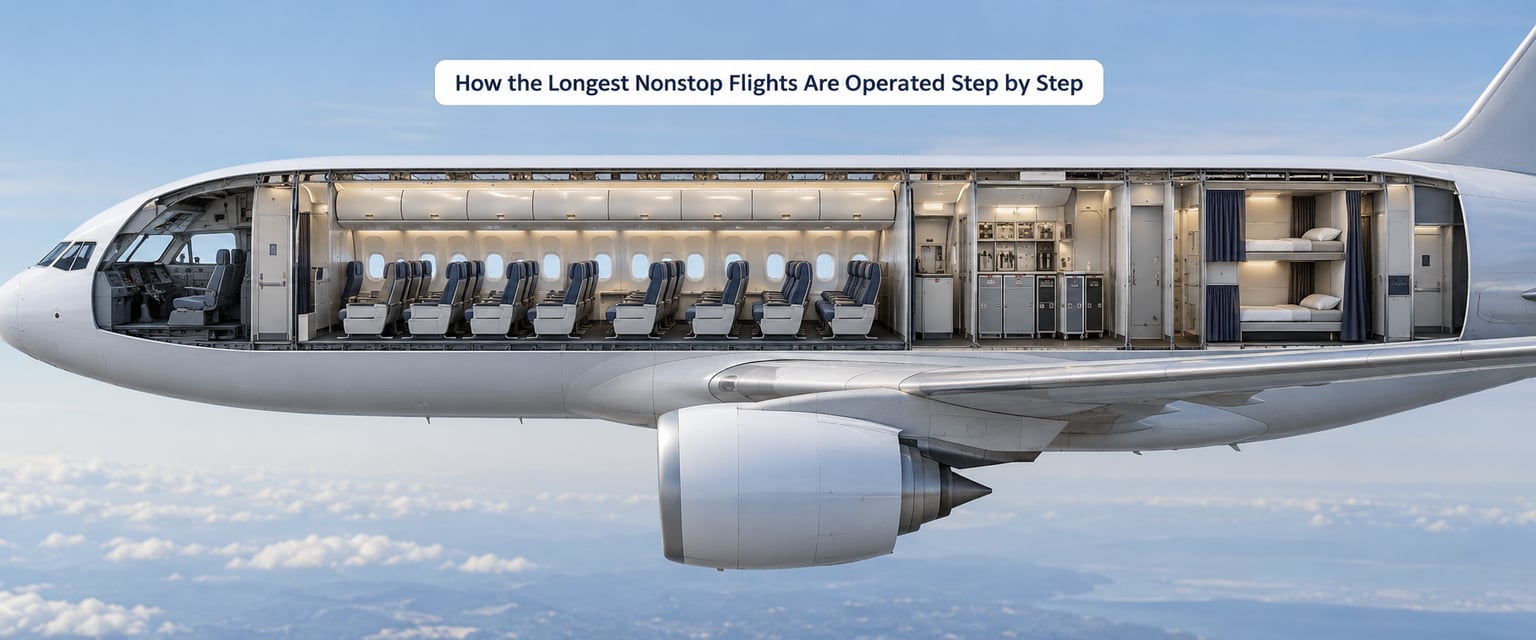
From boarding to the arrival gate, an ultralong nonstop runs in a fixed order, and each stage has its own crew priorities.
- Pre-flight and load. Aircraft released, passenger and baggage loading reconciled against the load sheet, door closed, weight and balance confirmed. Doors close earlier than on a short sector because the fuel load takes longer to finish.
- Pushback, taxi and departure. Slot assignment honoured, departure runway selected, performance computed for the actual weight, which on a fully fuelled ultralong aircraft is at the heavy end of the envelope.
- Climb. Rapid climb to an initial cruise level, then step climbs through the flight levels as fuel burns off and winds improve. Long-haul aircraft rarely cruise high for the whole flight.
- Early cruise. The crew settles into the climb-and-cruise routine, passenger service begins, and the flight deck takes position reports at intervals set by air traffic control.
- Middle cruise. Two to four hours in, the first flight deck crew members take their in-flight rest in the cockpit rest area. Meals are served in two or more services rather than one, timed around crew rest windows.
- Later cruise. The cabin crew takes its own bunked rest, connectivity traffic is managed, and the flight plan is amended for winds or traffic as the destination approaches.
- Descent and arrival. Top of descent, arrival sequencing across a very large time zone spread, approach briefing with alternates reviewed again, and landing at an aircraft weight far above anything a short sector would produce.
- Turn. Passengers clear, cleaning and catering restock begin, the crew completes paperwork and lands their duty hours or is relieved, and the aircraft may fly again the same day on a shorter sector.
How the Longest Nonstop Flights Are Operated, Hour by Hour
Splitting the sector into a first hour, a long middle and a last hour shows why these flights feel strange. The first hour is busy and noisy and everyone is awake. The middle is quiet, dark and repetitive. The last hour is a compressed version of arrival on any flight, except the crew have been awake or asleep on their own schedule for the best part of a day.
How the flight crew and cabin crews work in shifts
Regulations cap how long a crew member may work, how many hours they may be on task before rest, and how much rest they must receive before the next duty. On a sector long enough to break those rules, the airline adds people rather than ignoring them.
An augmented crew means more flight deck crew than a short flight needs. On the longest sectors that typically means a captain, a first officer and additional qualified pilots who rotate through rest periods in the cockpit rest area. Handovers at the controls are brief and formal: the incoming pilot takes over in stages rather than appearing suddenly, and the outgoing pilot confirms the aircraft state verbally.
Cabin crew work a similar pattern. They run the early services, hand the cabin over to a relief team partway through, sleep in bunks in a crew rest area, and return for the descent and landing. They stay on duty for the whole sector, but a large share of it is scheduled rest rather than active work. Pilots and cabin crew describing ultra-long sectors on aviation forums repeatedly describe the same rhythm: service, a walk down the aisle, then hours of sitting or sleeping while the flight continues.
Medical readiness comes with the extra time. Kits on board are more complete than on short sectors, and crews are trained for a medical event at altitude. When something happens, the cabin is used as a treatment area and the aircraft’s routing and speed become a medical decision, since a faster flight may mean getting to a diversion airport sooner.
What happens if the weather or route changes
On a sector with no fuel stop, the weather is not something the crew waits out. It is something the flight plan was built to absorb.
A forecast headwind worse than planned reduces the margin that was protecting payload. The response is a decision made on the ground before departure, or a re-route aloft toward the jet stream. Severe turbulence triggers an altitude change or a request for a different track. Thunderstorms are avoided by deviation, not by penetration. Volcanic ash closes airspace outright, and no aircraft flies through it regardless of how much fuel is on board.
Arrival-side problems are handled the same way. A closed runway or a congested arrival bank means holding, an earlier descent profile, or a diversion to an alternate. The alternates identified at dispatch stay live throughout the flight, and the crew re-checks them as the flight progresses, because an airport that was suitable at departure may have changed conditions.
If fuel becomes the deciding factor and the aircraft cannot continue safely or reach the planned destination, the crew can dump fuel to reduce weight and handling issues, or return to a suitable airport. Pilots do not continue into a situation they cannot resolve. That is the point of the reserve fuel carried from the start.
What passengers experience on flights lasting 17 to 20 hours
Cabin design on these routes is built around the length of the sector. Premium cabins usually use lie-flat seats, and the seat density is often lower than on a standard long-haul, because the airline knows passengers will be in the seat far longer. Laveatories and galleys are distributed so that a long walk is not needed for a single service.
Meals arrive in more than one sitting, and because the sector covers a large part of the day, your body clock will be out of step with both meal times and daylight outside the window. Drink water steadily rather than in one go, move around the cabin every couple of hours, and expect your legs to feel stiff in the second half.
Sleep is the part most people plan around. An eye mask and earplugs make the first rest period workable, and choosing a seat away from the galley and lavatories trades noise for a slightly worse view. Cabin crew on these flights describe the same passenger pattern: a service pass, then long stretches of quiet.
Arrival is the part that surprises people. You land in the middle of the day or the middle of the night depending on which way you flew, and your body clock may still be on the departure time zone. Some travellers find the nonstop harder on jet lag than a shorter connection, because a stop and an overnight rest can absorb the transition. There is no rule about which is better; it depends on how you sleep and how long you have at the other end.
Frequently Asked Questions
What is the difference between longest nonstop distance and longest flight time?
Distance and duration are ranked differently. Distance uses the great-circle figure between the two airports, which never changes. Flight time depends on the winds aloft on the day, the route flown and the aircraft, so the same pair of cities can be quicker or slower from one schedule to the next. A route can rank first by distance and not first by duration.
Why do some very long routes have a flight shorter than expected?
Because winds aloft do most of the work on a sector this long. A strong tailwind over the North Atlantic or North Pacific cuts hours off the same distance flown, while a headwind adds them. The route also has to bend around restricted airspace and traffic, so the flown distance exceeds the great-circle distance. Published block time includes taxi and climb as well.
Do airlines carry enough fuel to return to the departure airport?
Not as a plan. Fuel is loaded for the route to the destination plus final reserve fuel, alternate fuel and contingency fuel, and some airlines add extra on the longest sectors. The concept is that an engine failure or a pressurisation problem leaves enough fuel to reach a diversion airport within the aircraft’s ETOPS approval time, not enough to turn back to the departure field.
What happens if a passenger becomes seriously ill on an ultralong flight?
The cabin crew handle first response using the medical kit on board and contact the airline medical team by satellite link. The flight deck assesses whether continuing to the planned destination or diverting to an earlier suitable airport is the safer option, which can involve changing the routing or requesting priority handling. Diversion time on these sectors is measured in hours, which is why early assessment matters.
Can one airplane type always operate the same ultra-long-haul route?
No. Range depends on the payload and the winds, and the payload depends on how many people and how much freight are aboard. A long-haul sector may need a 777-200LR in one season and a different aircraft in another, and some routes swap between wide-body types. Airlines also assign equipment by fleet availability, so the aircraft on a specific flight can change without notice.
Why do flight attendants sit down for much of a long flight?
On a sector long enough to require an augmented crew, cabin crew work in relief teams with scheduled bunked rest partway through the flight. They stay on duty throughout, but the rest periods are built into the operation by regulation and by the airline’s duty rules. That produces the familiar pattern of an early service, an aisle walk, then long quiet stretches with the crew seated or asleep.
What to understand first about these flights
The achievement behind the longest nonstop flights is not one big aeroplane flying far. It is an aircraft matched to a route, a dispatch release built around forecast winds and legal reserves, a crew large enough to rest properly, air traffic control routing that clears the way across a third of the world, and a diversion airport that stays available the whole way.
Any of those can end the flight early, and that is the design. The system is built so that when something goes wrong, there is a defined answer that does not involve improvising at 38,000 feet over open water.
Before you book or quote a figure, check the current schedule and the aircraft assigned on your specific flight. Any write-up of how the longest nonstop flights are operated is only as current as the schedule data behind it: routes change, equipment gets swapped, and a flight that took eighteen hours last season can take a different time next season. Last checked for 2026 schedules and aircraft options; verified against airline and industry schedule data.