
An ultra long haul flight is a nonstop commercial flight scheduled to last more than 16 hours, typically covering roughly 8,000 miles (13,000 km) or more. It is the longest tier of air travel, flown by wide-body aircraft such as the Airbus A350-900ULR and the Boeing 787 Dreamliner.
Most people meet one by accident, booked onto a Sydney-to-Singapore or Los Angeles-to-Auckland itinerary without quite realising what they signed up for. Others chase them deliberately, comparing block times on a route map the way other travellers compare seat maps.
Route times and aircraft below were cross-checked against published schedules and manufacturer figures in October 2026. Treat every number as approximate: winds, seasonality, airspace closures and aircraft swaps all move the real-world figure.
Table of Contents
- 1What Is an Ultra Long Haul Flight?
- 2How Is an Ultra Long Haul Flight Measured?
- 3Ultra Long Haul Flight Distance and Duration Examples
- 4Why Are These Flights So Long?
- 5Can You Fly an Ultra Long Haul Route Nonstop?
- 6What Aircraft Are Used on Ultra Long Haul Flights?
- 7How Do Stops Affect an Ultra Long Haul Trip?
- 8How Does an Ultra Long Haul Flight Affect Your Body?
- 9How to Prepare for an Ultra Long Haul Flight
- 10Frequently Asked Questions
- 11How many hours is considered an ultra long haul flight?
- 12Are ultra long haul flights always flown nonstop?
- 13Which aircraft type is best for an ultra long haul flight?
- 14How should I reduce jet lag before and during the flight?
- 15Should I choose a nonstop route instead of one with a stop?
- 16Conclusion
What Is an Ultra Long Haul Flight?
An ultra-long-haul flight is a nonstop commercial flight scheduled to last more than 16 hours, typically covering about 8,000 miles (13,000 km) or more, and made possible by ultra-long-range wide-body aircraft. That single sentence is the definition most airlines, aviation references and route trackers now work from.
- Duration: more than 16 hours scheduled block time, gate to gate.
- Distance: roughly 8,000 miles (13,000 km) of great-circle routing, often more.
- Aircraft: wide-body twins with exceptional range, led by the Airbus A350-900ULR and the Boeing 787-9 Dreamliner.
- Cabin: often premium-heavy. Several ultra-long-range layouts seat 30 or fewer economy rows.
- Crew: multiple relief crews and a dedicated flight deck officer, because one crew cannot legally fly the whole sector.
- Example: Singapore to New York, scheduled at 18 to 19 hours and 15,300 km.
Note that the term describes the schedule, not the aircraft. The same A350 can fly a three-hour shuttle one morning and an 18-hour sector that night.
How Is an Ultra Long Haul Flight Measured?
Flight duration is the most useful defining measure, because it is what a traveller actually lives through. Block time runs from pushback to pushback and includes the climb, cruise, descent and taxi at both ends. Gate-to-gate time, which strips out the taxiing at each end, runs about half an hour shorter on a very long sector.
Distance comes second. A route is measured along the great circle between the two airports, which is the shortest path across the globe and the one a flight physically follows. Long-haul flight meaning is usually framed by distance bands, which is how the industry’s own long-haul categories were originally built.
- Short haul: up to about 3 hours or 3,000 km.
- Medium haul: roughly 3 to 6 hours.
- Long haul: over 6 hours, or a flight crossing a substantial ocean or continent.
- Ultra-long-haul: over 16 hours, or around 8,000 miles (13,000 km) and beyond.
- Proposed ultra-long-range band: 20 hours or more, the tier long-range projects such as Qantas Project Sunrise are designed around.
There is no universal legal cutoff. Regulators set rules about duty time, rest and range, not about a marketing label, which is why you will see some sources put the line at 12 hours and others at 16. The 16-hour figure is the one that has settled into everyday industry use.
Distance and duration also drift apart. Two routes of near-identical length can differ by two hours in the air because one flies straight across open ocean and the other is pushed around closed or restricted airspace.
Ultra Long Haul Flight Distance and Duration Examples
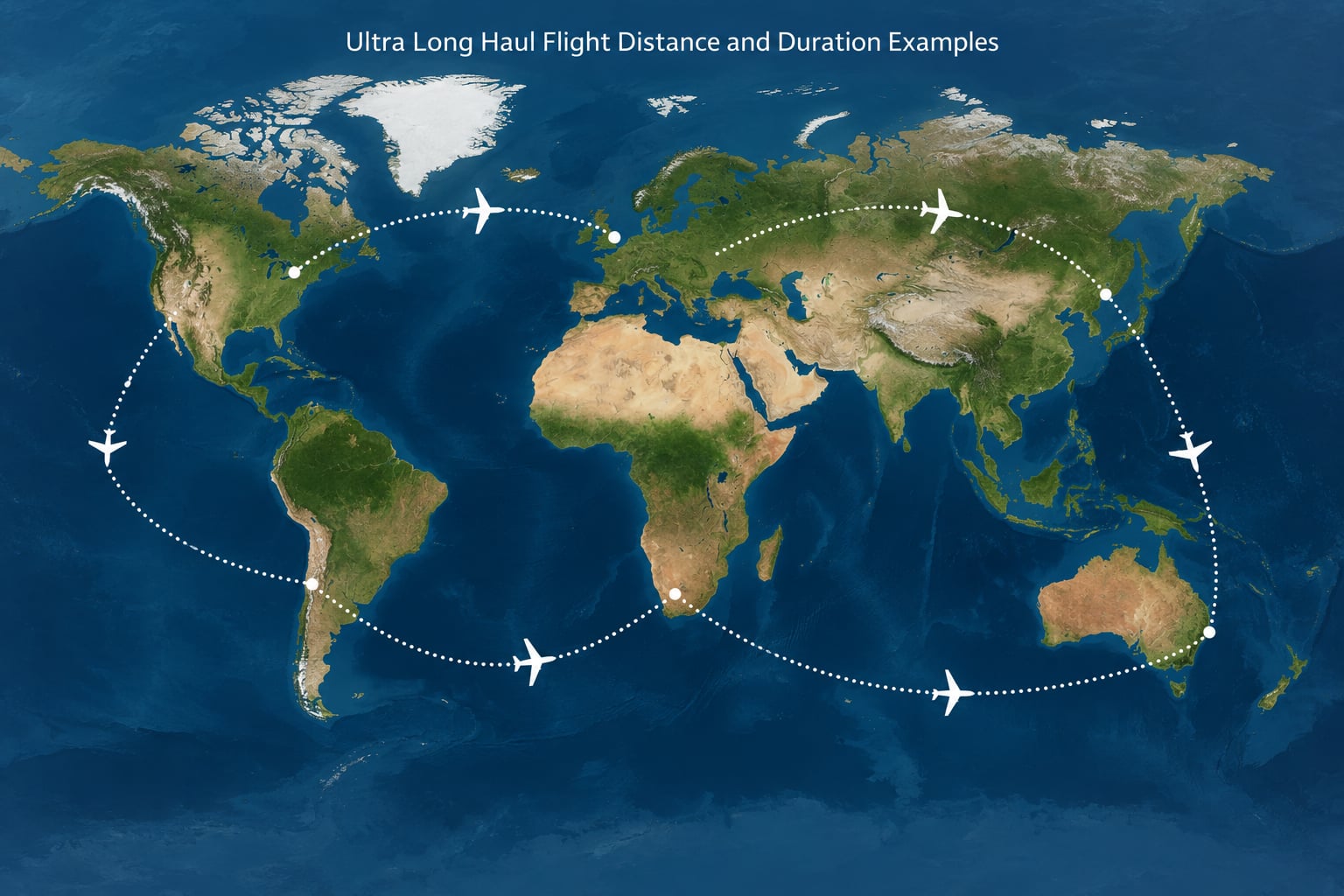
These are representative nonstop services rather than a ranked record list, and every figure is approximate and subject to change.
| Route | Airline | Distance | Typical duration | Typical aircraft | Nonstop |
|---|---|---|---|---|---|
| Singapore (SIN) to New York (JFK) | Singapore Airlines, SQ21/SQ23 | about 15,300 km (9,500 miles) | 18 to 19 hours | Airbus A350-900ULR | Yes |
| Newark (EWR) to Singapore (SIN) | United Airlines | about 14,800 km (9,200 miles) | around 18 hours | Boeing 777-300ER | Yes |
| Manila (MNL) to New York (JFK) | Philippine Airlines, PR126 | about 14,900 km (9,300 miles) | around 18 hours | Airbus A350-1000 | Yes |
| Auckland (AKL) to New York (JFK) | Air New Zealand, NZ1 | about 14,500 km (9,000 miles) | around 17 hours 30 minutes | Boeing 787-9 Dreamliner | Yes |
| Perth (PER) to London (LHR) | Qantas | about 14,700 km (9,150 miles) | around 17 hours | Boeing 787-9 Dreamliner | Yes |
| Dubai (DXB) to Los Angeles (LAX) | Emirates | about 13,300 km (8,300 miles) | around 16 hours 30 minutes | Boeing 777 or Airbus A380 | Yes |
The last row sits on the boundary, which is the point: a flight at 16 hours 30 minutes qualifies, one at 15 does not, and the difference can come down to seasonal winds.
Why Are These Flights So Long?
Continental scale is the simple answer. Very few city pairs on earth sit across an ocean from each other, and the ones that do are usually not the ones big demand centres are built on. Airlines fly between hub airports first, which means a traveller can spend 17 hours in the air to avoid a two-hour connection.
Direct airport pairs are limited by geography and by hub economics. A city with a modest airport and thin demand usually gets fed through a larger neighbour instead. Several carriers have experimented with genuinely remote or secondary airports as ultra-long-haul endpoints, but those routes need demand that survives an 18-hour commitment from both ends.
Jet streams push the times around. Westerly winds at altitude blow from west to east, so eastbound flights often ride them and westbound flights fight them. That is the reason a Sydney-to-London sector can sit near 17 hours while some northern-hemisphere eastbound services come in under schedule.
Airspace closures add distance without adding passengers. When a region is closed to overflight, an aircraft flies a wider arc that looks wrong on a map, adds flying time and burns more fuel. Crew then sometimes need a technical stop, which turns a supposed nonstop into a two-part journey.
Airlines also choose a stop on purpose. A fuel stop is sometimes operationally cheaper than carrying enough fuel to complete the sector at maximum take-off weight, and a crew-duty stop can keep a rotation legal and the aircraft on the ground for less total time than a single exhausting sector would.
Can You Fly an Ultra Long Haul Route Nonstop?
Yes, and most of the famous ones do fly nonstop. What limits the decision is not distance alone but how much of the aircraft’s range has to be left spare for weather, routing and reserve requirements.
A jet certified for a great-circle range of around 9,000 nautical miles cannot fly a 9,000-mile route and still carry the legally required reserves for diversion. The practical usable figure is lower, and it drops further when the aircraft is heavy with fuel, passengers and cargo, or when the forecast routing is long.
That is why comparable city pairs behave differently. One route gets a nonstop because a high-capacity aircraft with strong reserves can make it and the demand justifies burning the fuel. A nearby route of similar length gets a technical stop because the airline runs a smaller aircraft on that rotation, or because the winds are unfavourable, or because the pair sits at the edge of winter schedule planning.
Schedules also change under you. Ultra-long-haul services are the most exposed to seasonal frequency cuts, aircraft substitutions and short-notice cancellations, because a delay early in the day cascades through several later rotations on the same aircraft.
What Aircraft Are Used on Ultra Long Haul Flights?
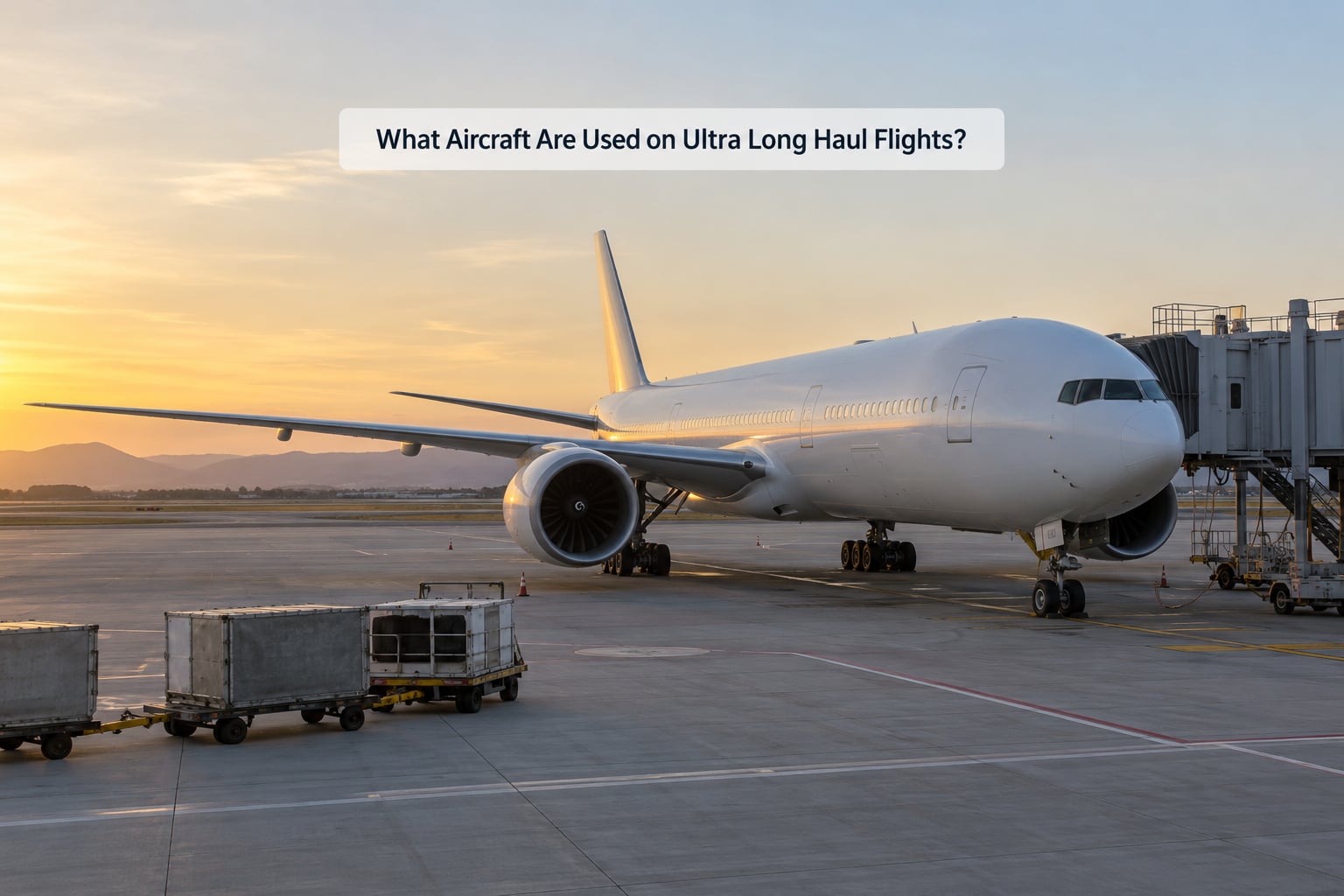
Two families do nearly all the work: large twin-engine wide-bodies and, on the longest and heaviest routes, four-engine aircraft. The deciding factor on an ultra-long-haul route is almost always range measured against payload, not top speed.
Modern large twins lead the category. The Airbus A350-900ULR is the flagship example, purpose-built to trim weight and stretch range for exactly this work, and the Boeing 787-9 Dreamliner does the same job with a slightly smaller cabin and lower capacity. Both pair composite fuselage construction with efficient engines, which is what pays for the extra range.
Four-engine aircraft still turn up where payload demands them. Two engines mean two chances to fail, and the certification rules for flying long over-water sectors without a diversion airport close that option below certain distances. The practical consequence is that four-engine types keep the very longest and heaviest services alive, at the cost of higher fuel burn per seat.
Cabin capacity is the trade-off airlines lean on. An ultra-long-range layout often holds only a few dozen economy rows and puts the rest of the cabin into premium seats with lie-flat or angled-flat seating, plus a larger premium-economy section. Fewer bodies in the cabin means more range for the same fuel load.
None of this makes the sector comfortable. Seats recline, cabins are pressurised to a limited cabin altitude to keep the air breathable, and passengers spend the whole trip in a metal tube. The aircraft makes the flight possible; it does not make it easy.
How Do Stops Affect an Ultra Long Haul Trip?
A stop changes the trip in ways that are easy to underestimate until you are the one walking the corridor at 3am. Two different stops need sorting out: passenger layovers, where you leave the aircraft, and technical stops, where the aircraft lands, refuels or changes crew and you stay on board.
A passenger layover breaks the sitting. An overnight in a decent hub with a hotel attached can be easier on the body than a full day in a seat, and it lets you eat properly, shower and walk. It also costs hours twice: once on the ground and once going back through security and boarding.
A technical stop does none of that. The doors open, some passengers use the toilets, the aircraft takes on fuel or swaps a crew, and then you are back in your seat. Total elapsed time is longer than the nonstop, but the difficult stretch is shorter.
Compare the same city pair both ways and the arithmetic gets interesting. Two sectors of eight and a half hours through a good hub, with a two-hour connection, can beat a single 18-hour nonstop on total elapsed time. What the nonstop wins is a single ticket, a single arrival, and no risk of a missed connection ending the trip in the wrong country.
Frequent-flyer forums split cleanly on this, and the disagreement is not really about comfort. People who value simplicity and arrive rested lean nonstop; people who have done 17 hours in economy once lean toward the connection. Choose based on how you handle a stop and how much transfer risk your itinerary carries.
How Does an Ultra Long Haul Flight Affect Your Body?
Eighteen hours seated in a pressurised cabin does things to you that a normal holiday flight does not. This is general information rather than medical advice, so if you have a history of clotting, circulation problems, recent surgery or take blood-thinning medication, ask your doctor before booking.
Dehydration is the first thing most people notice. Pressurised cabin air is very dry, commonly around 10 to 15 percent relative humidity, drier than most deserts, which pulls moisture out of your skin, nose and eyes. Drink steadily through the flight rather than in one go, and fill your own bottle after security so you are not waiting for a service round.
Immobility is the bigger long-term concern. Sitting still for 16-plus hours slows blood flow through the legs, and prolonged immobility on any long flight raises the risk of deep vein thrombosis, where a clot forms in a deep vein. The risk is low in absolute terms for most healthy travellers and rises with previous clotting history, recent injury, pregnancy, age, and being very tall or very overweight. Ask a doctor about graduated compression stockings if any of that applies to you.
Cabin pressure matters too. Pressurisation is capped by what the airframe can safely hold, and cruising altitude leaves the cabin at an equivalent altitude rather than at sea level. Most people feel nothing. A few get a blocked ear, a sinus headache or mild breathlessness, which usually clears after landing.
Jet lag is the one that follows you home. Crossing many time zones at once leaves your body clock confused far beyond the point where one bad night’s sleep fixes it. Adjust gradually where you can: shift sleep and meals toward destination time in the days before departure, get daylight at the right local hour on arrival, and set your watch to the destination before the doors open.
How to Prepare for an Ultra Long Haul Flight
Most of the improvement comes from the 48 hours before boarding, not from the flight itself. A little preparation turns an endurance test into something close to normal.
- Shift your clock early. Move sleep and meal times toward destination time for two or three days, and adjust on the side you will be travelling, not the side you are leaving.
- Choose the cabin honestly. Premium economy is where long-haul comfort is bought most cheaply. On an 18-hour sector the lie-flat business seat is the difference between finishing the flight functional and finishing it wrecked.
- Pick your seat for movement. An aisle seat near a galley or door is worth more than a window seat for walking. Check whether the aircraft offers a bulkhead or a row with no seat in front.
- Dress for swelling. Tight waistbands and heavy denim get worse over 18 hours, not better. Loose layers that can come off for sleep work far better.
- Fill your own bottle. Hydrate through the flight and pass the toilets whenever the seat belt sign is off, especially eastbound or westbound where the meal schedule will land at a strange hour.
- Set alarms for movement. A ten-minute walk every two hours, plus ankle circles and calf raises at your seat, keeps circulation moving. Do them with an empty cup of water for extra motivation.
- Plan the sleep blocks. Divide the sector into segments and treat each as a night. Eye mask, earplugs and a sleep mask over it make most travellers sleep through at least one block.
- Bring medication you already use. Pack it in your hand luggage, take anything time-sensitive on schedule, and check the destination’s import rules before you fly.
- Check documents early. Passports, visas and onward travel requirements can block a booking more often than the flying does.
Meal timing is the thing airlines get right and wrong in equal measure. On an 18-hour sector the service is paced to destination time on a well-run flight, so your body clock gets help instead of interference. Watch the light and the clock rather than the meal trolley.
Frequently Asked Questions
How many hours is considered an ultra long haul flight?
Most airlines and aviation references put the line at more than 16 hours of scheduled block time, roughly 8,000 miles or 13,000 km of flying. Some sources use 12 hours, which usually reflects a looser definition of long-haul rather than the ultra tier. If you want a defensible answer when comparing routes, use the 16-hour threshold and check the published schedule for the specific flight.
Are ultra long haul flights always flown nonstop?
No. Scheduled block time over 16 hours is the definition, and plenty of those services include a technical stop for fuel or crew rest. A stop adds elapsed time without necessarily adding seat time. Passenger layovers on a connecting itinerary can even beat a nonstop on total journey duration, though they introduce transfer risk and two separate boarding processes.
Which aircraft type is best for an ultra long haul flight?
Large twin-engine wide-bodies do most of this work, with the Airbus A350-900ULR and the Boeing 787-9 Dreamliner as the range leaders. Four-engine types like the A380 and 777-300ER still operate the heaviest longest services because two-engine aircraft cannot always carry the required payload and reserves over the sector. The aircraft that gets you there is not the one that keeps you comfortable, so compare cabin layout as well as range.
How should I reduce jet lag before and during the flight?
Start shifting sleep and meals toward destination time two or three days before departure, adjusting in the direction you will be travelling. On board, set your watch to destination time, stay awake through the local daylight hours at your destination, and keep meals and light exposure aligned to that clock. Expect the first day to be rough regardless, and build light plans into your arrival day rather than booking meetings.
Should I choose a nonstop route instead of one with a stop?
It depends on the stop. A technical refuelling stop adds time but breaks up the sitting, while a passenger layover through a good hub can beat a long nonstop on elapsed time and lets you sleep in a bed. Nonstops win when your itinerary has thin connection margins, when you want one arrival time, or when the connecting option means an overnight in an unfamiliar airport. Check total elapsed time rather than seat time before deciding.
Conclusion
An ultra long haul flight is best understood as an exceptionally long intercontinental journey: a nonstop commercial service scheduled beyond 16 hours, usually covering more than 8,000 miles or 13,000 km. Everything else on this page, from aircraft choice to cabin layout to how you prepare, follows from that one fact.
Before you book, read the full itinerary rather than the headline duration. Check for technical stops, count the time-zone change, and compare total elapsed time against a connecting option through a hub. Then pick your cabin with the length of the sector in mind, and treat the first day on the ground as part of the trip.