What to expect in international first class is simpler than the marketing makes it sound: a private suite or lie-flat bed with direct aisle access, a lounge before departure, priority services at the airport, a multi-course meal served onboard, and a higher crew-to-passenger ratio than any other cabin. What is not standard is how much of that you actually get. Inclusions depend on the airline, the aircraft, the route, and the fare you bought, so the honest answer covers the whole trip and flags where the rules change.
This guide is written for someone on their first long-haul flight in the top cabin, and it has been updated for 2026. It assumes an 8-hour-plus journey, because that is the length at which first class behaves differently from business class. If you are on a six-hour hop, most of this still applies, but the value calculation is a different one and we will get to it.
One more thing before we start. Forum threads about this topic are full of people who flew first once and had a brilliant time, and other people who flew first twice and were underwhelmed. Both are describing real first class. The difference is usually the aircraft, not the airline.
Table of Contents
- 1What to Expect in International First Class at a Glance
- 2How Does International First Class Work?
- 3What the cabin layout tells you
- 4What Happens Before You Board?
- 5How early should you arrive for an international first-class flight?
- 6Does a first-class ticket always get lounge access?
- 7What Seats and Private Suites Look Like
- 8What do lie-flat, angled-flat, pod and suite seats mean?
- 9Which first-class seats are worth choosing?
- 10What to Expect From Food and Drinks
- 11How Much Service and Privacy Can You Expect?
- 12When and how to ask for something onboard
- 13What Are the Benefits During a Long International Flight?
- 14What Happens When You Arrive?
- 15What Is Not Included in International First Class?
- 16How Do Airlines and Aircraft Differ?
- 17How to Prepare for Your First-Class Flight
- 18Common mistakes first-time first-class flyers make
- 19Frequently Asked Questions
- 20Does international first class include door-to-door service?
- 21Is first class worth it on a shorter international flight?
- 22Are first-class tickets always fully refundable?
- 23Is first class better than premium economy on a long flight?
- 24What should I check before booking an international first-class ticket?
- 25Conclusion
What to Expect in International First Class at a Glance
Here is the short version of what to expect in international first class, from the moment you reach the terminal to the moment you land.
- Priority check-in and security at most airports, often through a dedicated desk and lane.
- Lounge access before departure, usually with showers, a buffet and quiet space to work, though not guaranteed on every route.
- First boarding and usually first off the plane on arrival, with baggage sometimes delivered ahead of the rest of the cabin.
- A seat that converts into a bed — fully flat, angled-flat, or a pod with a door in the better products.
- Direct aisle access and more usable space than business class, in a 1-2-1 or 1-1-1 layout on newer aircraft.
- Multi-course dining, often with a wine list and premium bar service included.
- An amenity kit with sleepwear, a blanket or duvet, slippers, a toothbrush set and toiletries.
- More crew per passenger than anywhere else on the plane, which is the single biggest driver of how the cabin feels.
Every item on that list has a “depends on” attached. A first-class ticket on a codeshare partner’s aircraft may not include lounge access. An older widebody may have an angled-flat bed with no door. A short-haul first-class cabin on a 787 might be a recliner with a footrest and nothing else.
How Does International First Class Work?
International first class is the highest cabin on a long-haul flight, and it sits above business class and premium economy. It exists to make eight to seventeen hours of flying tolerable, not to be luxurious, and the difference between a good and a bad first-class flight is mostly about how much room you have and how many people share the cabin.
A first-class cabin does not always mean a separate aircraft. Plenty of carriers sell first class on the same plane as business and economy, and some of the best first-class products in the world are on aircraft that also carry four hundred economy seats. It does not mean a private suite, either. Only a subset of the industry offers that.
It also does not mean a nonstop route. Some of the most highly rated first-class experiences are on short segments of a journey that require a technical stop or a change of aircraft at a hub.
What the cabin layout tells you
Cabin configuration is the single most useful thing to check before you book, and it is written as a number.
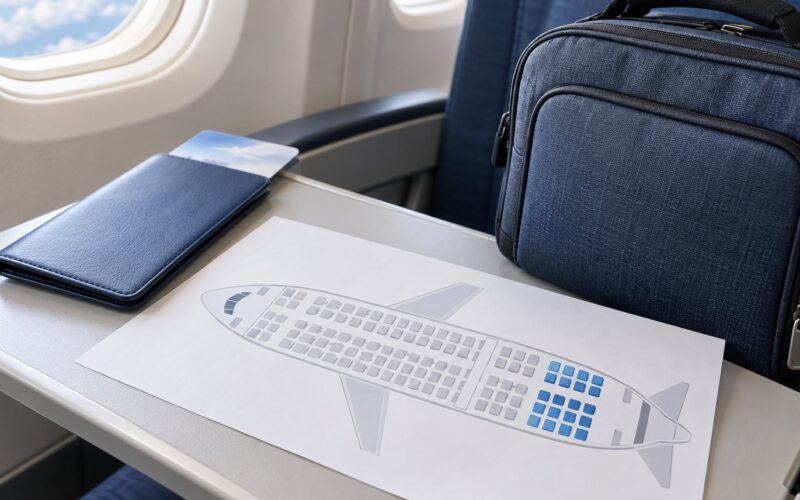
1-2-1 means every middle seat in the row is removed, so window, aisle, aisle, window. Every passenger has a window or direct aisle access. This is the modern standard for a good business-class seat and the most common first-class layout on twin-aisle aircraft.
1-1-1 gives every passenger both a window and direct aisle access, with just one seat on each side of the cabin. It is the most spacious layout you will find and it appears only on the newest aircraft and the most premium products.
2-2-2 is the old standard, still found on some aircraft in premium economy. Two seats, a middle pair, two seats. Only the window and aisle seats are usable, which is exactly what first class exists to solve.
Bonus point: doors. A suite with a sliding or hinged door gives you visual privacy, which is a bigger deal than most seat spec sheets admit.
What Happens Before You Board?
The ground experience is where first class diverges from business class most visibly, and it is the part people notice first. It is also the part most likely to vary, so treat the following as typical rather than guaranteed.
How early should you arrive for an international first-class flight?
Most first-class itineraries ask you to arrive three hours before departure for a long-haul flight, which is two hours earlier than the economy recommendation. r/AmexPlatinum regulars are the loudest group on this topic, and their whole routine is built on arriving early enough to use the lounge properly rather than only squeezing through security.
The sequence usually looks like this:
- Arrival at the terminal — a separate first-class check-in desk, usually with no queue, though the counter is not always open until a couple of hours before departure.
- Bag drop — often with a higher weight allowance and fewer bags counted as separate pieces. Check your allowance, because the limit is set by route and alliance agreement, not by cabin alone.
- Security — a priority lane exists at many major airports for premium passengers. It is not universal, and at a few hubs it means nothing more than walking past a different line.
- The lounge — typically three hours of access before departure. Bring a laptop charger; not every lounge has a wall of power outlets, and the ones that do have them are usually taken.
- Boarding — first class boards first, usually with a second group for the premium cabin behind it. You will be seated before the rest of the plane arrives.
Does a first-class ticket always get lounge access?
No, and this surprises people more than any other part of the trip. Lounge access can depend on the fare brand rather than the cabin, on whether the ticket is bought on the marketing carrier or an operating partner, on your alliance benefits, and on the departure airport. A first-class ticket on a non-alliance partner’s metal can mean a plain gate lounge with a coffee machine.
The safe habit is to check the lounge rules on your booking confirmation before you fly, not on the day.
What Seats and Private Suites Look Like
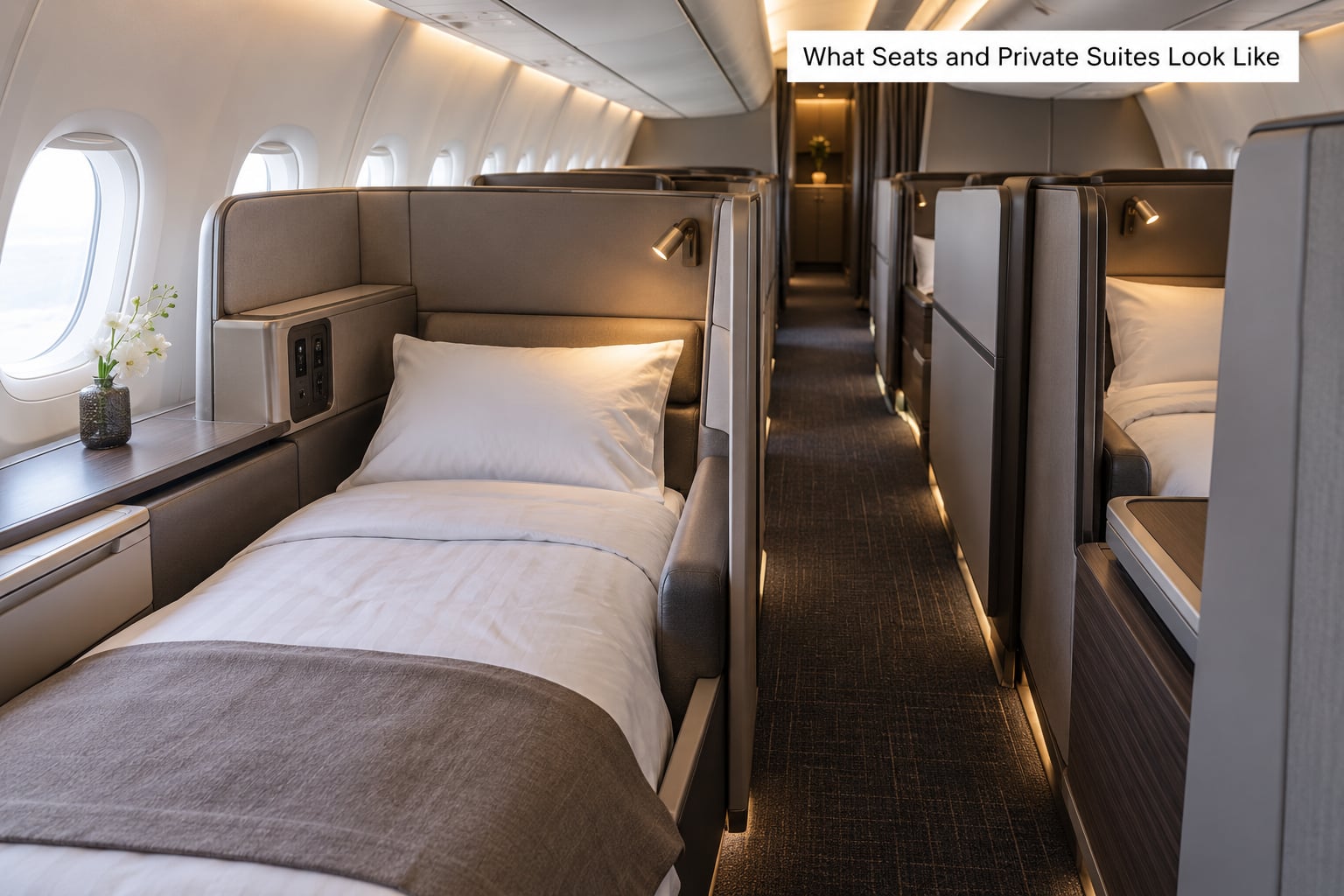
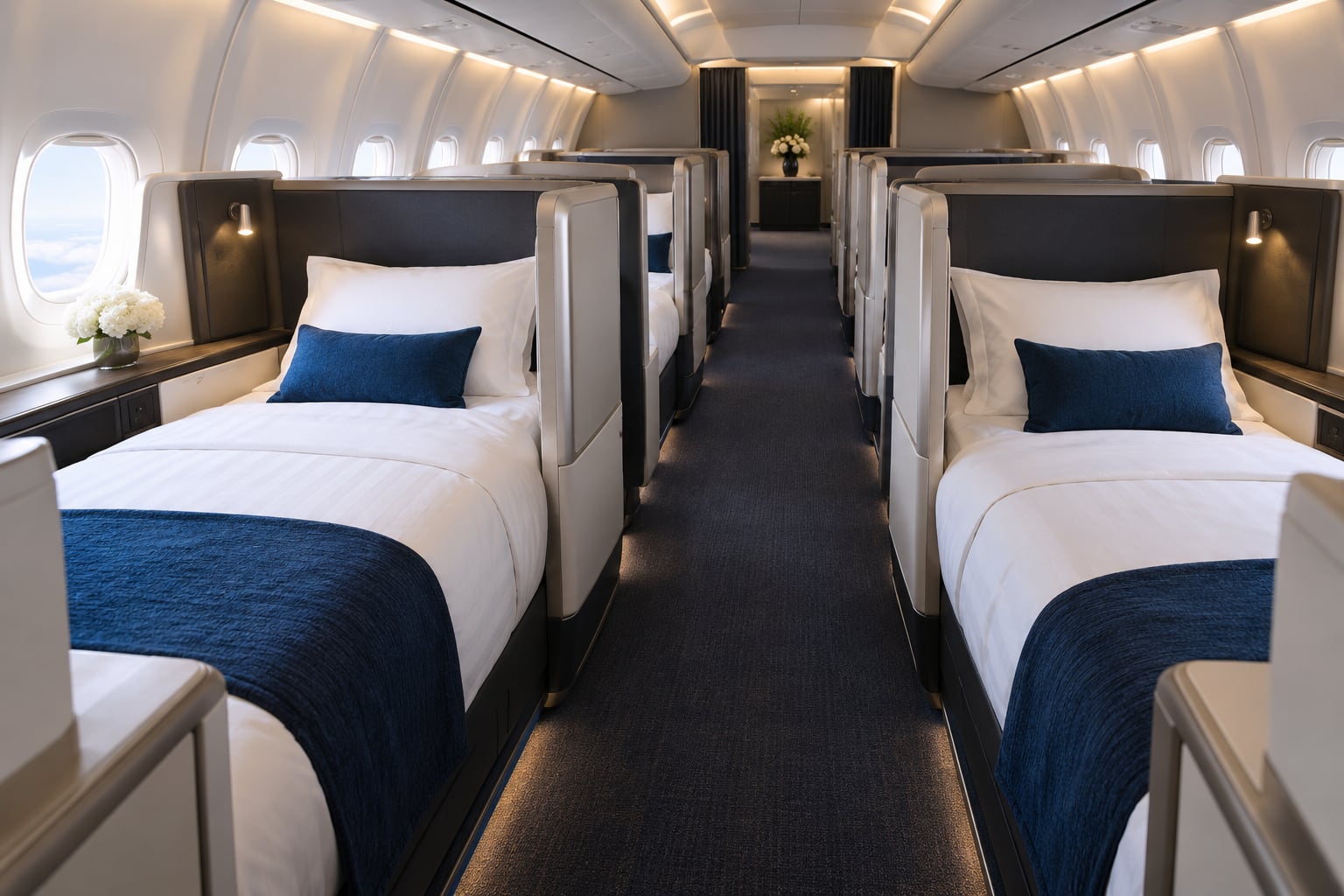
Expect a wider seat, a real bed length, and room to stand up and change without disturbing anyone. In a 1-2-1 layout with direct aisle access, you can get to the lavatory without squeezing past a stranger, which sounds trivial until you have tried it in a 2-2-2 row at hour nine.
Most first-class seats also have a side console that converts into a work surface, a power outlet at seat level, a large seatback screen, storage for a small bag, and window blinds. The best have a door. The middling ones have a tall divider. The worst are an angled-flat bed in a 2-2-2-style arrangement where somebody’s elbow is six inches from yours.
What do lie-flat, angled-flat, pod and suite seats mean?
Lie-flat is marketing for “the seat reclines to horizontal.” Read the fine print. A true lie-flat seat is fully horizontal and long enough to sleep on. An angled-flat seat reclines to maybe 120 degrees, which is comfortable for reading and marginal for sleeping. Airlines use the terms loosely, so check for the specific angle and the bed dimensions in inches rather than trusting the label.
Pod describes a seat with tall side panels that shield you from the aisle, with or without a door. Suite usually implies a door plus a separate storage area and a more enclosed feel. Neither term is regulated.
Bed length is the number that decides whether you sleep well. A six-foot-two adult needs more than 77 inches of sleeping surface, and plenty of otherwise excellent first-class seats fall short of that. Seat pitch alone tells you nothing useful, because pitch measures front-to-back space, not the length of the bed.
Which first-class seats are worth choosing?
Window or aisle in a 1-2-1 layout, away from the galley and lavatories, and never immediately behind or in front of a crew rest area. Bulkhead seats in some layouts give you storage but can be noisy if there is no barrier behind you.
Avoid seats next to the doors on many older aircraft, where the galley is a short walk away and conversations carry. The “avoid row 11” advice in first class is about the exit row, but in a premium cabin the noise problem is more often the galley.
One seat worth skipping: the one directly in front of an emergency row, if it exists in the first-class cabin, because you will be handing things over your head all flight.
What to Expect From Food and Drinks
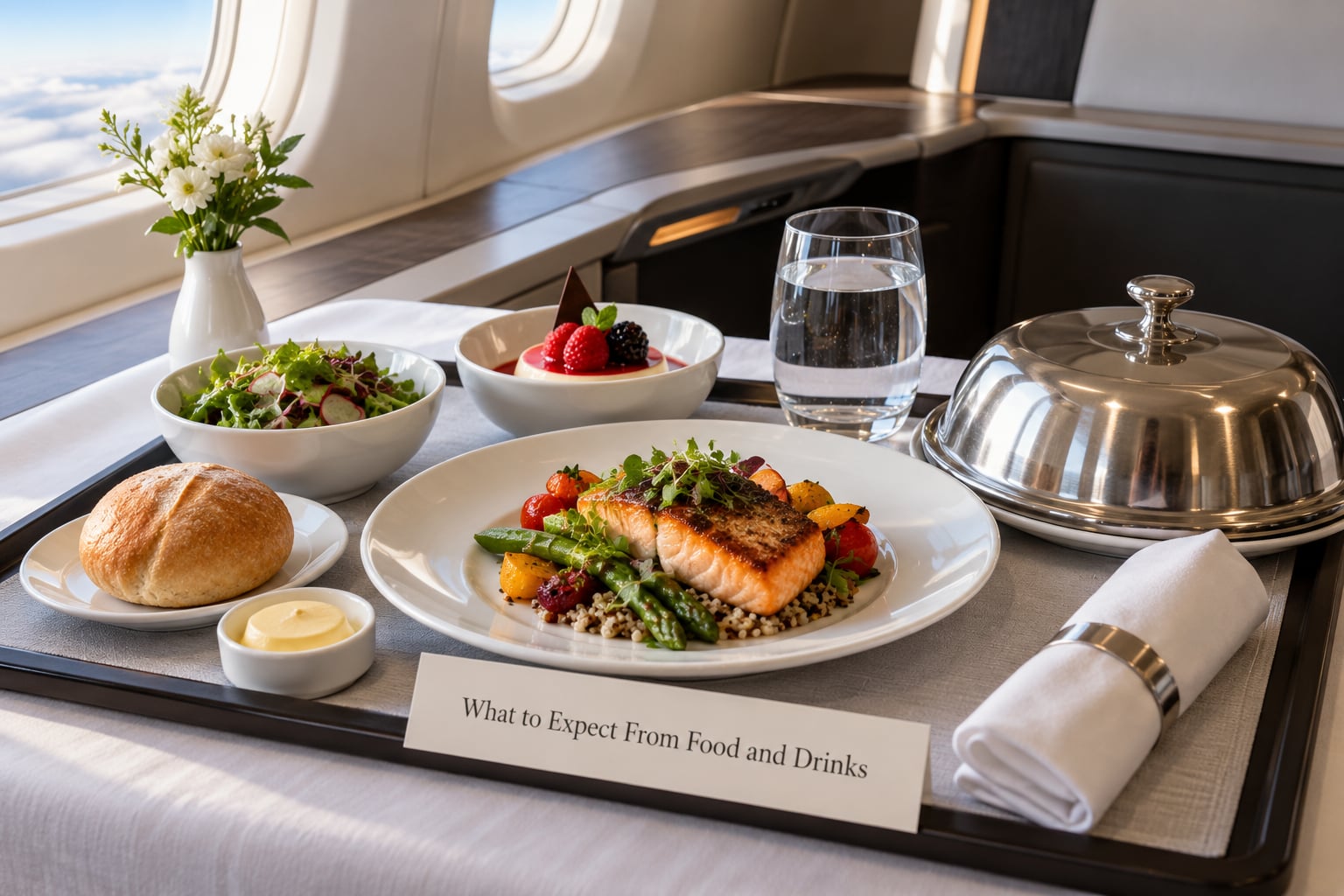
Dining in first class is usually table service rather than a prepaid tray, with several courses spread across the flight and the timing often at your discretion. On shorter routes you might get a single multi-course meal; on a sixteen-hour flight you can expect two full services plus snacks in between, which matters more than any individual dish.
Menus are designed for the route and the season rather than for you. r/delta posters will tell you the flagship catering on a given route can be excellent or genuinely bad, and the same airline can surprise you twice in one trip. If you care about the food, select your meal in advance where the airline allows it, and send special dietary requests as early as you can, usually at booking rather than 48 hours out.
Drinks are normally included and often generous. Premium alcohol is usually poured without a fuss in most first-class cabins, though the free-for-all pouring is not universal, and a few carriers limit how much. Champagne, a decent red or white by the glass, and soft drinks are the safe assumption. Some suites include a separate minibar and some cabins have a staffed onboard bar, which is rare enough to be worth checking for if it matters to you.
Ask when you want the next service rather than waiting to be hunted down. The crew would much rather serve on your schedule than work around theirs.
How Much Service and Privacy Can You Expect?
You can expect a lower crew-to-passenger ratio than any other cabin. Depending on the aircraft, you might have one flight attendant for six to eight first-class passengers, and some suites have a dedicated attendant for a handful of seats. That ratio is the reason first class feels different, more than the seat or the food.
You can also expect your preferences to be remembered within a single flight, and occasionally across sectors if you are connecting on the same airline. If you tell a crew member that you are trying to sleep, that is a normal thing to say in first class and it is the one request that tends to produce results: dimmed lights, fewer announcements, a mattress pad, and a wake-up call timed to your landing.
Privacy has two layers, and people confuse them. A suite door gives you visual privacy — people cannot see you, and you can change, work or lie down without an audience. It does not give you acoustic privacy. Cabin noise is a function of the aircraft, the engine, and where your seat sits, and a door will not stop a crying baby three rows back.
Noise does have patterns. Rows near the galley and lavatories hear crew traffic and door chimes all night. Rows at the front of the cabin are usually quieter. The most disruptive moment on any long-haul flight is the arrival, when everyone stands up and stows luggage simultaneously, so if you are sensitive to that, choose a seat forward in the cabin and keep your belongings out of the overhead bins until you have left.
When and how to ask for something onboard
Ask early and ask calmly. The most senior crew member onboard is called a purser on US carriers and an in-flight manager or in-flight supervisor on European and Asian ones, and they are the person to approach if something is genuinely wrong. The advice in the comments under long-running first-class trip reports is consistent: raise it with the senior crew member during the flight, calmly, not on social media after landing. Nearly every one of those threads says the same thing — a calm word from a passenger moves a crew member far more than a public review, and the crew member often cannot fix anything you find out about three hours later.
What Are the Benefits During a Long International Flight?
The real payoff shows up on the third hour, not the first. On an eight-to-seventeen-hour flight, first class buys you three specific things: the ability to sleep in a real bed, the ability to work or watch a screen without a stranger’s elbow in your peripheral vision, and the ability to arrive with your body clock closer to where it started.
Sleep support is the biggest one. Mattress pads, a duvet, a proper pillow and a dimmed cabin turn an eight-hour flight into something close to a normal night’s rest for a lot of people. That is the difference between landing functional and landing wrecked.
Connectivity and entertainment are much improved in premium cabins, but “much improved” is relative. Wi-Fi quality varies enormously by aircraft, and some long-haul routes still have slow connections in the sky. Do not plan a first-class trip around streaming a video at 38,000 feet. Bring a downloaded season of something, because you will be reading anyway.
Amortising the cost also changes. On a flight under four hours, the premium cabin delivers maybe 20 to 30 percent more comfort. On a fourteen-hour flight it can deliver the difference between a usable day and a ruined one. That is the calculation to keep in your head.
What Happens When You Arrive?
Arrival is where first class is most uneven. On a well-run flight, you will be among the first through the doors, first through immigration and first to your bags. On a badly run one, you will sit at the gate for twenty minutes while the cabin empties around you — a complaint that appears again and again in passenger forums, and it is usually a matter of crew workload on arrival rather than a class issue.
Priority immigration and fast-track entry exist at many major international airports, but they are airport programmes, not airline entitlements, and they usually require you to enrol in advance. Bags tagged as priority often come out first, and at a few airports there is a separate first-class belt. None of this is guaranteed.
Meet-and-greet assistance, airport transfers, lounge access on arrival and checked-bag delivery to your hotel all exist on certain routes at certain carriers, usually on specific fare brands rather than as a general first-class benefit. If one of those is the reason you are considering it, check that the fare you are buying includes it before you commit.
The other thing arrival buys you is time-zone head start. Landing rested and eating a normal meal at local time shortens the adjustment, which for many travellers is worth more than the bed itself.
What Is Not Included in International First Class?
Setting expectations is more useful than adding perks. Here is what a first-class ticket does not include.
It does not include a guarantee of the aircraft you booked. Equipment changes happen, and a long-haul first-class seat can be downgraded to an angled-flat seat without notice when the inbound aircraft is swapped. Booking the nonstop is the only real protection.
It does not include flexibility. First-class fares carry change and cancellation conditions that are stricter than economy, and a change fee can be substantial. Award tickets are frequently non-refundable.
It does not always include lounge access, as covered above.
It does not include free connections. A first-class ticket with a change of aircraft in the middle of the night may put you in an airport lounge at 3 a.m. between sectors with no first-class lounge open.
It does not include more baggage than the rules allow. Weight allowances differ by route and by alliance agreement, and going over is charged, not waived, because you are flying first.
It does not skip the full security and immigration process on arrival at your destination, unless a specific programme is running.
It does not include a guarantee of sleep. A fully flat bed of 75 inches is still 75 inches, and if you are tall or a light sleeper, an angled-flat seat will remind you what you paid for.
How Do Airlines and Aircraft Differ?
Airlines do not sell one product called first class. They sell several, on several aircraft, and they are not equally good. The differences that matter most are the aircraft and the route, not the logo.
Aircraft age and type are decisive. A 787 or A350 delivered in the last few years will have a lie-flat seat and a door. The same airline’s A330 from ten years ago may have a recliner with a footrest. Always check the seat map for the specific flight, including the aircraft, before you book.
Regions have different strengths. Middle Eastern carriers have built some of the most spacious cabins in the industry, with larger suites and extensive onboard facilities. Asian carriers tend to deliver consistent service and very high crew-to-passenger ratios. European carriers vary a great deal within their own networks, and their lounge and ground products are often the strongest part of the ticket. US carriers are improving quickly but their flagship products vary by route, and the same airline’s first class can be excellent on one transatlantic pair and unremarkable on another.
Loyalty benefits add up quietly. Elite status, points multipliers, free upgrades and extra baggage are real financial value that never shows up in a seat spec. Two routes on the same airline can differ by more in those benefits than in comfort.
Brand reputation is not a guarantee. An ANA first-class flight disappointed a writer who had expected the reputation to carry the experience on its own. It happens: catering changes, crew changes, an aircraft swap on a route you flew two years ago. Book the flight in front of you, not the airline you loved last time.
How to Prepare for Your First-Class Flight
A short checklist covers almost everything that matters, and none of it is complicated.
- Check the seat map and the aircraft type for your exact flight number, then check the seat length in inches. Confirm the cabin layout is 1-2-1 or better, and confirm whether your fare brand includes lounge access.
- Read the fare rules before paying, not after. Check change fees, cancellation terms, baggage allowance, whether the ticket is fully flexible, and whether the miles or points are refundable.
- Confirm your passenger details exactly as they appear on your passport, because a name mismatch on an international ticket usually means reissuing at your own cost.
- Arrive three hours early for a long-haul departure, and check whether the departure airport offers fast-track security or immigration that you can pre-enrol in.
- Order your meal and dietary requests early, at booking where possible, especially on a route with two full services.
- Pack for a cabin, not a bedroom. Layer clothing you can sleep in, a warm layer for the air conditioning at 38,000 feet, and your own earplugs and eye mask if you are a light sleeper. The bedding is good; your neck is specific.
- Charge everything before boarding and bring a battery pack for the lounge, because the outlet situation on board varies by seat and by aircraft.
- Decide your sleep plan in advance. A long-haul night flight goes better when you set your watch to destination time, eat on destination schedule, and use the first service to move your body clock rather than to stay up until midnight.
- Arrange transfers in advance for the airport at both ends, particularly on a redeye arrival in a city you have never visited.
Common mistakes first-time first-class flyers make
The most common errors are all about not using the product properly. Arriving at the last minute and skipping the lounge throws away an hour and a half of the ticket. Boarding early and then sitting in your seat for two hours is the same mistake in a different form.
The second common error is expecting a suite and getting a recliner, which is entirely a research failure rather than an airline one. The third is treating the first-class cabin like a lounge and lounging around the whole flight, then arriving with stiff hips and a wrecked back.
Also worth knowing: there is no formal dress code on most international first-class flights, and lounges that are smart-casual apply that to the lounge rather than to the aircraft. Comfortable, tidy clothing is the right answer. Tipping crew is not a universal expectation, but a small gesture for genuinely exceptional service costs you nothing and is not unusual in some markets.
Frequently Asked Questions
Does international first class include door-to-door service?
Sometimes, but rarely by default. Door-to-door benefits such as chauffeur transfers, meet-and-greet assistance, checked-bag delivery to your hotel or a car service at the destination are usually tied to a specific fare brand or a specific route rather than to first class as a cabin. Many carriers offer a free transfer only between the aircraft and a private terminal or lounge. Check the benefits listed on your exact booking, because the inclusion can change with the fare you buy rather than with the seat.
Is first class worth it on a shorter international flight?
On a flight of four to five hours, usually not. Premium business class on a short sector gives you most of the seat and service difference, and the first-class premium on that length is often a footrest and a nicer meal rather than a bed. First class starts to earn its cost around eight hours, where a lie-flat seat, real bedding and lounge time change how you feel on arrival. Below six hours, compare the price gap to a good business-class seat and decide on that instead.
Are first-class tickets always fully refundable?
No. Flexible first-class fares exist, but many first-class tickets carry change fees, and award tickets redeemed with miles are commonly non-refundable entirely, though some carriers offer points refunds within a short window. Rules vary by airline, route and fare brand, which is why the fare rules matter more than the cabin label. Read the change and cancellation conditions on your specific ticket before you pay, and photograph them in case you need them later.
Is first class better than premium economy on a long flight?
Yes on comfort, and the gap is much wider than the price gap suggests on an overnight route. Premium economy usually gives you a wider seat, a footrest and better food, but rarely a bed, and you still share a two-by-two or two-by-three arrangement with a stranger. First class adds a real sleeping surface, direct aisle access, privacy and a lounge. Whether that is worth it depends on how badly you need sleep and how many hours you are airborne.
What should I check before booking an international first-class ticket?
Four things, in this order: the aircraft type and seat map for your exact flight, the seat length in inches and whether it is fully flat, the fare rules including changes, refunds and baggage, and whether your fare brand includes lounge access. Then check the cabin and crew reviews for the route and aircraft rather than the airline overall. An equipment swap can replace a suite with a recliner, and only a seat-specific check protects you against that.
Conclusion
What to expect in international first class, in one line: a lie-flat bed with direct aisle access, a lounge, priority services, table-service dining, and fewer people around you than on any other cabin — with the exact inclusions set by the airline, the aircraft, the route and the fare.
So do three things before you book anything. Identify the exact flight and aircraft, then read the seat map and the fare rules for that specific ticket. Compare what the first-class cabin adds against what a good business-class seat would give you on the same flight at that length. Book when the difference is the thing you actually wanted — sleep, privacy, or a usable lounge at both ends — rather than the badge.