Basic economy is the lowest fare class an airline sells. You get a confirmed seat on the plane and little else. In exchange you give up advance seat selection, an included checked bag, free changes and refunds, early boarding, and on many carriers, mileage and elite status credit. Here is the part most people miss: those rules are set one airline at a time, so two fares both labelled basic economy can carry completely different terms.
Policies verified as of October 2026. Airlines revise fare rules several times a year, so treat everything below as a starting point and confirm on your own booking before you pay.
Table of Contents
- 1What Is Basic Economy and What You Give Up?
- 2How Airline Fare Classes Work
- 3Basic Economy: What the Label Means
- 4What You Give Up in a Basic Economy Fare
- 5Seat Selection and Boarding Restrictions
- 6Carry-On Bags, Checked Bags, and Extra Fees
- 7Changes, Refunds, and Travel Credits
- 8Loyalty Points and Other Benefits
- 9What You May Still Get Included
- 10How to Check the Rules Before You Book
- 11When Basic Economy May or May Not Be Worth It
- 12Break-even math
- 13Who it suits
- 14Who should pay more
- 15Frequently Asked Questions
- 16Is basic economy always the cheapest airline ticket?
- 17Can I get a seat with a basic economy ticket?
- 18Does basic economy include a carry-on bag?
- 19Can I change or cancel a basic economy flight?
- 20Is basic economy always cheaper than standard economy?
- 21What to Do First
What Is Basic Economy and What You Give Up?
What is basic economy and what you give up? You give up choice and flexibility. The seat is assigned late or for a fee, the bag allowance is smaller than the standard economy fare, the boarding group is near the back, changes usually cost money or are not allowed at all, and loyalty credit may be reduced or zero.
One myth worth clearing up right away: basic economy is not a standby fare and it is not an unconfirmed ticket. You hold a real, ticketed reservation with a flight number and a seat. What you have given up is the right to change it cheaply.
Basic economy: the airline’s lowest, least flexible fare in the main cabin, sold with the seat alone.
Fare class: the internal code attached to your booking that decides which rules apply, often shown as a single letter on the fare rules page.
Personal item: the small bag that fits under the seat in front of you, usually the only bag included at this level.
Trip credit: the voucher an airline issues in place of a refund when you cancel or are moved off a flight.
No-show: failing to fly or check in on a segment, which can void the rest of an itinerary on some fares.
How Airline Fare Classes Work
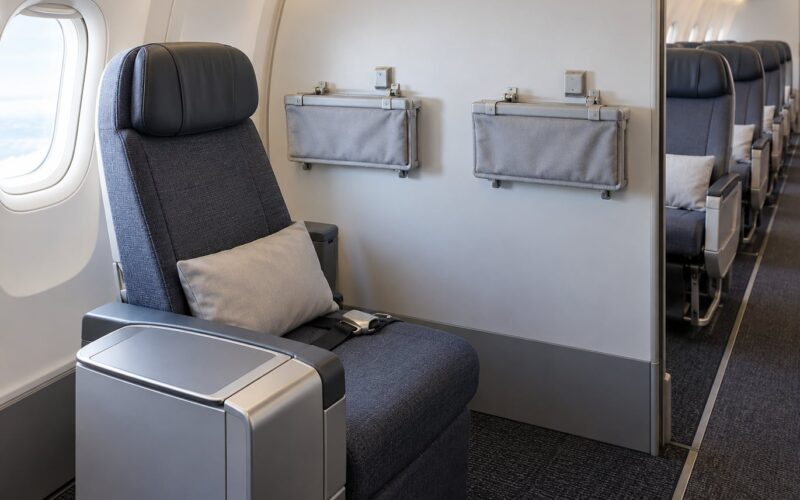
Every airline sells the same physical seat at several prices, and the difference between prices is a difference in rules, not in comfort. Under the business cabin sit premium economy, then main cabin. Inside main cabin, the airlines sort fares from standard economy down through several branded discount levels, with the most restricted fare at the bottom.
That bottom tier is called basic economy by American, Main Basic by Delta, Basic Economy by United, Saver by Alaska, Basic by Southwest, and Blue Basic by JetBlue. Same idea, different marketing name, and each carrier writes its own rule set. Booking codes also differ, so a letter that means one thing on one airline tells you nothing on another.
Basic Economy: What the Label Means
The label signals one thing above all: the fare is sold as a bundle of the bare minimum. Seat choice, an extra bag, a change and early boarding are not discounted, they are removed and offered separately, at a cost, or not at all. The lower headline price compensates the airline for restrictions rather than for anything you receive on board, where service is usually identical to standard economy.
It also helps to keep this fare away from things that sound similar. An award ticket you redeem from miles is a different product with its own rules, even when it seats you in the same cabin. A status-based ticket, a companion certificate, and a corporate travel rate each follow their own terms. If you paid cash on a specific flight, you bought a restricted economy fare.
What You Give Up in a Basic Economy Fare
The table below is the general pattern across major US carriers. Every row has exceptions, and the exceptions are where the surprises live.
| What changes | Basic economy fare | Standard economy fare |
|---|---|---|
| Advance seat selection | Usually not included, or available at check-in | Usually included at no extra cost |
| Boarding group | Last or near last | Earlier group, varies by carrier |
| Personal item | Almost always included | Included |
| Carry-on bag | Carrier and route dependent, not guaranteed | Generally included on most routes |
| Checked bag | Charged per bag, on every leg | Charged on most domestic routes, waived by many cards |
| Changes | Often not permitted, or a fee plus fare difference | Usually permitted for a fee plus fare difference |
| Cancellation | Credit only, with a validity window | Credit or refund depending on the fare |
| Loyalty credit | Reduced or zero on some carriers | Standard earn on most carriers |
In plain terms, you give up:
- Choice of seat. The seat most likely to go is a middle seat in the middle of the cabin.
- Advance seat selection. Paying to pick a seat is often the only way to get an aisle or window.
- Room in the cabin and the overhead bins. Boarding late makes bag space the first casualty.
- The ability to change plans cheaply. A schedule conflict can mean a full new booking.
- A refund. Cancelling normally produces a credit, not money back.
- Protection on later segments. A missed flight can strand you with no recourse.
- Loyalty miles and elite status credit. Some carriers award nothing on this fare.
- Family seating. Parents with young children can be assigned apart.
Seat Selection and Boarding Restrictions
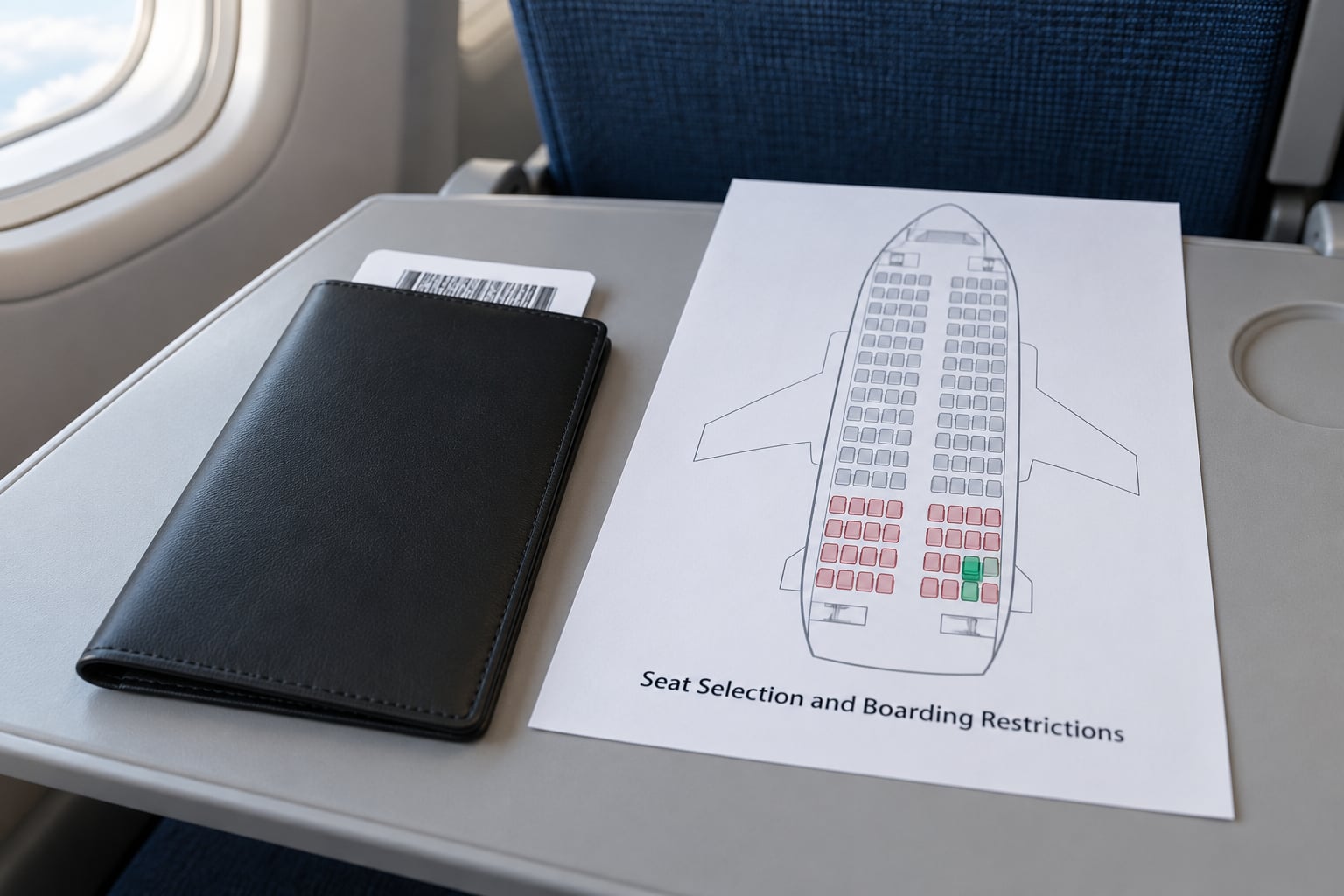
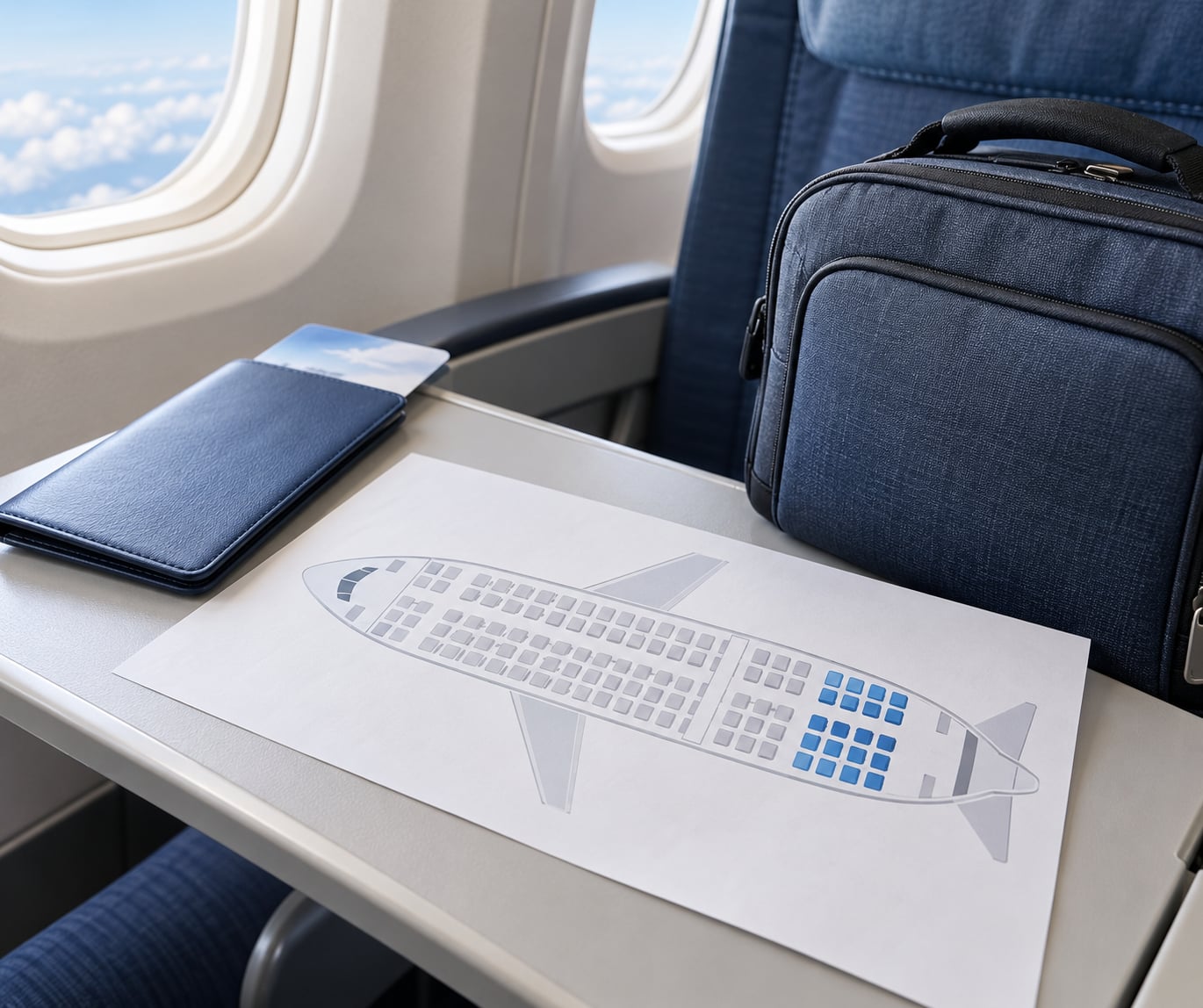
Seat assignment is where most people feel the fare on the day. On many basic economy fares you can buy a seat in advance, pay extra for a preferred one, or wait and take whatever is assigned at check-in. If you do not choose, the default is not a good seat. Frequent flyers report landing in a middle seat between two strangers while paying the same fare as the person at the window.
Boarding group is the other half. Cheap fares typically board in the final group, which means you reach the aircraft after the bins are full. If your bag does not fit, it gets gate-checked, and a gate-check on a fare where bags are already charged is a bill you did not plan for.
Two exceptions matter. Passengers with disabilities may have seating assigned so they can reach the aisle or a lavatory, and airlines generally try to seat a parent with a lap child together, though that is a courtesy rather than a guarantee. On r/delta, one parent described booking basic economy and accepting the real risk of being separated from their child during boarding. That is the trade adults make when the fare difference is the deciding factor.
Carry-On Bags, Checked Bags, and Extra Fees
A free carry-on bag is not guaranteed with every basic economy ticket. The personal item that fits under the seat is standard almost everywhere, but the larger overhead-bin bag depends on the carrier and often on the route. Some carriers sell a carry-on only on longer or international itineraries, which is exactly where people expect the benefit most.
Checked bags on this fare are unbundled. You pay per bag, the charge applies on each leg, and the amount often steps up when the bag is packed and weighed at the airport rather than prepaid. Gate agents also check that the personal item really fits the size limit, and enforcement has tightened at several carriers. On r/unitedairlines, travelers describe paying an extra charge at the gate for a bag they had assumed was allowed.
One practical note: a fee is not a fixed number. It changes by route, direction and travel date, so compare the fare plus your expected add-ons against the standard economy fare, not against the headline price alone.
Changes, Refunds, and Travel Credits
This is the most expensive thing to get wrong. Most basic economy fares cannot be changed at all. When a change is allowed, the carrier typically charges a change fee and you pay the fare difference between what you paid and what the new flight costs. That last clause is why a low fare can be expensive to move: the fare difference is calculated from the original low price upward, not downward.
Cancellation is usually credit only. How long that credit stays valid varies widely, and the shortest windows cause the most frustration. American offers a 24-hour cancellation window on qualifying bookings made directly with the airline, which is a useful safety net for a fare class that otherwise offers no refund. Southwest Basic flight credits expire after six months, which is short enough that you have to book the next trip inside that window to use the money.
Itinerary structure matters as much as the fare rules. On an Alaska Saver fare, missing one flight can cancel the rest of the trip, and Alaska will not mix fare types within a booking, so you cannot quietly upgrade one leg to protect the others. With Southwest Basic, one leg can affect the whole round trip. If your plan has more than one segment, read these sentences twice before you book.
One thing that can help: when an airline changes the schedule itself, the replacement fare often comes with better terms, sometimes a refundable or changeable fare. Booking early gives you more of those accidental upgrades, though it is not a strategy to rely on.
Loyalty Points and Other Benefits
Basic economy fares frequently earn nothing, or a reduced amount, toward the airline’s program. American stopped awarding AAdvantage miles on Basic Economy as of December 17, 2025, which surprised a lot of people who had banked on the small credit to cover the fare gap. Delta renamed its lowest fare to Main Basic, so check what the current earning rate is before assuming it matches the cabin you are sitting in.
Elite status follows the same logic. Some carriers exclude the fare from qualifying flights toward status, so months of flying can add nothing to your qualification count. Programs have their own rules, and card benefits work separately: a co-brand card can waive a checked bag, cover a seat charge or grant lounge access, which softens the fare considerably for those who hold one.
What You May Still Get Included
The honest other side is that you are not flying worse. Basic economy passengers sit in the same main cabin, get the same meals, drink service and crew attention, use the same lounges if they qualify another way, and reach customer support through the same channels.
It is a confirmed ticket on a scheduled flight, not a standby request. Many carriers offer priority service at some level. And on plenty of routes, especially domestic ones, a personal item is genuinely all you need, which makes the fare the right call rather than a compromise.
How to Check the Rules Before You Book
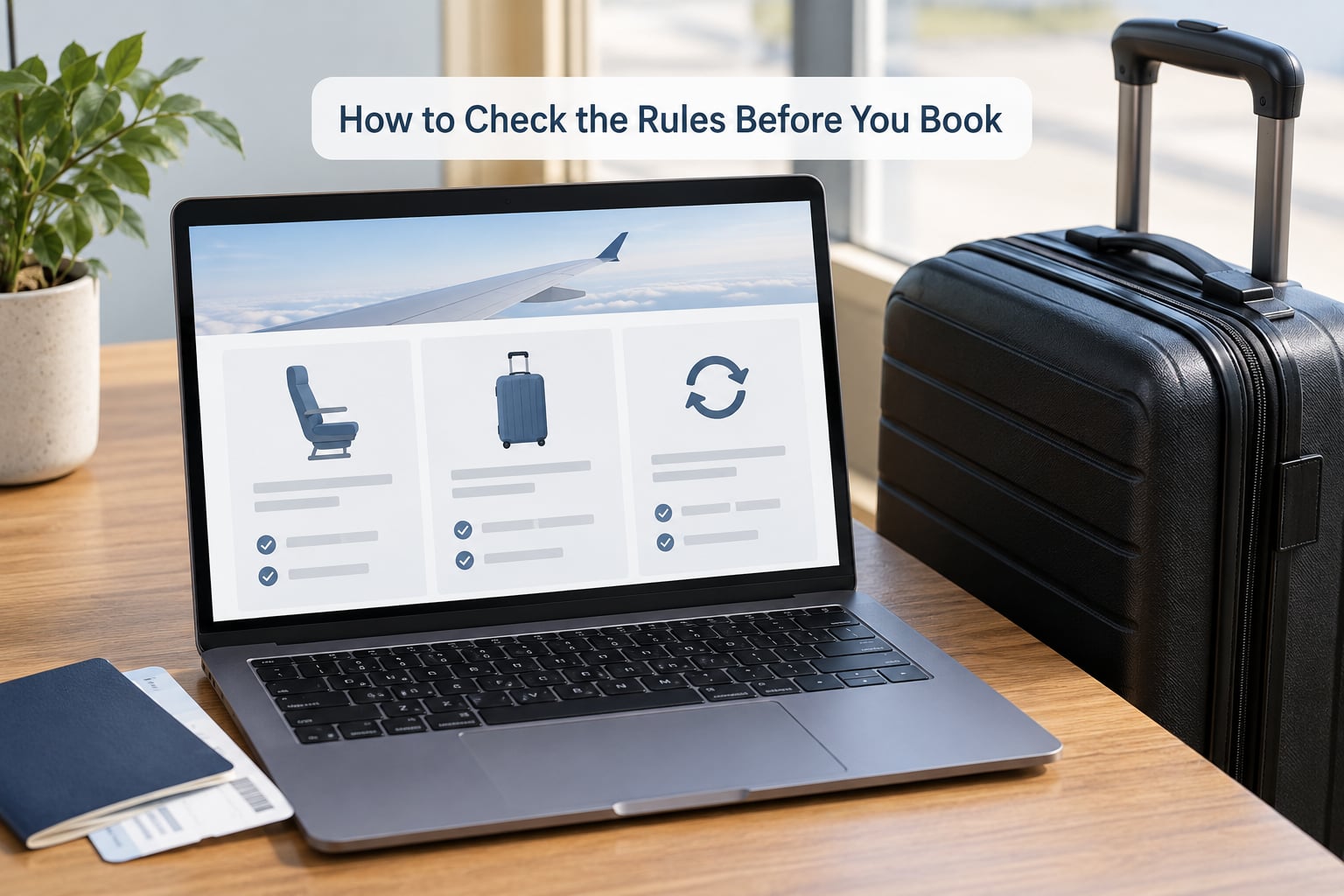
Six things to look at on the fare details page before you commit:
- The exact fare name. Basic Economy, Main Basic, Saver and Basic are different products with different rules.
- Seat selection. Whether a seat is included, assignable at check-in, or only available for a charge.
- The bag allowance on this specific route. Personal item, carry-on, and how many checked bags.
- Change and cancellation conditions. Whether changes are permitted, what credit you would receive, and how long it lasts.
- Boarding group. Shown on your confirmation or in the app.
- Partner flights. A codeshare leg can follow different rules than the marketing carrier sells.
Screenshot the fare rules when you book. If plans change later, that page is your evidence of what you agreed to.
When Basic Economy May or May Not Be Worth It
Break-even math
Add up what you are likely to spend on top of the fare: the seat charge if you want an aisle or window, the checked bag fee on each leg, and the change fee you would pay if your schedule moved once. Then compare that total with the difference between the basic fare and standard economy. If the add-ons exceed the difference, the cheaper ticket is not cheaper.
Travelers run this constantly in the other direction too. A commenter on r/delta itemised a bag charge, a paid aisle seat and no lounge access on one trip, and concluded the discount had evaporated. The same person still found the fare workable because a co-brand card covered part of it. The math changes with your situation, not with the fare.
Who it suits
Basic economy fits travellers with set dates, carry-on-only luggage, no reliance on a specific seat, no loyalty needs, and a short domestic route where a schedule change would not derail a holiday. One-way tickets and trips where you already have a backup plan are good candidates.
Who should pay more
Pay for standard economy if you are checking a bag, flying with children, splitting a group booking, holding status you care about, or booking a multi-segment itinerary. It is also worth paying more when the trip is important enough that being stranded would cost more than the fare difference.
Frequently Asked Questions
Is basic economy always the cheapest airline ticket?
It is usually the cheapest fare in the main cabin, but not always the cheapest option on the screen. Separate tickets, nearby airports and a different travel date can cost less than a basic economy fare on a popular route. Basic economy is cheapest relative to other fares on the same flight, not cheapest overall. Always compare it with standard economy on the same itinerary, since one bag or seat charge can erase the gap.
Can I get a seat with a basic economy ticket?
Yes, you always get a seat, but choosing which one is the part that changes. Many carriers let you pay for a seat in advance or assign one at check-in from whatever remains, which is often a middle seat in the middle of the cabin. Some carriers include free advance selection on the fare, so check the specific fare rules. If you want a window or aisle, assume you pay for it or take your chances.
Does basic economy include a carry-on bag?
The personal item that fits under the seat in front of you is almost always included. The larger overhead-bin carry-on is not guaranteed and depends on the airline and the route, with some carriers offering it only on longer or international itineraries. Gate agents check the size of the personal item and can gate-check it for a charge. If you plan to bring a full carry-on, verify the allowance before booking.
Can I change or cancel a basic economy flight?
Often you cannot change it. Where changes are allowed, expect a change fee plus the fare difference between your original fare and the new flight, calculated from the low original price upward. Cancellation usually produces a travel credit rather than a refund, and the validity window varies widely by carrier, with some credits expiring in as little as six months. Qualifying direct bookings also get a 24-hour cancellation window at some airlines.
Is basic economy always cheaper than standard economy?
No. The base ticket is cheaper, but the total trip cost may not be. Add the seat charge if you want a specific seat, the checked bag fee on each leg, and the change fee you would face if plans moved, then compare that with the fare difference between the two. A short fixed-plan trip with carry-on only usually favours basic economy. A flexible trip with a bag or a family usually favours standard economy.
What to Do First
Open the fare details page and total up the trip rather than the ticket. Add the bag you will actually check, the seat you actually want, and one realistic change. If that total beats standard economy on the same itinerary, book the basic fare with confidence. If it does not, the extra few dollars buys you a seat you chose, a bin with room in it, and a ticket you can still use when the week falls apart.