A mistake fare is a flight ticket that an airline or a travel agency accidentally sells far below the going rate, sometimes 60% to 90% below what that route normally costs. It happens because of a typo in a fare rule, a dropped fuel surcharge, a currency conversion mistake, or a bug in a ticketing system. It is not a sale, and it usually does not last.
Plenty of readers land on this question after seeing a deal post that looks too good to be real, sometimes wondering whether they just found a scam. Most of those posts are genuine, though the price is real only for a narrow slice of seats on a specific route and fare class, and the airline may still pull it hours later.
Table of Contents
- 1What Is a Mistake Fare?
- 2What Is a Mistake Fare in Practice?
- 3How Do Airlines Set Airfares?
- 4How Do Airline and Travel Sites Make Mistake Fares?
- 5How to Tell a Mistake Fare from a Bad Deal
- 6How to Search for Mistake Fares Responsibly
- 7What Should You Do If You Find One?
- 8Frequently Asked Questions
- 9Do airlines have to honor a mistake fare?
- 10How rare are mistake fares?
- 11Can an airline cancel a mistake fare after I book it?
- 12How long does an airline take to correct a mistake fare?
- 13Should I book a mistake fare, and should I buy more than one ticket?
- 14Conclusion: Check the Full Fare Before Booking
What Is a Mistake Fare?
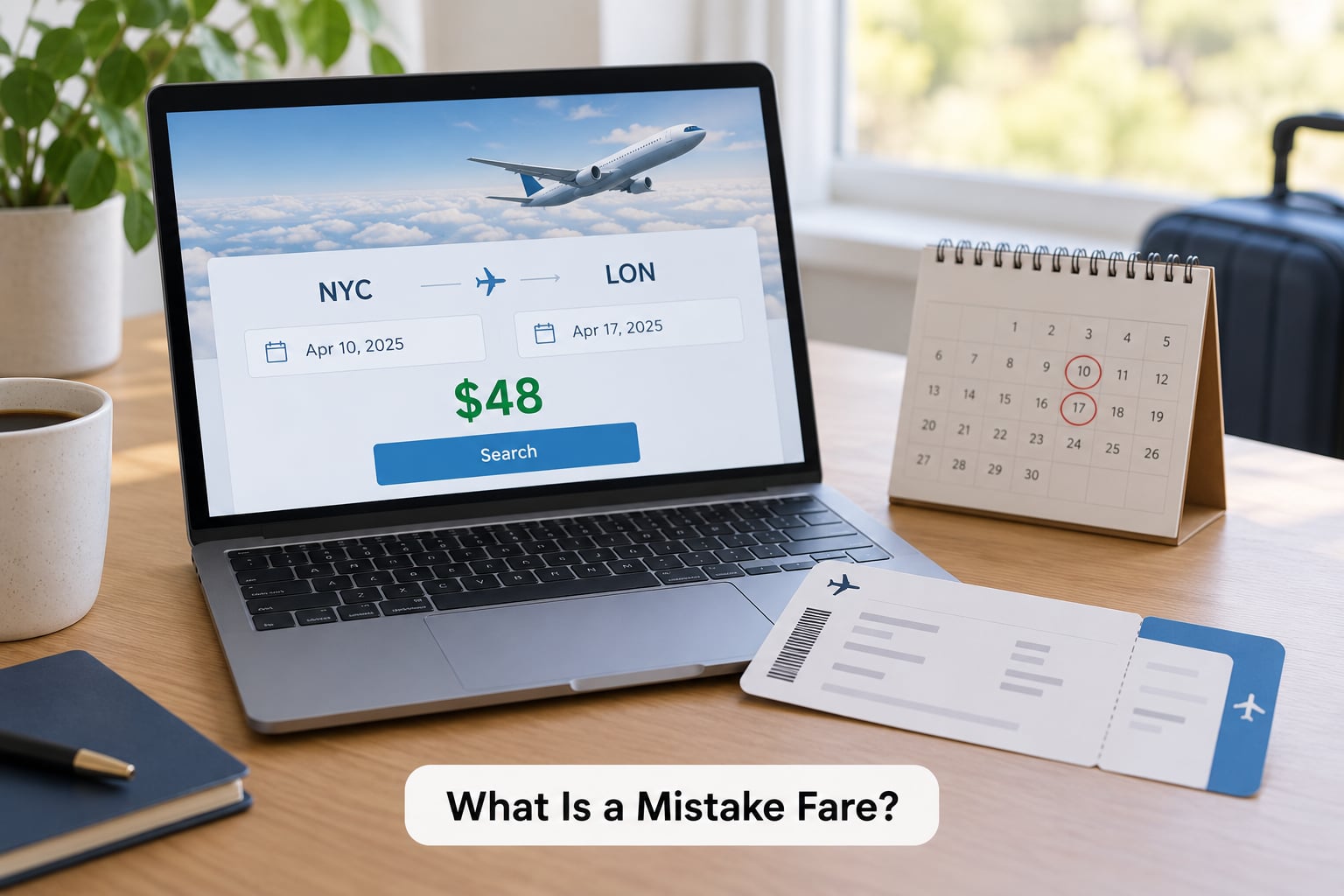
What is a mistake fare, in one sentence: it is a ticket sold for a price the carrier never intended to charge, usually because its pricing rules or distribution systems published a number that nobody reviewed before it went live.
Because these fares are accidental rather than promotional, they behave very differently from a sale. They tend to attach to one fare class, one route, one set of dates, and sometimes one airline within a codeshare. Once the inventory attached to that fare bucket sells out, the price snaps back to normal, even if the fare rule itself is still technically open.
There is another important detail. A mistake fare is usually priced on a specific flight or a specific combination of segments. Open a search on a neighbouring date and the price disappears. That is why screenshots of these deals tend to look identical across dozens of reposts.
What Is a Mistake Fare in Practice?
Plenty of things get called a mistake fare that are not one. A flash sale on a Caribbean route, a promotional business-class fare released for a loyalty programme, or a long layover itinerary that undercuts the direct flight all look surprising next to the usual price. None of them are errors.
Four situations cover most of what people post about:
- A true pricing error. The airline’s own system published a fare far below its rule, often with taxes, fees or a surcharge left out. This is the classic case, and the one most likely to be cancelled.
- A short promotional fare. A real discount, sold in small blocks, with a stated end date. Cheap, and entirely normal.
- A fare that only looks cheap. A self-transfer, an overnight arrival, a distant airport, or a routing through a country you would rather avoid. The headline price is honest; the trip is not what you imagined.
- A fare that is hard to book. The price is legitimate but every code-share partner and the airline site show sold out for long-haul cabins. Rare seats in a premium booking class do this constantly.
The difference matters because the first case carries risk and the rest do not. If you are booking something that will be voided later, you want refundable hotels and a plan B.
How Do Airlines Set Airfares?
Airfares are not a single number set by hand. They are built from a base fare, added to by taxes and carrier-imposed charges, then adjusted by demand, how far ahead you book, the time of year, and how much of the cabin is already sold. On top of that sit inventory controls that decide which fare buckets, and therefore which prices, are even available on a given flight.
That last part explains most surprises. A fare is not simply a price for a seat; it is a price attached to a booking code such as W or Q in economy, or I or Z in business. When the cheap bucket closes, the next price up appears automatically. What you see on the screen is just the cheapest bucket with inventory left.
Here is how the fare types you will meet compare, and whether each one is an error when it looks too good.
| Fare type | How it normally behaves | Is it a mistake fare? |
|---|---|---|
| Published economy fare | Sits at the bottom of the fare ladder and is the first bucket to sell out | No, unless a surcharge or tax was dropped |
| Promotional or sale fare | Real discount, limited block, published end date | No |
| Basic economy | Unbundled fare: bag, seat and changes usually cost extra | No, even when the total beats a full economy fare |
| Award fare | Paid in miles, taxed in cash, availability set by award charts | Only if the miles or tax requirement is wrongly calculated |
| Mistake fare | Published in error on one route, date or booking code | Yes, by definition |
Competition shapes the fare ladder as much as demand does. A route with three carriers competing usually has more price points and wider swings than a monopoly or thin regional route, where a single pricing decision can define the whole market.
A displayed price can also change between two searches minutes apart, with no error involved at all. That happens when the cheapest bucket sells out while you are reading, when the cache behind a comparison site goes stale, or when the fare you were quoted was only available with a partner carrier that has now closed.
How Do Airline and Travel Sites Make Mistake Fares?
Airline pricing runs through several systems that pass data along: the airline’s own reservation system, a global distribution system that travel agencies and other airlines book through, and the websites or apps that sit on top. A mistake fare usually enters the chain somewhere in that path.
- A dropped surcharge or carrier charge. A fuel surcharge, a security fee, or a carrier-imposed charge fails to attach, and what is left looks almost free. These are the classic cases and the easiest for an airline to notice quickly.
- A human input error. Someone types a fare rule and leaves out a digit, or a missing zero turns five hundred into fifty. Airline staff make these mistakes too, which is why a simple typo can outlast a technical fault.
- A currency conversion error. A fare built in one currency gets published in another at an absurd rate. This is the version of the story that spreads fastest, because the headline number looks like a small fortune in local money.
- A fare-class coding mistake. A premium booking code is mapped to an economy price, so business or first class sells at a fraction of its fare. Codeshares and new partnerships are more exposed, since the partner’s mapping is often not reviewed in detail.
- A system or agency glitch. A distribution outage, a failed feed between airline and partner, or a bug in an online travel agency’s ticketing path publishes a fare that was never meant to be sold. The booking may even fail at the last step, which leaves some people convinced the deal is fake.
Once it exists, an airline decides whether to honour it. Most published terms allow the carrier to void a fare it can show was issued in error, so the sale is not automatically binding. Some airlines honour it as a goodwill gesture; others void it within hours.
How to Tell a Mistake Fare from a Bad Deal
Run a quick sanity check before you start pacing. Most posts that look like errors are ordinary fares, and a five-minute comparison saves you from a refundable-hotel scramble later.
- Compare with the usual price for the route and cabin. Use a flight search tool on nearby dates and check the full total, taxes included, for the same cabin.
- Look at the total, not the base. A headline number with taxes added at checkout can double. Read the final page before you feel anything.
- Confirm the dates, times and airports. Error fares are pinned to one segment. Check the departure airport is the one you assumed, and that the return is the day you meant.
- Check the fare conditions. Baggage allowance, seat choice, changes and cancellation rules are shown before payment. A fare with no baggage on a long-haul trip is not a gift.
- Look at connection times. A cheap fare often hides a self-transfer, an overnight connection, or a terminal change with a long walk.
- Check the currency. If you are quoted in an unfamiliar currency, the conversion may be the story rather than the fare.
- Check entry rules for your passport. A transit or entry requirement can make a cheap routing unusable.
One clue that shows up again and again is a suspiciously round, small number for a real route. Round numbers rarely survive a pricing system, because fares are computed from taxes, distances and demand curves. A fare that ends in a tidy zero on an expensive long-haul route deserves a second look, though it is not proof on its own.
The fastest confirmation is the airline’s own booking engine. If the price survives a search on the carrier’s site, in the same booking class, with the same conditions, the fare is at least technically sellable right now.
How to Search for Mistake Fares Responsibly
Nobody can predict when one will appear, and any site promising a list of live mistake fares is usually recycling old ones. What you can do is widen your search and react fast when something real turns up.
- Turn on price tracking first. Google Flights and similar tools watch a route for you and email when the fare moves. It costs nothing and it catches most of what you would have missed.
- Search flexible dates and nearby airports. Widening by a few days, or adding a second airport within an hour’s drive, changes which fare buckets are open to you.
- Check more than one search engine. Each one pulls slightly different fare data, and a glitch can show up in one feed before it appears in another.
- Follow dedicated deal alerts. Services such as Secret Flying, Going and the premium fare forums on FlyerTalk exist for this. Some are free, some are paid, and the paid ones largely buy you speed.
- Follow airline and loyalty news. New partnerships and new routes are where fare-class mapping mistakes are most common, so a launch often produces a cluster of them.
- Watch award charts. Loyalty programmes repricing an award bucket, or a conversion error in a partners programme, produces the same kind of deal in points.
- Verify on the airline site before paying. Not every repost is accurate, and screenshots age badly.
A note on award bookings: error fares are not only about cash. In late 2023 Air France-KLM’s Flying Blue briefly repriced some long-haul award bookings, and the airline ended up honouring only part of the affected inventory. Points mistakes get corrected too, sometimes with a carve-out for top-tier elite members.
What Should You Do If You Find One?
If you are certain the fare is real, the sequence matters more than anything else you do afterwards.
- Check the details twice, then book. Names must match travel documents exactly. A wrong date or a different airport is the most common way a good deal becomes a costly mistake.
- Book on the airline’s own site. Your contract is then with the carrier. Bought through an online travel agency, your contract is with the agency, and forum regulars point out that this makes a voided fare harder to sort out.
- Pay with a card. You want the chargeback and dispute options that a card gives you if the booking unravels.
- Do not call the airline. Travelers repeatedly report that asking an agent to add a loyalty number, change a date or include a detail is what brings the fare to an agent’s attention. Leave it alone.
- Do not post your confirmation publicly. Wide attention sells out the remaining inventory and pulls attention onto the fare, which shortens the window for everyone.
- Wait about two weeks before non-refundable spend. Hotels, transfers and tours are the exposure that hurts. Forum consensus is clear: sort the ticket first, then commit money.
- Buy one seat, and be honest about it. Buying a block to resell is widely viewed as a form of fare arbitrage, and airlines notice and punish it.
If the fare is voided, what you get back depends on where you are and how you booked. In the United States, the common understanding among travelers and consumer advocates is that a voided booking means a full refund of the fare, plus reimbursement for nonrefundable ancillaries you bought in reliance on the ticket, such as hotels, tours, rail legs and visa costs. You are not generally entitled to fly at the error price. Other countries differ, and some, including the United Kingdom, offer no equivalent automatic protection, so your home rules and the airline’s own conditions matter more than anything a forum says.
Documented cases run from the famous to the merely odd. American Airlines once listed Atlanta to Cape Town for about 130 dollars against a normal fare above 1,300. El Al briefly offered transatlantic tickets at absurd prices in a short August window. Cathay Pacific has surfaced first-class fares at what looked like premium economy money. Every one of them ended the same way: some honoured, some voided within hours, refunds issued where the rules required it.
Frequently Asked Questions
Do airlines have to honor a mistake fare?
Usually not. A published fare issued in error can be voided under most airlinesu0026#8217; terms, so there is no general right to fly at the error price. Where the airline cancels, US rules are generally read to mean a full refund of the fare plus reimbursement of nonrefundable purchases made in reliance on it, such as hotels and tours. Protection differs by country, and the UK has no equivalent rule.
How rare are mistake fares?
Genuinely rare. One large deal service reported finding only a handful of real mistake fares across all of 2024, under 0.2% of the deals it flags. Most posts labelled mistake fares turn out to be promotional fares, unusual routings, or premium cabins with almost no inventory left. Set alerts and accept that most notifications will be ordinary sales.
Can an airline cancel a mistake fare after I book it?
Yes, and it happens often. Published honor-rate estimates vary widely, from around 50% in recent years and roughly 75% before the pandemic according to Going, to about 70% quoted by Jacku0026#8217;s Flight Club, and up to 85% among deal specialists who only track confirmed cases. Airlines that cancel generally refund the fare and reimburse eligible nonrefundable ancillaries.
How long does an airline take to correct a mistake fare?
Often minutes to a few hours, occasionally a day or two. The fare usually disappears once the cheapest booking bucket sells out or once someone inside the carrier spots the price. That is why the practical advice is to check the conditions and pay within the same sitting rather than screenshotting it and waiting for confirmation from anyone.
Should I book a mistake fare, and should I buy more than one ticket?
The financial downside is limited because a voided booking means a refund, which is why booking first and worrying afterwards is the common strategy. The catch is your own time and any non-refundable spend, so hold off on hotels for about two weeks. Buy the seats you actually need. Buying blocks to hoard or resell is widely criticised and makes a cancellation more likely.
Conclusion: Check the Full Fare Before Booking
A mistake fare is an accident in an airline’s pricing chain, not a sale, and it survives only as long as the booking buckets behind it have inventory. When you find one, confirm the total price, dates, airports and fare conditions on the airline’s own site, book straight away with a card, and keep your non-refundable plans on hold for about two weeks. That is the whole playbook, and none of it has changed in 2026.