The short version: check whether the reclined seat is actually blocking something you need, ask the passenger once in a quiet voice with a specific reason, and if nothing changes, ask a flight attendant rather than handling the seat yourself. Most of these situations end with one calm sentence and no argument.
That is the whole approach. Reclining is a real right built into the seat, and treating it as an act of hostility is what turns a small irritation into a row-wide incident. But a seat that stays folded back for three hours with no acknowledgment is also not a right anyone has to accept indefinitely, because it eats into your leg room and can block your route to the aisle.
Understanding how to deal with a reclining seat in front of you comes down to sequence, not force. Ask first, escalate to the crew, and skip the physical methods unless everything else has failed.
Table of Contents
- 1What You Need
- 2Step-by-Step: How to Deal with a Reclining Seat in Front of You
- 31. Check Whether the Seat Is Actually a Safety Issue
- 42. Ask the Passenger to Return the Seat Upright
- 53. Confirm That the Seat Has Been Reclined
- 64. Ask a Flight Attendant for Help
- 75. Use Airline Rules Without Escalating
- 86. Plan What to Do If the Reclining Seat in Front of You Stays Reclined
- 9Common Mistakes
- 10Frequently Asked Questions
- 11Is it rude to ask the person in front of me not to recline their seat?
- 12Can I press their seat forward myself with my knees or hands?
- 13Can a flight attendant make a passenger sit upright?
- 14Can I move to a different seat during the flight?
- 15What if the person in front of me is asleep or ignoring me?
- 16Do seats in front of the bathroom recline?
- 17Conclusion
What You Need
You do not need equipment, and you do not need permission to ask. What you need is a clear reason, a moment when the person can hear you, and a decision about your own seat made before you start.
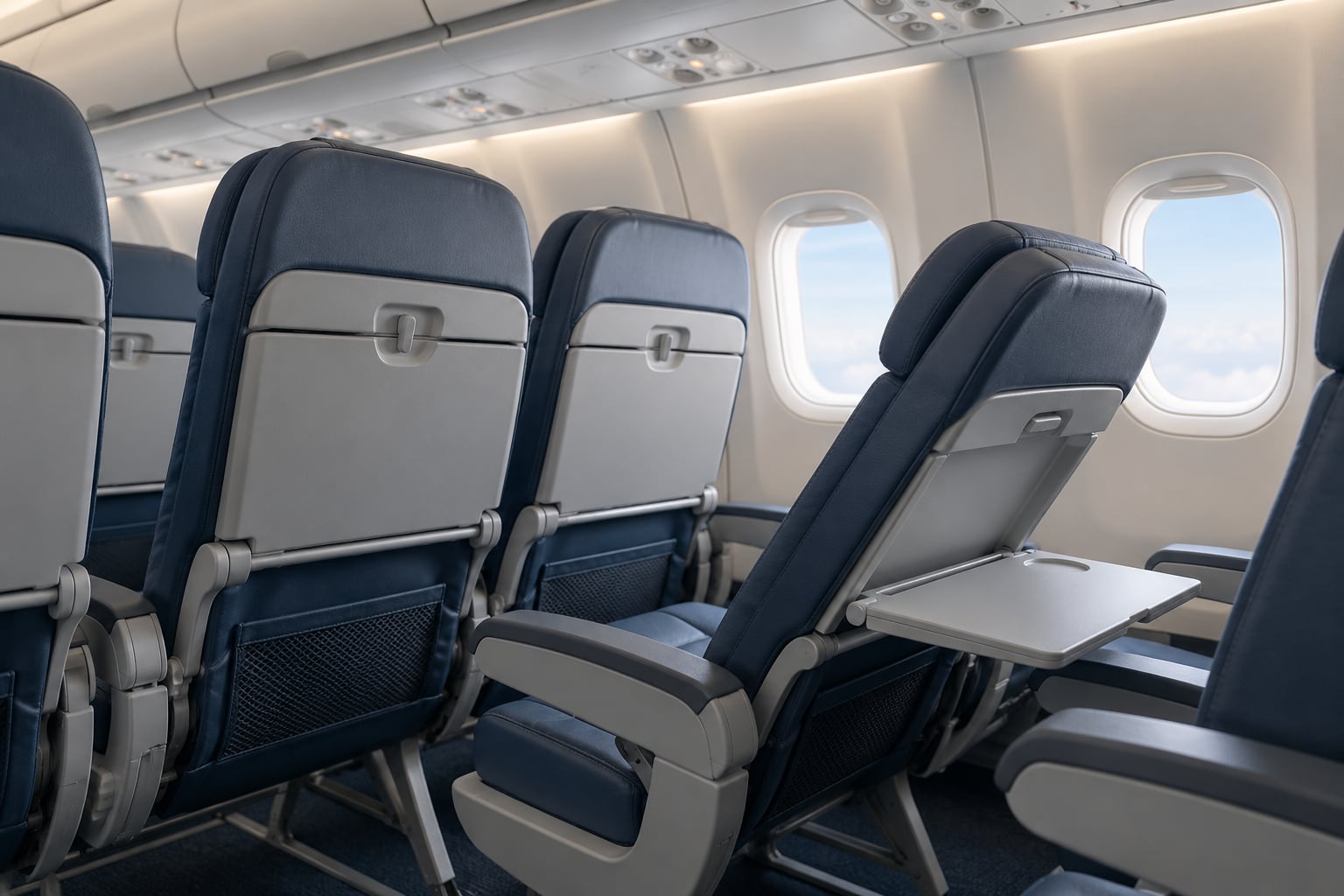
First, know how the seat works. On most economy rows the seatback pivots forward into the space behind it, and the recline button or foot lever sits on the lower right or left of your armrest. Some rows have a lock-out that only the cabin crew can release. A few aircraft have rows where the seat in front physically cannot recline at all.
Second, pick your reason. Leg room, a tray table you need for a meal, in-flight entertainment, or needing to get out for the lavatory. Height works well too, particularly for taller passengers whose knees already touch the seatback before anything moves. A specific reason gets results; a general complaint rarely does.
Third, time it right. The worst moments are right after boarding, during the meal service, and while someone is trying to watch the screen. The best moments are before the seat goes back or right after it comes back up.
Fourth, decide in advance whether you are willing to move. If the flight has empty rows behind you and you are tall or in a middle seat, knowing that you can relocate changes the whole conversation, because the ask stops being a fight about space you intend to occupy.
Step-by-Step: How to Deal with a Reclining Seat in Front of You
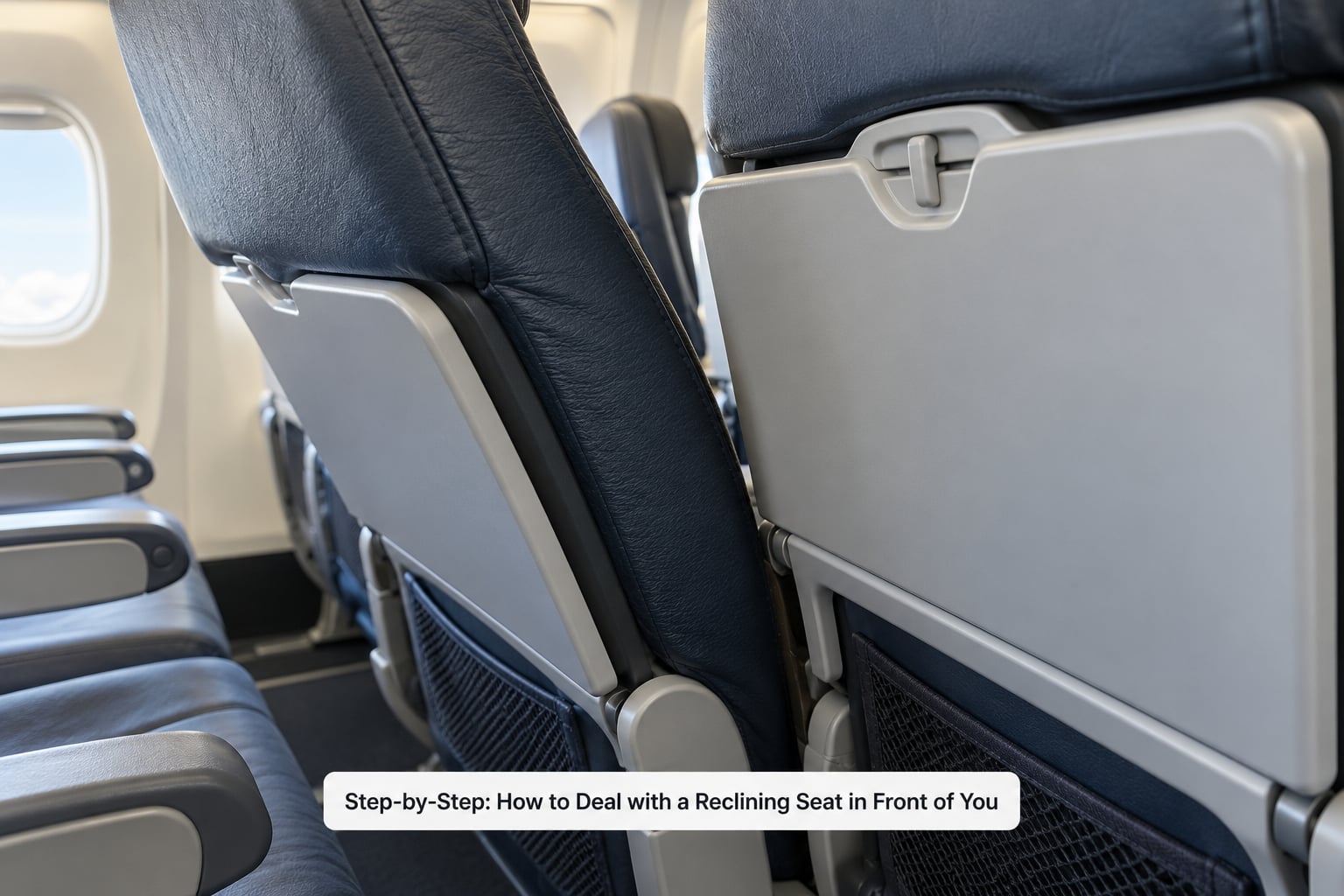
Six steps, in order. Each one has a signal that tells you whether to move on to the next.
1. Check Whether the Seat Is Actually a Safety Issue
Look at what is blocked rather than at the seat itself. Can you still reach your tray table latch? Can you see the screen? Are your knees free enough to shift position? Is there any route at all between you and the aisle?
Rows directly in front of a lavatory are the real safety case. When the seat ahead is folded back, the aisle passenger has to wake that row and shuffle sideways across two reclined seats to get out, then do the same awkward shuffle to get back. On a full flight that can take a minute and involves stepping over sleeping strangers. Rows next to an exit have a similar problem, because a blocked row slows down the evacuation path.
Signal: if you can eat, watch and stand up, this is a comfort issue and step two applies. If you cannot stand up or get out, say so plainly to the cabin crew, because that is a safety issue and gets acted on faster.
2. Ask the Passenger to Return the Seat Upright
Lean forward slightly and speak quietly, near their shoulder. Volume matters more than anything else here, because a request delivered at normal conversation level in row 24 becomes a public event.
A script that works: “Sorry to bother you. Would you mind keeping your seat upright for now? I’m six foot four and my knees are already touching.” Or during a meal: “Any chance you could keep it upright for the next twenty minutes? I need the tray table to eat.” If you are asking twice: “Sorry to ask again, I know it’s your seat, but could you keep it up for now? I can’t get out to use the toilet otherwise.”
If there is no reaction, do not repeat it a fourth time. Give it ten or fifteen seconds. If nothing happens, assume they heard you and chose not to respond, and move to the next step rather than escalating your tone.
3. Confirm That the Seat Has Been Reclined
Some seats drift slowly backward instead of moving in one go, which is far more disruptive than a single recline because you cannot tell when it happens. Watch the gap behind the seatback rather than the person. Check whether the tray table latch is still reachable. Look at how far the seatback has travelled relative to the seat pocket in front of you.
Do not lean over and press their button, and do not reach into their seat space to inspect anything. You are establishing a factual picture, not collecting evidence.
Signal: if the seat moves back again after you raised it, that is a pattern rather than an accident, which changes which step you go to next.
4. Ask a Flight Attendant for Help
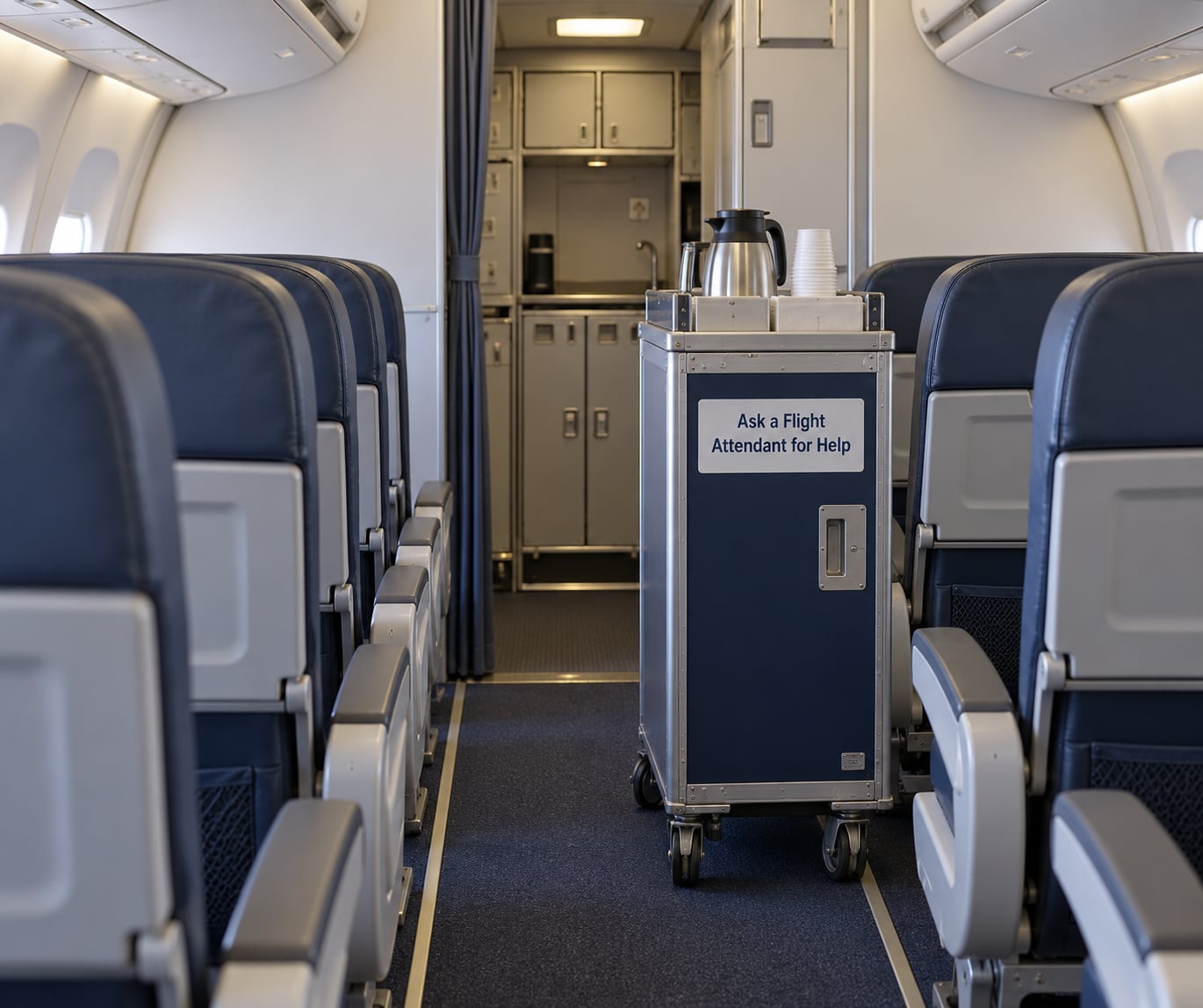
Wait for a natural pause, ideally as the attendant passes with a service cart, and keep it to two sentences.
“The seat in front of me has been reclined for the last hour and I can’t get out of my seat. Could you help me sort that out?” Or, if it is a comfort rather than safety issue: “The seat in front of mine is fully back and I’m struggling with leg room. Can you say something to them for me?”
Attendants deal with this constantly, so a plain request lands better than an accusation. They will usually walk up, say one or two words, and the seat comes back up without anyone raising their voice. That is the outcome you are after, because the crew asking removes the personal conflict from your hands entirely.
Signal: if the seat goes upright after the attendant speaks, the problem is over. If it goes back up a second time, treat it as a last-resort situation and move to step six.
5. Use Airline Rules Without Escalating
Two rules are worth knowing and neither is a weapon. First, seats must be upright and tray tables stowed for taxi, takeoff and landing, which is why an attendant will act instantly during those phases and much more slowly in cruise. Second, cabin crew can instruct a passenger to return a seat upright for comfort, safety or to resolve a dispute.
Airlines differ on how far that goes. Most publish only the standard safety rules. A small number ask passengers to check with the row behind first, and a handful of low-cost airlines fit rows where the seat does not recline at all, so no conversation is needed. Policies change, so check the carrier’s published rules before you fly rather than assuming.
Say it as information, not as a threat: “I know it has to be up for takeoff and landing, so I wanted to check whether there is anything else I should do here.” It comes across as cooperative. A courtroom tone does not.
Signal: if the attendant tells you the recline is permitted and offers no help, you have your answer. Treat it as settled and move on to deciding whether you can live with it.
6. Plan What to Do If the Reclining Seat in Front of You Stays Reclined
Some passengers never move. That is where your own choices take over.
Ask to move seats. Phrase it as a practical problem rather than a complaint: “I’m having trouble with the leg room here, is there an empty row I could move to?” Crews can often reassign you after boarding, though not always, and not on every aircraft. Middle-seat passengers benefit most from this, since they have no aisle escape.
If nobody moves, adjust yourself. Angle your knees to one side and slide forward in increments. This sounds trivial, but on a modern narrow-body economy seat the few inches you recover matter a great deal.
Put your tray table up anyway, even if it does not fold flush. A slightly raised tray table gives you a surface to eat from and something to lean against. Check the screen angle before you assume the entertainment is blocked.
And then decide whether to let it go. On a daytime flight of two hours or less, sitting through it is usually the cheapest option, and it is the version other passengers notice. On a long overnight flight, folding back your own seat partway is entirely reasonable, provided you give the row behind a heads-up first, which most frequent flyers consider the only courtesy that matters.
Common Mistakes
Coming at it from the wrong angle is what turns a minor friction into a confrontation. These are the moves to skip.
- Complaining about the seat instead of your problem. “You can’t recline that seat” gets a defensive answer every time. “I can’t get up to use the toilet” gets action.
- Asking at full volume. A loud request in row 24 recruits the entire cabin, and now you are the person who made a scene over a seat. Lean in and lower your voice.
- Waiting until the flight is fully settled. An ask in the first ten minutes after takeoff works far better than one three hours into cruise.
- Touching the seat, the lever or the button. Pressing another passenger’s recline control, or pushing their seat forward with your knees or hands, converts a polite disagreement into a physical one. Cabin crews treat this as a safety issue, not an etiquette issue.
- Blocking the seat with a device. Knee defenders and similar gadgets are sold for this, but airlines can and do refuse them at the gate, and a passenger who deploys one can be removed. Keep it as a last resort for your own seat only, never as a tool aimed at someone else.
- Assuming you must ask before reclining yourself. Most airlines expect you to check behind you once, especially before a meal or on a flight longer than two hours. That single check costs you nothing and keeps you on the right side of the argument.
- Arguing with a passenger who says the seat is theirs. It is. Once your polite ask and your request to the attendant have both been declined, further debate earns you nothing.
A few things prevent most of this entirely. On the seat map, look for rows marked as having limited or no recline, and rows near bulkheads if you want leg room without the pitch penalty. The very back row has nobody behind you, which regular flyers treat as the easiest place to recline in economy. An aisle seat near a lavatory saves you the shuffle, though you trade away the ability to stretch out. If reclining bothers you enough to plan around it, premium economy and business class both reduce the conflict, and business class removes it.
One last note for international routes. Expectations genuinely differ. On many long-haul and red-eye flights, reclining during cruise is close to universal, and a passenger who stays upright all night is the unusual one. Frequent flyers on those routes describe it plainly: sitting bolt upright for fourteen hours is a hard ask, and nobody with experience expects it. On short-haul European and domestic hops, the opposite convention holds and a full recline reads as inconsiderate. The strongest signal is the flight duration and the time of day.
Frequently Asked Questions
Is it rude to ask the person in front of me not to recline their seat?
No. The seat belongs to them and they are entitled to use the recline function, but asking once, quietly and with a reason is normal cabin behaviour rather than an imposition. Askers who annoy people are the ones who demand, argue or address the passenger loudly in front of the whole cabin.
Can I press their seat forward myself with my knees or hands?
Avoid it. Reaching into another passenger’s seat space, touching their recline lever or pushing the seat forward turns a courtesy request into a physical confrontation, and crew treat it as a safety and conduct issue. If you cannot get out of your seat, tell a flight attendant and let them handle it.
Can a flight attendant make a passenger sit upright?
Yes, in practice they can ask a passenger to return their seat upright, and most do when a passenger behind raises a genuine problem. During taxi, takeoff and landing it is not optional at all, since upright seats and stowed tray tables are required. In cruise, crew handle it as a comfort and courtesy matter.
Can I move to a different seat during the flight?
Sometimes. Once boarding is complete and the doors close, attendants can often reassign you to a vacant seat, particularly if you are a middle-seat passenger with a real leg room problem. It is not guaranteed, and it is less likely on a full flight, so ask early rather than waiting until you have been sitting cramped for an hour.
What if the person in front of me is asleep or ignoring me?
Speak quietly near their shoulder and say your reason, then wait ten or fifteen seconds without repeating yourself. If there is still no response, do not escalate your voice or wake them roughly. Go straight to a flight attendant, explain that you cannot get out of your seat, and let the crew decide how to handle it.
Do seats in front of the bathroom recline?
On many aircraft they do, which is exactly why those rows cause trouble: a reclined seat forces the aisle passenger to wake the row ahead and step across two seats to reach the lavatory, then repeat the shuffle to get back. Lavatory-adjacent rows are also where crew are most likely to ask for the seat to stay up, since it blocks an escape path.
Conclusion
Knowing how to deal with a reclining seat in front of you takes about thirty seconds of work. Check whether something real is blocked, ask once in a low voice with a specific reason, and if the seat goes back up again, hand the problem to a flight attendant.
What you leave out matters as much as what you do. No touching the seat, no public argument, no blocking gadgets aimed at another passenger, and no sitting in silence for three hours hoping someone notices. If you find yourself stuck, ask to move seats early, when there is still a choice.