To book multi city flights, you use the multi-city option in a flight search instead of round-trip, add each leg in the order you will fly them, then pay once for the whole route. The search itself takes about 15 minutes once your cities and dates are settled.
The part that catches people out is the choice between one multi-city ticket and a stack of separate one-way tickets. That decision matters more than the search box, because a single ticket makes the airline contractually responsible for getting you to your last destination. Separate tickets hand that job to you.
Table of Contents
- 1What You Need
- 2Step-by-Step: How to Book Multi-City Flights
- 3Choose a Booking Method to Book Multi-City Flights
- 4Map Every City, Airport, and Connection
- 5Compare the Total Price and Fare Rules
- 6Select Flights with Sensible Connection Times
- 7Confirm the Itinerary Before Paying
- 8Common Mistakes
- 9Frequently Asked Questions
- 10What does a multi-city flight mean?
- 11How do I add a stop on Google Flights?
- 12Can you do multi-city flights on Skyscanner?
- 13Is it cheaper to book a multi-city ticket or separate one-way tickets?
- 14How do you book multi-city flights for 20 people?
- 15What happens if one leg of my multi-city itinerary is cancelled?
- 16Conclusion
What You Need
Get these onto one page before you open any booking form. Hunting for passport details at the payment screen is how good fares get missed.
- Every city in the order you will fly them, with the date you want to arrive and leave each one
- Both airport options for each city, including the secondary airport 30 to 60 minutes away by train or shuttle
- Passenger names exactly as printed in the passport, including middle names
- Your passport expiry date, since many countries and airlines want six months of validity beyond your travel dates
- Any visa or transit permit required for each country you touch, including ones you only pass through
- A ceiling for the total trip cost, plus what you will pay for checked bags and seat selection
- How flexible the trip really is, because movable dates open up far more routing
Entry and transit rules differ by country and change without much notice, so check official government travel advice rather than an airline summary page. On a multi-country trip you also need to know whether you can pass through an airport without clearing immigration. That one detail can rule out a routing that looked perfect on the map.
Step-by-Step: How to Book Multi-City Flights
Five stages, in the order that wastes the least time. Start with the booking method, because it decides what you are able to search for at all.
Choose a Booking Method to Book Multi-City Flights
An airline website is the cleanest option when your trip runs on one carrier and its partners. Fares show the real baggage allowance, and a delay on leg two gets handled by the airline. The trade-off is that most airline tools cap out around six legs, and the results usually route you through that carrier’s default hub.
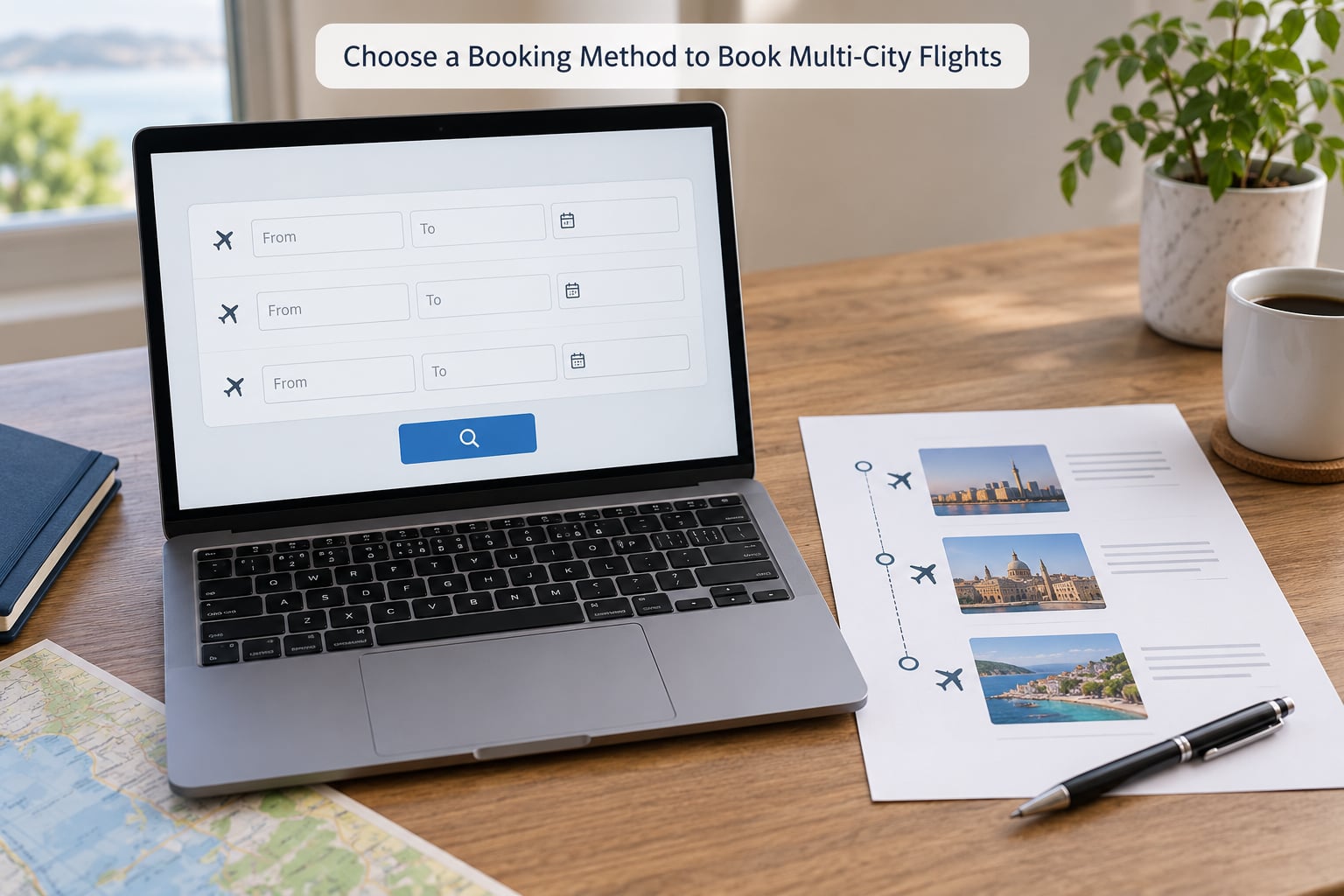
An online travel agency searches more airlines in one place and handles awkward routings easily. The downside, raised again and again on r/Flights, is that a fare displayed on an agency site can vanish at the payment screen. A traditional travel agent or an airline call centre charges more in fees but gives you someone to ring when a leg breaks.
My rule: book direct with the airline when the routing is simple and stays inside one alliance. Use an agency or an agent when you are mixing four or more carriers on a schedule with little slack.
Map Every City, Airport, and Connection
Enter the legs in the order you will fly them. Each row takes an origin, a destination and a date, and the arrival date on one row becomes the departure date on the next.
Read every airport code before you search. Flying into one airport and out of another 30 miles away can cost two extra hours of ground transport, and it is the reason some open-jaw itineraries look more expensive than the flights themselves. Check which airports have direct flights from your previous city rather than only connecting options.
Give each city real arrival and departure dates. If you want two nights somewhere, that is a two-night stop built into the route, not an overnight layover you will argue with later.
Compare the Total Price and Fare Rules
Compare the complete itinerary, not the individual legs. A multi-city fare is priced as one journey, so it often comes out under the sum of the same route bought as separate one-ways.
Then read the fare rules instead of the headline number: baggage allowance per segment, seat selection charges, change penalties, cancellation terms and payment options. On a six-leg trip across two airlines, each carrier may price checked bags by its own rules.
Look for code-share flights too. When the ticket is sold by one airline and operated by another, the operating carrier may apply different bag and seat policies than the name on your itinerary.
Select Flights with Sensible Connection Times
Balance price against convenience. A sub-two-hour connection on one ticket is workable. The same gap on two separate tickets is a gamble, because the second airline has no obligation to wait for you.
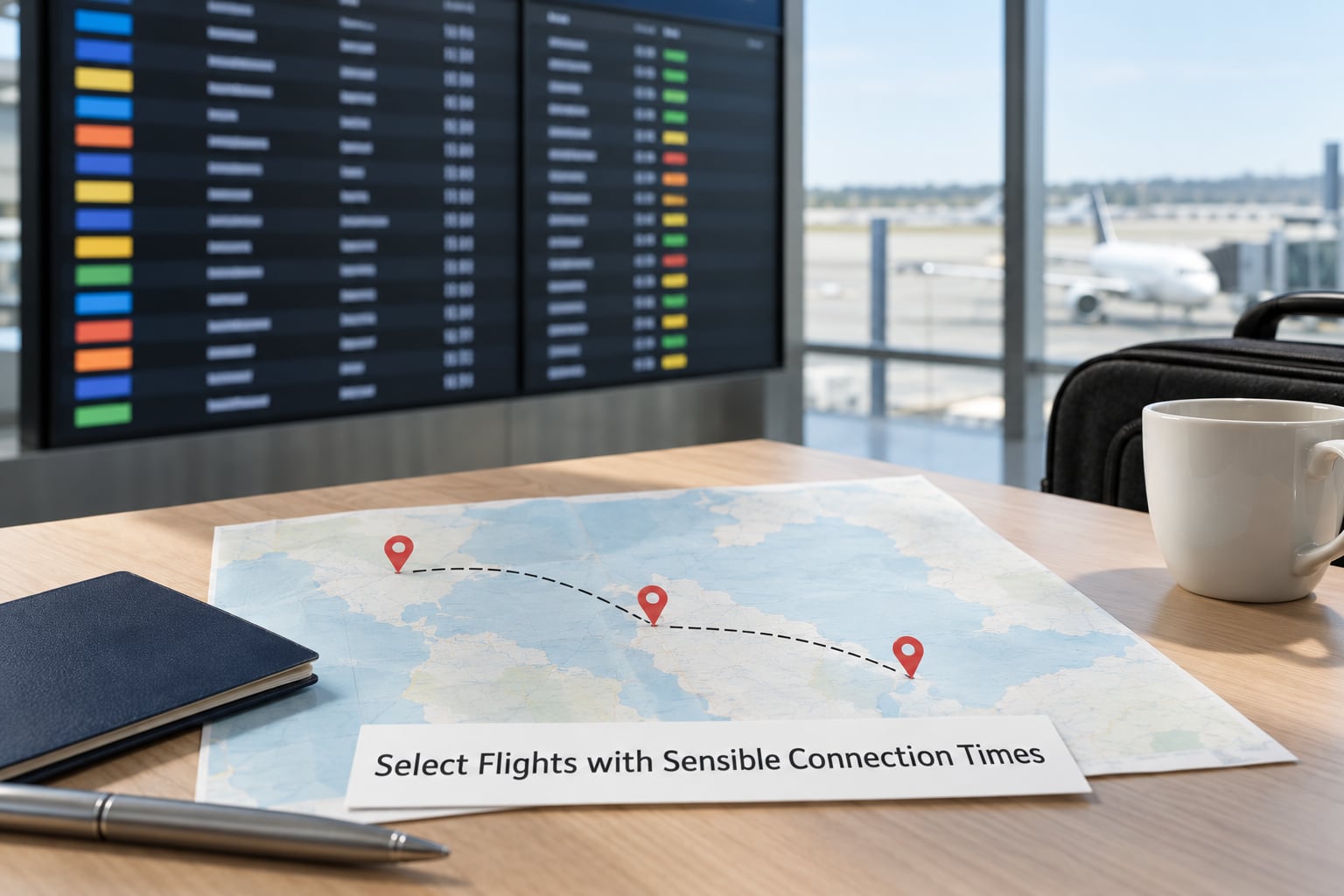
Travel experts on FlyerTalk and r/TravelHacks suggest at least two hours between separate tickets on the same airline, and three hours or more when the airlines differ, the airport is large, or you need to clear immigration and collect bags in between. Domestic-to-international connections usually need more room than either.
A single ticket means a protected connection. Separate tickets mean an unprotected one. If leg one is cancelled, the second airline owes you nothing.
Confirm the Itinerary Before Paying
Run this list once, slowly, before you type a card number.
- Every date and time, leg by leg
- Every airport code, matching what you researched
- Passenger names exactly as printed in each passport
- Baggage allowance on each segment, including the operated carrier’s rule
- Seat selections and the fee charged for each
- Visa and passport validity for every country, including transit-only stops
- Change and cancellation terms for the fare you picked
- The confirmation reference, and whether it covers all legs or one per carrier
Save the confirmation email before you close the tab. Multi-city bookings sometimes come back as a single record for the whole itinerary and sometimes as one per carrier, and you need to know which before you ever call anyone.
Common Mistakes
- Putting the return city in the wrong row. Read each row back out loud, origin then destination, before you search. A transposed pair can look valid and fly you somewhere you never meant to go.
- Treating a search bundle as one bookable ticket. Readers on r/Flights report Google Flights bundles that an airline call centre then refuses to ticket as a single multi-city fare. Confirm that one reference covers every leg before paying.
- Buying separate tickets without noticing. Nothing connects them. Add at least three hours between airlines, or pay for the single ticket.
- Forgetting the second airport. Check every airport serving each city, then price the ground transfer between them.
- Comparing fare headlines only. Bag and seat fees on four extra legs can erase the saving you thought you made.
- Assuming a connection is guaranteed. Protected means the airline has to see you through. Unprotected means you handle it.
- Overpacking the route. Five cities in nine days leaves no room for a delay. Cutting one stop often makes the rest of the trip work.
- Skipping the transit check. Some airports require a visa or transit permit even when you never leave the terminal.
- Booking a complex trip on a single fare quote. Reparse the itinerary on a second site before you commit.
On timing: most domestic US fares settle somewhere in the one to three month window, international routes run three to six months out, and peak-season or multi-leg trips often open up nine to twelve months ahead. Early booking is not magic, but a fixed trip with six legs and no flexible dates is exactly the kind of itinerary that gets worse the longer you wait.
Turn on price alerts for the individual legs if the trip is more than two months away, and check the date grid before you commit to a weekday. A one-day shift on the outbound can be worth more than an hour of searching.
Frequently Asked Questions
What does a multi-city flight mean?
A multi-city flight is a single booking that takes you through three or more destinations in sequence, from Point A to B to C rather than there and back. Every leg is issued on one ticket number, so the airline is responsible for carrying you through the whole route. It is the standard way to book a multi-country tour, an open-jaw holiday or a business trip with several stops.
How do I add a stop on Google Flights?
Open the Google Flights search, change the trip type from round-trip to multi-city, and fill in your first origin, destination and dates. Then click Add destination for each additional leg, choosing an airport and date for every row until your route is complete. Search, compare the results, and select Book with airline or Book with Google to finish.
Can you do multi-city flights on Skyscanner?
Yes. In the Skyscanner Flights tab, select the multi-city option at the top of the search panel, or follow the Create a multi-city route link on the homepage or in the app. You can add up to six flight legs. The results mix airlines, and the final step usually hands you off to the airline or travel agency that is selling the fare.
Is it cheaper to book a multi-city ticket or separate one-way tickets?
A single multi-city ticket is usually cheaper because the fare is priced as one journey rather than as three separate purchases. It also carries bags through to your final destination and gives you protected connections. Separate one-ways can occasionally cost less, but you collect and recheck bags yourself and you absorb the full cost if any leg is delayed.
How do you book multi-city flights for 20 people?
Enter the full route once, then add every passenger in the same booking so the group stays on one reference number. Enter names exactly as printed in passports, split the party across rows rather than across separate searches, and note which travellers need infant seats or lap seats. For 10 or more travellers, contact the airline group desk directly before you pay, since it can hold fares and assign seats together.
What happens if one leg of my multi-city itinerary is cancelled?
On a single ticket, the operating airline must reroute you to the next available flight and cover you if there is no option that day, so contact the airline directly rather than the agency that sold it. On separate tickets, each airline handles only its own leg and none of them is obliged to wait, so you may pay to rebook the missed flight yourself.
Conclusion
Write down every city and every date before you open a search form, in the order you will fly them. Then compare the complete itinerary rather than the individual legs, read the baggage and change rules, and pay once on a single ticket whenever the schedule allows. That is the whole job. Everything else is detail you can settle along the way.