Most airline meals are cooked on the ground, in a central flight kitchen, up to three days before you climb aboard. Once you know that, everything about the tray in front of you makes more sense: the rubbery edges, the heavy sauce, the fact that the chicken is somehow both dry and lukewarm. Understanding how airline meals are prepared comes down to one method, cook-chill, a strict cold chain, and a last-minute reheat in the galley oven on board.
Key facts at a glance: food is batch-cooked to roughly 90 percent doneness, blast-chilled from about 60°C to 5°C in under 90 minutes, chilled for no more than 72 hours, trucked to the aircraft in a refrigerated high-loader, and reheated in waves just before service. Nothing is cooked from raw in the cabin.
Table of Contents
- 1Where Are Airline Meals Actually Prepared?
- 2How Are Airline Meals Cooked and Assembled?
- 3How airline meals are prepared step by step
- 4How Are Airline Meals Kept Safe and Fresh?
- 5What Happens During Loading and Serving?
- 6Why Do Airline Meals Taste Different?
- 7What’s the Difference Between Short-Haul and Long-Haul Meals?
- 8How Do Special Diets and Allergens Change Preparation?
- 9Frequently Asked Questions
- 10Are airline meals cooked on the plane?
- 11Who prepares the food served on airline flights?
- 12How do airlines keep meals safe during transport?
- 13Why do airline meals often taste bland or different from restaurant food?
- 14How are allergen-free airline meals handled?
- 15Are meals reheated at a safe temperature before service?
- 16Conclusion
Where Are Airline Meals Actually Prepared?
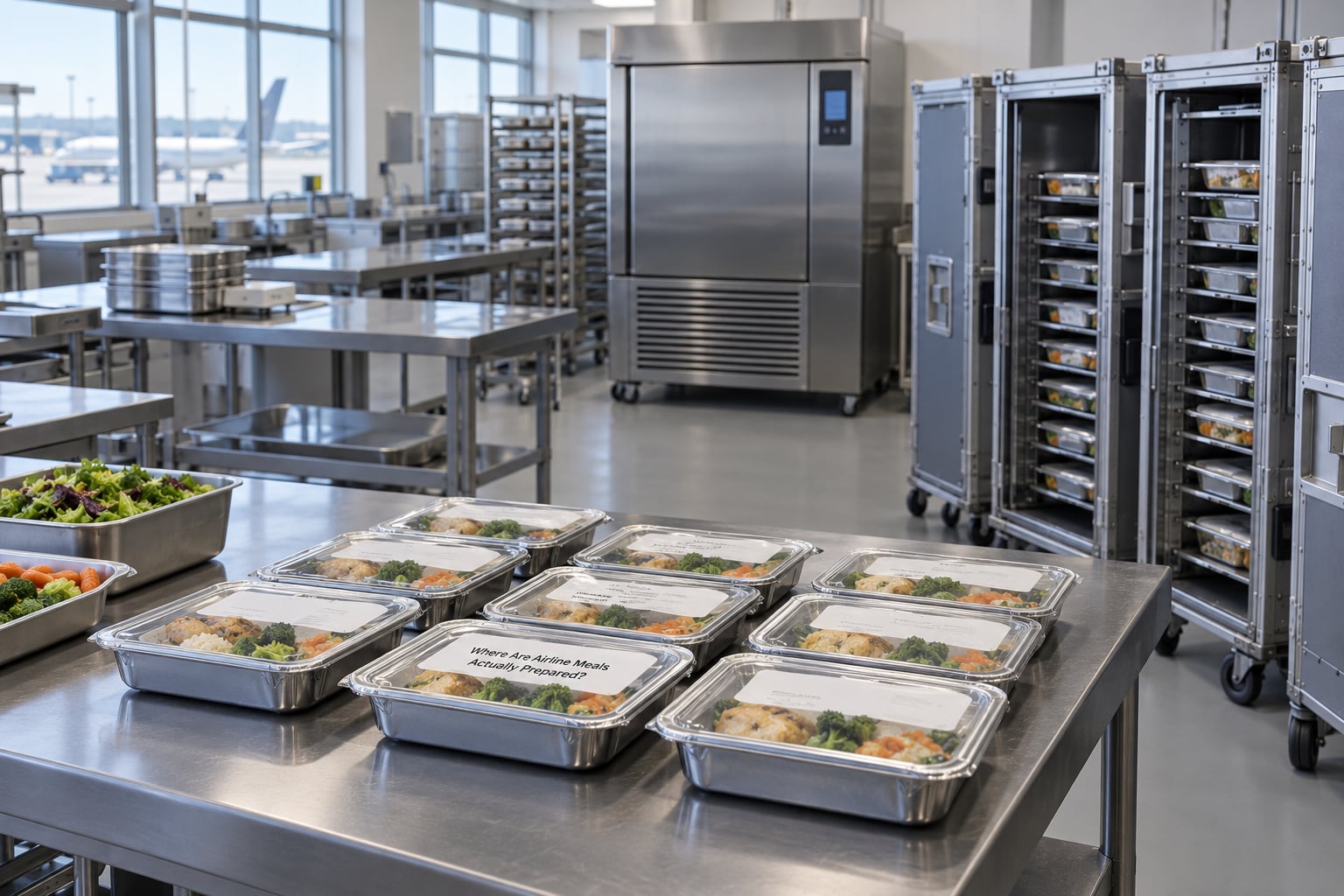
In a catering kitchen that sits somewhere off the airport perimeter, not inside the terminal. Most carriers do not cook their own passenger food. They contract specialist caterers such as Gategroup or Gate Gourmet, who build kitchens within driving distance of the airports they serve so meals can be produced and loaded close to departure.
A few very large airlines run their own flight kitchens instead. Turkish Airlines is the best-known example of a carrier that also keeps flying chefs working in the galley, finishing and plating parts of the dish on board. That setup is unusual, and it changes the character of the food noticeably.
So there are really two categories. Food prepared for an airport departure is cooked off-airport, chilled, sealed and delivered. Food finished in flight is the exception, limited to a handful of carriers and usually only the main course, not the whole tray.
How Are Airline Meals Cooked and Assembled?
How airline meals are prepared step by step
One tray passes through the same sequence every time, whether it ends up in economy or business class. The difference between cabins shows up in plating, portion size and how many components are made fresh rather than chilled.
- Recipe development. A dish is built and tested before it ever reaches a menu. Test kitchens, sometimes set up to replicate cabin pressure and low humidity, are used to see how a recipe holds after chilling and reheating.
- Menu planning. Menus are set months ahead, matched to route length and cabin, and rotated so passengers do not see the same dish every week.
- Batch cooking. Dishes are cooked in large batches in kettles and combi ovens, usually to about 90 percent doneness. Cooking stops short of done because the meal will be heated again later.
- Portioning. Sauces, sides and proteins are portioned into compartmented trays, sometimes by hand where delicate items need care.
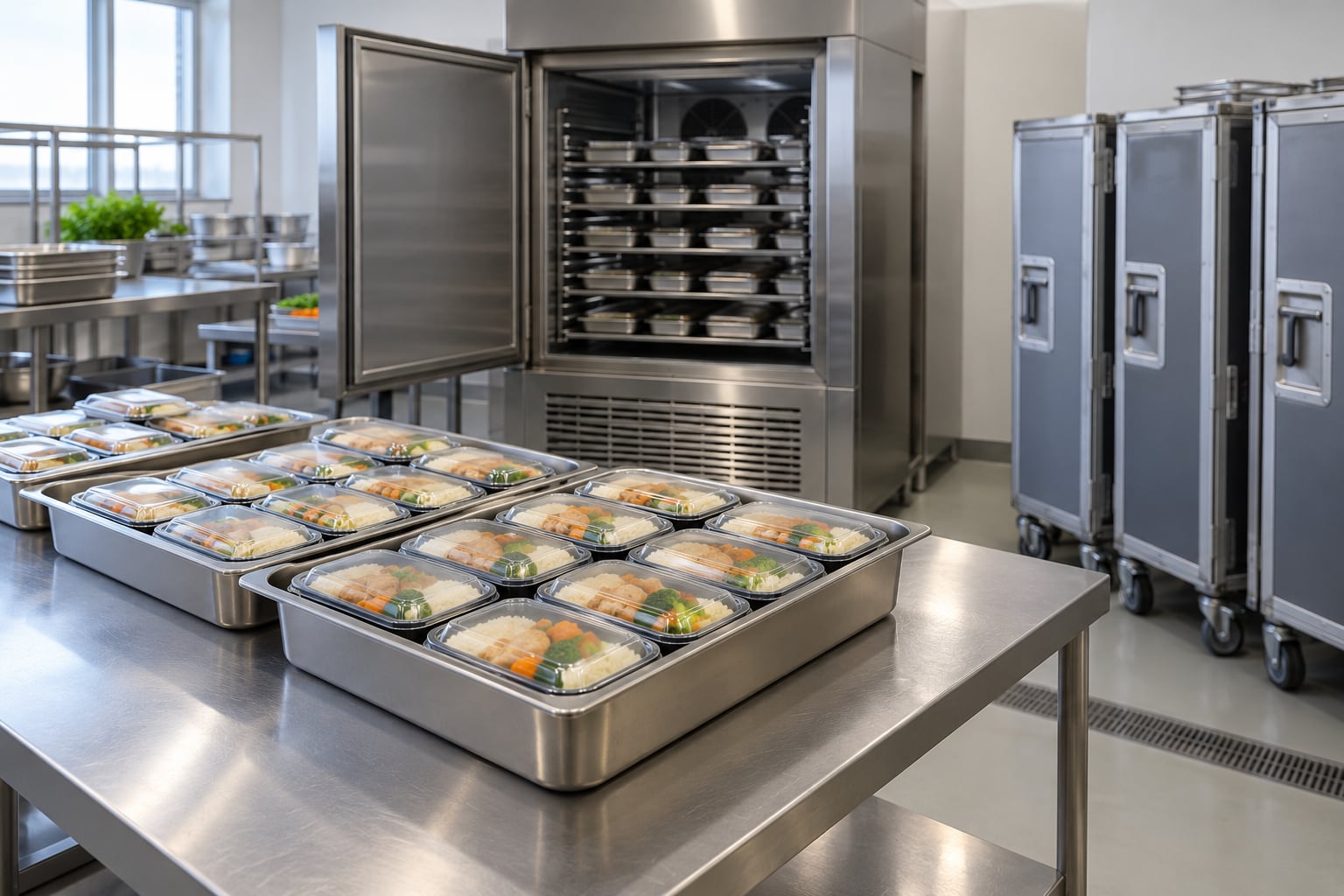
- Blast chilling. Trays go straight into a blast chiller, dropping from roughly 60°C to 5°C or below inside 90 minutes. Slow cooling is the enemy here because it lets bacteria grow in the warm zone.
- Labelling and sealing. Every tray is sealed, date-stamped and barcoded, so a specific batch can be traced if something goes wrong.
- Chilled storage. Trays sit in refrigerated storage until the uplift. The 72-hour ceiling from production is the number most often quoted, and in 2026 it is still the figure readers hear most.
- Delivery and reheat. A refrigerated high-loader truck takes the load to the aircraft, crew stows the carts, and the galley oven does the final heating.
| Checkpoint | What happens |
|---|---|
| Up to 72 hours out | Batch cooking, portioning and sealing in the flight kitchen |
| Within 90 minutes of cooking | Blast chill from about 60°C to 5°C or below |
| Chilled hold | Refrigerated storage, barcoded and dated, 72-hour ceiling |
| 6 to 24 hours out | Refrigerated high-loader drive to the aircraft stand |
| At the aircraft | Carts handed to cabin crew and stowed in the galley |
| On board | Reheated in waves in the galley oven, close to service time |
| At the seat | Trays collected from the cart and served |
Cook-chill is the standard method, but you will also hear cook-freeze, where food is frozen instead of chilled and thawed before service. It suits items like breads and some sauces that need longer storage. Freshly assembled onboard service is the third option and the freshest of the three, which is exactly why passengers often rate a cold dish or a special meal higher than the main tray.
How Are Airline Meals Kept Safe and Fresh?
Safety is managed by HACCP, the hazard analysis system airlines inherited from food science rather than inventing for aviation. In practice it means every step has a defined temperature, a recorded time and a person who signs for it. Records follow the tray, so a caterer can show which batch a meal came from and when each stage happened.
| Stage | Rule of thumb |
|---|---|
| Blast chilling | About 60°C down to 5°C or below, within 90 minutes |
| Chilled storage | Held at 5°C or below for up to 72 hours |
| Delivery to aircraft | Cold chain maintained; chilled food arriving above roughly 8°C is flagged |
| Reheat and hot holding | Reheated until hot and held hot |
| Safe minimum internal temperature | Poultry 165°F / 74°C, ground meat 160°F / 71°C, whole cuts and fish 145°F / 63°C |
Those last three figures are the same safe minimum internal temperatures used in any kitchen, which is the point. Airline catering is not held to a lower bar than a restaurant because it happens behind a security fence.
Seals and labels do the rest of the work. Tamper-evident film shows whether a tray has been opened, allergen meals carry their own marking, and barcodes tie a plate to a production batch. Caterers are also audited against published food safety guidance such as the World Food Safety Guidelines. What no airline publishes is a per-flight production timestamp, so the honest answer to how old your meal is a range, not a number.
What Happens During Loading and Serving?
The trip from kitchen to aircraft is short and cold. Carts are loaded into a refrigerated high-loader, driven across the apron and lifted to the aircraft hold or the forward galley, and crew move them inside. From that point the meal is out of the caterer’s hands and into the airline’s.
On board, the galley oven does the reheat, and this is where timing bites. Crew stage meals in carts and heat them in waves close to the service time rather than heating everything at once, because trays that sit in a hot cart dry out and go rubbery long before they reach a passenger.
Unserved trays get counted. Crew log what is left at the end of a flight and it feeds the airline’s food waste reporting, which is why catering waste shows up in sustainability targets rather than in a bin you ever see.
Why Do Airline Meals Taste Different?
Nothing in the process is a conspiracy. It is a set of engineering constraints, and each one shows up on the plate.
- It is cooked twice. The first cook happens hours ahead, the second in a galley oven. Proteins that dry out easily are swapped for slower-cooking cuts such as braised beef or lamb shoulder, which frequent flyers consistently rate as the dishes that survive reheat best.
- Sauces are thickened. A sauce thin enough to be delicate on a restaurant plate can split or soak into the starch during a second heating. Flour, starch and reduced stocks do the stabilizing work.
- The cabin is dry and pressurised. Low humidity dries your mouth and nasal passages, and aroma is a large part of flavour. When the smell of a dish never arrives, the taste flattens with it. Strong seasoning, which would be harsh on the ground, is the practical compensation.
- Herbs and delicate flavours get cooked out. Menus lean on stable flavours such as umami from mushrooms, tomato, soy and stocks rather than parsley or citrus, which disappear within hours.
- It has to survive handling. Everything is designed to travel, hold and reheat without spilling or collapsing, and mass production means every tray tastes the same. That consistency is the point, but it is not the same as a plate made to order.
One thing worth noting: the dulled taste is not permanent. Food regularly tastes noticeably better on the ground within hours of landing.
What’s the Difference Between Short-Haul and Long-Haul Meals?
| Factor | Short-haul | Long-haul |
|---|---|---|
| Sourcing | Same contracted flight kitchen, smaller volumes | Larger volumes, often with extra catering uplift at the destination |
| Service style | One tray, or a light snack on shorter routes | Two services on many routes, sometimes three on ultra-long sectors |
| Cooking method | Cook-chill in most cases | Cook-chill, with some dishes finished or assembled on board |
| Menu variety | Limited, since the same caterer serves many short routes | Wider, with several options per service including special meals |
| Presentation | Trays are stacked and heated in waves | Hot service in business class, plated rather than tray-wrapped |
Economy and business class food often comes out of the same kitchen on the same day. What differs is plating, portion, how much is finished fresh and how quickly it reaches you. The upgrade is real, but it is not a different supply chain.
How Do Special Diets and Allergens Change Preparation?
Allergen and special-diet meals are the ones produced under the tightest controls. Where an allergy is declared, the meal is typically made in a separate area with dedicated equipment, utensils, benches and packaging, so it never shares a surface with nuts, dairy, gluten or shellfish. Vegan, kosher, halal, Buddhist and medically tailored meals follow their own handling rules in the same way.
Each tray is labelled and matched to the passenger record, and crew are supposed to confirm the match before handing it over. For a genuine allergy, request the meal when you book and reconfirm the policy with the airline directly, since coverage varies by carrier and route and special meals are often only available on selected services.
Frequently Asked Questions
Are airline meals cooked on the plane?
Almost never on a full-service flight. The food is cooked in a contracted flight kitchen, blast-chilled, stored, trucked to the aircraft and reheated in the galley oven on board. Exceptions exist: a few carriers keep chefs in the galley who finish or plate parts of the dish, and some short-haul services serve chilled trays assembled from sealed components rather than hot food.
Who prepares the food served on airline flights?
Most carriers do not cook passenger food themselves. Airlines contract specialist caterers such as Gategroup or Gate Gourmet, or run an in-house flight kitchen, to produce, deliver and uplift every tray. A few airlines keep their own flying chefs on board. Either way the kitchen works to the airline’s recipe specifications and a HACCP-based food safety plan.
How do airlines keep meals safe during transport?
Through the cold chain. Sealed, labelled and dated trays are loaded into refrigerated high-loader trucks, kept chilled on the drive to the aircraft, then moved into carts that go straight into the galley. Each stage sits inside the caterer’s HACCP plan with temperatures logged, so a tray that breaks the chain can be identified and pulled rather than served.
Why do airline meals often taste bland or different from restaurant food?
Several effects stack up. Dishes are cooked in large batches, chilled fast and heated again minutes before service, which flattens seasoning and dries the edges. Dry, pressurised cabin air dulls aroma, and much of flavour depends on smell. Menus are also formulated to survive reheating, so sauces are thicker and delicate herbs are used sparingly.
How are allergen-free airline meals handled?
Allergen and special-diet meals are usually produced on a separate line, often in a dedicated area with its own equipment, tools and packaging, so there is no cross-contact with nuts, dairy or gluten. Each tray is labelled and matched to the passenger record at boarding. Policies differ by airline and route, so request the meal in advance and confirm with the carrier before you fly.
Are meals reheated at a safe temperature before service?
Yes, in principle. Cook-chilled meals are reheated in the galley until hot and then held hot, and caterers work to the same safe minimum internal temperatures used in any kitchen: 165°F / 74°C for poultry, 160°F / 71°C for ground meat, and 145°F / 63°C for whole cuts and fish. Crew heat in waves, so timing matters as much as temperature.
Conclusion
Airline meals are cooked and sealed by contracted flight kitchens, blast-chilled within about 90 minutes, held chilled for no more than 72 hours, delivered under a monitored cold chain, and reheated in the galley close to service. Before you fly, check the meal options and dietary cut-off times on your airline’s site, request any allergy or special meal in advance, and know that braised dishes and cold items will usually beat the reheated main.