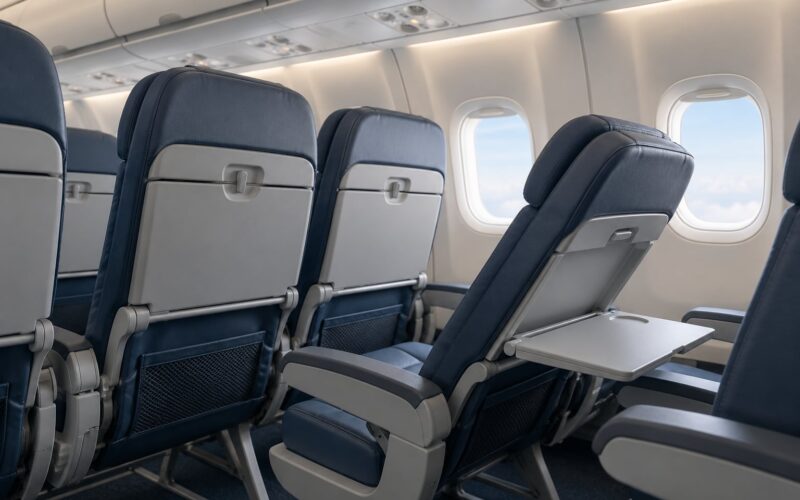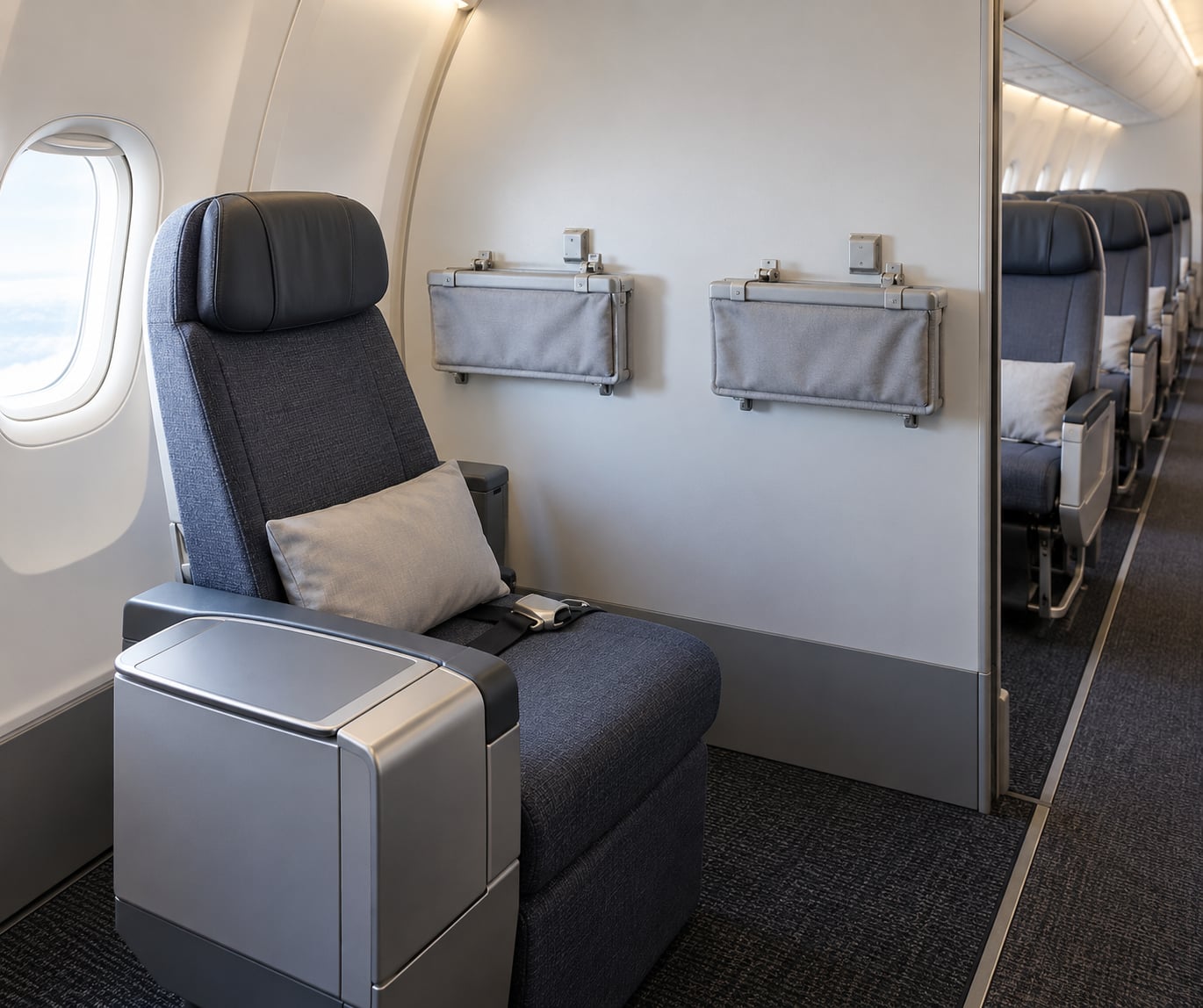
A bulkhead seat is the first row of seats in a cabin section, sitting directly behind a fixed partition wall instead of behind another row of passengers. You get more knee room and nothing to recline into, but you also lose under-seat storage and often the seatback recline.
That trade is the whole story. Whether it works for you depends on the aircraft, the cabin class, and what you plan to do with the extra floor space.
Table of Contents
- 1What Is a Bulkhead Seat?
- 2What is a bulkhead seat on a widebody versus a narrowbody?
- 3Why Do Airports and Airlines Use Bulkheads?
- 4Bulkhead Seats at a Glance
- 5What Are the Benefits of a Bulkhead Seat?
- 6What Are the Drawbacks of Sitting in Front of a Bulkhead?
- 7Does a Bulkhead Seat Give You More Legroom?
- 8How to Identify a Bulkhead Seat on a Seat Map
- 9Bulkhead Seat vs. Standard Economy Seat
- 10Who Should Choose a Bulkhead Seat?
- 11Frequently Asked Questions
- 12Is it good to sit at the bulkhead on a plane?
- 13What are the disadvantages of a bulkhead seat?
- 14Is a bulkhead seat worth paying extra?
- 15Can you have a personal item in a bulkhead seat?
- 16Do bulkhead seats have less legroom than other seats?
- 17Conclusion
What Is a Bulkhead Seat?
The bulkhead is the wall itself — a rigid divider that separates one cabin section from another, or that closes off a galley, a lavatory, or a closet. A bulkhead seat is any seat in the row immediately behind it.
Because there is no row in front, the wall becomes the back of your seat space. Legs go where an occupied seat would normally be, which is why flyers describe these seats as having extra room even when the seat pitch number on the seat map looks ordinary.
On a narrowbody like an A320 or a 737, you usually find one bulkhead per cabin, right after the galley or the forward lavatories. Widebodies have more of them, sometimes with two dividers inside a single premium cabin.
What is a bulkhead seat on a widebody versus a narrowbody?
Narrowbody bulkheads sit close to the front galley, so you get galley noise and cabin service traffic. Widebody bulkheads divide larger premium cabins and are often farther from the galleys, though you can be right next to a mid-cabin lavatory instead.
The other naming wrinkle: some airlines and seat maps use the term loosely. A row behind a curtain divider with no hard wall behind it may still be labelled as bulkhead or front row, and the extra space there varies.
Why Do Airports and Airlines Use Bulkheads?
Bulkheads are structural and regulatory furniture first, seating second. Airlines install them because the cabin has to be divided into zones, and each division creates a front row.
- Cabin zoning. Premium cabins need to be physically separated from economy, both for service reasons and so a partition can carry the fittings for seat pitches, bassinet points, and emergency equipment.
- Layout changes. When an airline swaps seats, adds a premium cabin, or repositions a galley, a partition is often the simplest way to close the gap left behind.
- Galley and lavatory placement. Service carts and crew storage need solid barriers, so the wall in front of you is frequently the back of a galley.
- Operational and safety fittings. Bassinet anchor points, life jacket stowage, and crew restraint seats attach to the partition structure.
None of that is a seating strategy. Bulkheads exist for reasons that have nothing to do with your knee room, which is exactly why the quality of the seat in front of a bulkhead varies so much between aircraft.
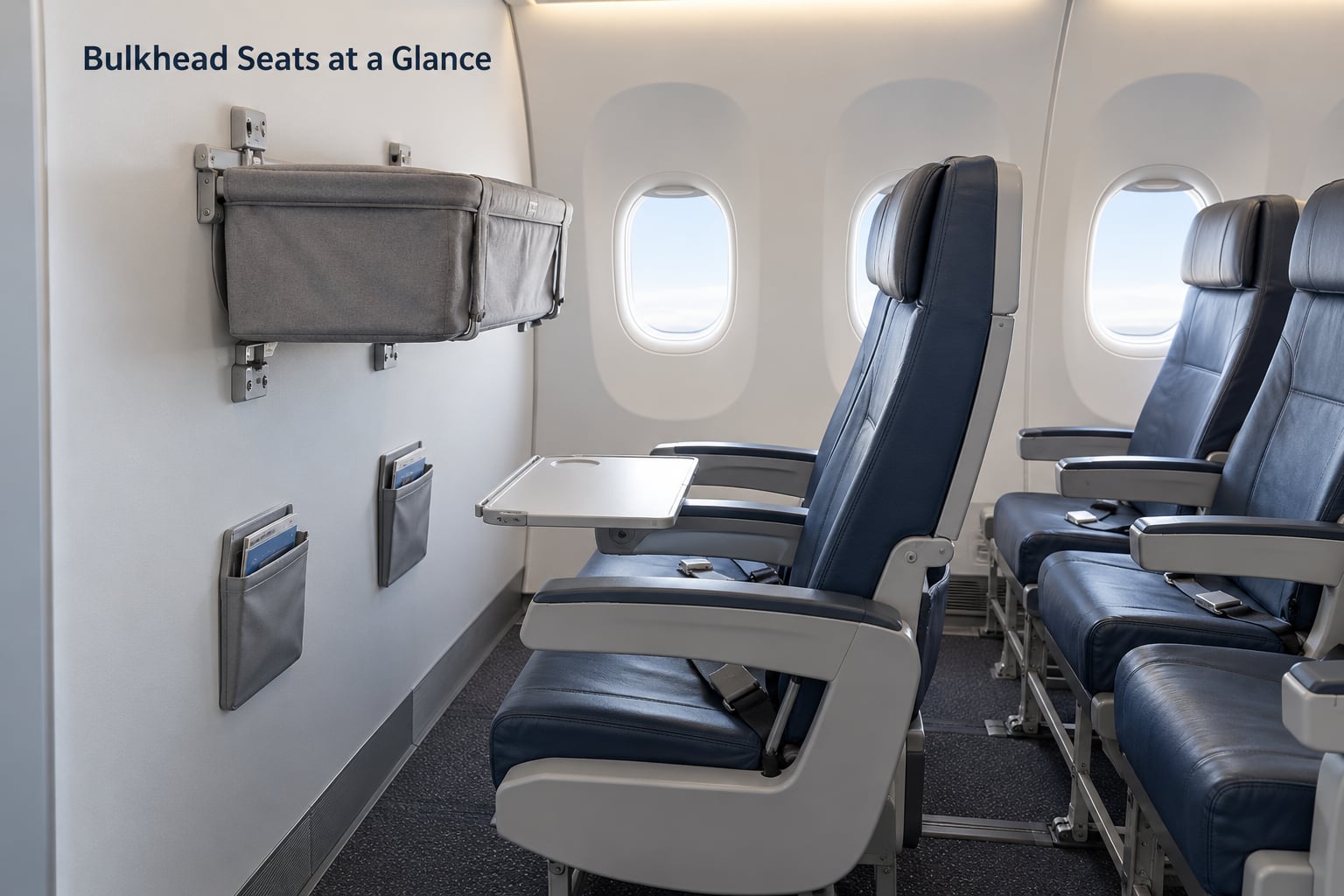
Bulkhead Seats at a Glance
| Factor | What a bulkhead seat usually gives you | What can go wrong |
|---|---|---|
| Legroom | Clear floor space to your feet and knees | Pitch may be identical to a normal row |
| Seat width | Often narrower than a standard seat on narrowbodies | Fixed armrests eat into usable width |
| Recline | Nothing in front of you to lean on | The seat itself may not recline at all |
| Under-seat storage | None — there is no seat in front | Everything goes to the overhead bin |
| Tray table | Usually smaller and fixed in the armrest | Less stable for a laptop or a large tray |
| Entertainment | Screen on the wall or on the armrest | Wall screens are further away, armrest screens reduce width |
| Bassinet | Bassinet points on the wall, on some bulkheads | Not every bulkhead row has them, and they cannot be reserved online everywhere |
| Noise and traffic | Often quieter than a middle cabin | Galley and lavatory rows get carts, crew and queueing passengers |
Read that table as a set of tendencies, not promises. The same row number on two different aircraft can behave completely differently.
What Are the Benefits of a Bulkhead Seat?
- ✅ More usable legroom. Your feet go somewhere instead of into a stranger’s seatback pocket.
- ✅ No seatback in your space. Nobody reclines into you, and you are not kicking a tray table hinge all flight.
- ✅ A clean surface to work on. Plenty of travellers use the flat space in front for a laptop on short flights.
- ✅ Straightforward access. Less climbing over neighbours, which matters if your hips or knees are not what they were.
- ✅ Quick boarding and deplaning. You are usually among the first in and out of the section.
- ✅ Bassinet fittings on some rows. Wall anchor points make a bassinet possible where a normal row is not.
- ✅ A defined place for a bassinet or a child. A wall behind you is useful when a cot is clipped on.
For a tall traveller on a red-eye, or a parent wrestling a sleeping toddler, those first two points are often worth more than any seat selection fee you pay.
What Are the Drawbacks of Sitting in Front of a Bulkhead?
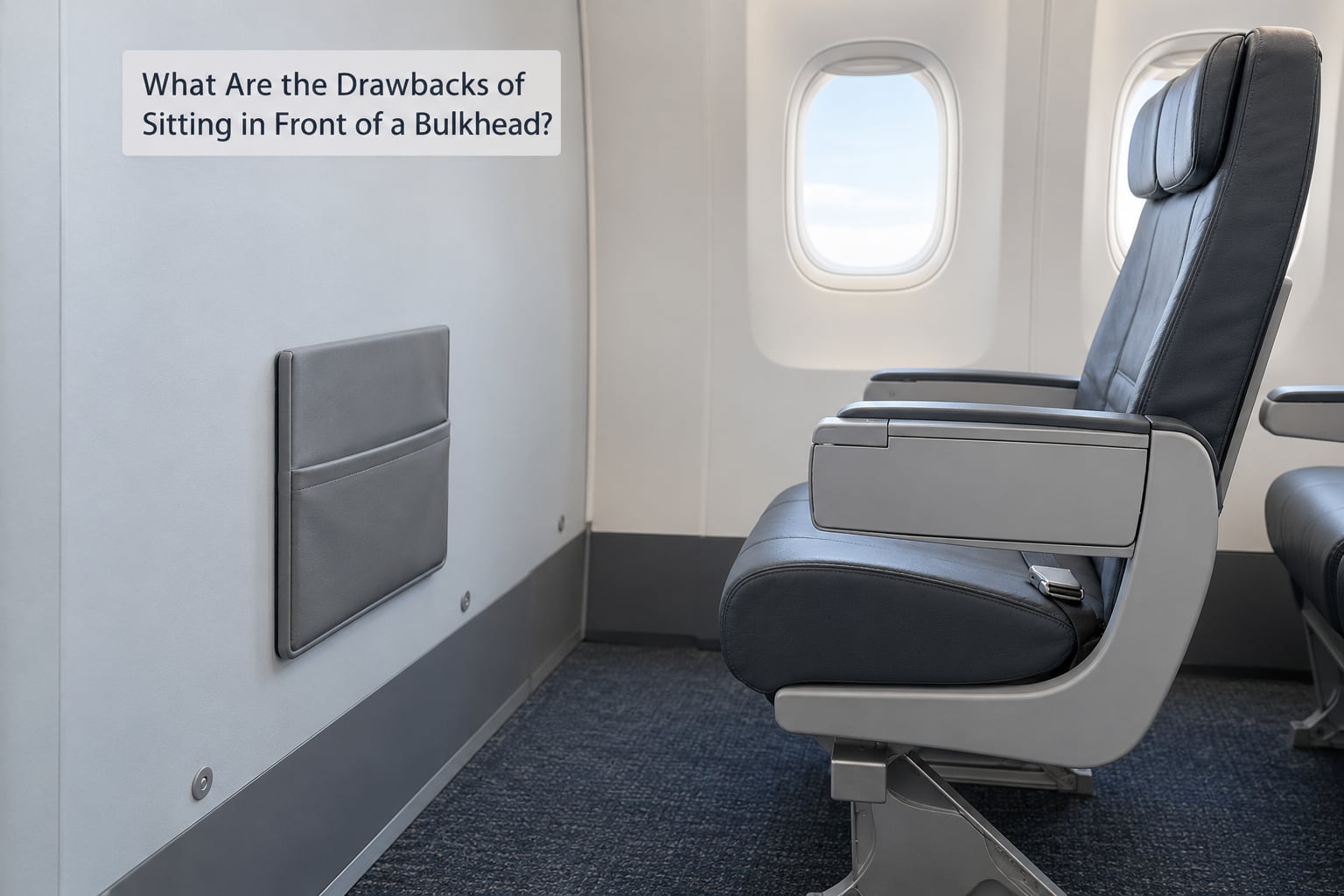
- ⚠️ Your seat may not recline. Manufacturers build many bulkhead rows with a fixed upright backrest because there is no seat in front to brace against.
- ⚠️ No under-seat storage. Bags that fit under a normal seat have to go in the overhead bin, and the bin above a forward row fills first.
- ⚠️ Fixed, narrow armrests. Some bulkheads have immovable armrests and a slimmer seat frame, and window or middle passengers in those rows have less room than the seat map suggests.
- ⚠️ A tray table you live with. In many bulkhead rows the table folds out of the armrest. It is smaller, sits lower, and does not wobble less when you type.
- ⚠️ Entertainment at arm’s length or across the aisle. Wall-mounted screens are further away and often shared logic with fewer controls; armrest screens eat into your width.
- ⚠️ Galley and lavatory noise. Cart noise, crew conversation, queueing passengers and a light left on all night. Light sleepers notice this more than anyone else.
- ⚠️ You may be seated next to a bassinet. A cot clipped to the wall takes real space from the adjacent seat.
- ⚠️ Pets usually cannot travel there. Most carriers require in-cabin pets to be stowed under the seat in front, which a bulkhead row does not have.
- ⚠️ The extra room varies. On some international layouts the first row behind a partition is a standard economy seat with no additional pitch at all.
That last point is the one that catches people out. A seat map showing bulkhead as a premium price does not mean the aircraft delivers premium space.
Does a Bulkhead Seat Give You More Legroom?
Sometimes, yes — more room in front of you, which is not always the same as more seat pitch.
Seat pitch is the distance from one seatback to the next. In a bulkhead row that measurement often stays the same, so a seat map may show no improvement. What changes is that the space is open rather than occupied by a seatback, tray table, and screen.
Two other things are worth separating. First, knee room goes up while the ability to stretch your feet out flat goes down, because there is no footwell. Second, on narrowbodies the bulkhead seat itself is frequently narrower than the rows behind it, so you can gain depth and lose width in the same move.
Row-specific photos are the fastest check. Seat maps from the airline and dedicated seat review sites show the actual seat frame for your aircraft type, and it takes about thirty seconds to look.
How to Identify a Bulkhead Seat on a Seat Map
- Start at the front of the cabin section. The first row after a divider, galley or lavatory block is your candidate. Row numbers resetting to 1 or 10A/10F in the middle of a cabin is the giveaway.
- Check the icons, not the row number. Airlines mark bassinet fittings, exit rows and preferred seats with symbols. A bassinet icon on your aircraft confirms the wall fittings exist on that row.
- Watch the seat letters. Some maps render the reversed order for a bulkhead row, so the window letter can appear first. It is a common bug, not a scam.
- Confirm the aircraft type. The same airline sells the same seat number on a 737 and a 757 with different spacing. A widebody booking can be swapped to a narrowbody at the gate.
- Look at row-specific photos for that exact type. They reveal narrow frames, upright seatbacks and armrest tables that a map never will.
- Call the airline for anything specific. Bassinet requests, accessibility needs and assistance with a tight connection are all things a phone call handles that a website does not.
A note on false positives. A row behind a galley or a lavatory is often called a bulkhead seat but has no hard wall behind it — sometimes just a curtain. That row can be quieter than a true bulkhead or much noisier, depending on the service traffic. Ask for the row, not just the label.
Bulkhead Seat vs. Standard Economy Seat
| Criterion | Bulkhead seat | Standard economy | Exit row |
|---|---|---|---|
| Legroom | Open space in front, pitch often unchanged | Fixed pitch, seatback in front | Often the most pitch in the cabin |
| Seat width | Can be narrower than normal | Standard frame | Standard frame, sometimes wider |
| Recline | Often upright and fixed | Reclines normally | Usually does not recline either |
| Under-seat storage | None | Yes | Yes |
| Tray table | Often fixed in the armrest | Folds from the seatback, larger | Back or armrest depending on type |
| Screen | Wall-mounted or armrest | Seatback, angled at you | Seatback |
| Best for | Tall travellers, infants, aisle access, working on a laptop | Storage, sleeping, anyone doing a normal trip | Maximum legroom and short boarding time |
Short version of the choice. Take the bulkhead if your height, your hips, a baby or a laptop matter more than storage and sleep. Take a standard row if you want a tray table that stays put, a seat that reclines, and somewhere to put your bag. Take the exit row if legroom is your single priority and you meet the airline’s requirements for it.
If you can only pick one for a long-haul economy flight, most people end up preferring a standard row a few seats back from the bulkhead. You keep storage and recline and give up only a few centimetres of knee room.
Who Should Choose a Bulkhead Seat?
Bulkhead suits you more often than the forums suggest, as long as you know which row on your aircraft you are actually booking.
- Tall travellers. The open floor space is the whole point.
- Anyone with limited mobility. No climbing over seatmates, and an aisle bulkhead gets you out fast.
- Families with babies. Wall-mounted bassinet fittings exist on many forward bulkhead rows, and no seat in front means more room for the cot hardware.
- Passengers working offline. A wide, flat surface in front of you is a genuine advantage if you do not need a screen.
- Short-haul flyers. On a flight under two hours, the loss of recline barely registers.
Pick something else if you sleep badly near noise or light, need in-cabin storage, travel with a pet, or plan to watch a screen for four hours straight. Window bulkheads away from a lavatory are the quietest option; aisle bulkheads trade sleep for speed.
Frequently Asked Questions
Is it good to sit at the bulkhead on a plane?
It depends on the row and what you need. A bulkhead is good when you want open knee space, quick aisle access, a flat surface for a laptop, or a bassinet fitting on the wall behind you. It is poor when you need under-seat storage, a large tray table, a seat that reclines, or quiet. Check photos of your exact aircraft row before choosing, because the same seat number varies between aircraft types.
What are the disadvantages of a bulkhead seat?
The main drawbacks are no under-seat storage, a tray table fixed in the armrest, a seatback that often does not recline, and possibly a narrower seat frame. Rows near a galley or lavatory add cart noise, crew chatter and light. In-cabin pets are usually not allowed in a bulkhead row because there is no under-seat space. Travellers who want to sleep through a long-haul flight usually prefer a standard row.
Is a bulkhead seat worth paying extra?
Often yes, but only if the extra fee buys the specific benefit you need. Premium seat pricing on a forward row can be justified for height, mobility, or an infant. It is poor value if you mainly want a tray table and storage, since you can get both in a standard row for less. Airline policies and fees differ widely, so check the seat selection page for the exact aircraft rather than assuming.
Can you have a personal item in a bulkhead seat?
You can, but it goes in the overhead bin rather than under the seat in front, because there is no under-seat space. Forward rows board first, so the bin above a bulkhead often fills before you board. Frequent flyers recommend keeping essentials in a small pouch at your seat for takeoff, landing and the whole flight, and stowing only the bulk of the bag overhead.
Do bulkhead seats have less legroom than other seats?
Not in front of you, but sometimes in width. Seat pitch often stays the same, and the extra depth comes from the open space rather than a longer gap. The trade is that many narrowbody bulkhead seats are a slimmer frame with fixed armrests, so the cabin is shallower but tighter. Look up the seat width for your aircraft to know which effect dominates.
Conclusion
A bulkhead is the wall at the front of a cabin section, and the seat behind it trades storage and often recline for open space, easy access and a flat surface in front of you.
Before you book, check three things on the seat map for your exact aircraft: the pitch, the seat width, and whether the row reclines. If any of those go wrong for your trip, pick a standard row two or three seats back instead.