Business class vs first class on international flights comes down to one question: how much privacy are you actually buying? Business class gives most long-haul travellers the thing they care about most, a proper lie-flat bed and quiet enough surroundings to use it. First class adds space, doors and service, which matters most on overnight and ultra-long flights. On most routes, the better value is business class.
I have booked both sides of this comparison enough times to stop pretending the choice is obvious. The category labels tell you almost nothing on their own. What decides the experience is the specific aircraft, the specific seat and, honestly, the crew you get that day.
So this guide skips the sales pitch and compares the two cabins the way a traveller actually compares them: seat width and bed length, cabin layout and privacy, meals and service, lounges and ground perks, and how the maths changes with flight length. Prices move daily, so no fares appear here. Instead you get the framework for deciding which cabin is worth paying for on your specific route.
Table of Contents
- 1Business Class vs First Class on International Flights at a Glance
- 2Business Class vs First Class on International Flights: Seat and Bed Differences
- 3Cabin Space and Privacy
- 4Food, Drinks, and In-Flight Service
- 5Lounges, Priority, and Other Benefits
- 6Comfort on Short, Long-Haul, and Ultra-Long-Haul Flights
- 7Price and Value
- 8Which Should You Choose?
- 9Frequently Asked Questions
- 10Is first class always more comfortable than business class on international flights?
- 11Is business class worth it on a six-hour international flight?
- 12How much of a difference does the business class or first class seat make?
- 13Do first class tickets always include lounge access?
- 14When is premium economy better than business class or first class?
- 15Bottom Line
Business Class vs First Class on International Flights at a Glance
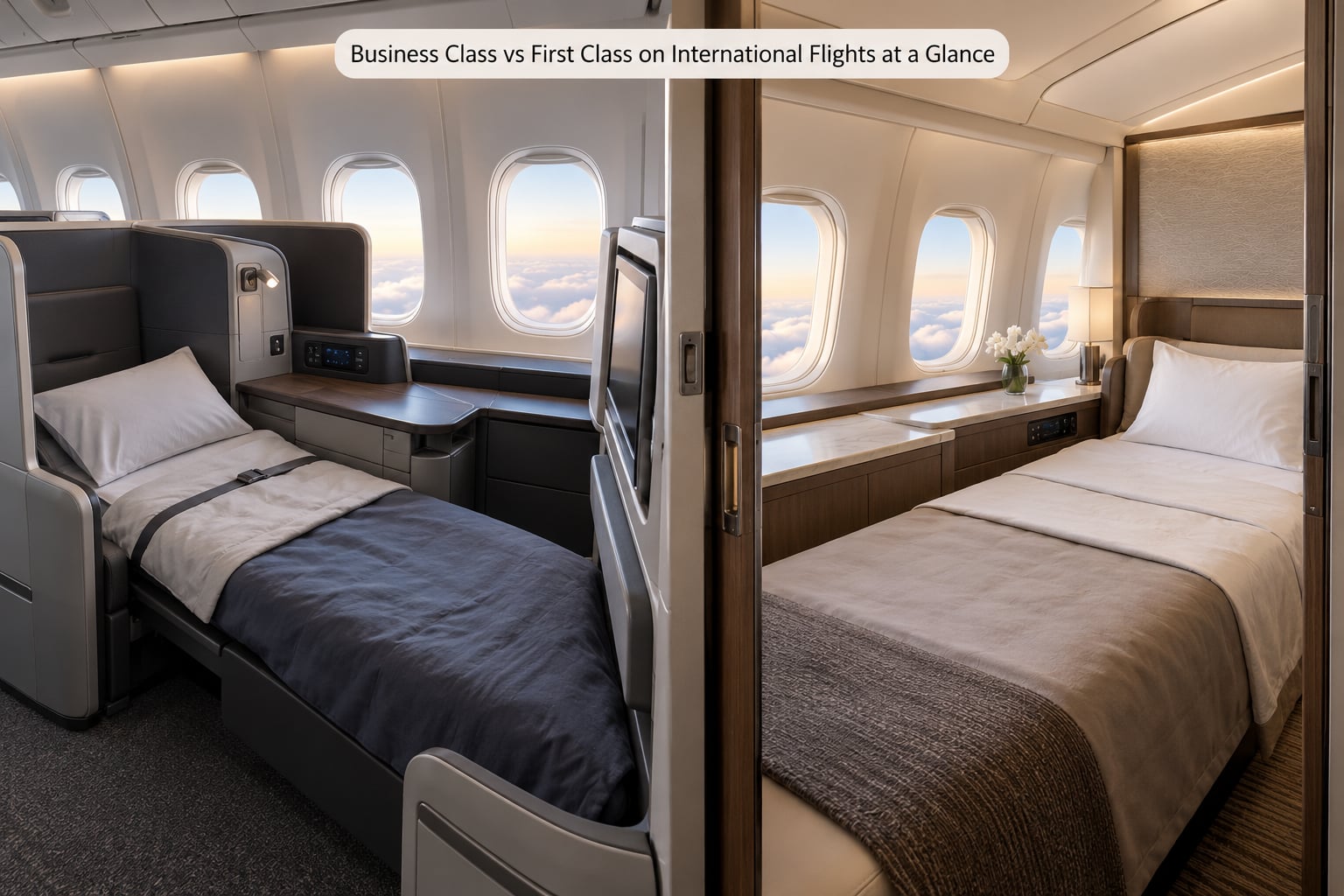
The table below sets the two cabins side by side across the criteria that actually change how a long flight feels. Read the ranges as typical rather than guaranteed, because no global industry standard governs what each label must include.
| Criterion | Business class | First class |
|---|---|---|
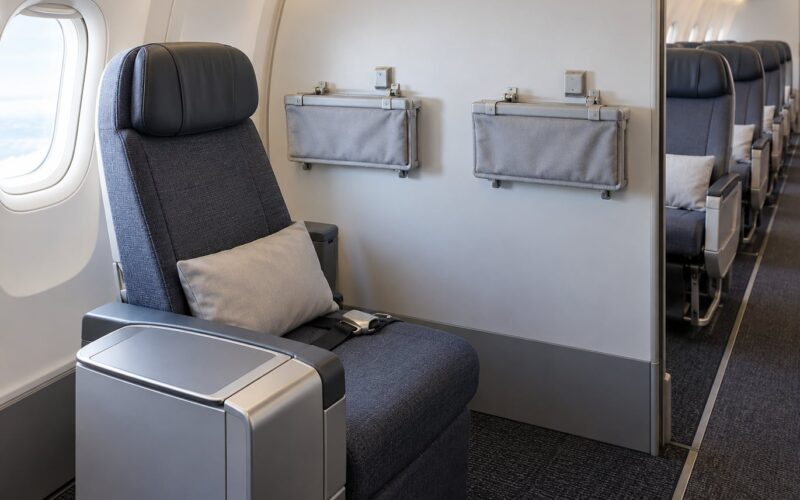
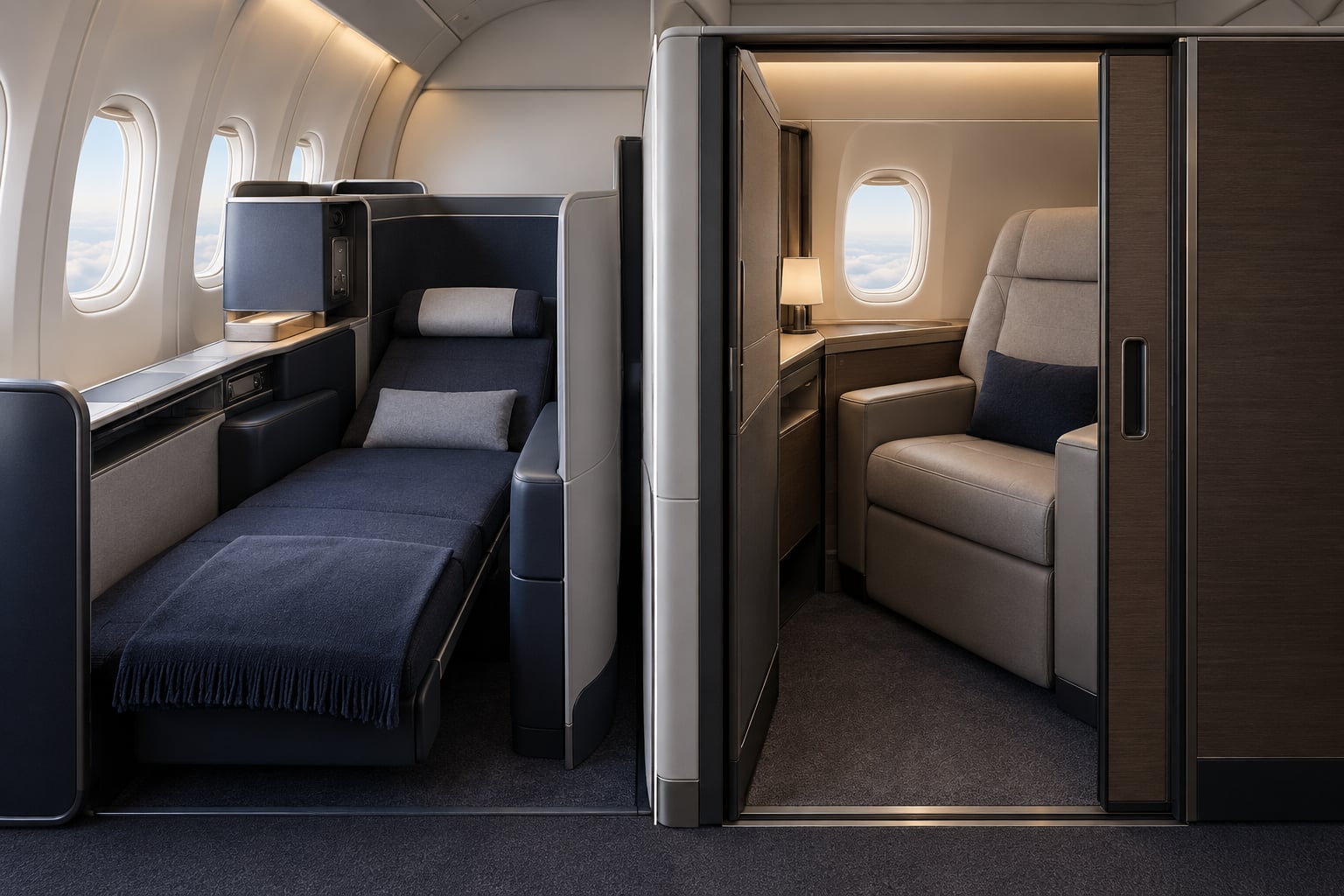
| Seat or suite format | Recliner-style seat that flattens, or a low-walled pod | Enclosed suite, often with a sliding or closing door |
| Typical seat width | Around 19 to 23 inches | Around 26 to 32 inches in the enclosed space |
| Typical seat pitch | Around 60 to 80 inches when fully reclined | Approximately 78 to 84 inches, in either a bed or suite layout |
| Aisle access | Mostly 1-2-1; some older layouts still use 2-2-2 | 1-1-1, or a two-aisle arrangement with a private door each |
| Bed quality | Flat or near-flat, sometimes with a mattress topper and duvet | True full-length bed, often with a separate seat that reclines alongside |
| Privacy | Divider or lip between pods, no full-height door on most | Tall partitions, and on some aircraft a usable sliding door |
| Cabin size | Commonly 20 to 40 seats on a wide-body | Commonly 6 to 14 seats on a wide-body |
| Meal service | Multi-course plated service, often tray-served | Restaurant-style plating, frequently with dining on demand |
| Cabin crew ratio | Typically one crew member for four to six passengers | Typically one crew member for two to three passengers |
| Lounge access | Usually included, either a dedicated lounge or a shared premium lounge | Usually included, but not automatically on every carrier or ticket |
| Ground service | Priority check-in and security, fast-track lanes at many airports | Adds chauffeur transfers, private jet bridges or lounge-side boarding where offered |
| Typical fare position | The standard premium-cabin fare on most long-haul routes | Often several times the business class fare on the same itinerary |
Two things stand out. First, the seat gap is smaller than most people assume: a good business class pod on a newer aircraft can match or exceed an older first class seat that has no door and no extra width. Second, the service and space gap is wider, and that is where first class spends its money.
There is no regulatory definition of these cabins anywhere in the world. An airline can call a 2-2-2 flat-bed cabin business class, and the next airline down the same alliance can sell you a doorless recliner under the same name. Route, aircraft and cabin density tell you more than the label printed on the ticket.
Business Class vs First Class on International Flights: Seat and Bed Differences
Business class seats have improved faster than first class seats in the last decade, and on plenty of aircraft the business product is the better bed. Bed length is the number to check: if the fully-flat length falls short of your height, you will spend the night with your feet angled against a bulkhead. A mattress topper and a real duvet make a short bed considerably more tolerable than the raw measurement suggests.
First class buys you width and vertical space rather than necessarily a longer mattress. A closed suite door, a taller partition and room to stand and change clothes are real advantages on an overnight flight, because the practical benefit is less about sleeping and more about not being climbed over at 2 a.m. when someone heads to the lavatory.
Some first class products go further still and stop being seat-based at all. Etihad’s Apartments and Emirates’ Residence-style offerings include a separate bedroom and bathroom or shower on board. Those exist on a handful of aircraft and are effectively private rooms, which is why they behave more like a hotel than a flight.
Cabin Space and Privacy
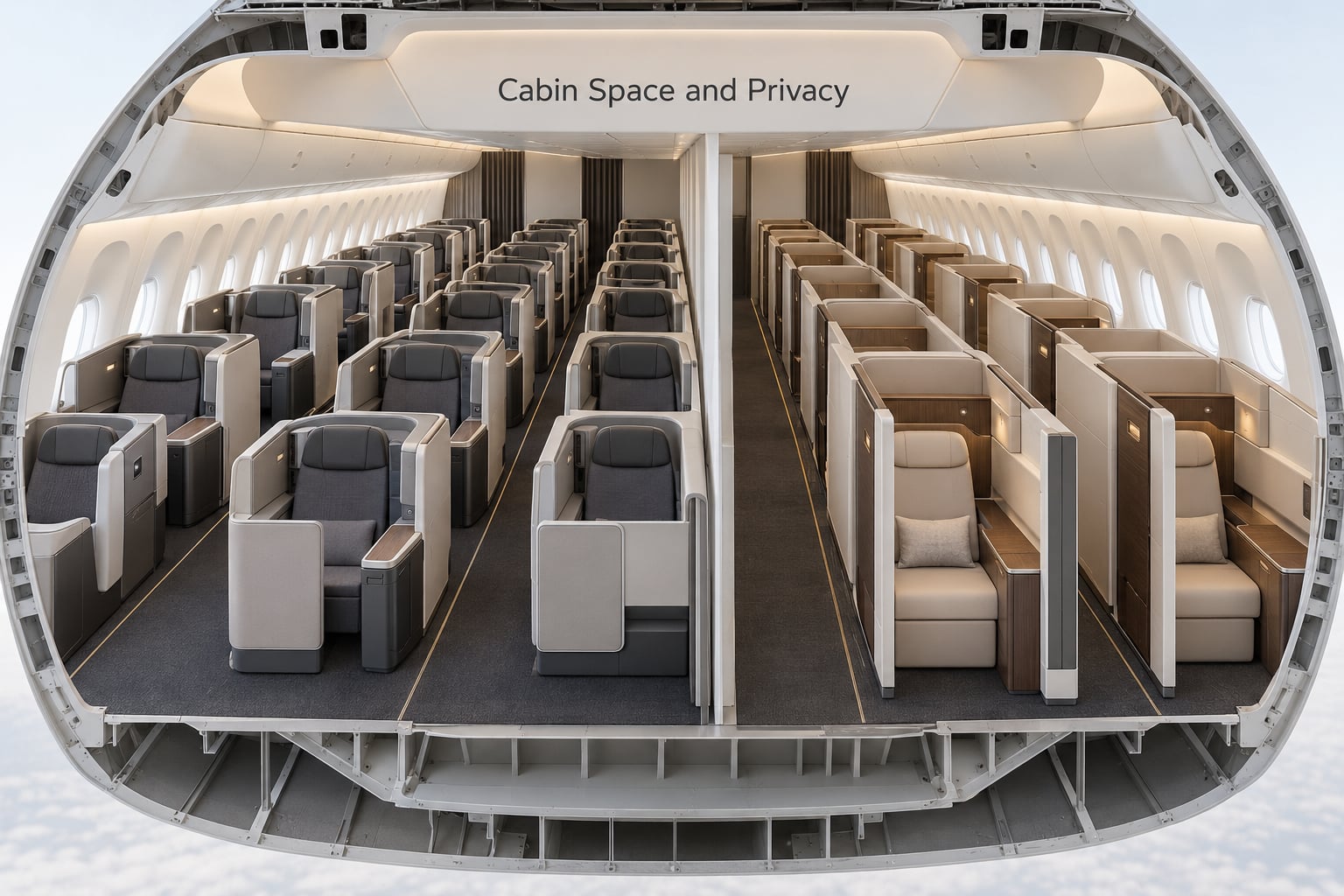
Privacy comes down to layout, and layout is written in a notation you’ll see on seat maps. The three numbers describe how many seats sit beside each window, centre and aisle position across a row.
- 1-2-1: one window seat, two in the middle, one aisle seat. Everyone in the row has direct access to an aisle without crossing a stranger. This is the standard modern business class layout.
- 1-1-1: every passenger gets their own window and aisle. It is the first class equivalent, and the reason first class feels calmer even at similar seat widths.
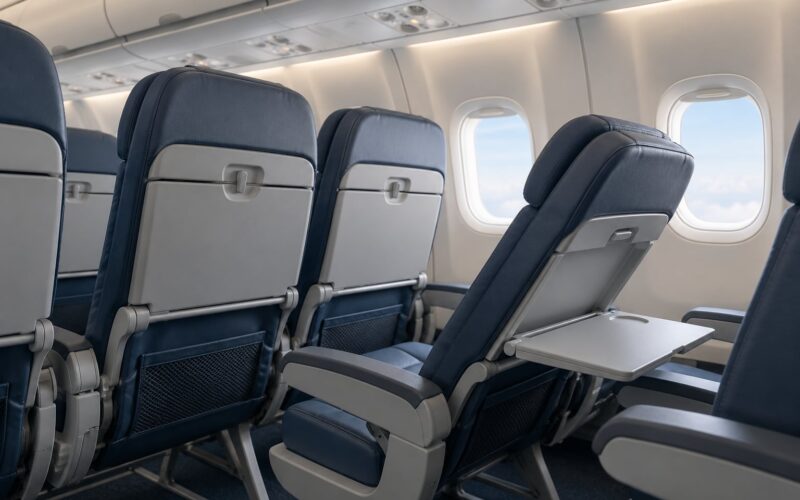
- 2-2-2: two seats on each side of two aisles. The middle pair backs onto a stranger and blocks the view, and neither passenger can get up without disturbing the other. Plenty of older wide-body business cabins still fly this way.
A conventional 2-2-2 business cabin is fine for a daytime flight and unpleasant overnight, because you are sharing a headrest and a blanket of privacy with someone you have not met. Staggered 1-2-1 seating fixed that problem for most carriers, and it is worth knowing which layout your flight uses before you decide a business class product is bad.
First class usually adds a partition between suites, and on aircraft with doors you can close one. A closed door helps with light, noise and the social awkwardness of eating a four-course meal next to a stranger, but it also cuts you off from the cabin crew when it is shut, so open it before service if you want to be looked after.
Noise is the quiet advantage of a small first cabin. Six to fourteen passengers spread over a fuselage section means fewer conversations, fewer overhead-bin conversations and less of the constant aisle movement that wears people down on a long sector. Window seats in a busy business cabin are the hardest place to rest; an aisle seat next to the galley is not much better.
Food, Drinks, and In-Flight Service
Business class meals are plated, multi-course and served on real crockery on most long-haul products, usually with a choice of two or three mains per course rather than a single fixed option. Wine, spirits and non-alcoholic drinks are generally included, and premium economy is where free drinks usually stop.
First class tends to add table service, a longer menu, and dining on demand on many carriers, which means asking when you are hungry instead of waiting for a tray to appear at set times. On some products the crew ratio is close enough to one attendant per two or three passengers that the dining is genuinely unhurried.
Here is the honest part: food quality is not a cabin class. The same carrier can serve an excellent tasting menu on one route and a forgettable one on the next, because catering contracts, galley capacity, departure airport catering and crew experience all change by sector. Fliers on FlyerTalk repeatedly make the same point in trip reports: judge the meal on the reviews for your specific flight, not on the cabin name.
Dietary requests are handled in both cabins, but the timing differs. In business class, a special meal needs to be requested in advance or picked up early. In first class, asking the attendant on the day is often enough because there are fewer people to manage.
Lounges, Priority, and Other Benefits
Lounge access is the most misunderstood perk in this comparison. Business class almost always includes it, either in a dedicated premium lounge or a shared one with a section reserved for premium passengers. First class usually includes a more private space, sometimes a separate room with its own showers, and on a handful of carriers a lounge you can sit in before an ultra-long flight.
But it is not automatic. Forum threads on this topic are full of people who bought a first class ticket and discovered the lounge was business-only, or that access depended on flying that morning rather than holding any ticket. A carrier can also sell you a first class fare on a codeshare partner, and the lounge benefit travels with the operating carrier’s rules, not the marketing name on your booking.
Beyond the lounge, both cabins usually get priority check-in, security and boarding. First class tends to add ground transfers by car on long-haul routes, a private or semi-private boarding area, and occasionally a private jet bridge that takes you from the lounge to the aircraft door. These are the perks that save the most time on a long connection, and they matter more than the meal course you will barely remember.
Baggage handling is a smaller difference than most marketing implies. Both cabins usually get priority tags, and weight allowances are often similar on long-haul, though the heavier allowance is common at first class on some carriers. Check the allowance rather than assuming it.
Comfort on Short, Long-Haul, and Ultra-Long-Haul Flights
Flight length is the variable that decides this. Below about four hours, the cabin barely gets used: you sit down, you eat a sandwich, you land. Neither premium cabin earns its keep there.
Between four and eight hours, business class is usually the right call. You get a recliner that genuinely sleeps, a decent meal and lounge access on both ends, and the fare difference is the least painful part of the trip. First class at this length is mostly buying a quieter cabin and a nicer lounge.
Between eight and twelve hours, the value of a flat bed climbs sharply because you can realistically sleep a full night. First class starts to make sense for overnight departures, particularly if you have an event or a meeting the next morning. On daytime flights of the same length, experienced fliers often conclude the premium buys little, because there is no sleep to protect.
Past twelve hours, the calculus changes again. Ultra-long-haul flights add real physiological strain, and closed suites with genuine beds help more with fatigue than any other factor. A FlyerTalk trip report comparing cabins on an overnight flight put it plainly: first is not worth very much extra overnight, while on a daytime flight it depends entirely. That sounds counterintuitive until you notice it was written about a specific shorter sector. On flights of fourteen hours and beyond, the same fliers tend to reverse themselves.
Premium economy is the option most people skip too quickly. On a modern product it offers a wider seat, more recline, a separate screen and a decent meal, and it costs a fraction of business class. For a seven-hour daytime flight, that is often the correct purchase, and it also means a business class fare upgrade later in the trip is more likely to be available.
Price and Value
First class on international flights commonly costs several times the business class fare on the same itinerary, and the multiplier widens as the flight gets longer and the premium cabin gets emptier. The gap is not a fixed percentage and it changes constantly, so treat any specific number you see as a snapshot of that route on that date.
That is the shortest honest version of business class vs first class on international flights pricing: one is a large, reliable upgrade and the other is a large, expensive one. To judge whether the gap is worth it, price the whole trip rather than the seat alone. Add the lounge you will use, the ground transfer you would otherwise pay for, the fast-track security fee, and the value of arriving able to work or function. Then subtract what a bad night costs you: a lost day of work, a missed meeting, a ruined day of a holiday. On a fourteen-hour red-eye, arriving functional has a real monetary value that is easy to underestimate.
Points change the calculation more than people expect. Award space in first class is scarce, so a search that only shows first class results often means there is no first class available. Search business class instead, then price an upgrade at the gate, which is frequently offered on flights that have empty premium rows. The same is true for fare-branded tickets, where a cheaper business fare can sometimes be upgraded for a modest fee on a full flight.
One more cost worth budgeting: the reverse journey. If one leg of a round trip is long-haul and the other is short, check both cabins on both legs before assuming the premium applies the whole way. Buying first class only on the long sector, when the booking engine allows a cabin split, is a common and sensible money-saving move.
Which Should You Choose?
Choose business class if you are flying eight hours or more, want a flat bed, need to work or sleep on board, or want dependable value on a route where first class is thin or mediocre. It is the default answer for most long-haul travellers, and on a surprising number of aircraft it is the better product anyway.
Choose first class if you want a closed door, a very small cabin, chauffeured transfers and a suite you can stand up in, and the flight is long enough to actually use them. The strongest cases are an overnight ultra-long-haul, a milestone or special-occasion trip, and a red-eye where you need to be functional on arrival.
Flying solo with a window seat you will rarely use, or on a daytime flight? Business class. The main first class advantages are privacy from other passengers, and a solo traveller in a 1-1-1 cabin sits alone anyway.
Travelling as a couple on an overnight flight? Either works. Look for adjacent pairs rather than two separated single suites, since some first class cabins only sell one seat to a booking.
With children, business class is usually the practical choice: a lie-flat adult seat and a normal seat next to it, with a familiar service model. Some first class products cannot accommodate an infant or child at all.
Redeeming miles or status upgrades? Business class. Award availability in first is thin, and lounge quality, seat layout and onboard comfort are what experienced fliers actually weigh, as the FlyerTalk conversations make clear.
Whichever cabin you pick, verify the exact product before you pay. Find the aircraft type assigned to your flight, open the seat map and check whether you get direct aisle access and whether the seat is genuinely flat. Seat map tools such as Seats.aero and SeatExpert show the layout, seat width, pitch and whether a door exists, and reviews on those sites flag the seats that are worse than the cabin name suggests. If a premium fare places you in a 2-2-2 cabin or a non-flat seat on a red-eye, change the flight or the cabin rather than accepting it.
Frequently Asked Questions
Is first class always more comfortable than business class on international flights?
No. On some aircraft, a newer business class pod is wider, sleeps better and has more usable space than an older first class seat with no door. First class wins more reliably on cabin size, crew ratio, meal service and privacy than on the seat itself. Check the aircraft and seat map for your exact flight before assuming the higher cabin is the more comfortable one.
Is business class worth it on a six-hour international flight?
Usually, yes, if your priority is arriving rested. Six hours is long enough that a lie-flat seat replaces a genuinely uncomfortable night, and lounge access on both ends softens the airport hours either side. Where business class is weaker is short daytime sectors under four hours, where you barely use the cabin. A good premium economy product can also handle a six-hour daytime flight comfortably.
How much of a difference does the business class or first class seat make?
A lot on long flights, very little on short ones. A flat business class bed with a duvet and a mattress topper changes how you feel after ten hours; the same seat on a three-hour hop changes nothing. The difference between the two premium cabins narrows further when the aircraft is older, so confirm the exact seat product and its recline before paying a premium.
Do first class tickets always include lounge access?
Most do, but not always. Access depends on the operating carrier, the airport and sometimes the fare you bought, and some first class tickets deliver business class lounge entry only. Codeshares are a common trap: the benefit follows the operating carrier’s rules. Check the lounge terms for your specific booking, especially on connections where you change operators.
When is premium economy better than business class or first class?
Premium economy wins on daytime flights of roughly four to eight hours, on short-haul sectors where the premium cabin is barely used, and for travellers who want a wider seat and more recline without paying for a bed they will not sleep in. It is also the smarter ticket to hold if you want a realistic chance of a paid upgrade to business later on a full flight.
Bottom Line
Pick business class for dependable all-around value on any long-haul flight, and first class when privacy, a closed suite and a very small cabin are worth the extra fare to you. The deciding variable is never the label. Look up the aircraft, open the seat map, and confirm the seat is flat before you book.