Travel insurance is a policy that reimburses you for the money a trip loses when something covered goes wrong, and pays for emergency medical care while you are away from home. It handles non-refundable costs if a trip is cancelled or cut short, medical bills if you get sick or hurt abroad, lost or delayed bags, and the cost of getting you home if you cannot fly commercially.
You need it most when the trip has a lot of prepaid, non-refundable money in it, when you are crossing a border and your health plan will not cover you there, or when something in your health history or planned activities would be excluded by a standard policy. You can probably skip it on a short, refundable domestic weekend with no medical worries and full coverage through your employer.
Updated October 2026. Coverage terms, limits and rates vary by country and state, and they change, so treat everything here as a framework rather than a quote for your specific trip.
Table of Contents
- 1What Is Travel Insurance and What Does It Cover?
- 2Is it the same thing as health insurance?
- 3When Do You Need Travel Insurance?
- 4When you can probably skip it
- 5What Are the Main Types of Travel Insurance?
- 6Single-trip policies
- 7Annual multi-trip policies
- 8Backpacker and long-stay cover
- 9Group and family cover
- 10Comprehensive policies
- 11Cruise-specific cover
- 12Travel Insurance vs. Credit Card Travel Protection
- 13How Much Does Travel Insurance Usually Cost?
- 14How Do You Choose the Right Travel Insurance Policy?
- 15How Do Travel Insurance Claims Work?
- 16Frequently Asked Questions
- 17Do I need travel insurance for a domestic trip?
- 18Is travel insurance worth it for a cruise?
- 19Does health insurance cover me while I am traveling?
- 20Can I buy travel insurance after booking a trip?
- 21Does travel insurance cover canceled flights or weather delays?
- 22What documents do I need to make a travel insurance claim?
- 23Conclusion
What Is Travel Insurance and What Does It Cover?
Any insurance product sold for a specific trip or a block of trips is travel insurance. The insurer bundles several separate protections into one contract, and you buy the combination you actually need rather than the one that looks most impressive on the sales page.
Five protections do most of the work in a typical policy:
- Trip cancellation pays back non-refundable costs when you cannot go at all, usually because of illness, a death in the family, a court order, or a declared storm at your destination.
- Trip interruption pays out when you have already left and something cuts the trip short, like an emergency back home that needs you to fly home immediately.
- Emergency medical covers doctor visits, hospital stays, prescriptions and outpatient treatment while you travel. This is usually the benefit that matters most, because out-of-network care abroad runs into the thousands.
- Evacuation and repatriation pays for ambulance flights, medical transport to a better-equipped facility, and the cost of returning you home for treatment.
- Baggage and delay reimburses lost luggage and covers meals, hotels and transportation when a delay of several hours or more eats into your schedule.
Some policies also add personal liability, missed connection cover, lost passport and money, and a 24/7 emergency assistance line that arranges care and payments while you are overseas. Assistance is not the same as insurance. The phone line helps you find treatment and handle paperwork, but it does not pay unless you hold a benefit that covers the event.
Is it the same thing as health insurance?
No, and this trips up a lot of people. A domestic health plan may say it covers you worldwide, but that usually means it covers you at an in-network rate in the country where you live, not that it pays a hospital in another country directly. Most plans carve out experimental treatment, elective procedures, and sometimes the local emergency room visit that becomes an overnight admission. A travel policy’s medical benefit sits alongside your health plan and is designed to handle exactly the bills your plan will not.
Travel insurance is also distinct from the airline’s flexible travel credit, from hotel rebooking guarantees, and from the permission slip some destinations demand before you board. Those cover a narrow slice. A cancellation credit from an airline reimburses the fare if the carrier cancels. It does not touch your hotel, your rental car, or a hospital bill in a language you do not speak.
When Do You Need Travel Insurance?
You need travel insurance when the potential loss is larger than the premium and something in your trip would not be covered by what you already have. That is the whole test, and it applies whether the trip lasts a weekend or six months.
The clearest reasons to buy it:
- Non-refundable international travel. The further ahead you book, the more of your money sits in things that cannot be changed back. Hurricane season, a long-haul connection, a destination with limited flights, any of these increase the odds you would want reimbursement.
- A trip where you cannot easily go home. Remote areas, mountain destinations, multi-day hikes, and any place with a long transfer from the nearest major airport.
- Cruises. Cruise lines rebook, but they rarely refund. A policy with trip-interruption cover protects the flights and hotels you booked around the sailing.
- Medical exposure. Anywhere your health plan does not cover treatment, or where language and payment systems make an unpaid hospital visit awkward.
- Pre-existing conditions. A condition disclosed properly can usually be covered, though often only after a waiting period and only if you buy early enough to clear it.
- Visa or entry requirements. Many countries now ask for proof of medical insurance with a minimum coverage amount as part of the application. That is not a sales trick, it is an entry condition, and it decides the question for you.
- Family trips and seniors. One sick child or one fall for an older traveler can end a two-week holiday, and medical costs climb sharply with age.
- Home or family members travelling alone. A relative back home can be the trigger for trip-interruption cover, and it is cheap to add.
When you can probably skip it
Be honest: some trips are covered well enough by what you already have. A weekend away booked on a refundable rate, with a drive instead of a flight, no strenuous activity, and a health plan that covers you at home, carries little financial exposure. Spend your attention on trip cancellation eligibility rules instead, which can be strict enough to change the answer.
Travelers on r/asktravel and r/travel frequently split into two camps on this. The practical resolution is to price the risk, not argue about it: total up what you would lose if the trip vanished tomorrow, then compare that figure to the premium. If the number is small, skip it. If it would genuinely hurt, buy it.
| Trip situation | How exposed are you? | What usually makes sense |
|---|---|---|
| Refundable domestic weekend, no activities | Low | Skip it, or buy a minimal medical-only policy |
| Prepaid international flight and hotels | High | Trip cancellation plus emergency medical |
| Cruise with flights and pre/post stays | High | Trip interruption plus medical, check cruise-line waivers |
| Skiing, diving, motorcycle, remote trekking | High | Policy with named adventure sports cover, not the standard plan |
| Known pre-existing condition | High | Disclose early and buy as soon as the trip is booked |
| Visa requires proof of medical cover | Decided for you | Match the required minimum amount, then compare |
| Three or more trips a year | Medium to high | Compare annual multi-trip cover against buying each time |
What Are the Main Types of Travel Insurance?
Types of travel insurance describe the duration and breadth of the contract rather than the brand behind it. These same five or six structures appear at nearly every provider.
Single-trip policies
One trip, one set of dates, one premium. This is the most common choice, and the one to compare carefully because pricing differences between identically named products can be large.
Annual multi-trip policies
Cover you for a full year across unlimited trips, with a stated maximum length per trip, often 30 to 45 days. Frequent flyers and anyone who takes three or four trips a year usually come out ahead. The break-even point is simple: if the annual premium is below the sum of the single-trip premiums you would have bought, it pays.
Backpacker and long-stay cover
Built for travellers carrying gear, staying in cheap accommodation, and moving around for weeks or months. Limits are often lower and certain activities are restricted, so read the activity list before you assume a policy fits.
Group and family cover
Insured in one contract with children sometimes included at no charge, and adult travellers sometimes getting individual medical limits. Worth a look for families, because adult medical limits on a group policy can be higher than a budget single-trip product.
Comprehensive policies
The bundle most people mean when they say travel insurance. Cancellation, interruption, medical, evacuation, baggage and delay in one contract, at a higher premium than any single add-on. Not worth it for a flexible weekend; often worth it for a long, expensive international trip.
Cruise-specific cover
Adds the things a general policy treats as an afterthought: missed port calls, cabin reassignment, itinerary changes, and the gaps before you board and after you disembark.
Travel Insurance vs. Credit Card Travel Protection
Credit card travel protection is a real benefit, not a myth, but it is secondary coverage: narrower, with lower limits, and usually secondary, meaning your health insurance pays first. It is enough on a modest domestic trip. It is rarely enough on an international one.
| Factor | Card benefit | Standalone policy |
|---|---|---|
| Trip cancellation | Almost never included | Core benefit, when you buy it |
| Emergency medical | Often around 250,000 to 1,000,000 depending on the card | Set by you, commonly 500,000 or more for long trips |
| Trip interruption | Sometimes, with a cap on duration | Adjustable, often unlimited |
| Baggage | Usually delay only, low cap | Loss, damage and delay on one limit |
| Evacuation | Rarely included | Standard in comprehensive plans |
| Pre-existing conditions | Sometimes tied to a lifetime card membership rule | Covered if disclosed, with a waiting period |
Three checks decide whether card cover is enough. Read the benefit in the card agreement, not the summary, since card portals update wording. Confirm you paid for the whole trip with that card, because benefits commonly require it. And check whether you must decline the card’s rental car and travel accident coverage before the trip, since declining one benefit is the usual condition for receiving the other.
The reverse is also true. A card benefit is not a reason to skip a policy when you are skiing in January, crossing an ocean, or carrying gear worth real money. Card protection rarely touches adventure sports, and almost never covers the flight and hotel you already paid for.
How Much Does Travel Insurance Usually Cost?
A comprehensive policy with trip cancellation typically runs about 5 to 10 percent of your total trip price, and that benchmark has held steady for years. On a mid-range international holiday that works out to a modest sum for protection against a much larger one.
What moves the premium around:
- Trip cost and how far ahead you book. Higher insured value costs more, and prices often rise as departure nears.
- Destination. Higher medical costs, visa medical requirements, or a country flagged for elevated risk push the price up. Medical evacuation pricing scales with distance, not risk.
- Traveller age. Costs climb noticeably after 60 and again after 70, and some providers cap the age they will cover at all.
- Coverage limits. Medical is the biggest lever. A 100,000 limit is far cheaper than a 500,000 limit, and the gap between them is often larger than the gap across every other add-on combined.
- Trip length. A week costs more than a weekend, but a month-long policy can be poor value compared with a backpacker product.
- Sports and activities. Anything with “extreme” in the name pushes you into a higher tier, or out of the standard product entirely.
Rates vary by region and change over time, and a quote from today may not match tomorrow. Treat any figure you see as directional.
How Do You Choose the Right Travel Insurance Policy?
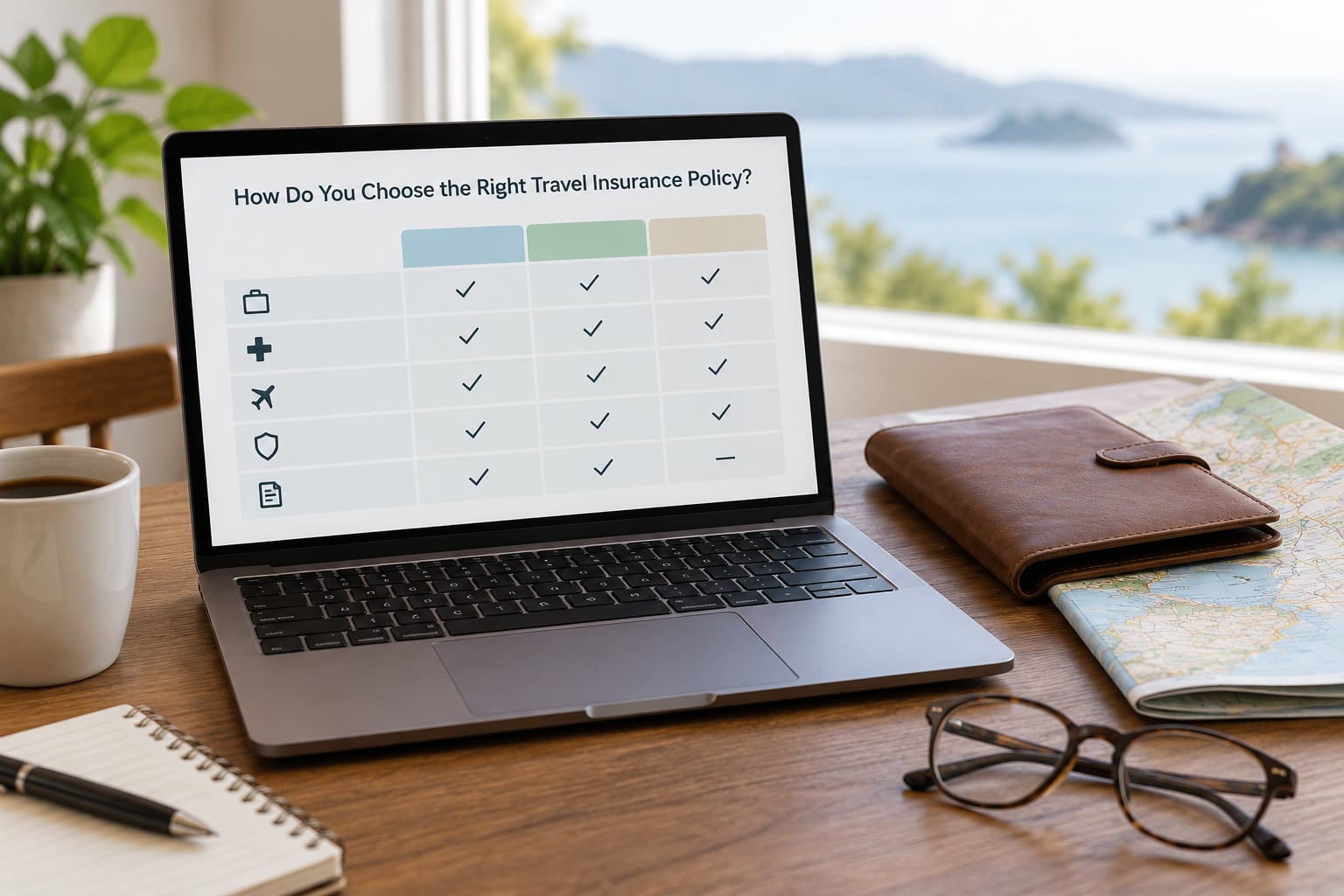
Choose on fit, not on how complete the brochure sounds. These six checks get you there faster than reading policy wording line by line.
- Start from the trip, not the product list. Write down the largest amount you would lose if the trip were cancelled tomorrow. Buy toward that number.
- Set the medical limit deliberately. Look at what an emergency would actually cost where you are going, including evacuation to a larger city. Twenty thousand is too little for many destinations; a hundred thousand is comfortable for most.
- Read the definition of “trip” and “pre-existing condition”. Some policies define a trip as requiring travel of a minimum distance or length, so a local weekend may not be insured at all. Pre-existing condition wording decides what counts.
- Check the exclusion list against your actual plans. Riding with an operator, driving a rental off-road, flying a private aircraft, or working part-time while travelling can all sit outside standard cover.
- Verify timing. Cancellation cover normally has to be in place by the time you pay the first non-refundable cost. Many insurers also impose a waiting period of a few days to two weeks before cover for a pre-existing condition begins, so the earlier you buy, the better.
- Look at the insurer’s standing and its assistance. Check that it is regulated in your country, look at the insurer’s AM Best or equivalent rating, and save the 24/7 assistance number offline before you travel.
Compare like with like. Matching a cheap policy against a comprehensive one produces a false comparison, since the numbers are cheap because of what is missing. Ask for the certificate of insurance in writing, save it, and check the exclusions that apply to where you are going rather than the general list.
Nothing can be bought for a loss that has already happened. Once you know illness or a storm may end the trip, it is too late. That is why the buy-early advice in step five is not a sales line, it is a genuine constraint.
How Do Travel Insurance Claims Work?
Claims run in a predictable order, and knowing it in advance is the difference between a reimbursement in weeks and a dispute that lasts months.
- Tell the insurer immediately. Most policies require prompt notice, and a late call is one of the most common reasons a claim stalls.
- Call the assistance line before treatment, where medical cover is involved, so the insurer can arrange direct billing with the hospital.
- Collect everything. Receipts and invoices for every expense, medical records and discharge summaries, the carrier’s cancellation notice, the airline delay message, police or airport report for lost property.
- File with the documents, usually through the provider’s online portal or by email.
- Track responses. Keep copies of everything you submit and note every reference number.
The cashless versus reimbursement question comes up constantly on r/InsuranceGyaan and Quora. Cashless means the insurer pays the hospital directly and you settle the small balance yourself, which is why calling ahead matters. Reimbursement means you pay first and claim later. Emergency medical claims are usually paid against itemised bills, so an itemised invoice is not an optional extra.
Claims are commonly denied for a handful of predictable reasons: an undocumented pre-existing condition, an activity listed under the exclusion heading, a deadline missed, or receipts that were never collected. Forum travellers repeatedly describe the same lesson, that the paperwork is what decides the outcome.
A gentle related habit: keep every travel receipt in one folder on your phone while you are away. It takes seconds and it removes the single most common reason a straightforward claim takes months.
Frequently Asked Questions
Do I need travel insurance for a domestic trip?
Usually not, if the trip is short, booked on refundable terms, and you have health coverage that follows you. The risk on a domestic weekend is low because you are close to home and can fix problems cheaply. Coverage becomes worth buying when you have large non-refundable bookings, are travelling far from a hospital, or plan activities your health plan excludes. Check your credit card benefit first, then decide whether the exposed amount justifies a premium.
Is travel insurance worth it for a cruise?
Often yes, but rarely for the sailing itself. Cruise lines rebook passengers onto later departures, so the loss you want to protect is the flights, hotels and transfers you booked around the cruise. Those are non-refundable, and a general policy with trip-interruption cover handles them. A cruise-specific policy adds missed ports, itinerary changes and cabin reassignment. Compare the two before deciding which fits your booking.
Does health insurance cover me while I am traveling?
Partly, in most cases. Many plans cover you abroad, but at in-network rates in your home country, which usually means you pay first and claim the balance afterwards. Emergency treatment, evacuation and repatriation are frequently excluded or capped. A travel policy fills those gaps with a direct-billing arrangement and a separate medical limit. Check your health plan’s out-of-area wording, and remember that Medicare generally does not bill foreign carriers directly.
Can I buy travel insurance after booking a trip?
Yes, but trip cancellation cover normally has to be in place by the time you pay your first non-refundable cost, so buying after that date removes that benefit. Medical and delay cover can still be bought close to departure, though last-minute premiums run higher and some insurers restrict new policies within days of travel. Pre-existing condition waiting periods can be two weeks long, which is a further reason to buy early rather than late.
Does travel insurance cover canceled flights or weather delays?
A cancelled flight is covered only under trip cancellation or trip interruption, and only when the cause is listed, such as illness or a declared storm at your destination. If the airline simply cancels for operational reasons, you generally claim from the airline instead. Delays are usually a separate benefit covering meals, lodging and transport after a stated minimum delay, often six hours. Neither benefit is standard on credit cards, which is why long international trips need a policy.
What documents do I need to make a travel insurance claim?
Expect itemised receipts and invoices for every expense, the carrier’s cancellation or delay notice in writing, medical records and any discharge summary, and proof you paid for the trip. Add a police or airport security report for lost property, and the insurer’s claim form submitted through its portal. File early, keep copies of everything, and note reference numbers. Most denials trace back to missing documentation rather than the event itself.
Conclusion
Start with one number: what would it cost you if the trip could not happen at all. If that figure is small and your health coverage follows you abroad, skip the policy and keep the money. If it is large, if you are crossing a border, or if you have a condition or an activity a standard policy would exclude, buy the cover before the first non-refundable payment lands.
Match the medical limit to what treatment would really cost at your destination, read the exclusions against your own plans rather than skim the list, and keep the receipts. Most of the regret travellers report comes from buying the cheapest policy without reading it, not from buying insurance at all.