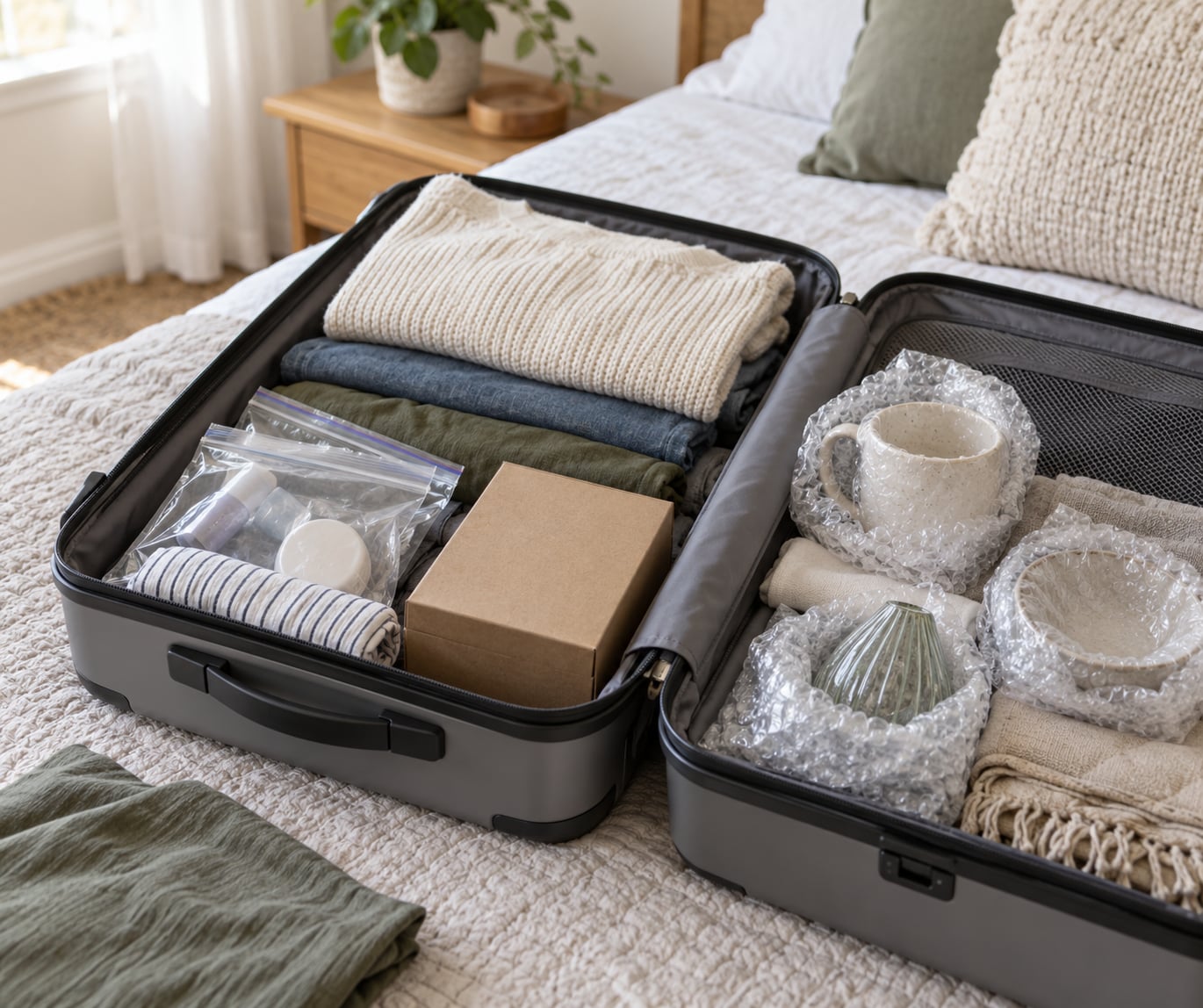
Wrap every fragile item on its own, cushion it on all sides, place it in the middle of the suitcase, and fill every gap so nothing can shift. If the item is in a container, seal that container inside a zip bag before it goes anywhere near your clothes. Most breakage happens because items touch each other or move inside the case, not because the bag itself failed.
I have watched a lot of checked bags come off the belt. The ones that survive are almost never the ones with a fancy packing kit. They are the ones where nothing could slide, and where the softest, most crushable item was buried in the middle rather than dropped in on top.
Before you start, a quick summary of what matters most:
- Wrap each item separately, and never let two wrapped items touch.
- Fill every empty space; movement is what breaks things.
- Keep fragile items away from the walls, corners, wheels and handle of the case.
- Ask for the fragile tag at check-in, but never treat it as protection.
- Photograph your items before you hand the bag over, and report damage before you leave the airport.
Table of Contents
- 1What You Need
- 2Rigid containers sized close to the item
- 3Cushioning material
- 4Sealable bags
- 5Tape and scissors
- 6A marker and your phone
- 7A fragile-item inventory
- 8Step-by-Step
- 9Check the Airline’s Rules Before Packing
- 10Choose the Right Box or Container
- 11Wrap Each Fragile Item Separately
- 12Fill Empty Space and Prevent Movement
- 13Seal and Label the Package
- 14Place the Package Inside the Suitcase
- 15Inspect and Document the Packed Item
- 16Common Mistakes
- 17Wrapping Two Items in One Bundle
- 18Leaving Gaps Unfilled
- 19Packing Fragile Items at the Edges
- 20Relying on the Fragile Sticker
- 21Trusting Liquids to Stay Put
- 22Over-Packing a Hard-Shell Case
- 23Checking Items That Should Never Be Checked
- 24Frequently Asked Questions
- 25Can I carry fragile items in checked luggage?
- 26What is the safest way to pack a fragile item in a suitcase?
- 27Should I put fragile items in my carry-on instead?
- 28Do airlines replace fragile items that break in checked baggage?
- 29What packing materials are best for glass or ceramics?
- 30How can I prevent bottles and liquids from leaking in checked luggage?
- 31Conclusion
What You Need
Gather these before you start wrapping. You need very little, and most of it is free or already in the house.
Rigid containers sized close to the item
A shoebox, a cereal box, a thick cardboard box, or a hard plastic tub. The closer the container fits to the item, the less padding you need inside it. A small snug box beats a big loose one every time.
Cushioning material
- Bubble wrap for anything breakable, glass, ceramics or framed pieces.
- Packing paper or soft cardboard for filling gaps.
- Foam board cut into squares, or an old foam mat, for sandwiching delicate items.
- Clothing, socks and jumpers as free filler that you were packing anyway.
Sealable bags
Zip bags in two or three sizes. They double as leak protection for bottles, dust covers for ceramics, and a way to hold padding in place while you seal a box.
Tape and scissors
Packing tape to close boxes, and scissors or a knife to cut bubble wrap. Bubble wrap is annoying to wrap around an entire box; cutting a sheet and folding it over the top works better and uses less.
A marker and your phone
A marker for labelling the inside of each box in case it gets separated from your bag. Your phone for photographs of every fragile item before packing.
A fragile-item inventory
A short list in your notes app: what is in the bag, what it is worth, and where you packed it. If the bag arrives damaged, this list plus your photographs is what you will be asked for at the baggage desk.
Step-by-Step
Work through these in order. The order matters more than the materials, because most of these steps are about stopping movement rather than adding softness.
Check the Airline’s Rules Before Packing
Open your airline’s baggage page before you wrap anything, not at the counter. Some carriers ask you to declare fragile, valuable or perishable items, and some restrict items such as certain alcohol, glass or sharp objects. If your bag crosses a border, the rules at your destination and any transit country apply too.
Read the fragile and valuables policy specifically. Most airlines limit liability for fragile, valuable or perishable goods, and many exclude breakage attributed to inadequate packing, no matter how carefully you packed. Knowing that before you travel keeps expectations honest.
Choose the Right Box or Container
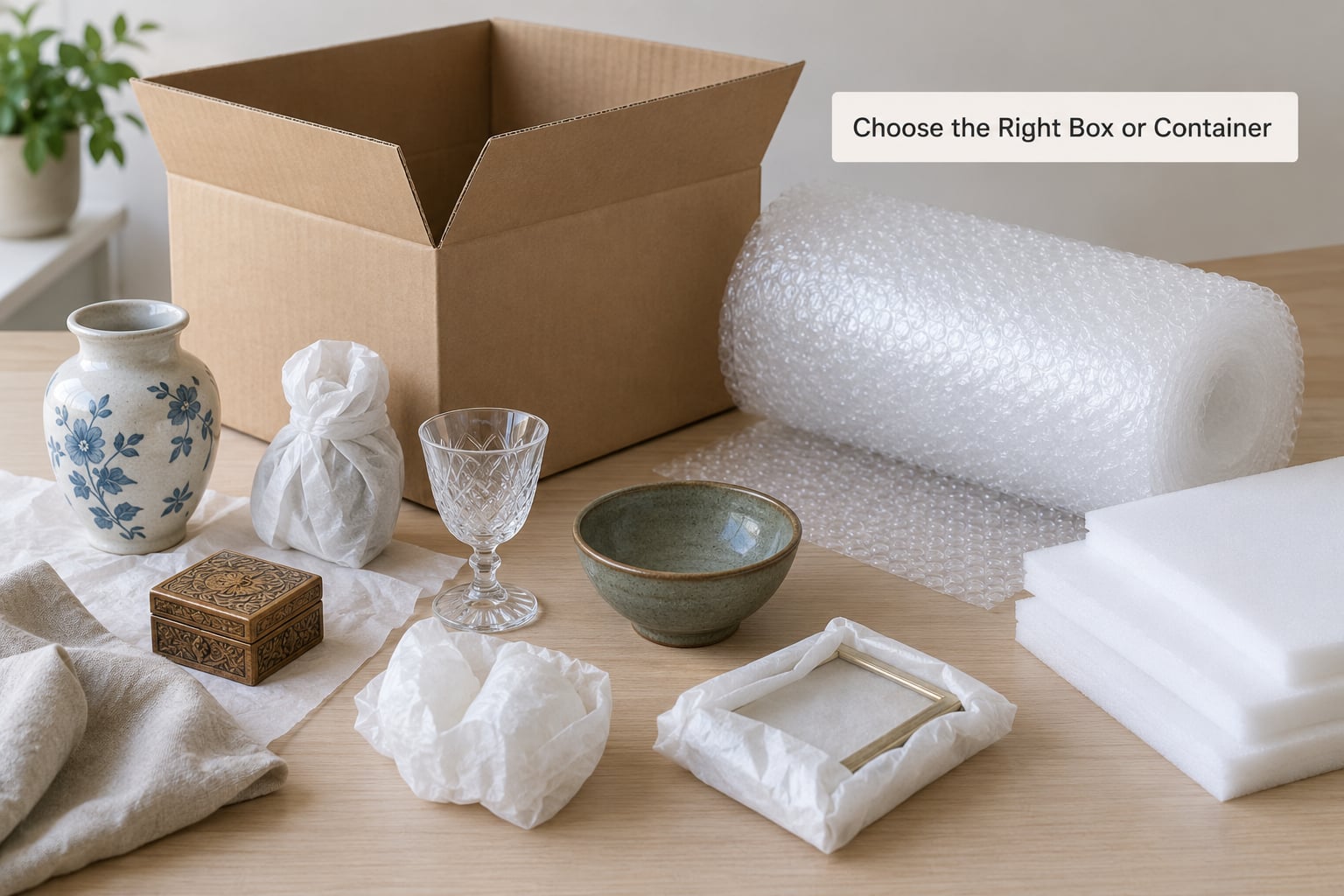
Pick a container that is rigid, uncrushed and only slightly larger than the item. Too much empty space inside is the enemy here, because padding has to travel a long way to reach the item before it does anything useful.
Test the box before you trust it. Press each face and corner firmly with your thumb. If the cardboard dents, creases or flexes, double it over with a second box or reinforce the weak faces with flat cardboard strips.
Wrap Each Fragile Item Separately
Wrap each item on its own, and pay attention to shape rather than surface. Corners, rims, handles, stems and thin sections are where objects actually fail, so add an extra layer there. For a mug or glass, put a small cushion inside the cup as well, because a hollow item breaks inward more easily than a solid one.
Two wrapped items touching each other is still two fragile objects meeting. If you can move them a centimetre apart inside the box, they stay a centimetre apart.
Fill Empty Space and Prevent Movement
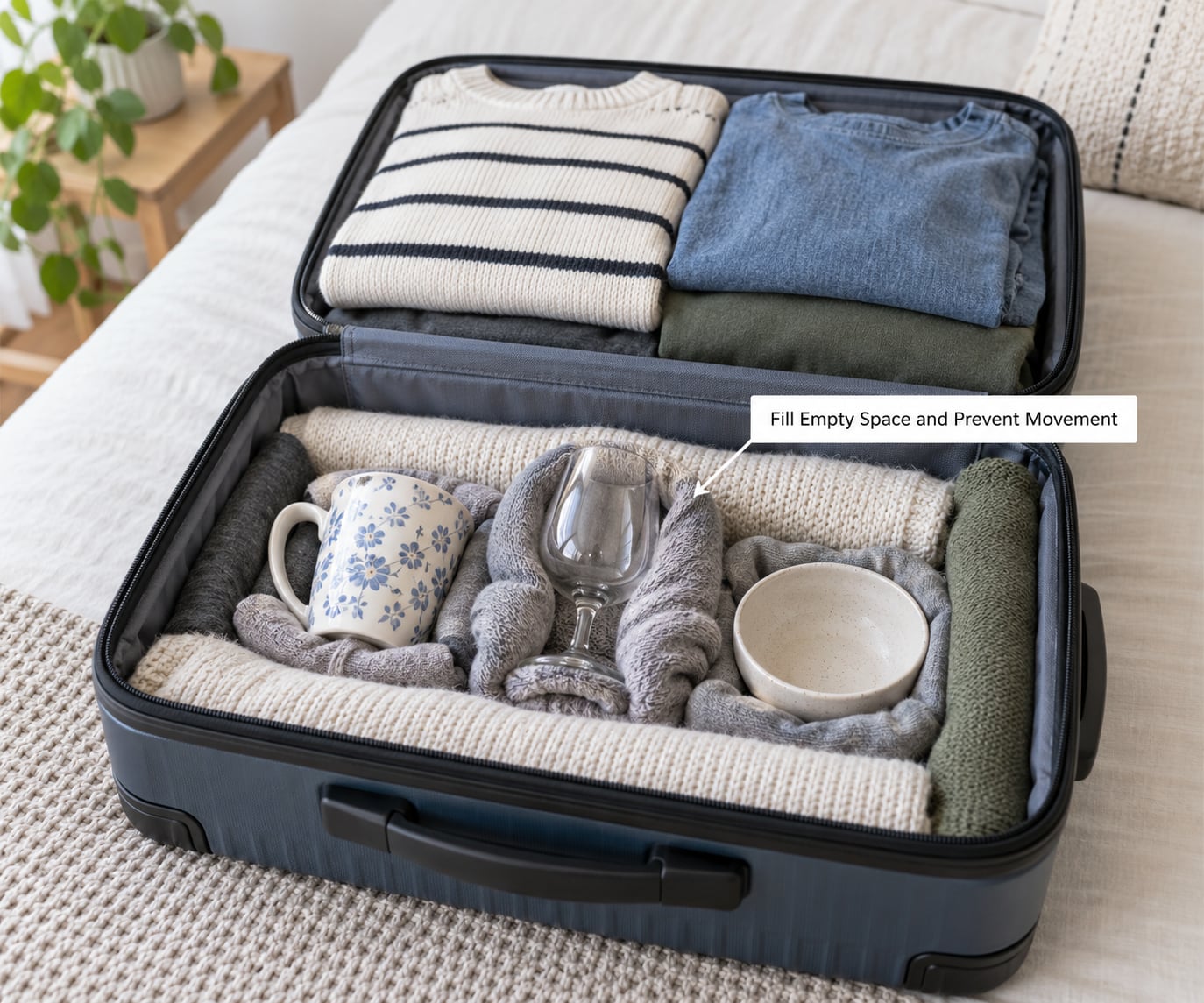
Cushion the bottom of the container with a folded jumper or a thick layer of clothing, then set the wrapped item in the middle of that. Pack soft material around every side, then lay a final soft layer on top. The item should be held in place on five sides.
Fill the remaining gaps with clothing, socks or packing cubes. Then do the shake test: lift the box a few centimetres and drop it onto a soft surface. If you hear anything sliding or any shifting sensation, add more filler and repeat. Do this with the suitcase too, once everything is in.
Seal and Label the Package
Tape the box seam in an H pattern, running tape across the top and down both sides. That resists the box splitting open when pressure is applied from above, which happens more often than most people expect.
Write on the outside of the box: your name, your phone number, the city you are flying to, and one word describing the contents. If the box gets separated from your suitcase in transit, someone can return it instead of dumping it.
For anything containing liquid, seal the container in a zip bag first, then wrap it. A box is not leak-proof and a suitcase is not leak-proof either, so double up: zip bag, then bubble wrap, then a second zip bag if the bottle is glass.
Place the Package Inside the Suitcase
Position the sealed package in the centre of the suitcase, surrounded on all sides by the softest things you packed, usually jumpers, towels or a padded laptop sleeve. Never against the walls. The shell, the wheels, the handle housing and the corners take the biggest hits, so give them nothing fragile to hit.
Put your shoes at the bottom or along one edge, well away from the package, and keep heavy hard objects away from it. Over-packing is its own failure mode: a bulging hard shell squeezes its contents from all directions, and that steady pressure can crack glass that a single drop never would.
Inspect and Document the Packed Item
Before you zip the case, run your hand over the packed box and press gently on each face. You should feel no give and no movement underneath. Take photographs of each fragile item in the open, next to your inventory list, so you have a clear record of its condition before it left your hands.
Photograph the packed suitcase too, then the bag with its tag attached at check-in. It takes thirty seconds and it is the only record of how you handed it over.
Common Mistakes
Most damaged bags share the same handful of mistakes.
Wrapping Two Items in One Bundle
Bubble wrap around two glasses held together protects them from the outside and nothing from the inside. They rattle against each other all the way to the destination. Wrap separately, then nest them with padding between.
Leaving Gaps Unfilled
An empty half of a case lets items travel. They slide, tap and collide, and glass plus glass plus vibration is a bad combination. Fill the gaps or the movement will fill them for you.
Packing Fragile Items at the Edges
The edges and corners of a suitcase are the impact zones. A ceramic plate flat against the outer wall of a hard shell has nothing between it and the drop. Centre it, and give it a buffer of clothing on every side.
Relying on the Fragile Sticker
You can ask for the tag at check-in, and it costs nothing, so ask. Be honest about what it does though: it flags a request for care, it does not change the handling, and travel forum regulars are split on whether it makes any measurable difference at all. Packing is what protects the item.
Trusting Liquids to Stay Put
Pressure changes in the hold can push against a cap that was tight at sea level, and a bottle that survived the flight can leak into everything around it. Seal it in a zip bag, tighten the cap with tape around the neck if needed, and keep it away from paper, fabric and electronics.
Over-Packing a Hard-Shell Case
A zipped-shut case that bulges means the contents are under continuous pressure from every side. Sit the case down and press the shell; if the shell flexes, the load is crushing your items. Remove something.
Checking Items That Should Never Be Checked
Spare lithium batteries and power banks, medication, passports and travel documents, jewellery, keys, and anything irreplaceable should stay in your cabin bag. Many batteries are prohibited in checked luggage entirely. No amount of packing protects a passport.
Frequently Asked Questions
Can I carry fragile items in checked luggage?
Yes, most airlines allow fragile items such as glassware, ceramics, framed art, cameras and bottles in checked baggage, provided they meet size and weight limits and are not prohibited. Some carriers ask you to declare especially valuable or delicate pieces, and some exclude fragile goods from their standard liability. Check your airline’s baggage page and its fragile or valuables policy before packing, and declare the item at the counter if asked.
What is the safest way to pack a fragile item in a suitcase?
Put it in a snug rigid box, wrap it individually in bubble wrap with extra protection on the corners, fill all remaining space inside the box, then seal the box and place it in the centre of the suitcase surrounded by soft clothing on every side. Fill the rest of the case so nothing moves, and keep the package away from the shell, wheels, handle and corners.
Should I put fragile items in my carry-on instead?
If an item is small, valuable or genuinely irreplaceable, carry it on. Cabin bags are handled far more gently, they never go through belt loaders or cargo holds, and a gate-check can happen without warning, so keep anything fragile near the top of the cabin bag and away from liquids. For bulky souvenirs, checking the item with the layered method is more realistic than fighting cabin size limits.
Do airlines replace fragile items that break in checked baggage?
Usually not, and this surprises people. Airline liability for checked baggage is limited, and most policies exclude breakage attributed to fragile, valuable or perishable goods or to inadequate packing, a term carriers describe as inherent vice. If something breaks, report it before leaving the baggage hall so the airline can open a Property Irregularity Report, and keep your photographs and receipts. Travel insurance that covers baggage damage is often the more realistic route.
What packing materials are best for glass or ceramics?
Bubble wrap is the strongest all-rounder for shock absorption, and it is what most travellers pick up at a hardware or shipping store. Packing paper is softer and folds into gaps well. Foam board squares sandwiched around an item add rigidity cheaply. Your own jumpers and socks make decent filler, and a snug cardboard box does more for glassware than any amount of wrap in a loose bag.
How can I prevent bottles and liquids from leaking in checked luggage?
Seal each bottle in a zip bag first, then wrap it, then add a second zip bag if the bottle is glass. Tighten the cap and tape around the neck if it is a screw cap, because pressure changes in the hold can push against it. Keep bottles upright where possible, away from paper, clothing and electronics, and remember that spirits and oils are still subject to airline alcohol limits.
Conclusion
Start with the airline’s rules, then pick a rigid container that fits the item closely. Wrap it on its own, cushion it on five sides, fill the gaps, and put it in the middle of the case away from the shell. Photograph it before check-in, report any damage before you leave the baggage hall, and treat the fragile tag as a courtesy request rather than a guarantee.
Packing well will protect fragile items in checked luggage for the large majority of trips. It will not cover the day the belt loader is careless, which is exactly why the irreplaceable things belong in your cabin bag.