Airline baggage allowance is the maximum number, size and weight of bags a passenger may bring on a flight, set by the operating airline, the fare you bought and the route you are flying. Airlines publish those limits, then charge at the airport when a bag goes past them, which is why the same suitcase can be free on one ticket and costly on the next.
Understanding how airline baggage allowance works takes about ten minutes of reading and saves the most common airport surprise there is. Most of the confusion comes from one thing: there is no single global rule. The allowance is a combination of a counting system, a size cap and a weight cap, and any one of the three can end your free allowance.
Table of Contents
- 1How Airline Baggage Allowance Works
- 2Why do airlines weigh luggage at all?
- 3Carry-On Bags: Size, Weight, and What Counts
- 4Checked Bags: How the Allowance Is Calculated
- 5What Is Included in Your Airline Baggage Allowance?
- 6Why Airlines Charge for Bags
- 7How Airline Baggage Allowance Differs by Fare Type
- 8International Flights and Connecting Itineraries
- 9What Happens If Your Bag Is Overweight or Oversized?
- 10Special Items and Baggage That May Not Count
- 11How to Check Your Airline’s Baggage Rules Before You Fly
- 12Frequently Asked Questions
- 13What does 1 piece baggage allowance mean?
- 14Why do airlines weigh luggage?
- 15How can I check my suitcase weight at home?
- 16Can I share my baggage allowance with my travel companion?
- 17Do baggage rules change on connecting flights?
- 18Does basic economy include a carry-on bag?
- 19Conclusion
How Airline Baggage Allowance Works
Two systems sit underneath every baggage rule, and once you know which one your airline uses, the numbers on your ticket make sense.
The piece-based system gives you a set number of bags, with a weight maximum for each one. Two bags at 23 kg each is a typical piece-based allowance on long-haul routes.
The weight-based system gives you a total allowance in kilograms or pounds, shared across all your bags. On a 20 kg weight-based allowance you can check one 20 kg bag, two 10 kg bags, or three light bags, and the total is all that matters.
| How airline baggage allowance works | Weight-based system | Piece-based system |
|---|---|---|
| What you are given | A total weight for all bags combined | A number of bags |
| Typical limit | 20 kg or 23 kg total | 1 or 2 pieces, 23 kg each |
| Can you split it up? | Yes, across as many bags as you like | No, one bag per piece |
| Common on | Many short and medium haul routes | Most long-haul and international routes |
| Size limit still applies | Yes, usually 158 cm total | Yes, usually 158 cm total |
Most routes you will book today describe the allowance in piece terms, but plenty of regional and budget carriers still sell weight allowances, so check the wording on your itinerary rather than assuming.
Why do airlines weigh luggage at all?
Three reasons, and none of them is arbitrary. Handling equipment is designed around a limit: a ramp worker lifting a 32 kg bag onto a belt is a different injury risk from the same person lifting 23 kg. Load planning matters too, because a hold that is too heavy on one section of the aircraft affects the balance figures the flight crew depends on. And a bag on an oversize belt takes up space that a standard bag would fill, so size and weight are capped together.
Carry-On Bags: Size, Weight, and What Counts
Cabin baggage is usually included with every fare, but not always, and the size rule is where most trouble starts.
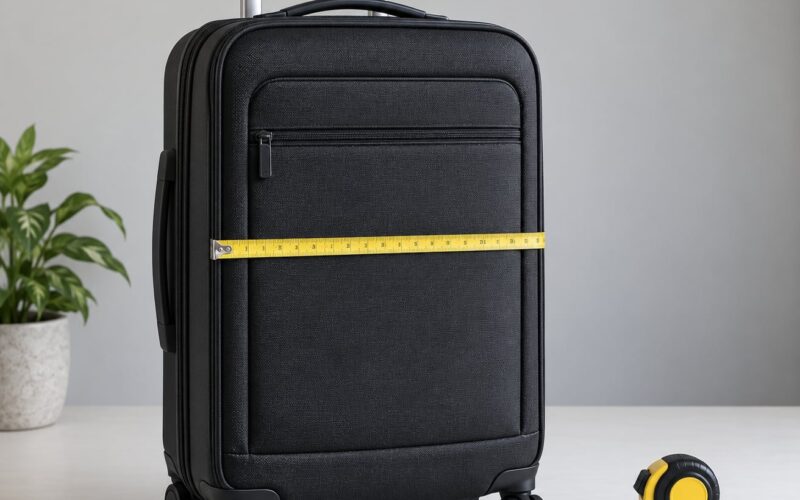
Size is measured as linear inches, which is simply length plus width plus height, including wheels and handles. Add the three numbers and compare the total with the airline’s limit, usually around 62 inches or 158 cm. Measuring a bag at home in two minutes prevents most gate-check fees.
Weight on carry-on bags is checked far less often than size. A few carriers in Europe and Asia weigh cabin bags at the gate, so if your route is one of those, an inexpensive luggage scale is worth packing.
| Bag type | Typical maximum size | Notes |
|---|---|---|
| Carry-on roller | 22 x 14 x 9 inches, about 56 linear inches | Must fit the sizer at the gate |
| Personal item | Around 18 x 14 x 8 inches | Under the seat, not the bin |
| Checked bag | 62 linear inches, 158 cm | Measured with handles and wheels |
The personal item is the one people misjudge. It has to slide under the seat in front of you, so a laptop sleeve, a small backpack or a handbag works, while a standard backpack with a rigid frame often does not.
Security rules are separate from airline rules and they apply to every passenger regardless of fare. Liquids in carry-on bags are limited to containers of 100 ml or less inside a clear bag, and anything larger has to go in checked luggage.
Checked Bags: How the Allowance Is Calculated
A checked allowance is counted per passenger, per ticket, per direction. One free bag on a one-way flight is one bag there and one bag coming back, and the allowance is not shared across the people on the booking unless the airline explicitly permits pooling.
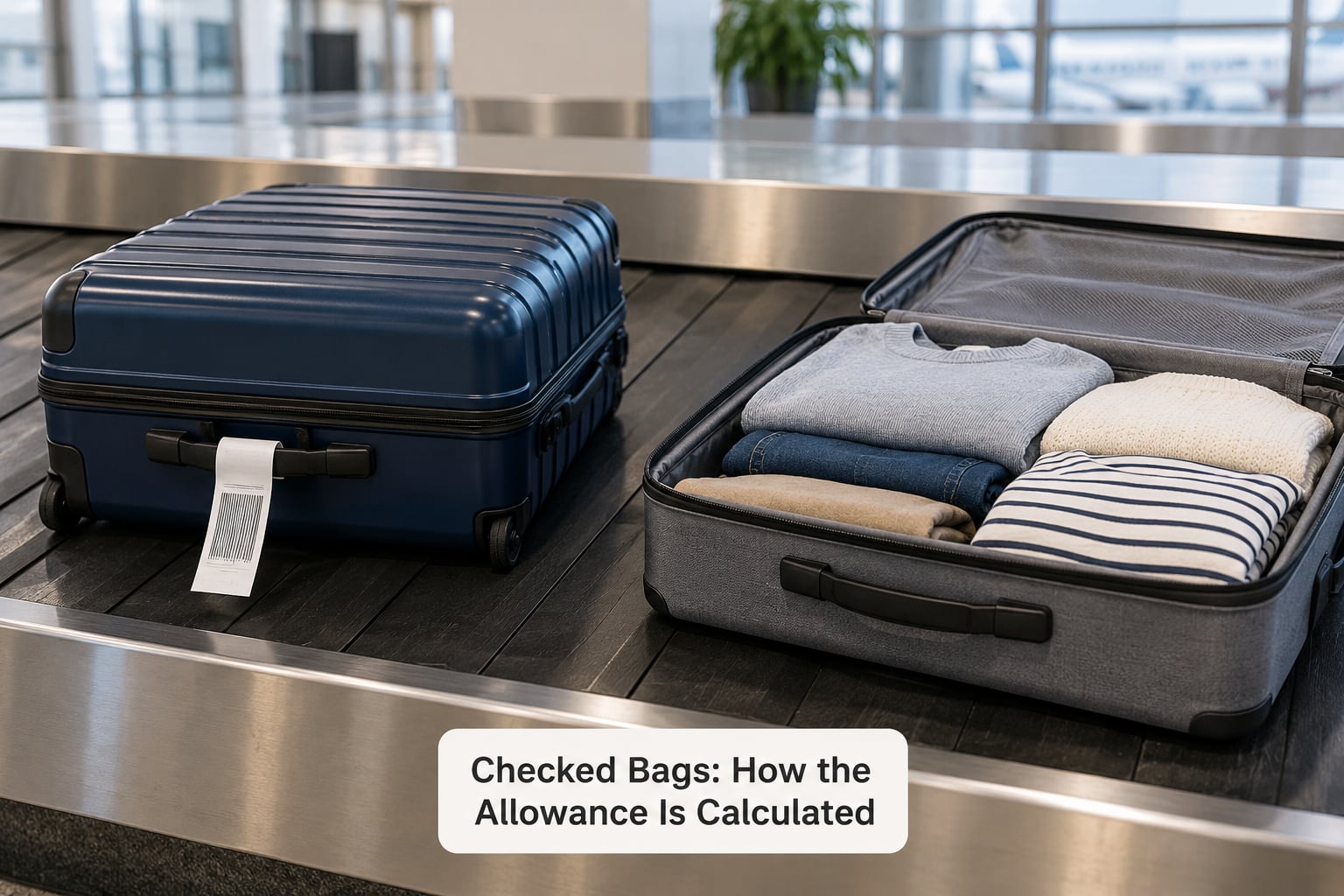
The per-bag weight ceiling is usually 23 kg, which is 50 lb, and many premium and long-haul fares raise that single-bag limit to 32 kg, which is 70 lb. A 70 lb allowance is not the same as two 50 lb bags: it is one bag that may weigh 32 kg. If you are packing for a family of four, read that line carefully.
Status changes the arithmetic as well. Elite tiers in most programmes add a free checked bag on top of the fare allowance, and some credit cards cover a bag for the cardholder only, not the whole booking.
Your itinerary line is also the contract. The number shown next to your fare, in the booking confirmation or in the airline’s own baggage calculator, is the number that gets applied at the check-in desk.
What Is Included in Your Airline Baggage Allowance?
Before you pack, confirm these seven details, and you will not be surprised at the airport.
- Number of pieces included with your fare
- Weight limit per bag, and whether it is a total-weight or piece system
- Maximum dimensions in linear inches or centimetres
- Fare family, since the cheapest fare often carries the least
- Route, because a short domestic hop and a transatlantic flight can differ on the same ticket
- Passenger type, since infants, children and adults are counted differently
- Loyalty status and card benefits that add a bag on top
Anything not on that list is an assumption, and assumptions are what cost money at the counter.
Why Airlines Charge for Bags
A free checked bag is bundled into the ticket price for some fares, which is one reason the same airline charges very different amounts for a bag depending on how you booked. The base fare is sold as a package, and the bag is part of that package on a full-service economy fare and sold separately on a low-cost fare.
Route matters as much as fare. Baggage handling costs more per kilo on a long sector than a short one, and fees are frequently set by route rather than by one national rate, so a single airline can quote two different figures on the same day for two different journeys.
Paying online before you travel is normally cheaper than paying at the airport desk or at the gate. Airlines publish the difference in their own fee tables, and adding bags during online check-in is usually the cheapest point to do it. Check the current figure yourself, because rates change and we do not quote numbers that go out of date.
Waiting until the gate is the expensive option. A bag that does not fit a full bin gets gate-checked, and the fee for that is applied at the higher rate with less warning.
How Airline Baggage Allowance Differs by Fare Type
Fare families, not cabins alone, decide how much luggage comes with the ticket. Business class almost always includes more, but the middle fares are where the difference catches people out.
| Fare type | Carry-on | Checked bags | Who it suits |
|---|---|---|---|
| Basic or light economy | Often personal item only | None included, charged per bag | Travellers who pack light and check in online |
| Standard economy | Usually one carry-on plus a personal item | Typically one bag included | Most leisure trips |
| Flexible or premium economy | Carry-on plus personal item | One or two bags, sometimes a higher weight cap | Travellers with heavier packing or a connection |
| Business and first | Two carry-ons plus a personal item on many carriers | Two or three pieces, often at 32 kg each | Long-haul and frequent travellers |
That basic economy row is the biggest source of airport friction. A personal-item-only ticket is genuinely a smaller allowance, not a courtesy version of the same thing, and the gate agent works from the fare on the booking.
International Flights and Connecting Itineraries
On a connecting itinerary, the baggage rule that applies is the one of the operating carrier, the airline actually flying the segment, not necessarily the airline whose code is on your ticket. Book through one airline and be operated by another, and the allowance can change mid-trip.
Two more things separate a smooth connection from an expensive one. On a single through-ticket, your bags are normally transferred to the next flight automatically. If you hold two separate tickets and self-connect, you collect your bag, re-check it and pay again at the second airport, because the second booking knows nothing about the first.
That is also why a positioning flight hurts. An economy domestic leg bought purely to connect into a long-haul business ticket still runs on economy baggage rules for that first sector.
What Happens If Your Bag Is Overweight or Oversized?
Oversize and overweight are separate conditions. A bag can be inside the weight limit and still be oversized, and it can be within the dimensions and still be too heavy, and the two are usually charged as different things.
A few kilos over is common and the response is usually a flat excess charge rather than an argument. Airlines typically allow a small tolerance before the fee applies, and the tolerance differs by route, so the only reliable answer comes from your airline’s fee table.
Carry-ons fail differently. If your bag passes the sizer at home and fails the gate sizer, it gets gate-checked at the higher fee, and you collect it at the carousel on arrival.
What you can do before departure is simple: weigh at home, measure with a tape including wheels, move items to a second bag if you are near a limit, and pay for the extra piece online rather than at the counter. Repacking at the check-in belt is the expensive option both in money and in time.
Special Items and Baggage That May Not Count
Some items are handled under their own rules and may not be included in your allowance at all.
- Sports equipment. Golf clubs, skis, snowboards and bicycles are usually charged as a separate special item, often counting as one of your pieces, and their size is judged as sports equipment rather than as a normal suitcase.
- Musical instruments. A large instrument may need to travel in the cabin and is only accepted if it fits the allowance or a seat is available, so ask before you book rather than at the gate.
- Mobility aids. Wheelchairs and similar equipment are generally carried at no charge and are exempt from normal size and weight limits, which is a legal entitlement rather than a courtesy.
- Baby equipment. Strollers and car seats are commonly carried free but policies on the gate vary, and infant baggage allowances differ from adult ones in every cabin.
- Batteries. Power banks and spare lithium batteries belong in carry-on luggage only. They are prohibited in checked bags because of the fire risk, and they get confiscated at security.
Check each item against your airline’s special baggage page rather than the general allowance table, because the general table simply does not cover them.
How to Check Your Airline’s Baggage Rules Before You Fly
Six steps, in order, and you will have the exact number for your trip.
- Open your booking confirmation and find the fare name and the itinerary, including every segment.
- Identify the operating carrier for each segment, which may not be the airline you booked with.
- Read the allowance line for your fare family and note whether it is stated in pieces or total weight.
- Open the airline’s own baggage calculator or baggage page and enter the route and fare class.
- Add any extras: your loyalty tier, a card benefit, a second adult on the booking, or a sports item.
- If the wording is still unclear, contact the airline through the channel in your booking before you pay for anything.
Write the numbers down, or screenshot the page. It takes ten seconds and it gives you something concrete to point at if the counter disagrees with you.
Frequently Asked Questions
What does 1 piece baggage allowance mean?
A piece-based allowance means you may check one bag, and that single bag has a weight ceiling, usually 23 kg or 50 lb, plus a size ceiling of about 158 cm measured as length, width and height together. It does not mean 1 kg of luggage and it does not mean the allowance is shared with anyone else on the booking. Some carriers offer a higher ceiling of 32 kg for premium and long-haul fares, so read the exact figure on your itinerary.
Why do airlines weigh luggage?
Three practical reasons. Handling equipment and staffing are built around a specific load, so ramp staff lifting a heavier bag face a greater injury risk. Load planning requires the hold to stay within weight and balance limits the flight crew depends on. And an oversized bag occupies hold space that a standard bag would fill. Size and weight are capped together for all three reasons, which is why both limits appear on every baggage rule page.
How can I check my suitcase weight at home?
A hanging luggage scale is the cheapest reliable option: hook it over a door handle and lift the bag until it hangs free. A bathroom scale also works, by standing on it with the bag first, subtracting your own weight and reading the difference. For rough estimates, most people carry a large fully packed roller bag at around 20 kg, so a bag that feels heavy to lift up stairs is usually close to the limit.
Can I share my baggage allowance with my travel companion?
Only if the airline allows it, and the answer varies by carrier. Most major airlines do let adult passengers on the same booking pool their allowance, which means two people each with one free bag can check two bags. A few carriers keep allowances strictly per passenger and will charge for the second bag regardless. Ask at check-in before you pay, because it is decided there rather than online.
Do baggage rules change on connecting flights?
Yes, and the rule that matters is the operating carrier on the next segment, which may not be the airline you booked with. On a single through-ticket your bags transfer automatically and the allowances are usually aligned. If you hold two separate tickets and self-connect, you must collect and re-check your bag, and you pay again under the second booking’s rules. Both cases are worth checking before you leave home.
Does basic economy include a carry-on bag?
On many carriers it does not. A basic or light economy fare commonly allows a personal item only, sized to fit under the seat rather than in the overhead bin, with any larger cabin bag charged separately. Some airlines in that category still include a full carry-on, so the fare name alone is not enough. Check the allowance stated against your exact fare code, and check in online to avoid surprises at the gate.
Conclusion
Open your booking, find the operating carrier and the allowance line for your exact fare, and write down the piece count, the weight limit and the size limit before you pack. Everything else on this page is detail; those three numbers decide what you are carrying to the airport, and getting them right is the whole job.