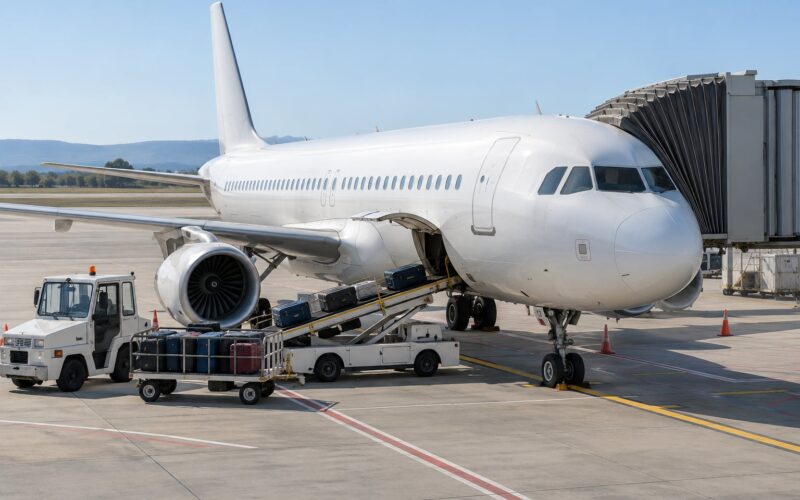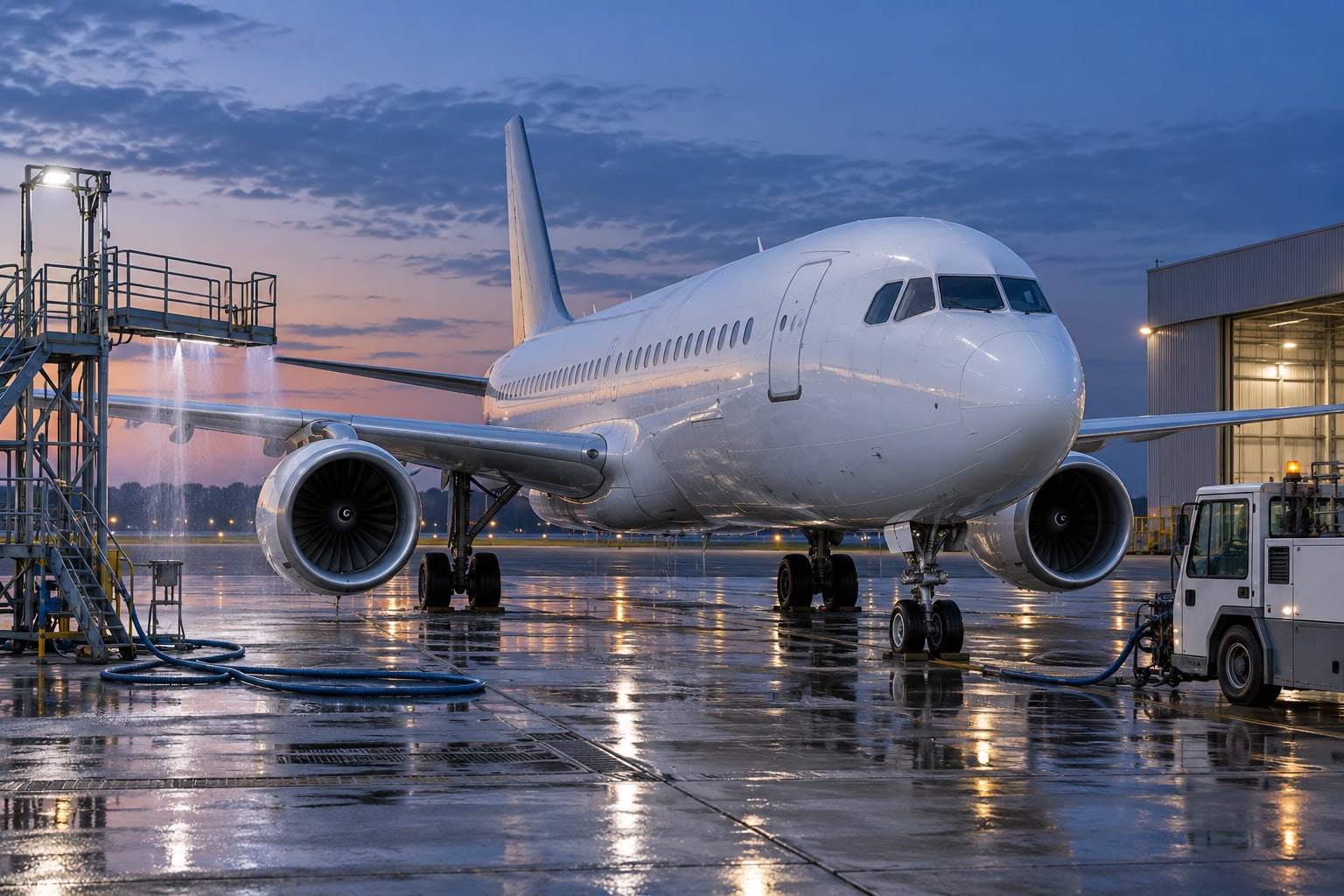
Airlines wash an airplane outside with approved detergent, high-pressure water and long-handled mops, after technicians plug and cover the engine inlets, sensors and outflow valves. Inside, cleaners reset the cabin during the turnaround with a vacuum, a full lavatory service and a wipe-down of the surfaces passengers actually touch. The exterior wash and the cabin clean are two separate jobs, run by two separate teams.
Most people only see the result. The interesting part is what has to happen before anyone is allowed to point a hose at a jet.
Table of Contents
- 1Why Aircraft Cleaning Matters
- 2Where Airplanes Are Washed and Cleaned
- 3What Happens Before an Airplane Is Washed?
- 4How Airplanes Are Washed and Cleaned Outside
- 5How Airplanes Are Washed and Cleaned During a Wash
- 6How the Flight Deck and Passenger Cabin Are Cleaned
- 7Cargo Holds, Galleys, and Wheel Wells
- 8How Teams Verify the Aircraft Is Clean
- 9What Specialized Aircraft Cleaning Involves
- 10How Often Are Commercial Airplanes Washed and Cleaned?
- 11Frequently Asked Questions
- 12Is routine airplane washing required for flight safety?
- 13Why do aircraft windows and sensors need special care during washing?
- 14Why are jet engines not washed like the rest of an airplane?
- 15What cleaning products are used on commercial airplanes?
- 16How can passengers tell whether an airplane has been properly cleaned?
- 17Conclusion
Why Aircraft Cleaning Matters
Cleaning is not mainly cosmetic. A layer of grime on a fuselage adds weight and roughness, and rough skin costs fuel. Salt and exhaust deposits left on metal can start corrosion, and corrosion that grows quietly under a paint layer is expensive and, in the worst cases, structural.
There is a third reason that surprises people: a clean skin is easier to inspect. Maintenance crews spot cracks, dents, fluid streaks and loose fasteners far more easily on a clean airframe, which is why a wash often lands shortly before a scheduled check. What looks like cosmetic work is partly a preparation step for the people who have to find defects.
Inside the aircraft, the argument is simpler: hygiene, comfort and presentation between flights. None of this is the same as maintenance. Anything structural goes to approved maintenance procedures and licensed personnel, and cleaning crews never make that call themselves.
Where Airplanes Are Washed and Cleaned
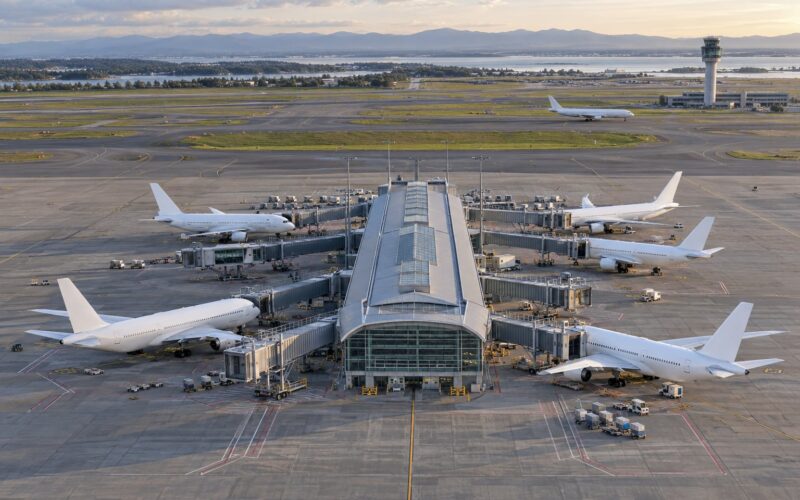
Four settings cover most commercial cleaning work: the gate, where turnaround cleaning happens between flights; the maintenance base, where a full wash is scheduled alongside checks; a dedicated wash facility, either a rinse-off bay or a wash hangar, used for larger or deep jobs; and specialist locations for paint, corrosion treatment and full interior refurbishment.
Where an aircraft gets cleaned depends on the job, the aircraft type, the operator’s own policy and how much ground time is available. A narrowbody with a short domestic turn usually gets its cabin reset at the gate and its exterior cleaned at the base. A widebody between long sectors may be routed to a wash hangar instead, because the job needs hours rather than a spare turn.
What Happens Before an Airplane Is Washed?
Nothing touches the airframe until the job is authorised and the aircraft is made safe to approach. Preparation comes first, and it is the part that decides whether the wash is a clean job or a costly one.
Crews confirm access authorisation and set up the area so that cleaners are not standing near running engines, live hydraulics or other ground hazards. Loose contamination and waste are cleared. Anything already damaged, cracked, loose or leaking gets noted before water reaches it, because a jet of water can turn a small defect into a large one.
Then come the covers. Engine inlets and exhausts get plugs or covers fitted, static wicks and pitot tubes are protected, windows and optical sensors get their own covers, and outflow valves are sealed. Cleaning products and methods come from the operator’s approved list, which in turn reflects the aircraft manufacturer’s instructions. Crews follow those procedures rather than improvising with whatever is in the store room.
How Airplanes Are Washed and Cleaned Outside
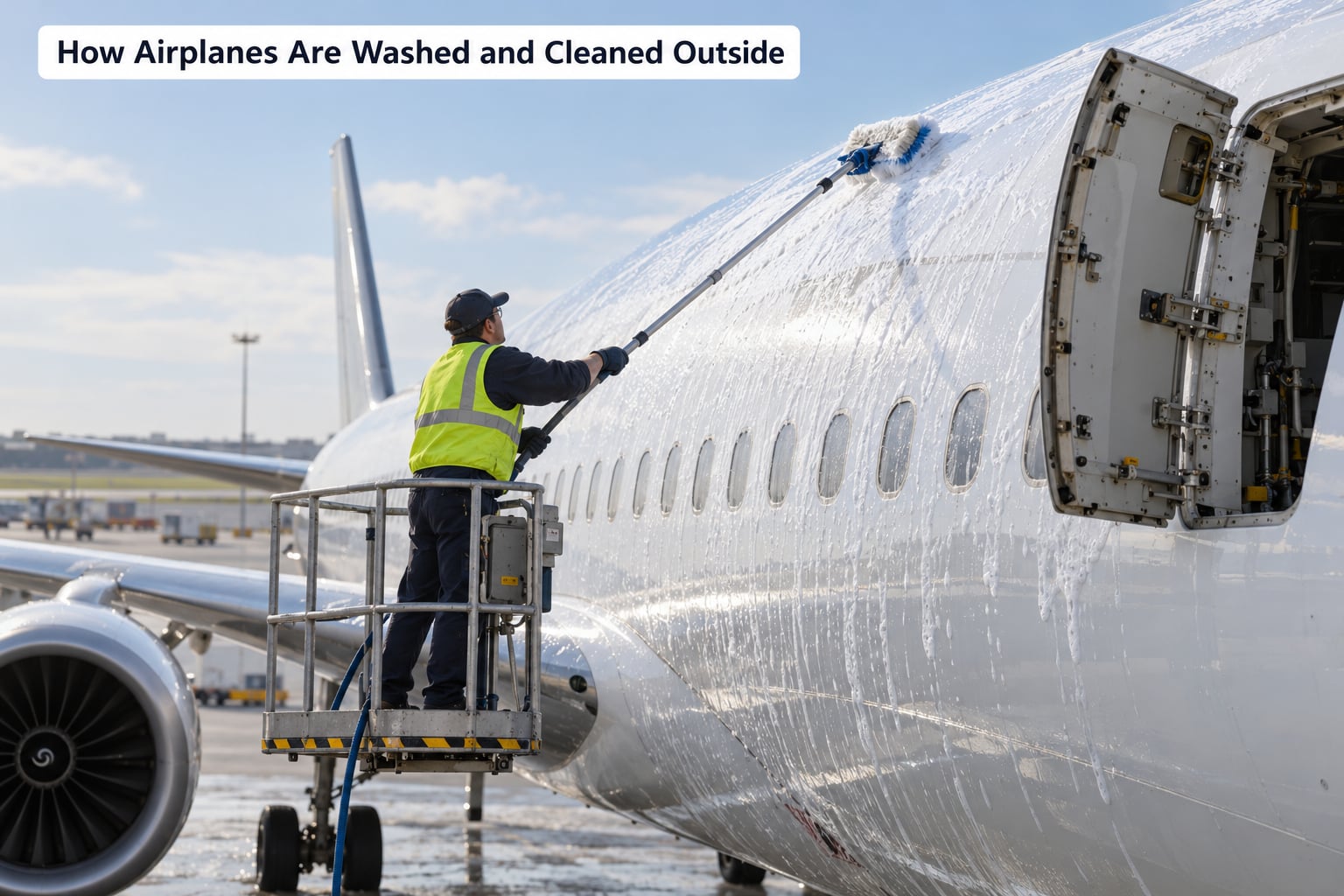
Approved cleaner goes on first, usually as a foam that is left to soften the grime rather than scrubbed off dry. Crews work top down with extendable brushes and mops so debris falls away from clean surfaces instead of across them. High-pressure water then rinses the detergent and the dirt with it, followed by a dry-down of the accessible surfaces before the covers come off.
Three methods cover almost everything. A wet wash uses detergent and high-pressure water, the traditional approach. A semi-dry wash uses a cleaning agent with far less water, and the dirt is mopped or wiped off rather than rinsed. A dry wash uses no water at all beyond what the process needs, with cleaning agents and microfibre cloths removing the contamination. Some operators publish annual water savings for the methods they use, which is the argument they make for moving away from a full wet wash.
A wash is not the same as waxing, polishing or repainting. Wax and polish are cosmetic treatments applied to a clean, dry surface. Paint correction and repainting are separate, much longer jobs handled by licensed paint shops, not by a turnaround crew with mops.
How Airplanes Are Washed and Cleaned During a Wash
A typical wash runs protect, treat, agitate, rinse, dry, inspect, uncover. That order is the reliable part. The exact products, dwell times, pressures, number of people on the job and which surfaces may be touched at all vary by aircraft model, by operator and by the approved maintenance manual for that airframe.
How the Flight Deck and Passenger Cabin Are Cleaned
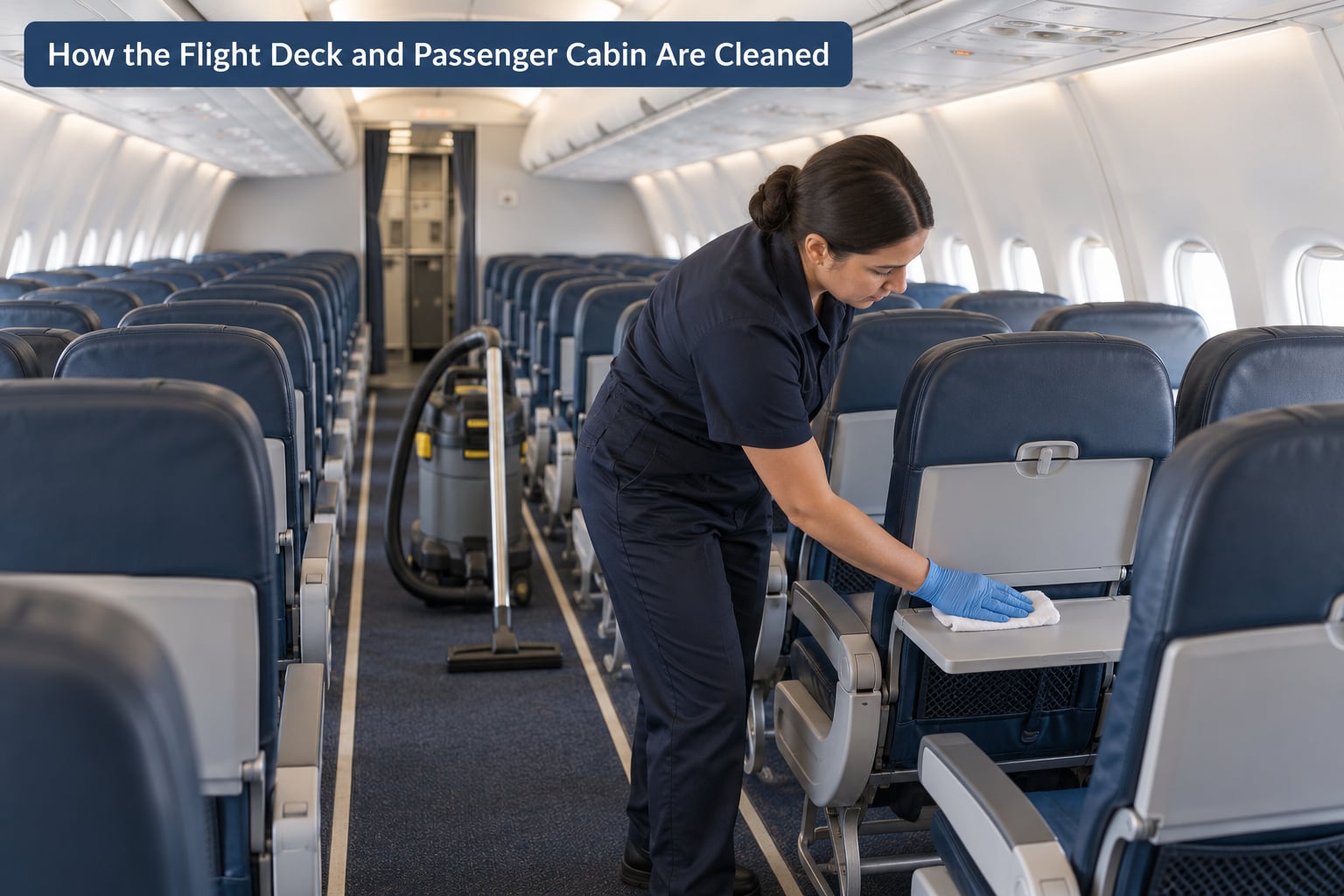
A turnaround clean is fast by design. Crews remove trash, empty and service the lavatories, clean the galleys and restock them, vacuum the aisle and seats, then wipe down the tray tables, armrests, seat-back screens, reading-light switches, overhead bin handles and the vents above them. Those last surfaces are the high-touch ones passengers share all flight, so they get targeted disinfection with an approved product and the dwell time that product needs to work.
There is real care underneath it. Crews avoid soaking upholstery, because saturated foam takes days to dry and grows something worse than dirt. They know which screens and seat-back units are touch-sensitive, which seat fabrics cannot take a wet wipe, and which galley equipment is sealed. Life vests, safety equipment, emergency exits and their markings are never blocked or wiped with an unapproved product. Crew restrooms and crew areas get the same attention as the passenger cabin, and cleaning continues behind closed doors in parts of the cockpit and flight deck most travellers never see.
Deeper cleaning happens outside the turnaround. Tasks like shampooing seats, cleaning behind and underneath seat pans, degreasing galleys and detailed work in crew areas are scheduled periodically rather than squeezed between flights.
Cargo Holds, Galleys, and Wheel Wells
Some of the least visible work sits in the parts of the aircraft nobody photographs. Cargo holds get debris removed, spills treated and floors scrubbed, with loose items checked so nothing rattles in flight. Galleys and service areas get degreased, because ovens and coffee machines leave films that become smells. Wheel wells accumulate brake dust, oil and rubber, and crews clean those areas while also checking for damage, leaks and anything that has come loose.
Evidence of pests changes the job. Live insects, nesting material or droppings mean containment and treatment, sometimes a specialist call-out, and the aircraft may not be released until it has been resolved. And if a cleaner finds a mechanical fault while working in a wheel well or under a cargo floor, they escalate it to maintenance. They do not judge it, and they do not quietly leave it.
How Teams Verify the Aircraft Is Clean
The people doing the work are aircraft cleaners, cabin services agents and, on the ramp, ramp agents. Cabin cleaning is usually contracted to a specialist cleaning company rather than handled by the airline’s own flight crew, and the same team may service several aircraft at one station.
Verification is real but light. Cleaners work to a checklist covering their assigned zones, supervisors check the work where time allows, and inspectors look for missed areas, residue, water intrusion, blocked ports or anything the cleaning itself caused. A missed spot behind a seat or an ingress seal that let water past get recorded and dealt with under the operator’s procedure.
One thing is worth being clear about: nobody inspects a finished cabin clean the way an inspector signs off a component. Aircraft cleanliness is governed by an operator’s own manual and contract, not by a binding regulator standard, which is a gap most passengers do not expect. So the aircraft does not go back into service simply because it looks clean. Issues found during cleaning are either resolved before the doors close or formally deferred, and the crew on duty accepts the aircraft with that record in hand.
What Specialized Aircraft Cleaning Involves
Aircraft cleaning is not the whole story, either. Engines have their own process: fresh water is pumped through the turbine and cycled until the outflow runs clear, with degreasing solvents used where particle build-up has set. Engines are plugged or covered during a routine fuselage wash precisely because detergent and grit do not belong anywhere near them.
Beyond that there is pest treatment and biohazard cleanup after a report of illness on board, corrosion treatment and stripping of damaged paint, cabin refurbishment with new seats and sidewalls, and full repainting. Airlines at military or naval bases deal with salt removal after seaboard operations, where a freshwater rinse is a separate and non-negotiable task. Some operators now use automated wash gantries and robotic systems on military types, where the same clean has to be repeated on a fixed schedule rather than on appearance.
How Often Are Commercial Airplanes Washed and Cleaned?
There is no universal interval, and anyone quoting you one fixed number is guessing. The exterior wash depends on visible condition, weather, route, operator policy, aircraft type and the ground time available, with scheduled washes often timed to precede a maintenance check.
Inside, the pattern is more predictable. A light clean happens on essentially every turnaround, a fuller clean at the end of a duty day or the end of a longer sector, and a periodic deep clean on its own schedule tied to the maintenance programme. The more sectors a cabin flies in a day, the faster it wears, and the schedule shifts to match.
Exact intervals are not published and change by operator. If you want to judge whether a specific aircraft is maintained on a sensible cycle, the operator’s published maintenance and safety record tells you more than any guess about washing.
Frequently Asked Questions
Is routine airplane washing required for flight safety?
No rule requires a wash on a fixed schedule. Airlines set their own frequencies based on aircraft condition, route, weather and operator policy, and routine washing is treated as part of preserving the airframe rather than a certified safety task. What is not optional is that damage, corrosion and contamination found during cleaning get escalated to approved maintenance procedures before the aircraft flies again.
Why do aircraft windows and sensors need special care during washing?
Cockpit windows are multi-layer acrylic, not glass, and many sensor and pitot openings are easy to damage or block. A scratched window or a contaminated probe can affect instruments or pressurisation, and static-sensitive ports cannot be sprayed. That is why crews cover and plug these areas before any water or detergent goes on, and why the plain-language version of the wash sequence always starts with protection.
Why are jet engines not washed like the rest of an airplane?
Because water, detergent and grit entering an engine can cause corrosion and damage that is far more expensive than a dirty fuselage. During a routine wash, inlets and exhausts are plugged or covered. Internal cleaning is a separate job run by maintenance: fresh water is pumped through the turbine and cycled until the outflow runs clear, with degreasing solvents used where particle build-up has set.
What cleaning products are used on commercial airplanes?
Exterior work uses an approved alkaline or neutral detergent, sometimes as a foam, applied with brushes and mops and rinsed with high-pressure water. Inside, crews use low-lint cloths, an approved disinfectant with a required dwell time, and lavatory and galley cleaning agents. Semi-dry and dry washes replace much of the water with dedicated cleaning agents. Products must come from the operator’s approved list, which follows the aircraft manufacturer’s instructions.
How can passengers tell whether an airplane has been properly cleaned?
Look at the surfaces passengers touch rather than the general impression. Check the lavatory, the tray table and its latch, the armrest and the seat-back screen. A fresh bin liner, clean glassware and an unstained table tell you more than a shiny fuselage, because the cabin is the part with a short window between cleans and a much longer window for problems to hide.
Conclusion
Aircraft cleaning is a controlled grounding process, not a shine. Outside, it means protecting the sensitive parts, treating the airframe with approved products, rinsing or mopping it off, drying it and inspecting the result. Inside, it means a structured turnaround clean plus periodic deeper work. Specialist jobs sit alongside both, and everything found along the way goes to the people qualified to act on it.
The first thing to understand is that the visible wash is only one part of the process. Everything protective and everything hidden is where the real work sits.