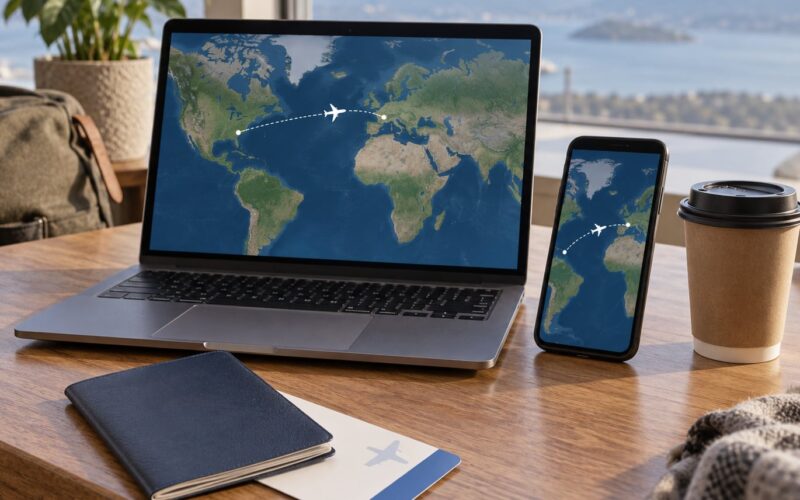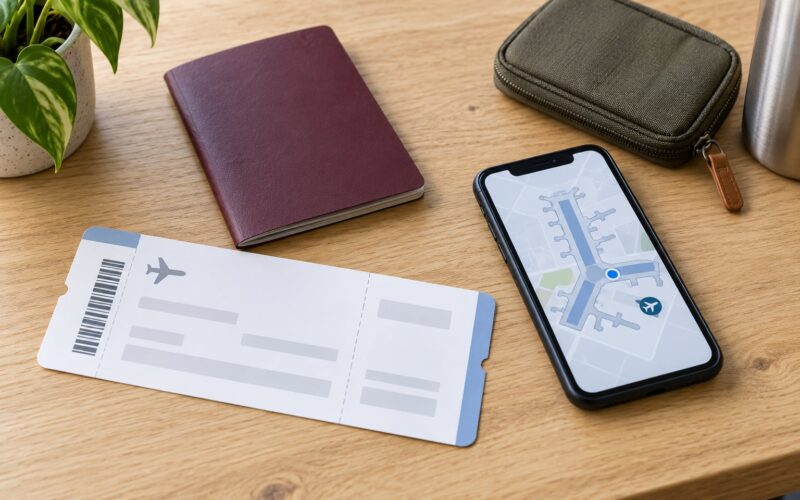
You track your checked bag with the airline’s own baggage tracker, using two things: your 6-character record locator (also called the confirmation code or PNR) and the 10-digit bag tag number printed on your baggage tag or claim stub. Enter both on the airline’s site or app and you get a timestamped list of scans — check-in, sortation, aircraft door, arrival — that tells you where the bag has been. If your bag never reaches the carousel, a personal tracker like an AirTag and a filed baggage claim are your backup routes, but neither replaces the airline’s barcode system.
The awkward part is that most guides online only cover the AirTag announcement and skip the part you actually need at baggage claim: how the airline’s scan data works and how to file a proper report before you walk out of the terminal. That is what this guide covers, step by step, plus what each tracking status really means and the honest limits of Bluetooth trackers.
Table of Contents
- 1What You Need
- 2Step-by-Step: How to Track Your Checked Bag
- 31. Save Your Baggage Tag and Flight Details
- 42. Check the Airline’s Website or App
- 53. Read the Scan Statuses Before You Panic
- 64. Wait for the Bag at the Correct Carousel
- 75. Contact the Airline’s Baggage Service Desk
- 86. Use a Personal Tracker if the Bag Is Still Missing
- 97. Arrange Delivery or Pick Up
- 10If You Have a Deadline Ahead
- 11Common Mistakes
- 12Frequently Asked Questions
- 13Can I track a bag without the bag tag number?
- 14What is the best app to track my luggage?
- 15Which airline trackers are best for finding a lost bag?
- 16How long does a lost bag take to arrive?
- 17Do airlines pay for delayed luggage?
- 18Can I track a bag that is already delayed or lost?
What You Need
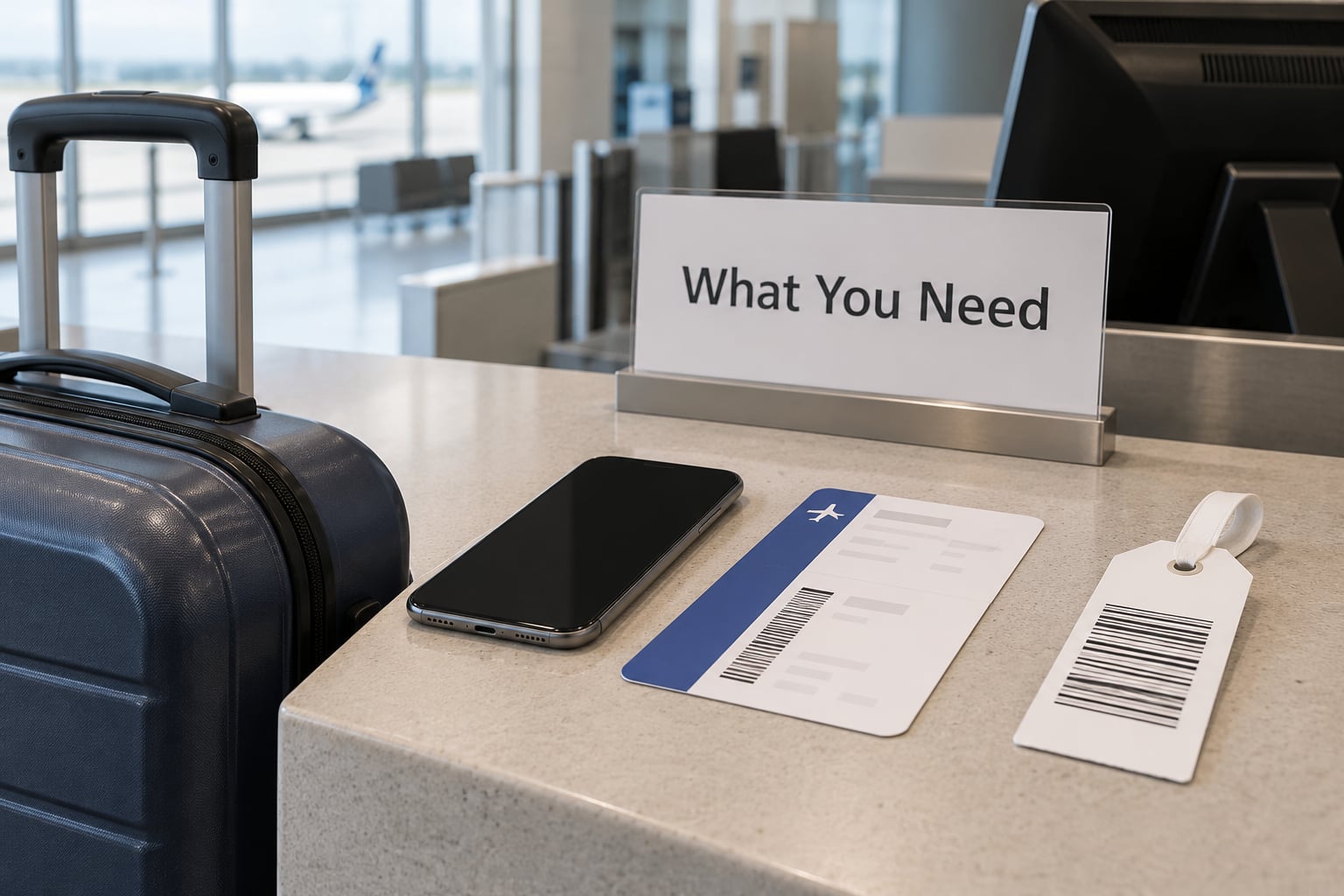
Gather these before the bag leaves your hands, because most of them are impossible to reconstruct once you are standing at an empty carousel.
- Record locator — the 6-character code in your confirmation email. Delta, United, American and Southwest all put it in the same place: at the top of the itinerary email and in the app under My Trips.
- Bag tag number — 10 digits, printed on the tag looped through your suitcase handle and on the perforated stub the agent hands back at the bag drop counter.
- Flight number and date, plus the destination airport code and the scheduled arrival time, so you can match a status update to the right inbound flight.
- Phone, email and where you are staying — a home address or a hotel name and check-in date. Delivery to a hotel is common but they hold bags for a limited window, so the date matters.
- A photo of the bag and its contents — take it before you check it. It speeds up claims and settles arguments about what was inside.
- Optional: a personal tracker — an AirTag, Tile, or Samsung Galaxy SmartTag, added to the bag before you check it in.
One note on photos: a bag tag photo is worth more than a photo of the bag itself. The 10-digit number is the only key that ties a physical suitcase to a flight record in the airline’s tracking system.
Step-by-Step: How to Track Your Checked Bag
1. Save Your Baggage Tag and Flight Details
Photograph the tag while you still hold the stub, before it goes in a pocket or gets binned at security. Write down the record locator, flight number, departure and arrival airports, and the date.
How do you check baggage for a flight? Usually you pay and print at the airline app or website before you arrive, then drop the bag at the counter or a bag-drop belt on arrival. Either way, the tag is printed at the drop, not before, so the photo has to happen at the counter.
Is it better to check bags online or at the airport? Pay online and you walk past the fee tables and straight to bag drop, which is faster. It does not change your tracking data, because the bag tag is generated when the bag is physically accepted.
2. Check the Airline’s Website or App
Open the airline’s “Track” or “My Trips” page, choose the flight, and enter the bag tag number when asked. Some carriers, JetBlue among them, run a separate bag-tracking page at trackmybag.jetblue.com. United walks you through filing a delayed bag report first and then attaching a location share from the same flow.
Here is where each carrier’s tracker lives:
| Airline | Where to look up your bag | What you need |
|---|---|---|
| Delta | delta.com “Manage Trip”, or the Delta app, Trips tab | Record locator, last name, bag tag number |
| United | united.com “Travel information” bag tracking, or the United app | Record locator and 10-digit tag number |
| American Airlines | aa.com “My trips”, or the American app | Record locator, bag tag number |
| Southwest | southwest.com “Track a bag”, or the Southwest app; support page explains the flow | Record locator, tag number |
| JetBlue | trackmybag.jetblue.com, or the JetBlue app | Tag number with the flight date |
| Alaska | alaskaair.com “My trips” and the Alaska app | Record locator, tag number |
| KLM / Air France | Manage My Booking on klm.com or airfrance.com, “Baggage tracking” | Booking reference, tag number |
| British Airways | Manage My Booking, “Track my bags” | Booking reference, tag number |
| Emirates | Manage Booking, “Track bags and bags delayed” | Booking reference, tag number |
| Turkish Airlines | Manage My Booking on turkishairlines.com, baggage section | Booking reference (PNR), tag number |
Is there a way to track checked baggage without the airline app? Yes — every carrier above has a web version, and the web version is often more complete than the app. Forum posts about inconsistent updates between app and site are common, so if the app shows nothing, check the browser before you assume the bag has not moved.
3. Read the Scan Statuses Before You Panic
Each handling point scans your bag’s barcode and writes an event. Most airlines behind this run on the same industry tracing platform, which is why the vocabulary is nearly identical across carriers.
What triggers a checked bag search? The absence of an arrival scan. If the last event your bag recorded was at the departure airport and the flight has landed, the bag either missed the aircraft, was offloaded at the destination, or is waiting on the carousel. That is what starts a physical search.
| Status | What it means | What to do |
|---|---|---|
| Checked in / accepted | Tag printed and attached, bag handed to the airline | Nothing, this is normal |
| At security screening | Bag went through the x-ray conveyor | Nothing, this is normal |
| In transit / sortation | Routed through the baggage handling system toward the aircraft | Nothing, this is normal |
| Loaded | On the aircraft | If the flight has landed and nothing changed, watch the carousel for 30–40 minutes |
| Arrived | Offloaded at the destination | Head to the carousel; if it does not appear, go to the baggage service desk |
| Out for delivery | On a van to your address after a report was filed | Confirm someone will receive it |
| Delivered to claim | On the belt or handed to the belt loader | Nothing, this is normal |
| Exception / mishandled | The system could not route the bag automatically | File a report and get a reference number |
A status that hasn’t changed in hours is not always bad news. The timestamp updates only when a scanner reads the tag, and a bag that sits in a container in a hold may go quiet for a long stretch. Look at the time, not at the silence.
4. Wait for the Bag at the Correct Carousel
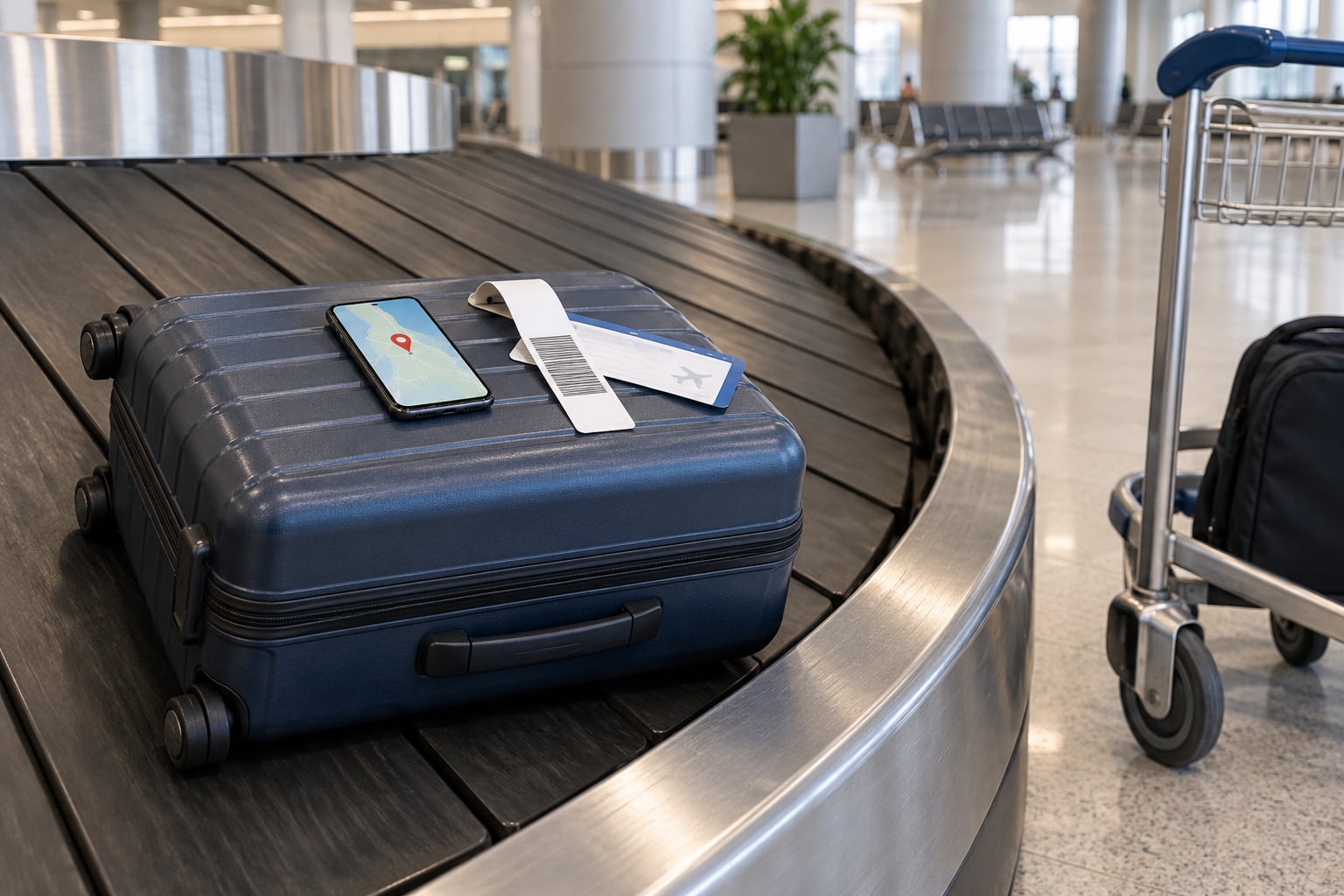
Check the monitors for the carousel number assigned to your flight, because the belt changes between arrivals. Give it 30 to 40 minutes after the belt starts before you assume anything. Bags that arrived earlier are pulled off and stacked beside the belt, and misloaded bags can be delivered to a completely different carousel.
Then step away from the crowd at the edge of the belt and walk the full loop once. Wrinkled hard cases look identical in a pile, and most reunions happen within the first ten minutes.
5. Contact the Airline’s Baggage Service Desk
The baggage service desk is a separate counter from customer service, usually near the carousel exit or in the arrivals hall. Go before you leave the baggage claim area, because the desk closes when the last flight’s bags are delivered, and after that your options drop sharply.
Have ready: the record locator, the 10-digit tag number, flight number, the contents list, and your contact details. Ask for a Property Irregularity Report, also called a PIR or file reference number, and write it down. Ask them to read the last recorded scan back to you, and note whether it shows the bag was loaded on your aircraft or offloaded elsewhere.
This is the step people skip and regret. A Delta passenger was told to file the claim online with no other instructions, and the online form would not submit without the reference number the desk should have issued. Get the number first.
6. Use a Personal Tracker if the Bag Is Still Missing
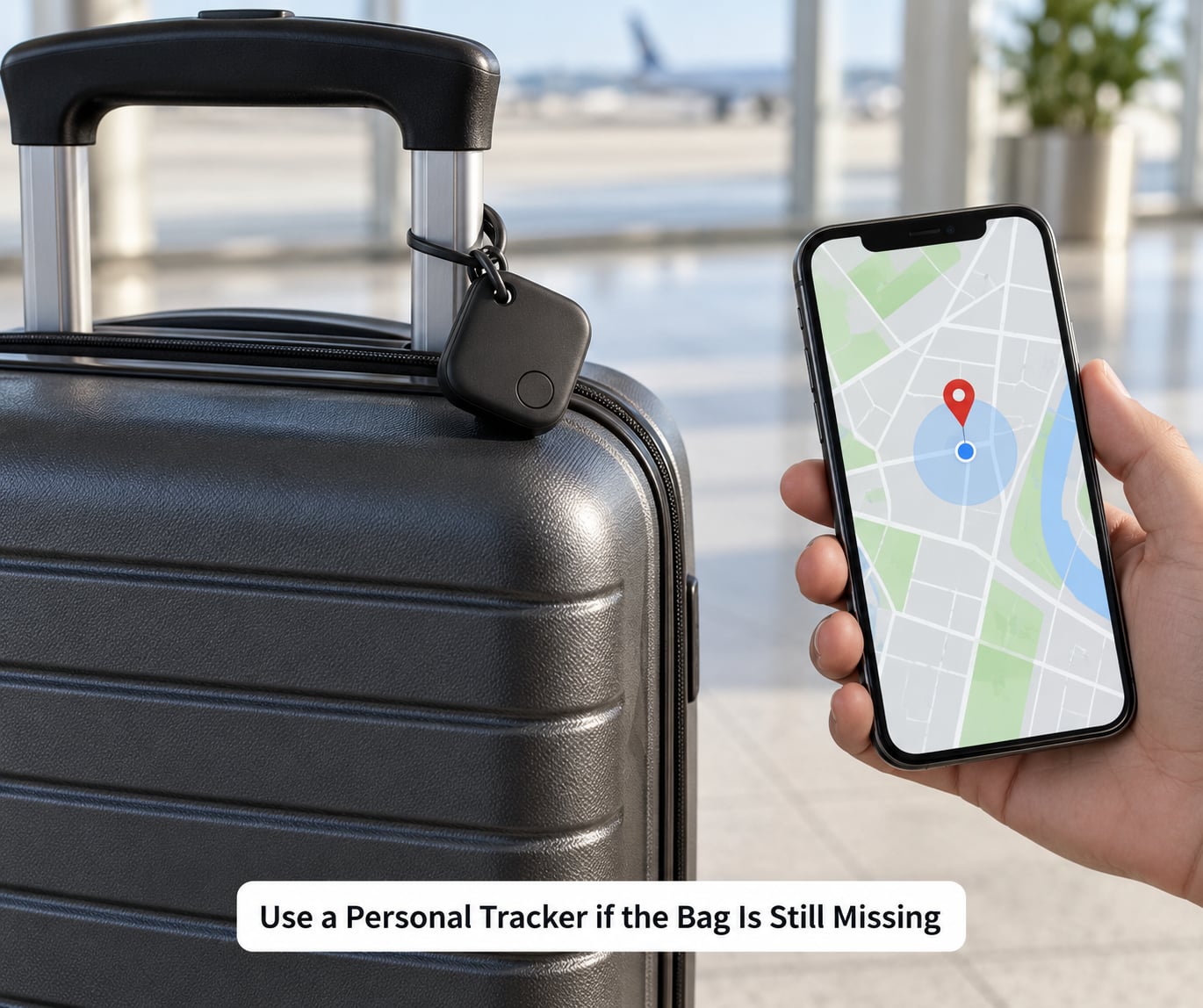
A personal tracker works differently from an airline scan. It does not need the airline’s system at all, which makes it useful exactly when the airline’s data has gone quiet. It also has real limits, and pretending otherwise wastes your time.
In the Apple Find My app, open the AirTag, choose Share Item Location, and generate a link. That link shows an interactive map with automatic updates and timestamps for whoever opens it. Send it to the baggage agent or attach it to a delayed baggage report. Sharing is designed for privacy: the recipient sees an approximate position rather than your raw movements, and the link disables itself once the bag is back with you.
Where to put it matters. Inside the main compartment, wrapped in a sock or tucked against the lining, is better than clipping it to the outside handle where it can snap off or draw attention. Keep it away from the shell so a rough handling does not break it.
What is the downside of AirTags? The honest list:
- No updates in a cargo hold or a sealed container, because location refreshes only when a nearby device on the network detects it.
- Stale positions. One user’s AirTag still showed a US departure gate hours after the bag had landed in Europe, because nothing nearby had pinged it in transit.
- Battery. A year is typical, and a tracker with a flat battery tells you nothing.
- iPhone only, if you want the Find My sharing flow. Android travellers have Tile and Samsung Galaxy SmartTag instead, both of which work with their own apps but not with Apple’s sharing links.
- The airline cannot see it unless you send it, and a wrong position sends agents looking in the wrong building.
Used honestly, a tracker turns “somewhere in this airport” into a building and a street address. A Paris traveller’s AirTag showed the bag sitting in the CDG lost and found building, which let them give Air France the exact location instead of waiting and hoping. Another watcher tracked a bag from Lisbon to a hotel in Lagos, which is how they discovered it had been taken by someone else. Just treat a fresh timestamp as a strong clue, not proof.
7. Arrange Delivery or Pick Up
Once a report is filed, most airlines deliver delayed bags to your address or hotel rather than making you return to the airport. Give the desk a destination that someone can sign for, and confirm whether the airline covers the delivery fee — this varies by carrier and by where you are flying from, so check your airline’s baggage policy rather than assuming.
Hotels will usually accept a delivery, but many hold luggage only for a limited number of days after checkout, and some charge a handling fee. Give the airline the hotel name, the street address, and your check-out date so the driver is not turned away.
Keep the case number, every receipt you submit for essentials, and copies of your claim form. Airlines reimburse reasonable expenses for the delay — toiletries, a change of clothing, a phone charger — and the whole process is much easier when each purchase is documented and attached to the file. Coverage rules differ by airline and by international or domestic route, so read your carrier’s delay policy before you start buying things.
If You Have a Deadline Ahead
A wedding, a conference, a sailing, a flight home: tell the airline immediately and ask for priority handling when you file. Also ask what they will reimburse while you wait, because that allowance often starts from the delay rather than from a full 24 hours, and knowing that changes what you buy.
If you are mid-itinerary and the bag is at a hub airport while you are already past it, ask the airline to courier it to your current city rather than to your original destination. A passenger at a four-hour Houston connection submitted a retrieval request using Find My and watched the bag start moving within about ten minutes.
Common Mistakes
Losing the baggage tag or stub. It is a piece of plastic the size of a receipt and it is the only key to your bag’s record. Photograph it, or photograph it before it is attached. If it is truly gone, many carriers can still trace the bag from the flight record, but the process gets slower.
Waiting at the carousel far too long. Thirty to forty minutes after the belt starts is plenty. Standing there for two hours does not change anything, and the desk’s staffing gets thinner late at night.
Contacting the wrong airline. If you booked a codeshare, the ticket may be issued by one carrier and the bags handled by another. Use the operating carrier shown next to the flight number in your itinerary, not the one whose site you have bookmarked.
Filing after you leave the airport. Online claims exist, but the desk-issued file reference number is usually the prerequisite for submitting one. Once you are home without that number, the process restarts.
Not keeping the case number. Every follow-up call, email and reimbursement submission needs it. Screenshot it the moment it is issued.
Trusting a stale tracker pin. A location with an old timestamp is a snapshot from the last nearby device, not a live feed. Tell the airline when the update was made so they can weigh it accordingly.
Packing everything in the hold. Medication, travel documents, a spare key, chargers, and anything you cannot replace on this trip belong in your carry-on. Tracking solves most delays; it does not solve a bag that was never going to come back.
Assuming the app is the only source. Several carriers publish scan updates on the website more promptly than in the app, and some forums report the two disagreeing. When the app shows nothing, check the browser.
Frequently Asked Questions
Can I track a bag without the bag tag number?
Sometimes. Most carriers will look up a bag from your 6-character record locator and flight date alone, especially inside the airline app, but the 10-digit tag number is what unlocks the full scan timeline and is required for a formal claim. If your tag is gone, contact the airline with your record locator, flight number and a description of the bag. Have a replacement tag number from the check-in screen or app ready if you can find one.
What is the best app to track my luggage?
There is no third-party app that beats the airline’s own system, because only the airline holds the barcode scan data. Use the carrier’s app or website first, and treat a personal tracker like AirTag or Tile as the backup layer for when the airline’s data goes stale. Search in your airline app for the bag or Trips tab rather than a separate tracker app.
Which airline trackers are best for finding a lost bag?
Your best tracker is the one the airline’s system can read, which means the 10-digit tag number, not a Bluetooth device. Personal trackers help in two specific situations: locating a bag that ended up in a lost and found building, and catching a bag that was taken by someone else. On iPhone, AirTag with Find My sharing is the standard choice. Android travellers can use Tile or a Samsung Galaxy SmartTag.
How long does a lost bag take to arrive?
A bag that was simply left behind often arrives within 24 to 72 hours once it is found and forwarded. A bag that has to be searched, transferred between airports, or handed to an investigator can take a week or longer, and one reader reported a single bag travelling between five airports after losing its tag. If you have a fixed deadline, say so when you file, because priority handling changes the timeline.
Do airlines pay for delayed luggage?
Most airlines reimburse reasonable essentials while your bag is delayed, subject to a per-day limit set by that carrier, and the allowance usually starts from the delay rather than after a full 24 hours. Keep every receipt and attach it to your claim number. Domestic and international routes can follow different frameworks, including the Montreal Convention on international itineraries, so check your carrier’s delay policy for the exact limits.
Can I track a bag that is already delayed or lost?
Yes, and it is often more useful than people expect. Ask the airline for the Property Irregularity Report or file reference number first, since that number is usually required before an online claim will submit. Then attach a Find My location share if you packed a tracker, and update the location each morning. A fresh position often tells the agent exactly which building or city to search.
If you only remember one thing from this guide: photograph the bag tag at the counter, and stand at the baggage service desk rather than the general customer service line the moment your bag does not appear. Airline-native tracking gives you the cleanest trail, and the file reference number you walk out with is what makes every later call, reimbursement and courier request actually work. Add a tracker before you check the bag next time, and keep the essentials you cannot replace in your carry-on.